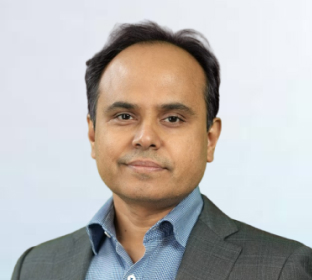





Artificial Intelligence is transforming medical imaging by enabling faster, more consistent, and often more accurate diagnosis. However, the integration of AI into clinical workflows demands a responsible approach that prioritizes patient safety, fairness, and transparency. This talk will explore the core principles of Responsible AI in medical imaging, including the need for robust validation, bias mitigation, explainability, and data privacy. As a case study, we will examine Thermalytix, an AI-powered breast cancer screening solution and how Responsible AI principles were applied to ensure accuracy, equity, and trust in real-world public health programs. Attendees will gain insights into building and deploying AI systems that not only scale but also uphold the highest standards of ethical healthcare innovation.
Read More

This hands-on session reveals battle-tested strategies for scaling AI agents from prototype to production. We'll cover critical engineering practices including robust monitoring systems, comprehensive logging frameworks, automated testing pipelines, and CICD workflows optimized for agent deployments. Participants will learn concrete techniques to detect hallucinations, measure reliability metrics, and implement guardrails that ensure consistent agent performance under real-world conditions. Join us for practical insights on building GenAI systems that don't just work in demos, but deliver dependable value in production environments.
Retrieval-Augmented Generation (RAG) has been a game-changer for grounding LLMs with relevant context. But in real-world scenarios, traditional RAG and sometimes Agentic RAG can hit limitations—especially when reasoning, relationships, and domain context become more complex.
This is where Agentic Knowledge Augmented Generation (Agentic KAG) comes in. By combining Knowledge Graphs, Graph Databases, and AI Agents, we enable LLMs to generate knowledge-rich, contextual, and deeply insightful outputs—all with traceability, transparency, and reasoning baked in.
In this live hack session, we will:
Implement Langfuse for Agentic traceability and observability—so you can see exactly how your agents think, retrieve, and decide.
Read More
As AI evolves from machine learning models and LLMs to Autonomous AI agents, the nature of threats is rapidly shifting, from data bias and hallucinations to agents taking actions misaligned with human intent. This session explores how autonomous AI agents differ fundamentally in behavior, decision-making, and risk. We’ll discuss why traditional governance is no longer enough, and outline practical strategies to embed human values during onboarding and ensuring these agents act with responsibility, purpose, and alignment from the start.
Read More
Although Large Language Models and AI are known to generate false and misleading responses to prompts, relatively little effort has gone into understanding how we can quantify the confidence we should have in the output from these models. In this hack session, the speaker will illustrate the problem using a simple neural network and then demonstrate two methods for quantifying our confidence in the model outputs. He will then show how these methods can be applied to Large Language Models and AI.
Read More
Generative AI is driving the biggest platform shift since the advent of the internet, transforming every industry by reshaping customer service, software development, marketing, HR, and beyond. However, many organizations face a gap between GenAI’s promise and its actual performance. Unlike traditional ML, GenAI systems are harder to evaluate due to their subjective, multimodal, and human-in-the-loop nature. This session explores the critical need for robust GenAI evaluation frameworks across technical aspects (like prompt evaluation, red teaming, and reproducibility), observability (including production logging and cost monitoring), and business metrics (such as ROI, service improvements, and responsible AI measures).
We’ll contrast GenAI and traditional ML evaluation methods and introduce a holistic framework that includes ground truth creation via gold/silver datasets. Through real-world case studies in Enterprise and HealthTech—including recommender systems, auto form filling, de-identification, and structured note generation—we’ll show how to evaluate GenAI systems effectively both pre- and post-production. The session will highlight key tools and techniques that enhance GenAI evaluation usability, especially for complex tasks like summarization and compliance.
Read More
In recent years, large language models (LLMs) have redefined what machines can do with text. But language alone is not enough when the goal is true intelligence — grounded, embodied, and interactive. In this session, the speaker will share his ongoing journey from working with LLMs, Language agents and natural language processing to diving deep into the world of reinforcement learning and robotics.
Logesh will walk through how the intuitions developed in NLP & LLMs — translate (or don't) into embodied learning systems. He will explore some of the key concepts for making the transition, and his practical learning and struggles of building and training a robotic arm ( LeRobot and So-100). Of course, including a live demo featuring my robotic arms.
Whether you're a curious NLP expert or an RL enthusiast seeking cross-domain insights, this session offers practical wisdom, reflections, and guidance to navigate your next leap.
This session unveils how intelligent agents leverage large language models and agentic frameworks to execute key media and marketing tasks across Paid, Organic, and SEO channels. Witness firsthand as an agent:
Attendees will gain insights into the agent's operational flow, understand the underlying architecture enabling these actions, and learn how the Model Context Protocol (MCP) ensures alignment with strategic marketing objectives. The session will emphasize how to define robust evaluation criteria and measurement strategies for these AI-driven workflows, ultimately leading to more informed decisions and enhanced marketing effectiveness.
Read More
In this session, we begin by presenting the recent advances in the area of artificial intelligence, and in particular, foundation models, which are giving rise to the hope that artificial general intelligence capability is achievable in a not too distant future. We describe the tremendous progress of these models on problems ranging from understanding, prediction and creativity on one hand, and open technical challenges like safety, fairness and transparency on the other hand. These challenges are further amplified as we seek to advance Inclusive AI to tackle problems for billions of human beings in the context of the Global South.
We will present our work on improving multilingual capabilities and cultural understanding of foundation models like Gemini, and on improving the computational efficiency of LLMs to enable scaling them to serve billions of people. We then showcase how the multimodal and agentic capabilities of these models have the potential to unlock transformative applications like personalized learning for everyone.
We will also describe our work on analysis of satellite imagery to help transform agriculture and improve the lives of farmers. Through these examples, we hope to convey the excitement of the potential of AI to make a difference to the world, and also a fascinating set of open problems to tackle.
Read More
The attention mechanism is a revolutionary leap that helped Large Language Models generate text in a sensical way. In a nutshell, attention adds context to words in an embedding. In this talk, we'll see attention as a gravitational force that acts between words, adding context to text. We'll study the keys, queries, and values matrix, and how they contribute to this theory of word gravitation.
Read More
Despite their impressive capabilities, Large Language Models (LLMs) still struggle with tasks that require understanding simple, generalized concepts, things that come naturally to humans. In this talk, we’ll walk through real-world yet intuitive examples where even state-of-the-art LLMs fail to apply basic logic.
But there’s a silver lining: with minimal, domain-specific fine-tuning, these models can rapidly learn the underlying rules and dramatically improve performance on the same tasks they initially fumbled. We’ll showcase case studies across BFSI, retail, and healthcare to demonstrate this transformation in action.
Whether you’re building GenAI-powered solutions or evaluating their deployment in critical workflows, this session will offer practical insights into pushing LLMs beyond their limitations using lightweight, high-impact fine-tuning techniques. A must-attend for AI practitioners who want to turn GenAI into a precision tool, not just a powerful one.
Read More
Enabling LLMs to enhance their outputs through increased test-time computation is a crucial step toward building self-improving agents capable of handling open-ended natural language tasks. This session explores how allowing a fixed but non-trivial amount of inference-time compute can impact performance on challenging prompts—an area with significant implications for LLM pretraining strategies and the trade-offs between inference-time and pretraining compute.
Reasoning-focused LLMs, particularly open-source ones, are now challenging closed models with comparable performance using less compute. We’ll explore the mechanisms behind this shift, including Chain-of-Thought (CoT) prompting and reinforcement learning-based reward modeling.
The session will cover the architectures, benchmarks, and performance of next-gen reasoning models through hands-on code walkthroughs. Topics include foundational LLM architectures (pre/post-training and inference), zero-shot CoT prompting (without RL), RL-based reasoning enhancements (beam search, Best-of-N, lookahead), and a comparison of fine-tuning strategies Supervised Fine-Tuning (SFT), Direct Preference Optimization (DPO), and Generalized Rejection-based Preference Optimization (GRPO)). Finally, we'll demonstrate how to run and fine-tune models efficiently using the Unsloth.ai framework on limited compute setups.
Read More
Autonomous AI agents promise super-charged productivity but without the right guardrails they can also jailbreak, leak data, or go off-topic. In this session we will discuss about:
What we will build -
In the hands-on segment we will build a complete agent to go from blank notebook to governed production prototype. We’ll begin by bootstrapping a one-file Python agent with LangChain and OpenAI Functions that can plan, call external APIs, and write concise summaries. Next, we’ll wrap that agent with the open-source Python libraries, layering in rate-limits, PII scrubbing, and role-based tool permissions so you can see policy enforcement in action. With guardrails in place, we’ll shift to offense - running an automated PyTest suite populated with the red-team prompts to expose prompt-injection and tool-abuse weak spots. We’ll then quantify how well the patched agent stays on-mission by applying a lightweight PRISM-style alignment rubric that emits a JSON scorecard. Finally, we’ll wire everything into a Streamlit mini-dashboard that streams agent actions, policy hits, and manual override controls in real time, giving a turnkey template we can fork for our next project.
In today's data-driven world, extracting meaningful insights quickly is paramount. Our AI analytics platform redefines this process by harnessing the transformative power of Large Language Models (LLMs). Beyond traditional data analysis, our innovative accelerator, QLytics, leverages LLMs to seamlessly convert your complex legacy queries into optimized, cloud-native code for platforms like Databricks and Snowflake. This integration not only accelerates your migration to the cloud but also democratizes data access, allowing users to interact with data using natural language, summarize vast datasets, and uncover hidden patterns with unprecedented ease and speed. Experience a new era of intelligent data analytics, where insights are just a conversation away.
Read More
As AI becomes a cornerstone of global influence, India must chart its own path, not to isolate, but to secure strategic autonomy. This session explores why developing a Sovereign AI Ecosystem is critical for addressing India’s unique socio-economic and linguistic diversity, while ensuring our voice shapes the global AI discourse.
We'll discuss the urgent need for domestic investment in compute and storage infrastructure, enabling foundational model development to remain within national borders, delivering resilience, control, and security at scale.
Equally vital is nurturing an AI innovation ecosystem where Indian developers, startups, and researchers build solutions rooted in local relevance with global potential.
Finally, we’ll spotlight the importance of hands-on GenAI education to cultivate a deep talent pipeline and fuel long-term innovation. Join us to understand how India can lead responsibly in the AI era—with strength, inclusivity, and sovereignty at its core.
Read More
In this hands-on workshop, participants will explore the cutting-edge world of Large Language Models (LLMs), Reinforcement Learning (RL), and building autonomous AI agents. Combining theory with hands-on coding examples, this session is designed to bridge the gap between theoretical concepts and real-world applications. By the end of the workshop, participants will have a solid understanding of how to build, train, and fine-tune an LLM for specific applications as well as how to increase their utility with RAG and AI Agents.
Prerequisites: Basic Python programming skills
*Note: These are tentative details and are subject to change.
Read More
New to the world of Agentic AI and want to quickly get proficient in the key aspects of learning, building, deploying and monitoring Agentic AI Systems? This is the workshop for you! In this workshop you will get a comprehensive coverage of the breadth as well as deep dive into the depth of the vast world of Agentic AI Systems. Over the course of six modules, you will spend the entire day focusing on the following key areas:
While we want to keep the discussions as framework and tool-agnostic as possible, since 90% of the workshop will be hands-on focused; we will be using LangChain and LangGraph (currently the leading framework used in the industry) for most of the hands-on demos for building Agents and also a bit of CrewAI. While the focus of the workshop is more on building Agentic AI Systems we will also showcase how you can build a basic web service or API on top of an Agent using FastAPI and deploy and monitor it using frameworks like LangFuse or Arize AI Phoenix.
Important Note: You may need to register for some platforms like Tavily, WeatherAPI etc for the workshop (no billing needed), we will send the instructions ahead of time. That will be essential for running the hands-on code demos live along with the instructor in the session.
Additional Points
*Note: These are tentative details and are subject to change.
Read More
Agentic RAG adds a “brain” to the RAG pipeline – bringing reasoning, tool use, and adaptiveness – which translates to tangible business value in accuracy, flexibility, and user trust
This workshop is a deep dive into Agentic RAG (Retrieval-Augmented Generation) – an emerging approach that combines the power of LLM-based agents with retrieval techniques to build smarter AI applications. Over an 8-hour session (of course including breaks in between), participants will explore how to move beyond “vanilla” RAG pipelines and infuse them with agentic behavior for greater flexibility and intelligence.
The full-day (8-hour) session employs Google Colab notebooks for immersive practice. Participants will work with:
Agentic RAG empowers large-scale, enterprise-ready AI systems by combining retrieval-augmented generation with intelligent, decision-making agents. The result? Smarter, more reliable, and adaptable GenAI solutions.
💡 Think of Agentic RAG as adding a decision-making brain to your RAG pipeline—boosting precision, flexibility, and business value.
We will start with the Capstone Project overview—a real-world, multi-modal Agentic RAG application—explaining all the complex concepts we will learn and implement during the day. This includes:
Prerequisite:
*Note: These are tentative details and are subject to change.
Read More
This workshop is designed to provide a comprehensive overview of LLMs, right from foundational NLP concepts to the latest in this domain. This workshop is aimed at working professionals but covers the required details to help beginners get started. You will gain valuable insights and hands-on experience to learn & adapt concepts to your professional lives.
Key Takeaways:
Prerequisites:
*Note: These are tentative details and are subject to change.
Read More
In this workshop, we’ll build a fully functional multimodal Telegram agent, putting into practice a wide range of concepts from the world of Agentic AI. This isn’t just another PoC — it's designed for those who are ready to level up and build complex, production-ready agentic applications.
Throughout the session, you’ll learn how to build a Telegram agent you can chat with directly from your phone, master the creation and management of workflows with LangGraph, and set up a long-term memory system using Qdrant as a vector database. We’ll also leverage the fast LLMs served by Groq to power the agent’s responses, implement Speech-to-Text capabilities with Whisper, and integrate Text-to-Speech using ElevenLabs. Beyond language, you’ll learn to generate high-quality images using diffusion models, and process visual inputs with Vision-Language Models such as Llama 3.2 Vision.
Finally, we’ll bring it all together by connecting the complete agentic application directly to Telegram, enabling a rich, multimodal user experience. Throughout the day, you will focus on the following key areas:
In this workshop, participants will work hands-on with a cutting-edge stack of tools and technologies tailored for building multimodal, production-ready agentic applications. LangGraph serves as the backbone for orchestrating agent workflows, with LangGraph Studio enabling easy debugging and visualization. SQLite powers short-term memory within the agent, while Qdrant, a high-performance vector database, handles long-term memory for contextual awareness. Fast and efficient responses are delivered using Groq LLMs, complemented by natural voice interactions through Whisper for speech-to-text and ElevenLabs for text-to-speech synthesis. For visual intelligence, Llama 3.2 Vision interprets image inputs, and diffusion models are used to generate high-quality visuals. Finally, the complete system is integrated with the Telegram Bot API, allowing users to interact with the agent in real time via chat, voice, or image directly from their mobile devices.
Prerequisites:
*Note: These are tentative details and are subject to change.
Read More
This full-day workshop equips business and enterprise leaders with the essential knowledge to confidently navigate the AI revolution.
Through simple explanations, real-world examples, and live demos, you'll demystify AI and ML concepts, uncover actionable GenAI use cases, and master the art of prompting for better business outcomes.
From foundational techniques to strategic adoption roadmaps, this session will empower you to spot opportunities, manage risks, and build a future-ready GenAI strategy — without needing a technical background.
Prerequisites: No technical expertise is necessary, but understanding basic business processes is important across functions.
*Note: These are tentative details and are subject to change.
Read More
In this hands-on technical workshop, you'll master the fundamentals of building production-grade AI agent applications with AG2 (formerly AutoGen), a lending open-source AI Agent framework that is adopted by millions of users and downloaded over 700k times per month.
You'll explore essential AI agent design patterns and discover how to customize agents for specific domains using reference implementations from the AG2 team. You'll also learn production deployment strategies using FastAgency and build complete agent solutions for real business scenarios.
Through guided exercises, you'll develop AI agent systems that can tackle real-world applications like customer support, marketing research, and data analysis. By the end of the day, you'll have the knowledge to build specialized, scalable agent applications that deliver reliable results in production environments.
This workshop introduces AgentOps, a subcategory of GenAIOps, which focuses on the operationalization of AI agents. It dives into how we can create, manage, and scale generative AI agents effectively within production environments. You’ll learn the essential principles of AgentOps, from external tool integration and memory management to task orchestration, multi-agent systems, and Agentic RAG. By the end of the workshop, participants will have the skills to build and deploy intelligent agents that can automate complex tasks, handle multi-step processes, and operate within enterprise environments.
Prerequisites:
*Note: These are tentative details and are subject to change.
Read More
Ready to go from experimentation to production with LLMs? This hands-on session will guide you through training language models using HuggingFace, building Retrieval Augmented Generation (RAG) pipelines with Qdrant, and deploying automated training workflows on Amazon SageMaker. You’ll also learn how to orchestrate multi-agent workflows using LangGraph and test, monitor, and evaluate your models with LangSmith. Through practical labs, participants will build end-to-end, production-ready GenAI systems that prioritize scalability, reliability, and real-world performance, equipping you with the tools to operationalize LLMs with confidence.
Prerequisite: Basic Python programming skills, basic understanding of machine learning concepts, and familiarity with AWS services.
*Note: These are tentative details and are subject to change.
Read More
In this hands-on technical workshop, we’ll explore multi-agent orchestration using CrewAI, diving into how autonomous agents can collaborate to solve complex problems. You’ll learn how to define, configure, and coordinate agents using CrewAI’s core components, all in Python.
We’ll walk through the main classes of problems this approach is suited for and guide you step by step through building real-world workflows. Topics include agent creation, orchestration strategies, tool integration (including custom tools), and LLM-agnostic setups. We’ll also look at how to connect CrewAI with external libraries such as Streamlit to bring your solutions to life.
What You’ll Learn:
Prerequisites:
*Note: These are tentative details and are subject to change.
Read More
Honoring the leaders whose relentless pursuit of innovation is shaping the world of tomorrow.
.png)

Join top data scientists, GenAI scientists, researchers to create real-world AI solutions. Navigate the Agentic AI revolution, gaining insights you can immediately apply in your role.
Immerse yourself in live demos and interactive showcases of cutting-edge AI agents and generative AI tools, revealing transformative applications across industries.
Connect directly with industry visionaries. Share strategic insights, build influential relationships, and unlock practical strategies to excel in the rapidly evolving AI landscape.
Celebrate visionary leaders shaping the future of AI. Join an inspiring gathering honoring bold achievements and transformative innovations driving the next generation of progress.
Gain insights from AI pioneers as they break down Generative, Agentic, and Responsible AI - walk away ready to solve tomorrow’s toughest challenges.
Watch GenAI and Agentic AI in action! Experience real-time problem-solving and cutting-edge AI techniques through live demos that bring theory to life.
Dive into immersive, instructor-led sessions where you’ll design GenAI and Agentic AI solutions and walk away with ready-to-use skills.
Experience the AI Trinity in action - bold ideas, smart systems, and ethical impact changing the way businesses operate.
Engage with industry icons in high-impact discussions. Gain actionable strategies, big-picture insights, and the inspiration to drive AI-powered innovation
Celebrate the game-changers, innovators, and visionaries leading AI’s evolution. Be part of a community shaping the next frontier of technology.
Feel the energy and innovation in action – get a glimpse of India’s most influential AI conference.


Note: Workshop venues differ from the main conference venue. Please refer to your respective workshop pages for exact locations.


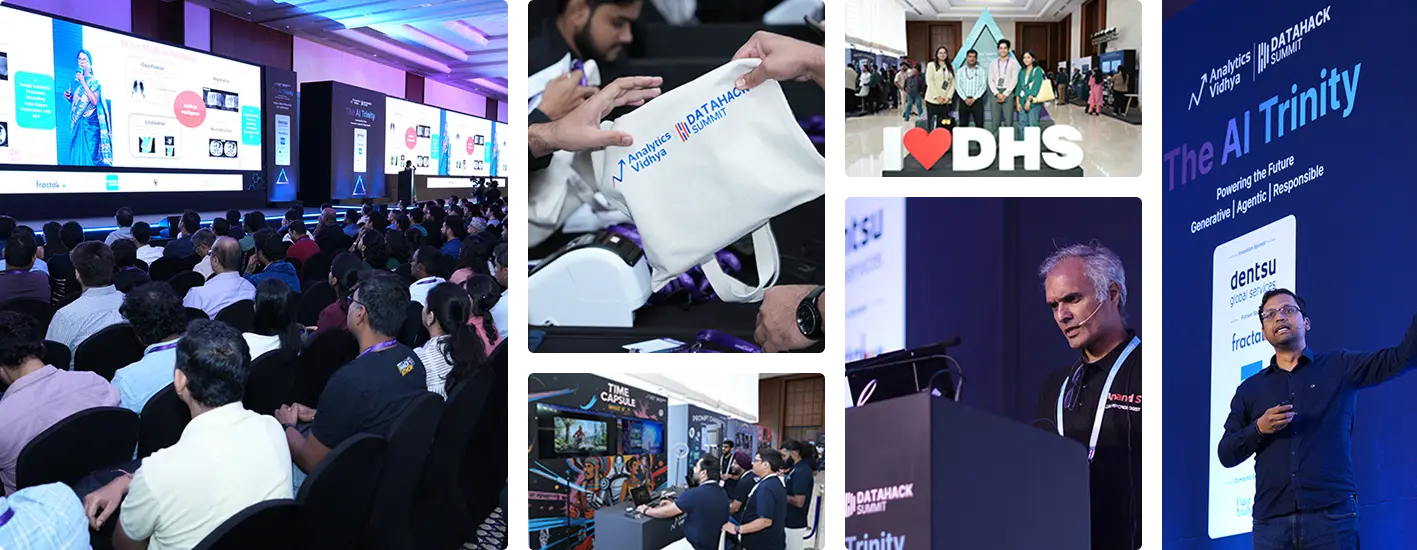
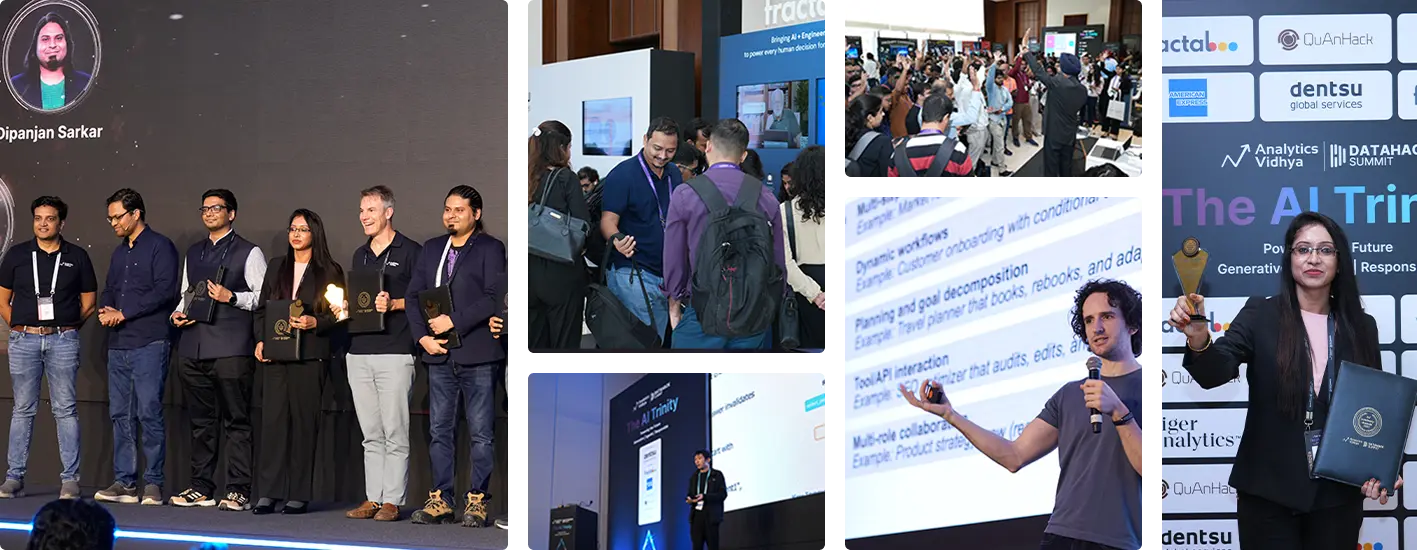
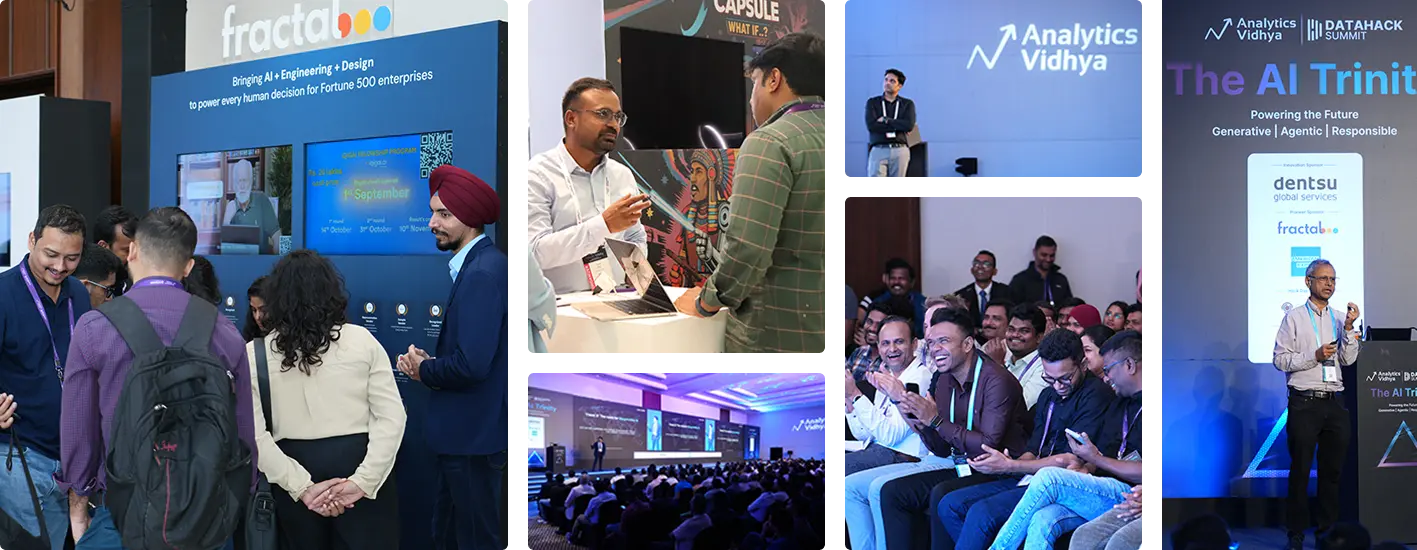
Now in its 6th edition, DataHack Summit 2025 is India’s largest AI conference designed specifically for AI and data science practitioners.
This flagship event brings together leading innovators, researchers, and hands-on professionals from across the AI ecosystem. As the top GenAI summit in India, it offers a deep dive into the transformative power of Generative, Agentic, and Responsible AI. Explore cutting-edge applications, level up your practical skills, and connect with a vibrant community shaping the future of AI that creates, decides, and leads responsibly.
Set in the heart of Bengaluru, this event will take place from August 20–23, 2025. The 3-day conference will be hosted at The Leela Bhartiya City Bengaluru, offering a premium experience for attendees. The 4th day (last day) will feature day-long workshops conducted in a classroom setup. Workshop venue details will be announced shortly.
The theme for DataHack Summit 2025 is “The AI Trinity: Powering the Future – Generative | Agentic | Responsible.” It explores the three core forces shaping the next wave of AI innovation.
Generative AI fuels creativity, Agentic AI enables intelligent autonomous action, and Responsible AI ensures ethical and accountable progress. Together, they are transforming industries including healthcare, finance, entertainment, and more.
Join India’s top Generative AI conference to explore the frontiers of this AI trinity, unlock its real-world potential, and lead with purpose in a future driven by intelligence and integrity.
Yes, we offer exclusive group discounts to make your experience even more rewarding. Reach out to us at [email protected] or call us at +91 8368808185
DataHack Summit 2025 offers two tailored ticket options:
Tickets for DataHack Summit 2025 are now available on our official website: https://www.analyticsvidhya.com/datahacksummit/. We offer two main tracks, thoughtfully designed to cater to different learning goals and interests. You can review the details for each track on the website and choose the one that best aligns with your objectives. Alternatively, if you prefer a quicker checkout experience, you can book your tickets directly here.
The Call for Speakers is now closed. We’re excited to showcase a diverse lineup of AI and data science experts. Stay tuned for the agenda, and keep an eye out for future speaking opportunities!
Hack Sessions are short, expert-led demos showcasing practical GenAI solutions, perfect for quick insights and inspiration in a casual setting.
Workshops, on the other hand, are immersive, full-day learning experiences held in a classroom environment. They offer hands-on problem-solving, guided instruction, and a deep focus on building real-world skills.
Absolutely. As one of the top GenAI conferences, DataHack Summit 2025 is designed to help you connect with industry leaders, expert speakers, and like-minded peers. Whether it’s during coffee breaks, hallway conversations, or lunch meetups, you’ll find plenty of chances to exchange ideas, share experiences, and build meaningful professional relationships.
Yes, all attendees will be provided with lunch and high tea during the conference. These refreshment breaks are not just about recharging, they also serve as valuable moments for informal networking, idea exchange, and deepening conversations sparked during the sessions.
DataHack Summit 2025, India’s largest AI conference, offers prime sponsorship opportunities for brands looking to lead in the AI and tech ecosystem. Showcase your innovations, connect with decision-makers, and build visibility around Generative and Agentic AI through tailored packages designed to match your marketing goals and budget.
To learn more, contact us at [email protected]. Check out our current sponsors here
We understand that plans can change, but please note that all ticket sales are final. Tickets are non‑refundable, non‑transferable, and non‑cancelable. We recommend confirming your availability before completing your purchase.