
LLMOps in Action: Build, Deploy & Scale RAG-Powered AI Systems
IntermediateLevel
138+Students Enrolled
2 Hrs Duration

About this Course
- Learn how to build, deploy, and scale RAG-powered AI systems using LLMOps for advanced AI applications.
- Master LLMOps principles for deploying scalable, robust AI systems, with a focus on RAG architecture and optimization.
- Explore deployment best practices, from architecture design to monitoring, for building production-ready AI systems with LLMOps.
- Gain hands-on experience building RAG-based AI systems with LLMOps, including scaling, deployment, and evaluation strategies.
Course Benefits
- Build and deploy production-ready RAG AI systems using LLMOps best practices and modern tools.
- Gain hands-on experience in monitoring, evaluation, and improving AI system performance at scale.
- Learn to design scalable AI architectures with strong guardrails, governance, and reliability.
- Develop practical skills to manage end-to-end LLM lifecycle from build to deployment and scaling.
Learning Outcomes

Build RAG Systems
Build scalable RAG-powered AI systems with LLMOps.
Deploy AI Systems
Deploy robust, production-ready AI systems with LLMOps.
Scale AI Solutions
Scale RAG-based AI systems for real-world performance.
Who Should Enroll
- AI developers looking to master the deployment, scaling, and reliability of RAG-powered AI systems.
- Data engineers and architects interested in optimizing AI workflows, pipelines, and operations with LLMOps.
- AI enthusiasts eager to learn cutting-edge techniques for designing and building scalable AI solutions.
Course Curriculum
Learn LLMOps through a structured journey covering RAG architecture, system design, deployment pipelines, and monitoring. Build and scale production-ready AI systems with hands-on projects and real-world workflows.


Build a strong foundation in LLMOps by understanding its purpose, lifecycle, and core components. Explore roles, system design, and compare hosted vs self-hosted LLM models.
1. What is LLMOps?
2. Why LLMOps Exists
3. LLM Application Lifecycle
4. Components of the LLMOps Stack
5. LLMOps Roles and Responsibilities
6. Hosted v/s Self Hosted LLM Models
Understand real-world AI challenges and dive into LLM architecture. Compare hosted APIs with open-source models like vLLM to choose the right setup for performance, cost, and scalability.
1. Real-World Problem Statement
2. Deep Dive into LLM Architecture
3. Hosted API Models vs Open-Source Models (vLLM)
Design and build production-ready LLM systems using config-driven workflows, multi-LLM integration, guardrails, and versioned prompts. Implement end-to-end RAG pipelines with evaluation and reliability layers.
1. Introduction
2. Environment Setup & Production Folder Structure
3. Config-Driven LLM & Embedding Management
4. Reliability, Guardrails & Governance Layer
5. Multi-LLM Integration & Provider Abstraction
6. Prompt Engineering with Version Control
7. End-to-End RAG Pipeline
8. Evaluation Layer: Structured Output & LLMOps Signals
Apply LLMOps in real-world scenarios by improving reliability with retrieval grounding, exploring runtime patterns, scaling strategies, and deploying AI systems on the cloud.
1. Hands On: Improve Reliability with Retrieval Grounding
2. Hands On: LLM Runtime patterns
3. Scaling Concepts
4. Cloud Deployment
Learn how to monitor LLM systems, evaluate answer quality over time, and implement guardrails. Understand drift, governance, and feedback loops to continuously improve production AI systems.
1. Monitoring Essentials
2. Evaluation - Measuring Answer Quality Over Time
3. Guardrails & Feedback Loop
4. Operational Signals - Drift, Governance, and Improvement
Get this Course Now
With this course you’ll get
- 2 Hours
Duration
- 4.8
Average Rating
- Intermediate
Level
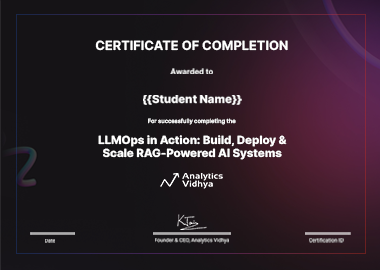
Certificate of completion
Earn a professional certificate upon course completion
- Career Advancement Credential
- Industry-Recognized Credential
- Shareable Achievement
Frequently Asked Questions
Looking for answers to other questions?
LLMOps refers to the practices required to build, deploy, monitor, and scale Large Language Model applications in production. It is important because building AI systems is not enough ensuring reliability, performance, cost control, and governance is critical for real-world adoption.
Basic understanding of AI concepts is helpful, but not mandatory. The course is structured to gradually build your knowledge from fundamentals to advanced topics like RAG systems, deployment, and monitoring, making it suitable for both beginners and intermediate learners.
You will work with modern LLMOps tools such as vector databases, APIs, deployment frameworks, monitoring systems, and evaluation pipelines. The course focuses on practical implementation rather than theory, ensuring you gain hands-on experience with real-world tools.
Yes, this course is highly hands-on. You will build end-to-end RAG-powered AI systems, including designing architecture, integrating LLMs, deploying applications, and adding monitoring and evaluation layers to simulate real production environments.
Retrieval-Augmented Generation (RAG) systems combine language models with external knowledge sources like databases or documents. This approach improves accuracy, enables up-to-date responses, and makes AI systems more reliable for business use cases.
Yes, deployment is a key focus area. You will learn how to move from prototype to production, including API deployment, system architecture, runtime considerations, and scaling strategies for handling real-world usage.
Related courses
Expand your knowledge with these related courses and expand way beyond

5 Hours5 Lessons 4.6
Real World Projects on RAG

2 Hours4.8
Building RAG Applications

1 Hour 30 Minutes 2 Lessons 0
Graph RAG: Build Knowledge Graph Powered Retrieval Systems
Popular free courses
Discover our most popular courses to boost your skills

5 Hours5 Lessons 5
Real World Projects on RAG

12 Hours10 Lessons 10
Data Analyst Learning Path
9 Hours5 Lessons 5
Vibe Coding Learning Path

9 Hours7 Lessons 7
GenAI Learning Path
30 Hours9 Lessons 9
Data Science Learning Path

2 Hours5 Lessons 5
LLMOps in Action: Build, Deploy & Scale RAG-Powered AI Systems
1 Hour 30 Minutes 2 Lessons 2
Graph RAG: Build Knowledge Graph Powered Retrieval Systems
1 Hour 30 Minutes 4 Lessons 4
Mastering Google Antigravity

2 Hours0
Building RAG Applications

1 Hour 30 Minutes 3 Lessons 3
Foundations of LangGraph
40 Minutes 0
NotebookLM Essentials to Pro: The Complete Practical Guide
40 Minutes 0
Foundations of Vector Database
1 Hour5 Lessons 5
Gemini 3: The AI That Thinks, Sees and Creates

1 Hour1 Lesson1
RIP Data Scientists

2 Hours1 Lesson1
Building Multi Agent Systems with Strands Agents
1 Hour2 Lessons 2
Vibe Coding with Cursor

1 Hour 30 Minutes 1 Lesson1
Advanced Strands Agents with MCP

2 Hours4 Lessons 4
GenAI to Build Exciting Games

1 Hour1 Lesson1
MCP: Unlock AI integrations with real-world demos
1 Hour2 Lessons 2
ChatGPT as Your Assistant

2 Hours6 Lessons 6
Ace a Data Scientist Interview in 2025
2 Hours 30 Minutes 4 Lessons 4
LangChain Fundamentals

50 Minutes 2 Lessons 2
Introduction to CrewAI: Building a Researcher Assistant Agent
2 Hours2 Lessons 2
Understanding the working of Neural Networks

1 Hour2 Lessons 2
Vibe Coding with Replit

2 Hours5 Lessons 5
Excel : From Beginner to Expert
2 Hours1 Lesson1
A Complete MLops Journey
2 Hours3 Lessons 3
Data Analysis with Apache Hive
1 Hour1 Lesson1
No Code Predictive Analytics with Orange

45 Minutes 1 Lesson1
Building Intelligent Chatbots using AI
1 Hour2 Lessons 2
GenAI for Everyone

4 Hours5 Lessons 5
A B C of Coding to Build AI Agents
30 Minutes 1 Lesson1
Getting Started with Kimi K2
2 Hours2 Lessons 2
Getting Started with Tableau

40 Minutes 2 Lessons 2
How to Build an Image Generator Web App with Zero Coding

2 Hours2 Lessons 2
Building and Evaluating RAG System
40 Minutes 1 Lesson1
Guide to Vibe Coding in Windsurf

30 Minutes 1 Lesson1
Build Products 10x Faster with GenAI
30 Minutes 1 Lesson1
Building a Collaborative Multi-Agent system

2 Hours4 Lessons 4
Building Smarter LLMs with Mamba and State Space Model
1 Hour2 Lessons 2
Nano Banana : Image Magic with Gemini 2.5 Flash

1 Hour1 Lesson1
n8n - A Complete Guide to Automation Tool

2 Hours6 Lessons 6
Building ML Pipelines using MLflow & DVC
1 Hour6 Lessons 6
Generative AI on AWS

1 Hour3 Lessons 3
Model Deployment using FastAPI
30 Minutes 6 Lessons 6
Demystifying OpenAI Agents SDK
30 Minutes 1 Lesson1
Build a Document Retriever Search Engine with LangChain

1 Hour1 Lesson1
Exploring Stability. AI

45 Minutes 6 Lessons 6
Knowledge Bases & Memory for Agentic AI

1 Hour1 Lesson1
Building Data Analyst AI Agent

40 Minutes 1 Lesson1
Building Scalable Industry Applications with RAG and Agents
1 Hour2 Lessons 2
OpenEngage: Build a complete AI Driven Marketing Engine
1 Hour1 Lesson1
Building a Deep Research AI Agent

5 Hours4 Lessons 4
Mastering Multimodal RAG & Embeddings with Amazon Nova & Bedrock

60 Minutes 3 Lessons 3
Frameworks for effective Problem Solving

1 Hour6 Lessons 6
Framework to Choose the Right LLM For your Business
1 Hour3 Lessons 3
Introduction to AI & ML

3 Hours6 Lessons 6
Microsoft Excel Formulas & Functions
15 Minutes 7 Lessons 7
Tableau for Beginners
5 Hours4 Lessons 4
Introduction to Natural Language Processing
1 Hour20 Lessons 20
Introduction to Python

1 Hour 15 Minutes 3 Lessons 3
Docker for Absolute Beginners
1 Hour3 Lessons 3
Foundations of Data Science

1 Hour 20 Minutes 1 Lesson1
Building Agentic AI System with Bedrock
3 Hours9 Lessons 9
Build Data Pipelines with Apache Airflow
1 Hour1 Lesson1
Building a Sentiment Classification Pipeline with DistilBert and Airflow
3 Hours3 Lessons 3
Introduction to Transformers and Attention Mechanisms

40 Minutes 1 Lesson1
Mastering Agentic Conversation Pattern with AG2

1 Hour1 Lesson1
Coding a ChatGPT-style Language Model From Scratch in Pytorch

30 Minutes 1 Lesson1
Navigating LLM Tradeoffs Techniques for Speed & Accuracy
1 Hour1 Lesson1
Data Preprocessing on a Real-World Problem
1 Hour 20 Minutes 6 Lessons 6
Getting Started With Large Language Models
4 Hours4 Lessons 4
Exploring-natural-language processing using deep learning
30 Minutes 5 Lessons 5
Ensemble Learning and Ensemble Learning Techniques
2 Hours4 Lessons 4
Evaluation Metrics for Machine Learning Models
1 Hour3 Lessons 3
Exploring OpenAI o3 and o4-mini

1 Hour1 Lesson1
Deep Dive Into QwQ-32B
30 Minutes 1 Lesson1
Build a Resume Review Agentic System with CrewAI
1 Hour 30 Minutes 3 Lessons 3
Getting Started with OpenAI o3-mini

30 Minutes 30 Lessons 30
Reimagining GenAI: Common Mistakes and Best Practices for Success
2 Hours3 Lessons 3
Building LLM Applications using Prompt Engineering
1 Hour6 Lessons 6
Bagging and Boosting ML Algorithms
1 Hour 20 Minutes 1 Lesson1
Understanding Linear Regression
1 Hour1 Lesson1
The A to Z of Unsupervised ML
2 Hours3 Lessons 3
Build your first RAG system using LlamaIndex
9 Hours4 Lessons 4
Getting Started with Deep Learning
1 Hour2 Lessons 2
Dreambooth: Stable DIffusion for Custom Images

1 Hour2 Lessons 2
Nano Course: Building Large Language Models for Code
9 Hours 30 Minutes 5 Lessons 5
Building Data Stories using Excel and Tableau
30 Minutes 2 Lessons 2
Naive Bayes from Scratch

3 Hours2 Lessons 2
Building Agent using AutoGen
3 Hours 30 Minutes 2 Lessons 2
Analyzing Data with Power BI
30 Minutes 1 Lesson1
Foundations of Model Context Protocol
30 Minutes 1 Lesson1
Revolutionizing Query Resolution with a RAG System Assisted by Agents
20 Minutes 6 Lessons 6
xAI Grok 3: Smartest AI on Earth

1 Hour1 Lesson1
DeepSeek from Scratch
34 Minutes 2 Lessons 2
Getting Started with DeepSeek-AI
30 Minutes 1 Lesson1
End to end RAG Application Development with LangChain and Streamlit

1 Hour1 Lesson1
Learning Autonomous Driving Behaviors with LLMs and RL

1 Hour1 Lesson1
GenAI for Quantitative Finance & Control Implementation

1 Hour1 Lesson1
Creating Problem-Solving Agents with GenAI for Actions
4 Hours3 Lessons 3
Generative AI - A Way of Life
30 Minutes 5 Lessons 5
K-Nearest Neighbors (KNN) Algorithm in Python and R

1 Hour 30 Minutes 9 Lessons 9
Fundamentals of Regression Analysis
1 Hour9 Lessons 9
Pandas for Data Analysis in Python

45 Minutes 1 Lesson1
Building a Customized Newsletter AI Agent

2 Hours4 Lessons 4
Agentic AI Design Patterns
30 Minutes 1 Lesson1
Build a QA RAG system with Langchain
1 Hour1 Lesson1
Improving Real World RAG Systems :Key Challenges
34 Hours1 Lesson1
Building Your First Computer Vision Model
1 Hour 10 Minutes 1 Lesson1
MidJourney: From Inspiration to Implementation
1 Hour 10 Minutes 2 Lessons 2
Building Text Classification Models in NLP

38 Minutes 1 Lesson1
Nano Course Cutting Edge LLM Tricks
19 Minutes 1 Lesson1
Introduction to Data Visualization
1 Hour5 Lessons 5
Introduction to Business Analytics
31 Minutes 4 Lessons 4
Introduction to PyTorch for Deep Learning
30 Minutes 4 Lessons 4
Time Series Forecasting using Python
2 Hours3 Lessons 3
Build Your 2025 Winning Data Science Resume with AI
2 Hours2 Lessons 2
Essential : SQL Skills for Data Beginners
2 Hours3 Lessons 3
A comprehensive Learning path to become a Data Analyst

1 Hour1 Lesson1
Mastering Multilingual GenAI Open-Weight for Indic Language
2 Hours5 Lessons 5
A Comprehensive Learning Path to Become a Data Scientist in 2025
1 Hour1 Lesson1
Introduction to Cloud
30 Minutes 5 Lessons 5
Dimensionality Reduction for Machine Learning
30 Minutes 1 Lesson1
Getting Started with Decision Trees
30 Minutes 1 Lesson1
Twitter Sentiment Analysis (Using Python)
30 Minutes 1 Lesson1
Big Mart Sales Prediction Using R
30 Minutes 1 Lesson1
Loan Prediction Practice Problem (Using Python)
Contact Us Today
Take the first step towards a future of innovation & excellence with Analytics Vidhya
Unlock Your AI & ML Potential
Get Expert Guidance
Need Support? We’ve Got Your Back Anytime!
+91-8068342847 | +91-8046107668
10AM - 7PM (IST) Mon-Sun[email protected]
You'll hear back in 24 hours