
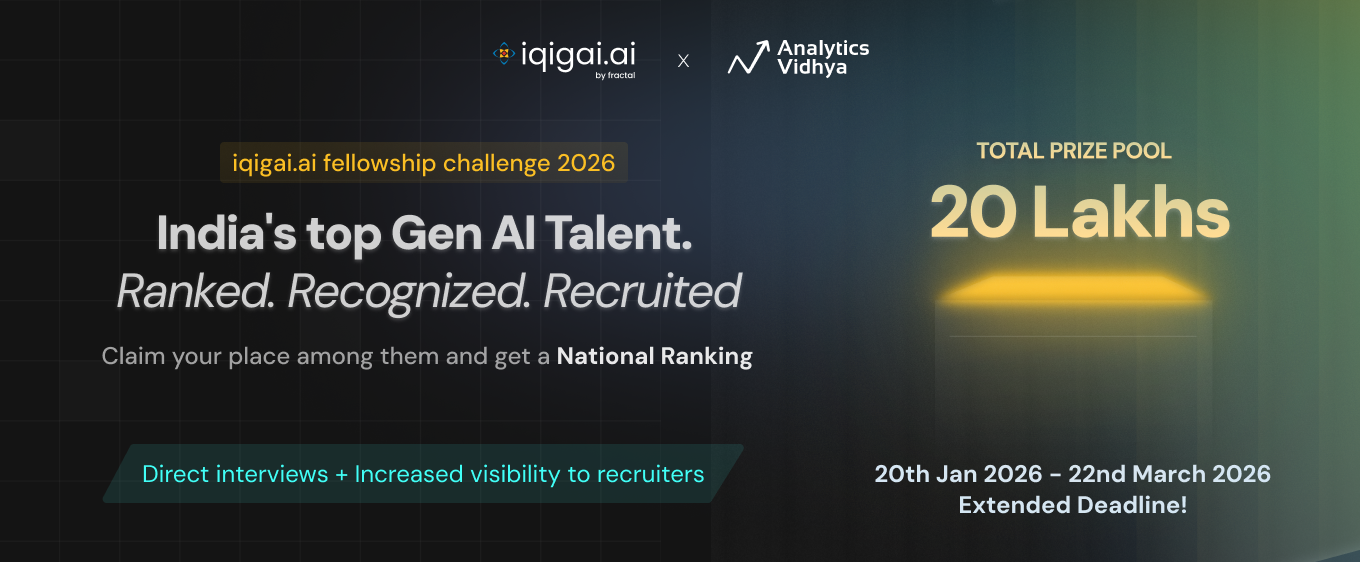
iqigai AI Fellowship Challenge 2026
About the Event
Are you operating at the level of India’s top GenAI minds—or just assuming you are?
The iqigai AI Fellowship Challenge 2026, powered by Fractal Analytics in partnership with Analytics Vidhya, isn't just another online competition. It's a national spotlight on India's best GenAI, AI, ML, data engineering, and analytics professionals—with real projects, direct job interviews, and a verified public rank that proves you belong at the top. Skip this and you skip national recognition, recruiter visibility and opportunities to bag final interview rounds at Fractal Analytics and other leading AI recruiters in India.
Bonus? You also get to win prizes from a cash prize pool of ₹20 Lakh!
Two intense rounds. Real-world problems. The kind of work that gets you noticed by the companies that matter. Why NOT participate?
Why participate?
- Direct interviews with Fractal Analytics for top performers
- ₹20 Lakh prize pool split across 1,000 ranked professionals
- Verified public rank that separates you from the crowd
- National recognition based purely on what you build and solve
- Visibility with India's top AI recruiters actively looking for proven talent
Prize Pool
₹20 Lakhs in total rewards:
🏆 Top 3 Winners
🥇 ₹5,00,000
🥈 ₹3,00,000
🥉 ₹2,00,000
🎖 Ranks 4–1000
Win from a pool of ₹10,00,000 in cash rewards
Eligibility Criteria
- GenAI developers, ML/AI engineers
- Data scientists, data engineers, analysts
- Engineering students and freshers are not eligible to participate in this challenge
- This challenge is open to Indian Nationals only
- Users need a valid Indian phone number to participate
How it works
- Registrations and Round 1 go live on Jan 20
- Round 2 starts on 8th March - Strictly through email invites only.
- Winners of Round 2 will access direct interviews with Fractal Analytics and get visibility from top AI recruiters in India
Round 2 Assessment Instructions
Round 2 of the selection process will be conducted on the iqigai assessment platform.
Important: Round 2 can only be taken through the iqigai desktop application. Candidates must download and install the application before starting the assessment.
Assessment Window
Candidates can start the assessment post 6PM on 8th March onwards
Assessment Access
Assessment Link: https://app.iqigai.ai/app-entry-page
Assessment Code: Round 2 is by invite only for participants who have cleared Round 1. The iqigai team will send the assessment access code to the registered email addresses of qualified candidates.
After completing registration on iqigai and entering the assessment code, candidates can begin the test.
Assessment Structure
The assessment contains 41 questions across 5 sections and will take approximately 90 minutes.
-
Quantitative Reasoning — 8 questions | 16 minutes
-
Data Insights — 8 questions | 14 minutes
-
Verbal Reasoning — 8 questions | 15 minutes
-
Technical Assessment — 14 MCQs + 2 SQL coding questions | 40 minutes
-
Personal Question — 1 audio response | 5 minutes
Dates
- Overall contest dates: 20th Jan to 15th March
- Round 1: 20th Jan to 7th March
- Round 2: 8th March to 22nd March - Strictly through email invites only.
Support
If you face any issues before or during the assessment, contact:
[email protected]
Let your work do the talking. Join the challenge. Rise through the ranks. Get recognized.
Participate in Discussion
Registration Details
Total registered
Number of teams
Know where you stand
Spaces You Can Join
Data Science
Over here, you can engage in discussions, ask questions, share insights, and converse about all things Data Science, from regression models to LLMs!

10.4K
Generative AI
Over here, you can engage in discussions, ask questions, share insights, and converse about all things Data Science, from regression models to LLMs!
10.4K
Data Engineering
Over here, you can engage in discussions, ask questions, share insights, and converse about all things Data Science, from regression models to LLMs!
10.4K
Frequently Asked Questions
Find the answers for the most frequently asked questions
There are no specific requirements to register for the hackathon, although it is recommended to have some basic knowledge of the relevant topics, such as Data Science, Machine Learning, or Deep Learning, along with proficiency in a coding language, preferably Python.
Depending on the type of competition, you can participate individually or in a team.
You can access the problem statement under the "Problem Statement" tab once the Hackathon is live.
Participants benefit from one-on-one feedback, publication on a respected platform, recognition from a global audience, and monetary rewards for each published article. Additionally, the top articles receive special rewards.
Each article must be original, and pass plagiarism and not AI generated content checks. You can submit multiple articles as long as each is distinct. Proper citation of all references and image sources is mandatory.
In the Blogathon, an article typically explores a specific topic or idea within Data Science or Generative AI and is required to be at least 1000 words long. A guide, on the other hand, is a more comprehensive resource, covering all aspects of a particular subject in data science, and must be at least 2500 words long. Guides aim to serve as a one-stop resource, providing detailed insights and practical applications, whereas articles might focus on narrower or more specific topics.
Multiple submissions of the same article are prohibited and could lead to disqualification. Articles failing to meet the required length, originality, or citation standards will be rejected.
AVCC is a community for authors who have had three or more articles published in the Blogathons. Members benefit from monetary rewards for each published article and get the opportunity to showcase their work to a larger audience.
Invite team members to the team20% off
Basic details
Team avatar
Add members to the team
Selected team members will show here...

Submit solution20% off
Please login/signup to participate in the discussion
0/1000