Most AI tools still require constant supervision, forcing you to guide every step. Claude Cowork,, the latest offering by Anthropic, changes that! By bringing an agentic system into everyday workflows, you describe the outcome and let it handle the execution independently.
It can deliver organized files, structured documents, and synthesized research while you focus elsewhere, and is currently available as a desktop research preview for paid plans. In this article, we explore how it works and what it enables, and whether it is up to the mark or not.
Table of contents
What is Claude Cowork?
Anthropic latest project called Cowork enables users without programming skills to interact with Claude Code’s capabilities. The Cowork application operates within the Claude Desktop software by using the same agent software development kit that powers Claude Code while providing users access to their complete local file system. The system enables Claude to complete extended multi-step procedures because it requires no user interaction during the entire process. The standard chat system shows its main difference through its ability to provide users with control over their conversation.
The Cowork system starts with Claude who evaluates the request before creating an execution strategy which he divides into smaller tasks that he manages through sub-agents who will work together when the situation requires it. Users have three options for managing the process which include observing progress tracking through indicators, making instant corrections, or allowing the process to continue until it finishes. The design philosophy is deliberate: it should feel less like a chatbot and more like leaving work for a capable colleague who keeps you informed.
Key capabilities of Claude Cowork
Understanding what Cowork has to offer will help to prepare you for the hands-on work we’ll be performing once we get started:
- Local File Access: Claude has direct read/write access to your local files and does not require any manual upload/download steps in order to use them at any point.
- Coordination of Sub-Agents: When using Claude, tasks can be divided into smaller, more manageable parallel workflows, which Claude will coordinate to allow for them all to run at the same time.
- Native Formatting of Outputs: You can produce native output formats such as live formula spreadsheets in Excel, PowerPoint decks, and formatted Word documents, in Claude.
- Long-Running Tasks: With Claude, you’ll be able to complete long-running tasks without having them interrupted by timeouts or lost context after 15-30 minutes.
- Scheduled Tasks: You can set up recurring/on-demand automated tasks to run while Claude is active on your desktop by entering the commands “/schedule.”
- Plug-in Support: Plug-ins are available to allow you to install a collection of capabilities, connectors, and agents specific to your job function/role or team.
- Excel + PowerPoint Bridge: Under the Max, Team, and Enterprise plans, you have the capability to transfer data between the Excel Add-in and PowerPoint Add-in.
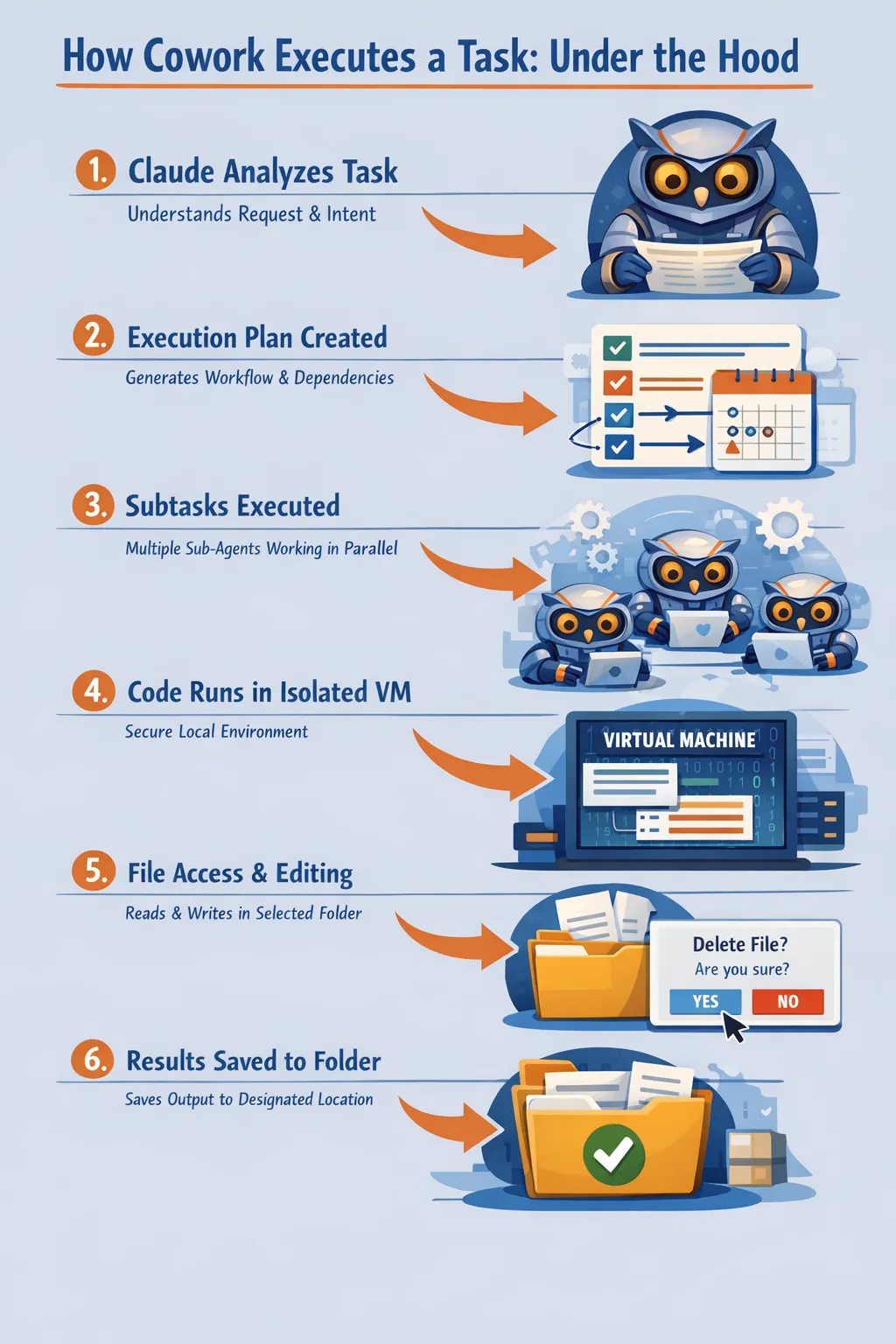
How Cowork Executes a Task: Under the Hood
The execution model provides you with guidance which enables you to develop improved task descriptions while creating realistic expectations for your work from the initial phase. The process starts automatically when you submit a task through Cowork which follows this specific sequence of events.
- Claude receives your task description and analyses the full scope and intent of the request.
- The system generates an organized execution plan which describes all task dependencies and workflow schedule points.
- The complex project divides its work into multiple subtasks which can be executed at the same time using several interconnected sub-agents.
- All code execution happens inside an isolated virtual machine (VM) running locally on your computer.
- Claude reads and writes files within the specific folder you granted access to during the session.
- The system delivers completed work results directly to your file system at the designated storage location which Claude established in advance.
Claude performs distinct functions in a separate VM from your main OS but has access to files within the folder(s) you grant it access to. It has a real (consequential) access to those files; there are potential consequences associated with Claude executing destructive functions (including delete); Claude will always ask for permission to physically destroy your files. But due to the nature of the tasks, it is important to be precise when issuing instructions to it about the deletion of sensitive files.
Getting Started with Claude Cowork
- Download the Claude desktop app via https://code.claude.com/docs/en/desktop-quickstart and select your preferred version. The package download will begin automatically.
- After downloading, extract the files and launch the application.
- Sign in to your Claude account.
- Claude Cowork works only on Max or Pro account and not on free trial mode so buy your subscription plan accordingly.
Hands-On Tasks: Two Real Workflows to Try
Let’s experiment with some tasks which will help us in demonstrating the Cowork’s abilities via below use cases:
Task 1: Organize a Messy Downloads Folder by Type and Date
An entry-level task to showcase Cowork’s file management abilities, with no data sensitivity issues. Claude will organize several hundred files into categorized subfolders. Claude must rename each file using a consistent naming convention on its own.
Instructions for this task:
- Open the Claude Desktop application and then click the Cowork tab in the top bar to switch from Chat mode to Cowork mode.
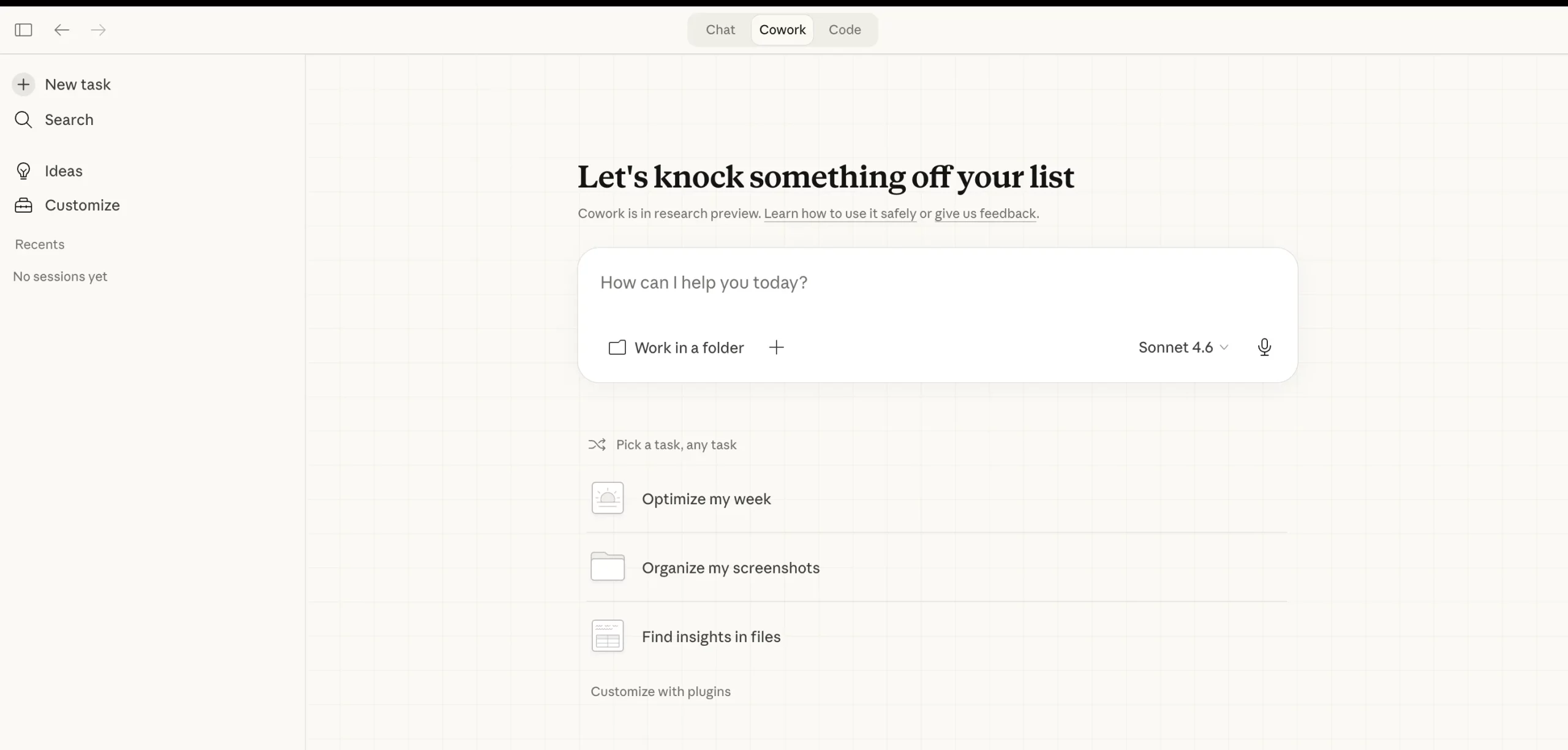
- When prompted, choose your Downloads folder or a designated test folder.
- Write in the following, “In this folder, organize all of the files within subfolders by file type (PDFs, images, spreadsheets, videos, etc.), and then by year month (e.g., 2023-08) within each file type. Any file that does not have a date included in the filename should have its name prefixed by YYYY-MM-DD. No files should be deleted.”
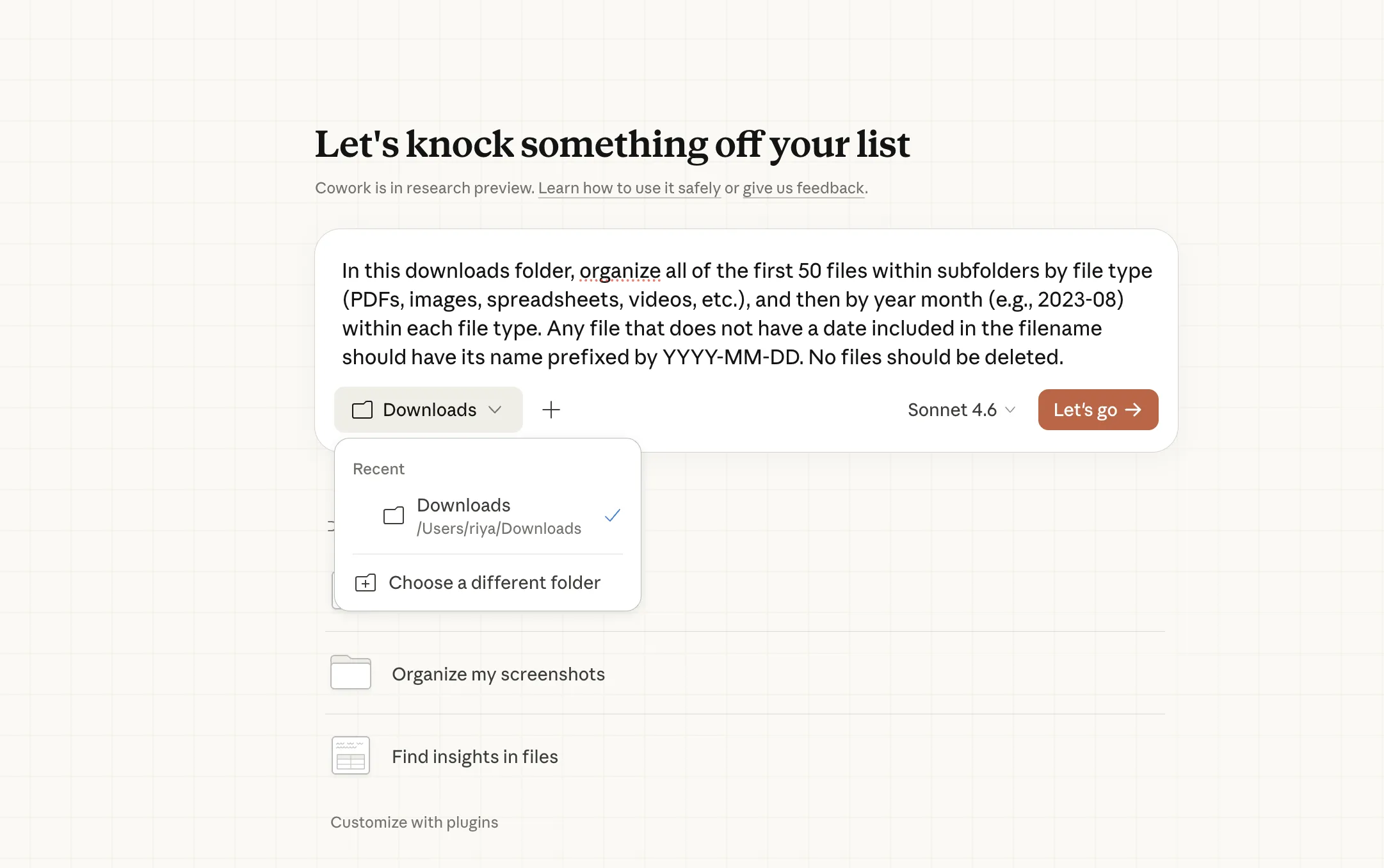
- As soon as Claude has a plan for how it is going to accomplish the task, review this ‘execution plan’. If you agree with the plan, you can give Claude the go-ahead and it will execute the plan.
- As Claude executes the plan, you can track progress through on-screen indicators. These will represent the stages of processing the files: reading each file, determining file type, creating subfolders for each file type, and then either moving the file to its appropriate folder or renaming the file and moving that to its appropriate folder.
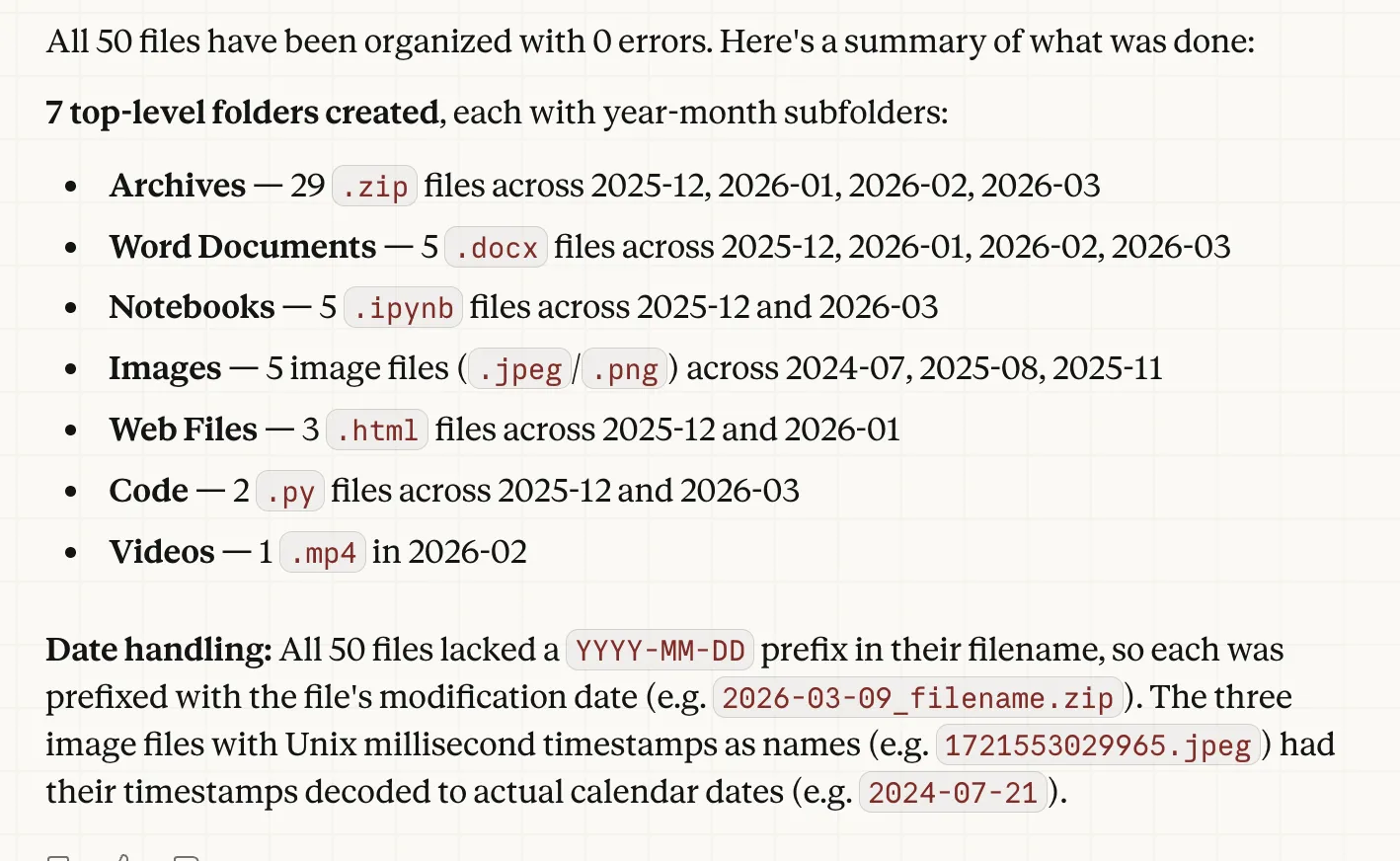
- After Claude has completed the plan, go to your computer’s file management system and verify that the folder structure created is what you expected.
Evaluation & Analysis
Through this activity, you can see that Cowork has the ability to complete the repetitive, high-volume task of handling data that would take a human a great deal of time to accomplish manually. We found Claude to be particularly capable; it was able to identify specific types of files including edge cases (for example, .pages or .numbers), apply consistent filename logic across file types and present us with true cases of ambiguity (for example, files that do not have a file extension), rather than risk making guesses about how we wanted the ambiguity handled.
As a side note, keep in mind that Cowork’s token usage will scale based upon the number of files located in the parent folder of the files you’re processing. A folder containing 500+ files will use up significantly more of your plan than the same folder would if it contained only 50 files. If you are processing files within large directories, you may want to consider batching your processing by file type, instead of attempting to process all files at the same time.
Task 2: Turn Scattered Notes into a Research Report
This task evaluates Cowork’s research synthesis ability, one of its most effective features that sets it apart from typical chat tools. The scenario needs you to create one complete document which combines all your research project materials including notes and article snippets and rough transcripts from your work.
Instructions for this task:
- Create a dedicated folder on your desktop and populate it with at least 5–10 text files that contain notes and bullet points and short paragraphs about a topic which you will select.
- Open Cowork and select this folder as your working directory for the current session.
- Submit this task prompt: “Read all files in this folder and synthesize a structured research report. The report should start with an executive summary which presents key themes supported by evidence and shows contradictions or gaps in the notes and ends with a recommendations section. The report should be delivered as a formatted Word document named research_report.docx.”
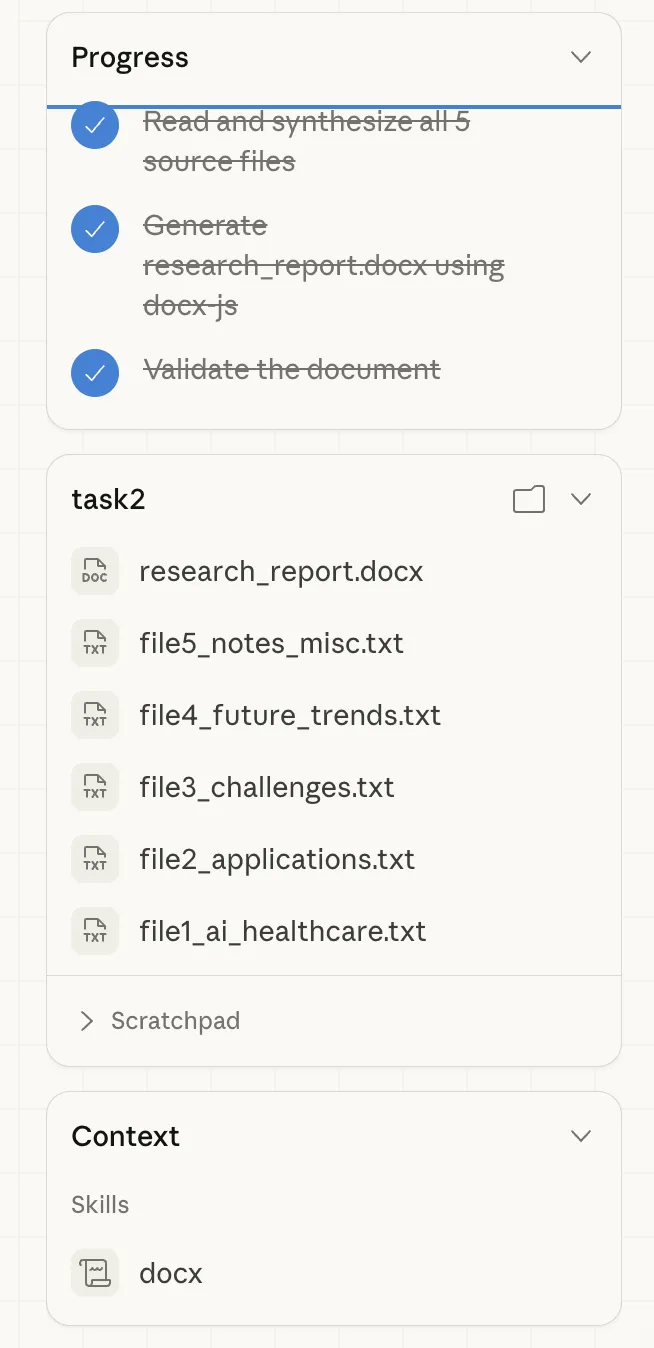
- Claude’s reading plan shows all files which it will scan before starting its synthesis work.
- The plan needs verification before execution begins. Claude will read each file to identify relevant themes which he will use to create the output document.
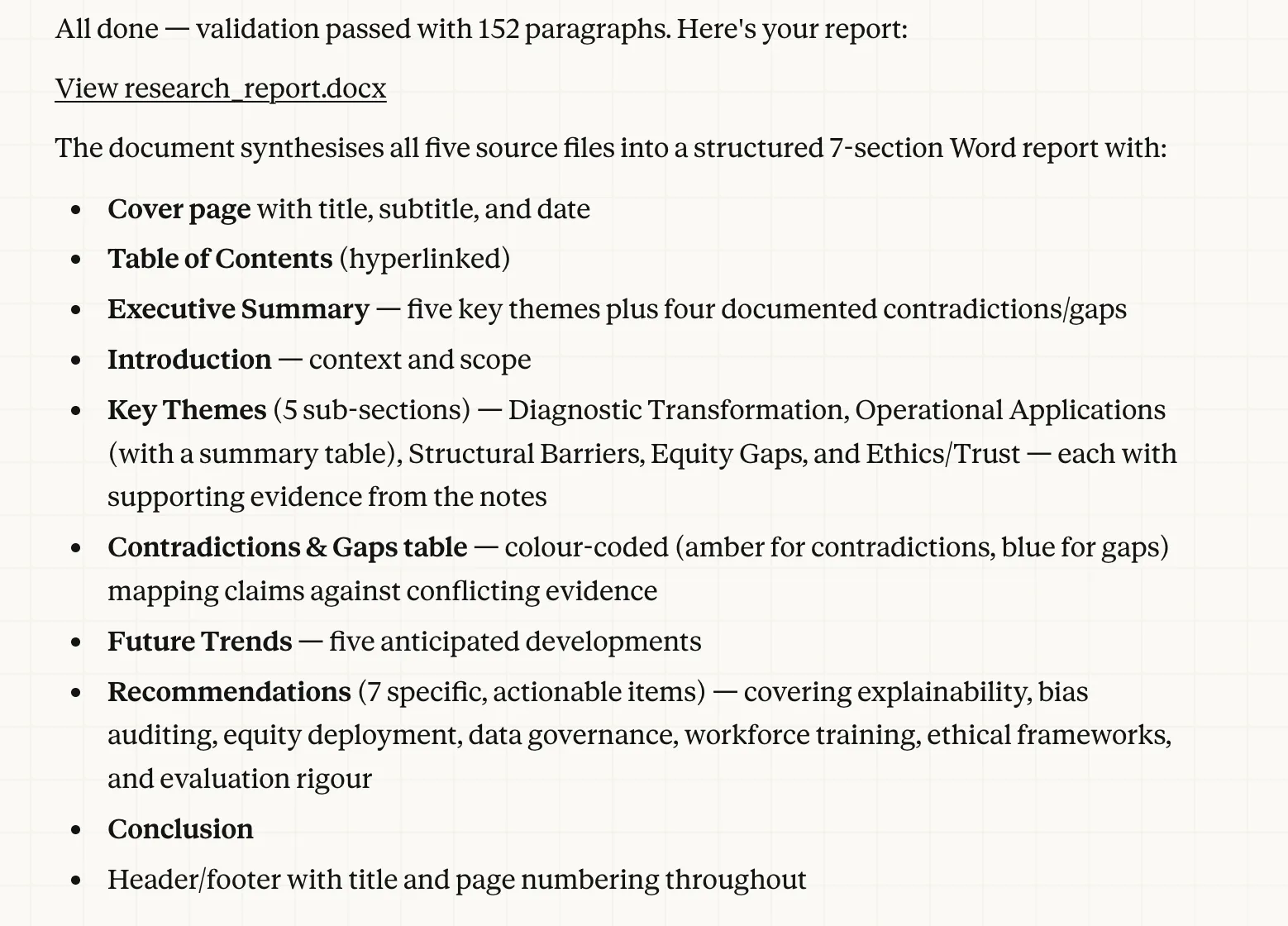
- Open research_report.docx from your folder and review the structure, accuracy, and overall completeness of the synthesized output.
Review & Analysis
The quality of output here is highly dependent on the clarity of your source notes going in. When notes are well-structured, Cowork produces publication-quality reports with clear flow, accurate citations, and surfaces research gaps that would take hours to uncover. The first research method enables Claude to identify research conflicts when notes contain uncertain information or opposing information whereas the second method lets him contact his research supervisor about those conflicts.
The most significant practical advantage is that Cowork holds the full context of all files simultaneously within a session without you needing to copy-paste anything. The system outperforms standard Claude chat because it can handle multiple document synthesis tasks which require processing documents from multiple sources at the same time.
Current Limitations to Keep in Mind
The research preview of Cowork exists because Anthropic has disclosed all remaining incomplete sections of their product. The organization needs to assess these constraints before they make their decision to implement the system into their operational processes.
- No cross-session memory: Claude starts completely fresh with each new Cowork session and retains nothing from previous tasks.
- Desktop-only and non-syncing: The Claude Desktop app provides Cowork access to users who cannot use the application on different devices.
- Reset of Session: The application needs to remain active because all scheduled tasks and current sessions will terminate when users close Claude Desktop.
- Higher usage consumption: Your plan allocation will decrease at a faster rate when you use agentic multi-step tasks instead of standard chat interactions.
- Not suitable for regulated data: The current system lacks ability to track Cowork activity through Audit Logs or Compliance API or Data Exports.
Conclusion
Claude Cowork brings agentic, file-based automation beyond terminal tools, making it especially useful for researchers, analysts, ops teams, and project managers handling heavy workflows. Its strengths include mature agent architecture, practical file access, and scheduled tasks. However, the lack of cross-device sync and session memory limits adoption, though Anthropic plans to address these issues. As a research preview, it already offers a strong glimpse of independent, task-executing AI that works in the background.
Frequently Asked Questions
Q1. What is Claude Cowork?
A. Claude Cowork is an agentic AI feature that completes multi-step tasks independently, handling files, research, and workflows without constant user interaction.
Q2. How does Claude Cowork execute tasks?
A. It analyzes your request, creates an execution plan, breaks tasks into sub-agents, runs them in a local VM, and delivers results to your files.
Q3. What are the limitations of Claude Cowork?
A. Claude Cowork lacks memory, works only on desktop, uses more resources, skips compliance tracking, and resets when closed.
Data Science Trainee at Analytics Vidhya
I am currently working as a Data Science Trainee at Analytics Vidhya, where I focus on building data-driven solutions and applying AI/ML techniques to solve real-world business problems. My work allows me to explore advanced analytics, machine learning, and AI applications that empower organizations to make smarter, evidence-based decisions.
With a strong foundation in computer science, software development, and data analytics, I am passionate about leveraging AI to create impactful, scalable solutions that bridge the gap between technology and business.
📩 You can also reach out to me at [email protected]