Hiring the right candidate is one of the biggest challenges HR professionals face today. From crafting job descriptions and posting ads to coordinating interviews and managing stakeholder communications, the recruitment process involves many moving parts. While these tasks can be handled manually in smaller companies, the approach quickly becomes inefficient and error-prone as the organization grows. This is where artificial intelligence (AI) is transforming the game.
AI-powered recruitment tools are helping HR teams automate repetitive tasks, streamline candidate screening, and make data-driven decisions. In fast-paced environments where companies hire for multiple roles simultaneously, relying solely on manual methods often leads to delays, missed opportunities, or hiring mismatches.
In today’s competitive talent landscape, leveraging AI isn’t just a nice-to-have, it’s becoming essential. According to Precedence Research, the AI in HR market is projected to reach USD 30.77 billion by 2034, growing at a CAGR of 15.94%.
In this blog, we’ll explore how AI and machine learning are reshaping talent acquisition, discussing their benefits, limitations, and the top tools available. Plus, we’ll tackle the big question: Will AI ever replace human recruiters?
Table of contents
AI Use in Hiring
Here are some of the ways in which you can utilize AI in different steps of the hiring process:
Creating Job Posts
Drafting a job post is the most important step of the hiring process. The job posting must clearly reflect what kind of skills you are looking for in prospective candidates. You can take the assistance of GenAI tools such as ChatGPT or Claude AI to write effective job descriptions with relevant keywords. This SEO practice makes it easy for you as a recruiter to reach a suitable candidate and also simplifies the efforts of job seekers.
Resume Shortlisting
After you post open positions on job boards, social media, and the company website, AI can help you track down candidates who are compatible with your requirements. LinkedIn Recruiter, HireEZ, and SeekOut are some such platforms that enable you to leverage AI for candidate tracking and resume shortlisting. These platforms use machine learning algorithms to match the keywords in your job description with the candidate’s resume. The ML models also predict if a candidate is looking for a job change based on activities such as profile updates.
This helps you approach candidates who may not have applied for the role but have the required skill sets for the job opening.
Sorting Candidates Through Pre-Screening
Next, you can leverage AI in filtering out candidates through screening before you, as a recruiter, take charge of further hiring steps. AI agents and chatbots can ask basic eligibility questions to candidates to identify whether they meet most of the required criteria. This saves you time and energy in going through each candidate’s profile and sorting them manually.
Conducting Assessments and Interviews
For tech roles like software developer, you need to conduct several rounds of assessments. You can use AI in diverse ways to perform these tests. For example, you can change the difficulty level of the test based on the candidate’s skills, checking the correctness of the code using AI.
Such utilization of AI makes the hiring process more skill-based and fairer. You can also use AI to consolidate a candidate’s complete profile, including resume and test results, before the final interview. If you have recorded the interview, AI tools like HireVue can help in preparing a transcription. By analyzing this transcription, your hiring team can make a final call regarding the selection of the candidate.
Offer Management and Onboarding
After selection, you can use AI to share offer letters, gather documents, and finish onboarding. With the help of AI assistants, you can also guide new employees with tasks such as form-filling or going through training materials. This reduces your work as an HR, speeding up the onboarding.
Post-hire Analysis
You can take the assistance of AI in analyzing the retention rate and post-hire performance of employees. This helps you in evaluating if your hiring decisions are right. Based on the results, you can refine the company’s approach for shortlisting, assessment activities. Post-hire analysis also provides insights on whether the guidance provided to newly hired people in settling down is helpful or not.
How AI Can Help With Recruitment
There are some obvious benefits of employing an AI system in the recruitment process. Let me quickly walk you through those:
- Saves Hiring Time: Recruitment tasks such as filtering resumes and scheduling interviews are time-consuming. With the help of AI, recruiters can get a well-crafted list of top candidates. This avoids the need to spend hours reading and sorting applications. For instance, AI solutions like HireEZ can quickly sort out the most relevant profiles based on job requirements.
- Helps in Managing Large Volumes of Applications: In present times, several candidates apply for the same job opening, due to which the volume of applications is quite large. Further, during bulk hiring or campus placements, it can be overwhelming to manage massive amounts of applications. AI enables you to resolve this issue through data parsing, data matching, or filtering applications based on keywords.
- Increases the Employee Retention Rates: AI tools can be used to analyze what factors compel employees to remain with an organization for a long time. These analytical insights help in identifying hiring practices that lead to a better retention rate. AI tools can also aid in studying employee churn patterns, based on which you can avoid the factors that lead them to leave your organization.
Also Read: Impact of Machine Learning on HR in 2025
Limitations of AI-Based Hiring
While AI has made recruitment more efficient, it also presents some challenges. Let’s have a brief look at a few of these challenges:
Biased Training Data
AI algorithms are trained on historical data. If the data related to past hirings consists of biases such as favoring specific genders or backgrounds, it can reflect in the predictions made by AI systems. The tool trained on such data can promote discriminatory hiring practices. To avoid this, you should regularly monitor your AI systems and ensure that training data is bias-free.
Non-Transparency
Most AI algorithms behave like black boxes and do not explain how they arrive at a particular decision. For example, you are using an AI-based resume sorting tool that does not explain what criteria it uses for candidate selection. Due to the absence of explainability features in this tool, your hiring process can become non-transparent, eroding the trust of candidates in the selection process.
Data Security Risks
To shortlist candidates, all AI tools utilize the personal data present on job boards or resumes. If proper data security measures such as end-to-end encryption and consent from candidates are not taken, then it can leak personal data. To prevent this, you must implement data security measures and data protection frameworks such as HIPAA and GDPR.
Difficulty in Integration with Legacy Hiring Practices
Incorporating AI into conventional hiring practices can be difficult. Some of your team members may fear that they are being replaced by AI, or some might find it technologically challenging to use AI for their work. On the other hand, if the AI algorithm is trained on biased data, job aspirants may feel that your selection process is discriminatory.
Besides, you may find it challenging to use legacy data for updated, AI-driven hiring practices. This is because the historical data might be stored in a scattered way across numerous spreadsheets. Such separated datasets do not provide any meaningful information. To resolve this issue, you can utilize tools like Workato, which helps in unifying dispersed datasets. This data can then be analyzed to generate useful insights for workforce planning.
Top 5 AI-powered Recruitment Tools
Now that you know the pros and cons of using AI tools for talent acquisition, let’s briefly look at some tools that help with AI-powered recruitment:
Workable
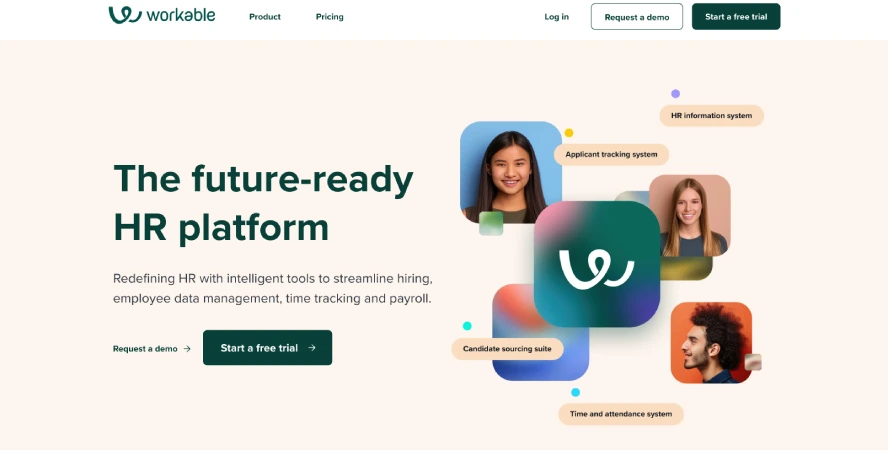
Workable is an effective HR platform that simplifies finding, hiring, and managing human resources. It helps automate important functions such as candidate evaluation, onboarding, payroll processing, and performance reviewing through AI technology. Workable also allows you to use AI for tasks such as preparing job descriptions, interview questions, and candidate shortlisting. While seeking AI assistance, the platform ensures that your data remains secure through a dedicated team of cybersecurity experts. They use features like multi-layer application security and encryption to make sure that your data is secure.
Humanly
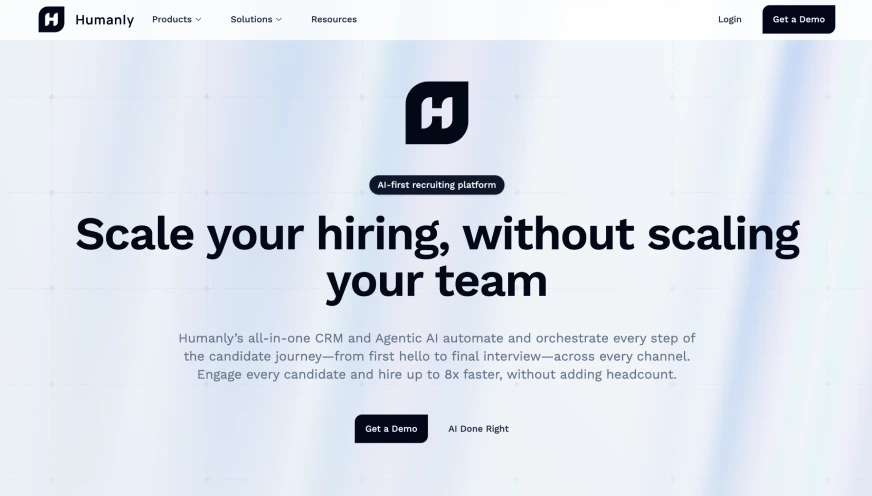
Humanly is a widely used HR software that facilitates AI-powered SMS and emailing services. This platform leverages AI agents to engage with candidates 24/7, helping resolve their queries instantly at any point in time. The AI agents also pre-screen candidates beforehand, saving you time and effort. Owing to such effective features, Humanly has become a go-to tool for many hiring managers.
Paradox
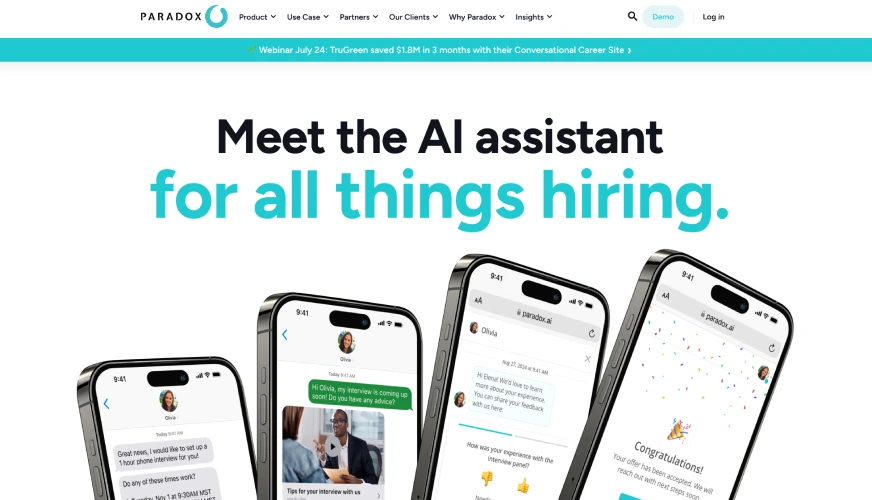
Paradox is conversational software that uses AI-based virtual assistants to simplify job search, initial screening, interview scheduling, and even onboarding. The platform also assists candidates with interview preparation and helps you as a recruiter to conduct virtual hiring events. Due to such functionalities, Paradox is used extensively across various industries, including retail, healthcare, finance, and logistics.
Wellfound
Wellfound is a popular hiring job board that provides you with easy access to a large pool of talented job seekers. If you are a tech-focused startup, you can use this platform to hire the right candidates to promote your business growth. Wellfound offers many AI features to help you with resume screening and sorting. This allows you to focus your efforts on more critical aspects of recruitment.
Recooty
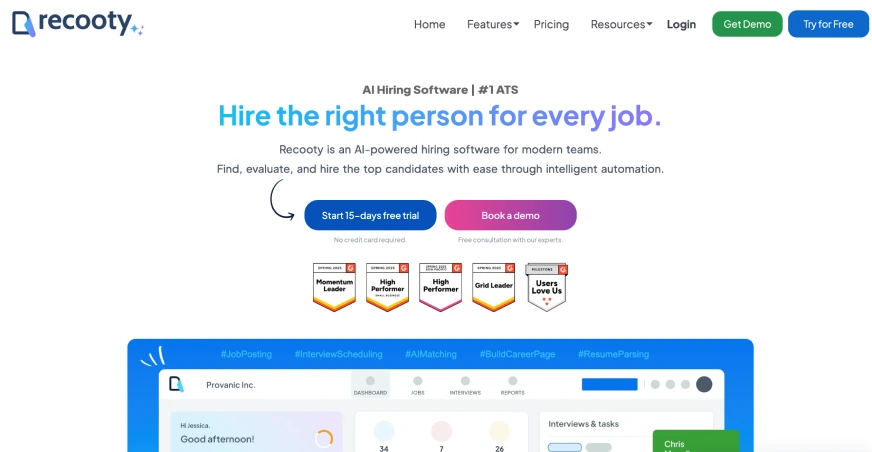
Recooty is an AI-powered software that you can use to write clear job descriptions containing relevant keywords for targeted hiring. Using Recooty, you can also generate professional email templates and interview questions, as well as improve employees’ onboarding experience. The AI-powered applicant tracking system of Recooty enables you to hire faster without biases through effective analysis of a candidate’s skill set.
Here is a summary of example AI tools that can be used in various steps within the recruitment process.
| Hiring Steps | Example AI Tools |
|---|---|
| Creating Job Posts | Claude AI, ChatGPT, Jasper, Workable, Recooty |
| Resume Shortlisting | Humanly, Recooty, Wellfound |
| Pre-Screening Candidates | Paradox |
| Assessment and Interviews | Wellfound, Paradox, Workable |
| Onboarding | Paradox, Workable |
| Post-Hire Analysis | Workable |
Human Recruiters vs AI Hiring
While AI can manage repetitive operations such as initial screening or setting up interviews, it cannot fully understand any job-seeking candidate’s potential. To achieve this, human judgment plays a critical role as humans can communicate with empathy and extract the actual personality traits through deeper questions.
Qualities such as adaptability, motivation, and a growth mindset cannot be assessed by AI algorithms. It is humans who can analyze these capabilities through interactive conversation and by sharing your company’s values with the candidate.
This indicates that human recruiters will not face a threat due to the rise of AI. It can save time by automating the hiring process, helping you make the right decisions. The final verdict will always remain in the hands of HR managers, who are professional recruiters.
How AI Improves Candidate Satisfaction
While we have extensively discussed how AI can assist recruiters in their work. Let’s now briefly focus our attention on how AI enhances the experience of candidates looking for jobs. Here are some of the ways in which AI can be beneficial for job seekers:
- Real-time Communication: AI-powered voice assistants and automated messaging software help in establishing real-time communication between you and a job-seeking candidate. This can be done via NLP techniques such as text summarization or using a trigger mechanism. For example, Paradox’s AI assistant Olivia takes charge of scheduling interviews and resolving candidates’ queries, reducing their mental uncertainty.
- Personalized Job Matching: Generative AI tools and recommendation algorithms facilitate better job matching by analyzing candidates’ profiles, skillsets, and experience. Some AI tools also provide feedback on how to improve resumes for future applications. For example, Careerflow.ai is one such tool that helps reduce job search frustration by accurately matching a candidate’s resume with desired job roles.
- Increases Chances of Reconnecting: Some AI tools can go through historical data and provide you with a list of candidates who were earlier rejected for some position. You can go through the profiles of such candidates and contact them if they are suitable for the current job role. In this way, the candidates also get another opportunity to showcase their eligibility for your organization.
Future Outlook: Upcoming Trends in AI-Based Recruitment
Owing to rapid evolution, AI can impact hiring in diverse ways. Some key trends that can shape the future of AI-driven workforce hiring are as follows:
- GenAI for Better Candidate Engagement: Using GenAI tools, you can create customized job postings and provide real-time feedback to eligible candidates through NLP techniques. As a result, you can take advantage of GenAI technology to engage prospective candidates in a better way.
- Predictive Analytics for Workforce Management: AI algorithms can help you and your team analyze HR data. The insights generated through this study allow you to understand training effectiveness, retention, and churn rates in addition to the historical hiring trends. You can combine this with external factors such as economic indicators and competitors’ hiring practices to improve your recruitment efficiency.
- Minimizing Biases Through Explainable AI: To avoid bias in hiring, you should use AI platforms that leverage explainable AI (XAI). It is a set of techniques that enable AI systems to explain their decision-making process. This enables you to monitor and resolve any possible biases, making the hiring process fully transparent.
Conclusion
AI is transforming several business components through automation. From product development to talent acquisition, AI is undoubtedly a critical element of numerous organizational operations today.
This blog comprehensively explains the role AI can play in various aspects of hiring processing. Using this information, you can devise a foolproof strategy for smarter hiring. Here are the primary takeaways from this article:
- AI automates many hiring tasks, including creating job posts, listing candidates, screening resumes, and scheduling interviews.
- You can save time and make better hiring decisions with the help of AI.
- Workable, Wellfound, HireValue, and Recooty are some prominent tools that offer AI-driven features to simplify talent acquisition.
- AI will not replace but aid human capabilities to build a team of strong and skillful employees.
Naveen Kolli is a seasoned technology leader with over 18 years of experience at the intersection of engineering, innovation, and business transformation. He specializes in AI/ML, enterprise systems, cloud platforms, and digital transformation strategies, with a strong track record of driving impactful solutions across multiple industries.
He has contributed to the technology community through mentorship, academic collaborations, and volunteer engagements with professional societies such as the IEEE, where he actively participates in judging, reviewing, and supporting innovation-driven events like international hackathons. His leadership and collaborative skills have been acknowledged in various global initiatives, including his nominations for senior-level memberships and fellowships in prestigious organizations.
Naveen is passionate about bridging the gap between academia and industry, supporting initiatives that promote AI-driven talent development, employment resilience, and ethical technology adoption. His current focus includes building frameworks for industry engagement within professional societies and enabling scalable community-based tech initiatives.