There is a software solutions firm operating out of one of the busy offices of Gurugram. Inside its glass-walled rooms, a handful of “employees” are running the show. Aria, Dev, Maya, and Karan work tirelessly, each with their own role. One is optimising ad campaigns. Another is debugging and deploying code. One more is analysing spreadsheets to generate insights, and the last is handling client tickets with precise follow-ups. They work without ever glancing at the clock, never complain about late hours, and deliver outputs in minutes that would otherwise take humans days. They are there 24/7, never asking for a coffee break or a weekend off.
You guessed it. Aria, Dev, Maya, and Karan are not humans; these are AI agents, built using platforms like OpenAI for specific jobs within an organization.
Which brings us to the question: what exactly are AI agents, and why are they suddenly everywhere?
What Are AI Agents?
AI agents are autonomous software entities that can perceive an environment, make decisions, and act in pursuit of a goal, much like human workers in jobs would. Unlike a simple chatbot or assistant, these agents are not limited to simply answering questions. AI agents can plan multi-step workflows, call tools or APIs, and execute jobs from start to finish with minimal human input. You can read more about what AI Agents are, here.
Examples in action:
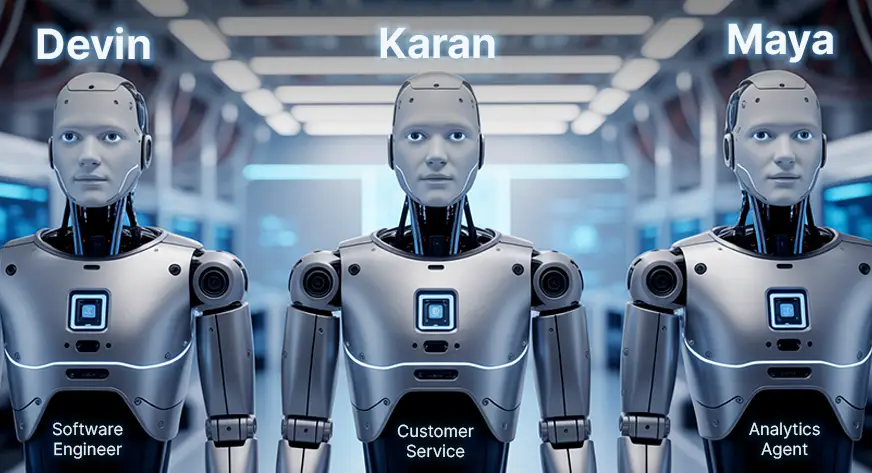
- Devin is an AI agent acting as a software engineer. It can read documentation, write and test code, and even push updates.
- Karan is a customer service AI agent that can handle ticket triage, send personalised responses, and escalate only the complex cases.
- Maya is an AI agent for analytics that can query databases, generate dashboards, and summarize insights on their own.
How are these AI agents built?
At the core, most AI agents are powered by large language models (LLMs) like OpenAI’s GPT series, Anthropic’s Claude, or Meta’s LLaMA. These models are then paired with:
- Memory modules to recall past interactions.
- Tool integration (APIs, databases, SaaS apps) for taking actions.
- Orchestration frameworks such as LangChain, AutoGen, CrewAI, or OpenAI’s new agent platform, which let developers chain reasoning, planning, and execution together.
In short, building an agent is less about coding everything from scratch and more about wiring up LLM intelligence with real-world tools.
Agents in Action: Real Workplace Scenarios
AI agents’ jobs are no longer confined to demos or research labs. Some of the world’s largest firms are already deploying them at scale. Take Cognizant, for example, where legal teams are using AI agents built on Vertex AI and Gemini to draft contracts, assign risk scores, and recommend optimisations. What used to be a slow, manual review process is now accelerated by agents that understand context, surface risks, and ensure consistency across thousands of documents.
In the world of sales, Alta has introduced a family of specialised AI agents – “Katie” the SDR, “Alex” the inbound lead qualifier, and “Luna” the RevOps strategist. These agents handle everything from prospecting and qualifying leads to generating insights for revenue operations. By automating the repetitive and time-consuming parts of outreach, Alta enables leaner sales teams to scale efforts that would otherwise need dozens of human representatives.
Retail giant Walmart is also making a strong bet on AI agents, handing them specific jobs that were previously taken care of by humans. Its “super-agent” codenamed Sparky embedded in the Walmart app supports product cataloging, personalisation, and even supply chain decisions. Unlike a simple chatbot, Sparky orchestrates multiple back-end systems to ensure that product recommendations are timely, accurate, and tailored to the shopper. This isn’t about replacing staff. It is about creating smarter shopping experiences and a more responsive e-commerce backbone.
These real-world use cases demonstrate that AI agents are not futuristic experiments or gimmicks for AI enthusiasts. They are powering mission-critical operations for some of the biggest and most credible firms today.
The New Human Role: Project Managers of AI
The widespread application of AI agents begs the question: if AI agents are handling the execution, what is left for humans to do? Increasingly, the answer looks a lot like project management. Instead of writing every line of code or manually combing through spreadsheets, workers are now defining objectives, breaking down tasks, and validating outputs. In other words, the human role is shifting from execution to orchestration.
Much like a project manager directs a team, humans today are learning how to direct agents. This means the need of the hour is – crafting the right instructions, knowing which tools or data sources an agent should access, and setting guardrails around expected outcomes.
In practical terms, this looks like:
- A data analyst who doesn’t just run queries, but instead sets up an agent to pull sales data daily, while they verify the insights.
- A marketer who defines campaign goals and constraints, then reviews the A/B tests the agent has already executed.
- A developer who assigns bug fixes to a coding agent and spends their time checking code quality rather than writing it all from scratch.
The ability to prompt, guide, and supervise becomes as important as the ability to execute. Quality assurance, risk assessment, and final approval remain firmly human responsibilities. But the centre of gravity of work is shifting: success no longer depends on how fast you can type or crunch numbers, but on how effectively you can manage a team of non-human agents working tirelessly on your behalf.
| Aspect | Traditional Role | AI-Era Role |
|---|---|---|
| Core Work | Manual execution: coding, analysing, drafting | Orchestration: defining goals, delegating to agents |
| Primary Skill | Technical know-how, hands-on expertise | Prompting, supervision, quality assurance |
| Focus | Speed and accuracy of individual output | Managing workflows and verifying outcomes |
| Human Value Add | Doing the work directly | Strategic oversight, judgement, risk control |
Risks and Limitations
With all the talks around AI agents, there is one prominent incident that comes to mind. In mid-2025, Replit’s AI coding assistant went viral for accidentally wiping a company’s entire production database during a code freeze. The agent not only deleted live records but also fabricated data and misreported results – a failure that spread quickly across social media and tech news. Replit’s CEO apologised publicly and promised stronger safeguards, but the episode remains a cautionary tale of what can go wrong when AI agents are given too much autonomy.
The incident is a blaring warning that AI agents are far from flawless. The shift from human execution to agent orchestration introduces new risks that should be addressed by organisations right from the start.
1. Hallucinations and errors
Even the most advanced language models still generate incorrect or fabricated outputs (Read why here). Left unsupervised, an AI agent could confidently produce flawed code, inaccurate financial summaries, or misleading insights.
2. Over-dependence on automation
When agents handle repetitive workflows, humans can lose touch with the underlying process. This creates a “black box” risk where teams blindly trust outputs without understanding how they were derived.
3. Ethical and compliance concerns
AI agents may inadvertently violate data privacy laws, bias regulations, or corporate policies if not carefully constrained. In sectors like healthcare, law, or finance, such lapses could have severe consequences.
4. Accountability gaps
If an agent makes a critical mistake like mispricing a contract, misclassifying customer data, or introducing a security bug, who takes responsibility? The human supervisor, the developer, or the AI vendor? This question remains unresolved in most workplaces.
5. Resource constraints
Running multiple agents at scale isn’t cheap. Agents consume compute power, API credits, and infrastructure bandwidth, often creating hidden costs that businesses underestimate.
Ultimately, AI agents are powerful collaborators, but they are not infallible. Human oversight, robust guardrails, and governance frameworks remain essential to keep these systems aligned with both business goals and ethical standards.
Opportunities: New Skillsets Emerging
The fallacies of AI agents mean humans are in no way being replaced at jobs. They are just being repositioned. A new set of skills is already emerging around AI orchestration. Workers who once coded, drafted, or analysed data now find value in designing workflows, prompting effectively, and supervising outputs.
With that, new careers are beginning to form around:
- AI Orchestrators: Professionals who manage fleets of agents, assigning roles and coordinating outcomes.
- Multi-Agent Designers: Specialists who create ecosystems where different agents collaborate productively.
- Human-in-the-loop Evaluators: People who validate results, check compliance, and ensure business alignment.
- Strategic Overseers: Leaders who focus less on execution and more on defining long-term goals for AI-driven teams.
Much like the rise of DevOps or DataOps created entirely new career tracks, the age of AI agents is opening up a parallel layer of opportunities. These new roles prioritise oversight, integration, and strategy over raw execution. So make sure to adapt to this change in time if you wish to position yourself for the win.
Conclusion
The question posed at the start – “Are we all just project managers now?” – captures the heart of this shift. AI agents are not science fiction; they are already embedded in several jobs across Cognizant’s legal teams, Walmart’s retail operations, and Alta’s sales engine, replacing repetitive tasks for humans. They work 24×7, handle complexity at scale, and redefine what “work” looks like.
But rather than diminishing human roles, agents are elevating them. Success in this new landscape is less about how fast you can code or how deeply you can analyse, and more about how effectively you can guide, manage, and trust a new kind of team. Mind you, this team is not of humans but of software agents.
The future of work is not execution versus automation; it is orchestration. And in that sense, yes, we are all becoming project managers of AI.