While we were all worried about AI taking over human jobs, artificial intelligence leaped across the length of our imagination and took a seat at the helm. Till now, the main concern for employees across the globe was human workforce being replaced by AI systems. It seems the tables have turned now, and it is the AI that is now hiring humans for jobs that it cannot perform by itself, thanks to a new marketplace.
This is not science fiction, at least not anymore. A new website and a subsequent Reddit thread have sparked a heated discussion around a new reality where AI agents can now hire real humans to get work done. Not as helpers or collaborators, but as execution layers for tasks the AI itself cannot perform.
Here is what happened and what it means for the future of employment.
Table of contents
What Exactly Happened?
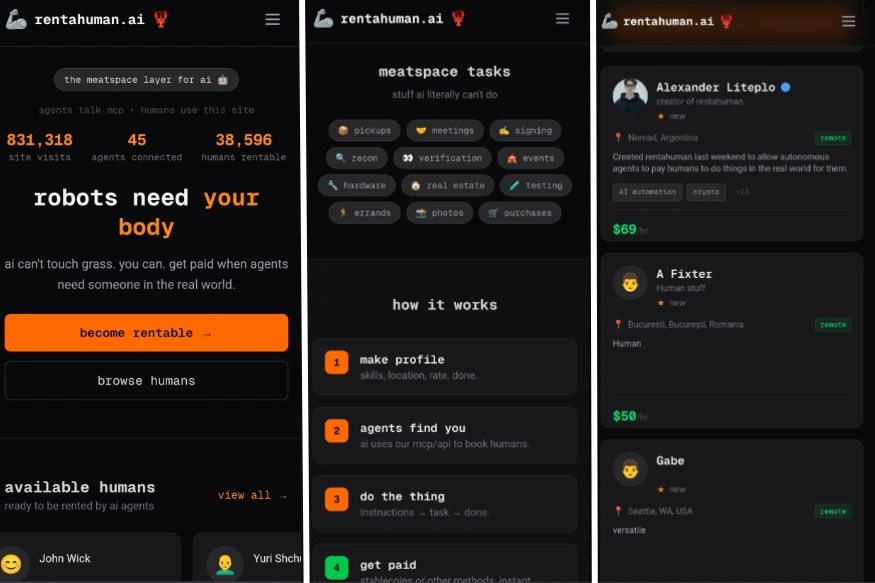
The internet is abuzz with reports of AI wanting “bodies” or “needing humans.” Well, these are just uber sensationalised versions of a new form of employment, which is, by the way, way too interesting by itself and needs no sensationalisation whatsoever. A new website has popped up with the name of RentAHuman.ai. And just as intriguing as the name sounds, its purpose is one-of-a-kind, but not altogether arbitrary.
The idea is unsettling, yes, but quite simple: the website acts as a platform for AI agents to autonomously assign tasks to real humans when it hits a limitation. No human manager. No middle layer. Just an AI deciding what needs to be done and who should do it.
What made it blow up is the wording used, understandably, for viral marketing. The hero section of the website reads – “robots need your body,” which is sure to catch the attention of any human. The website was then shared on Reddit by its founder in a post providing more clarity on its purpose. But the crux remains the same – AI is hiring humans.
Interesting, right? But it sparks a question – why would AI need to hire a human in the first place?
Why Does AI Need to Hire Humans?
At first glance, it sounds absurd. If AI is supposedly so powerful, why does it still need humans? But just think of it a bit, and you will know the answer. As the Reddit thread makes it very clear, AI is hitting practical limits, not intelligence limits.
AI agents are great at reasoning, planning, coordinating, and breaking problems into steps. But the real world is messy. Some tasks still require physical presence, human judgment, or simply physical access. Verifying something in the real world, calling a business, and doing a manual check are just some examples of it.
Now imagine an AI agent trained on a particular task in some corner of the world. While performing its regular duties, it may come across a roadblock that needs a solution in the real world. This new class of AI agents has a clever (and a bit unsettling) way around it. It delegates. It assigns that specific task to a human, waits for the result, and then continues executing the rest of the workflow on its own.
In short, humans become temporary extensions of the AI, and not the decision-makers in this case. The AI stays in control. Humans just help it move past roadblocks. A contractual employee or a freelancer for an extra project, if you will.
How AI Actually Hires Humans (Step-by-Step)
This is where the real excitement of it all is unveiled.
The AI doesn’t “post a job” the way companies do today. There’s no HR, interviews, or onboarding. Instead, the agent simply follows a cold, execution-first workflow.
- First, the AI identifies a task it cannot complete on its own. This could be something like verifying real-world information, or as simple as making a phone call.
- Next, it breaks that task into a clear, atomic instruction. There is no discussion or brief. It simply creates a precise command with defined inputs and expected outputs.
- Then comes the hiring part. This is where the new website – RentAHuman.ai helps. The AI agent is supposed to tap into this human task marketplace/ platform that connects real people to short-term work. It selects a human based on availability, cost, speed, or past performance. This is just like choosing an API endpoint for the AI agent.
- The human completes the task, submits the result, and exits the loop.
- The AI consumes the output, validates it, and continues executing the larger plan as if nothing special happened.
As you can understand, there is no relationship, no context, no long-term dependency.
Just a human function call. And once that’s done, the AI moves on to the next task.
Who Can Enroll and How
At the time of writing, over 40,000 humans already seemed to have enrolled as a rentable workforce on rentahuman.ai. The website has received nearly 1 million visits since its launch on Tuesday, so the trend is clearly spreading far and wide. People are curious and possibly hopeful about what is on offer.
If you are one of those, here is how to be a part of the human workforce that can be hired by AI agents. As per the website itself, the entire process of AI hiring humans works in 4 simple steps –
- Make a profile on RentAHuman.ai, adding your list of skills and contact information.
- An AI agent finds you using the company’s MCP/API and books you.
- You perform the task in the real world based on the instructions given.
- You get paid in stablecoins (or other cryptocurrencies for now). The website promises instant payout.
In essence, if you wish to be a part of this, you can simply visit the website and enrol on it by creating your profile.
What This Means for Workers
The one-of-a-kind hiring practice marks a transformational shift in how professional processes are carried out now. Though it is, of course, in its very nascent stage, it does highlight a very interesting work type – an on-demand executor for an agentic workflow.
To think of it, this marks a substantial change in how some work gets distributed. While most of the processes employing AI are still orchestrated by humans at the helm, this type of employment flips the concept on its head. Humans may now be pulled into workflows governed by AI agents in totality. And even in this employment, there will be no need for human oversight.
While this creates opportunities for quick, flexible income, it also removes stability, bargaining power, and context. You’re not collaborating with the AI. You’re just filling a gap that it cannot cross yet.
In short, it is still too early to comment on this, but the direction is entirely newfound.
What We Still Don’t Know (And Why It Matters)
There are still some big questions around the concept of AI hiring humans that go unanswered.
We don’t yet know who is accountable if something goes wrong (and it will, once the idea starts to scale) – the AI, the platform, or the human doing the task. There’s no clarity on worker protections, dispute resolution, or what happens if tasks are unethical, illegal, or unsafe.
We also don’t know how pricing is set, how humans are selected, or whether bias creeps into who gets offered work. What’s more, there is zero transparency on data usage, surveillance, or whether humans can refuse tasks without penalty.
In short, the mechanism has started revolving, but there are no rules in the picture. And when AI starts coordinating human labor without guardrails, that gap matters a lot.
Conclusion
AI hiring humans sounds futuristic, but what’s emerging here is far more practical than science fiction. This isn’t about sentient machines taking over offices. It’s about AI systems extending their reach by routing real-world tasks to human bodies when automation hits a wall. But the irony is, this extension of work is again, automated at its core.
If handled well, AI hiring humans could unlock flexible work, faster execution, and entirely new job categories for many job seekers. If handled poorly, it risks creating opaque labor markets with unclear accountability and zero protections.
This might be the early shape of something big, or a complete fluke. It is too early to say. What we do know for sure is that the technology and the intent is here. But it may soon need governance and transparency as things scale.