Much more than a cutting-edge electric car manufacturer, Tesla is an artificial intelligence (AI) company. In fact, its use and vision of AI is one of the biggest reasons that skyrocketed the comparatively much younger carmaker to the pole position, beating centuries-old automobile manufacturers in the process.
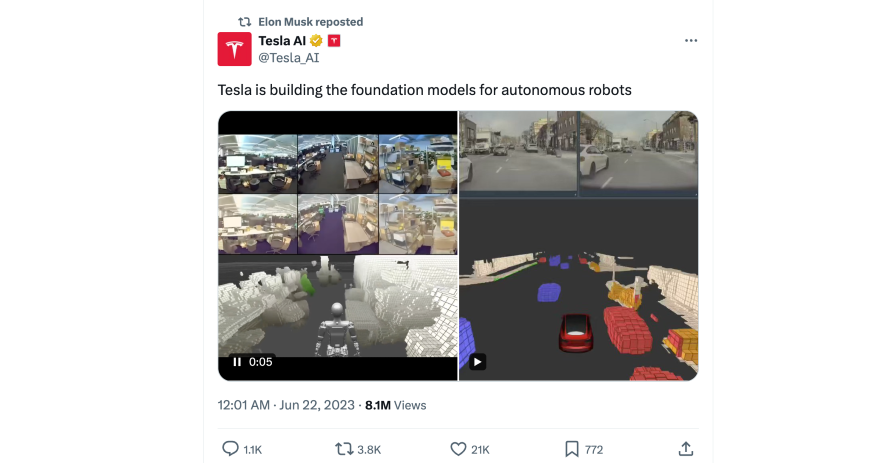
Tesla AI is at the heart of everything, from how its factories build cars to how those cars drive on the road. Elon Musk has even described Tesla as “building the foundation models for autonomous robots,” noting that advanced AI for vision and planning is key to achieving full self-driving cars and even bipedal robots.
In this article, we’ll explore how Tesla is incorporating AI in its manufacturing processes and in its vehicles, including its self-driving capabilities. We’ll also look at Tesla’s grand vision of a self-driving robotaxi fleet, what it will require, and what challenges are slowing it down. Throughout, we’ll dive deep into why Tesla AI is central to the company’s strategy and how it compares to other automakers’ AI efforts.
Table of contents
AI-Powered Manufacturing: Tesla’s “Smart Factories”
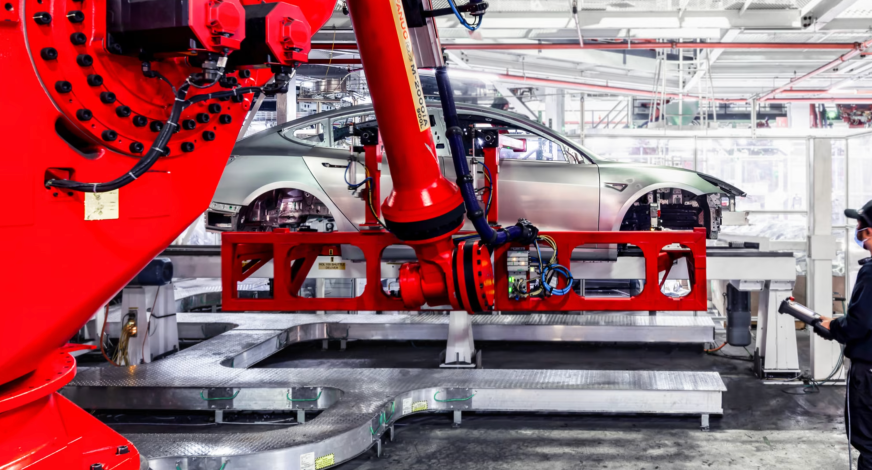
I remember how the world went bonkers when Tesla first released inside footage of its Gigafactory having robot arms put together its cars piece by piece. It was a sight to behold, showcasing the advanced manufacturing era that human ingenuity had achieved. In case you didn’t, know that Tesla AI also guides all these robots that build its cars.
These AI-powered robotic arms can learn and adapt to different tasks without constant reprogramming. Using vision data, the robots precisely position parts, weld seams, and apply adhesives, adjusting on the fly based on feedback. This means parts are aligned perfectly, and the process can be easily reconfigured for new models. This is efficiency, combined with flexibility.
Tesla Gigafactory: AI-Driven Processes
This basically means Tesla’s use of AI begins long before its car ever hits the road – on the factory floor. The company has invested heavily in what some call “smart factories,” where AI and robotics streamline production. In Tesla’s Gigafactories, AI-driven systems monitor and optimize many aspects of manufacturing.
Just like predictive maintenance. Tesla employs AI to monitor equipment conditions and predict failures before they happen. By analyzing patterns in sensor data from machines, the AI can flag when a robot or conveyor is behaving abnormally and likely needs service. This keeps Tesla’s high-speed production lines running with minimal interruptions – a key factor when you have to manufacture over a million vehicles per year.
Tesla’s recent “unboxed” manufacturing process was a masterpiece of AI-powered manufacturing. Introduced at Tesla’s 2023 Investor Day, unboxed manufacturing involves assembling large submodules of the car independently and then bringing them together at final assembly. This modular approach can reduce the factory footprint by about 40% and cut costs by up to 50%. Tesla’s Computer Vision AI plays a key role here by coordinating robots and quality checks across these parallel assembly lines – helping automate, optimize, and ensure quality and safety.
Notably, Tesla even uses AI to make its factories more sustainable. A Teslarati report mentions an AI-based HVAC control system in Gigafactory Nevada managing the majority of the heating and cooling infrastructure, optimizing energy use. This AI-driven system reduced HVAC energy demand significantly and even optimized entire chiller plants in a closed loop. Result: thousands of MWh of energy saved per year.
Industry-wide AI Transition: Tesla in the lead
Tesla is not alone in leveraging AI in manufacturing. Other automakers have also adopted similar technologies in their factories. For instance, Nissan uses AI-guided Automated Guided Vehicles (AGVs) at its Oppama plant to deliver parts to workers efficiently, reducing the need for manual material handling. BMW has integrated AI for quality control, using machine learning to detect paint flaws or assembly errors faster than the human eye. The entire auto industry is moving towards AI-driven production for greater efficiency and safety.
However, Tesla’s aggressive use of automation and Tesla AI systems – from robotic assembly to predictive analytics and HVAC controls – has set it apart as a leader in what some call the AI manufacturing revolution.
Bottom line – Tesla AI doesn’t just build cars. It also cuts costs and energy usage behind the scenes, making production smarter and greener.
But that is not the most potent and visible use of AI for Tesla. That title easily goes to Tesla’s Autopilot.
Tesla Cars on Autopilot: AI on the Road
AI literally takes the driver’s seat when it comes to Tesla’s vehicles. Every Tesla comes equipped with a suite of cameras, sensors, and a powerful onboard computer, enabling features like Autopilot and Full Self-Driving (FSD) (currently in a supervised beta). These cars essentially have an AI driver-assist system that is constantly learning from the road.
Tesla’s approach is unique in one important metric here: instead of using expensive lidar sensors or high-definition maps like some competitors, Tesla relies on a vision-based AI system. This is much like a human using eyes and a brain.
Eight surround cameras on each Tesla vehicle feed a deep neural network that interprets the car’s surroundings in real time. With this, the self-driving system is able to recognize lanes, vehicles, pedestrians, traffic signs, and just about every other element found on the roads. For this, the network was trained on billions of miles of driving data collected from Tesla’s fleet, enabling the system to handle a wide range of scenarios.
The result of this Tesla AI approach is seen in features like Autopilot, which can center the car in its lane and maintain a safe distance from other vehicles, and FSD Beta, which attempts complex maneuvers on city streets. Tesla recently garnered headlines for its completely autonomous vehicle delivery to a customer, as a Tesla car navigated its own way from a Tesla factory to the Tesla buyer’s home.
Check out the video here:
AI-Enhanced Safety on Roads
While these systems are not fully autonomous yet (Tesla’s cars are currently Level 2 automation, requiring an attentive driver), they have shown impressive capabilities. A commendable stat highlighting this is on-road safety, as Tesla reports significantly fewer accidents per mile when Autopilot is engaged. In Q3 2024, Teslas on Autopilot logged one crash for every 7.08 million miles driven, compared to one per 670,000 miles for typical US drivers. Even Teslas driven without Autopilot performed safer than average (one in 1.29 million miles). This suggests that the AI driver-assist features are already reducing accidents and improving safety.
Elon Musk has highlighted this, stating that “Autopilot is a major safety improvement” after seeing the data. One reason Tesla’s self-driving AI improves over time is that it learns from every Tesla on the road. The company has built a dedicated supercomputer called Dojo to process the flood of real-world driving data coming in. Dojo can train Tesla’s deep learning models using video feeds from millions of Tesla miles, helping the AI better recognize and react to rare events.
Tesla continuously updates its models and sends improvements to cars via over-the-air software updates. This means all Tesla owners effectively contribute to, and benefit from, a collective AI “brain” that gets smarter each month. By mid-2025, Tesla’s fleet was reportedly adding around 15 million miles per day on FSD – a staggering scale of data that no other automaker currently matches.
Tesla noted that the fast-growing volume of vision-based driving data reinforced its belief that “the vision-based approach, which uses cameras and AI, is the right path to autonomy.”
Despite the advances, do not forget – Tesla’s Full Self-Driving is still classified as “Supervised”.
Tesla Autopilot AI: Where it Lacks
The system can navigate a car through city streets, traffic circles, and highway interchanges, but a human driver must remain ready to take over at any moment. There have been instances of Tesla’s AI misidentifying objects or making poor decisions, especially in complex urban environments or bad weather. Certain highly unfortunate events have served as dark reminders that even Tesla AI hasn’t mastered common sense on the road yet.
I have written in detail about why AI lacks common sense and why it is very dangerous. You can read it here.
Tesla has continually iterated on its AI models (it’s currently testing FSD Beta v12, which Musk says will use end-to-end neural networks for even better performance). For now, though, drivers must keep their hands on the wheel. Tesla’s cars “see” with AI and can drive themselves in many situations, but true autonomy is still a work in progress.
What Competitors are Doing
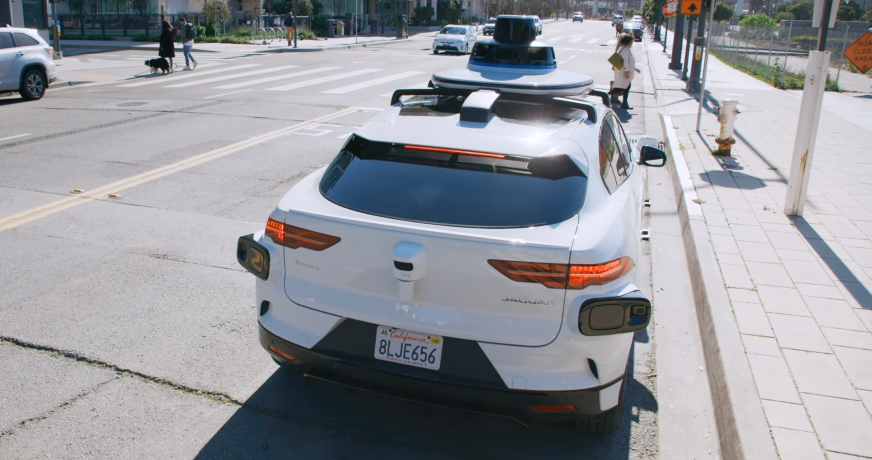
Other automakers are taking different paths for AI on the road. Waymo (Google’s self-driving unit), for example, uses a combination of AI with lidar and radar in its vehicles. Waymo’s robotaxis have already driven over 100 million miles with no human behind the wheel in cities like Phoenix and San Francisco. General Motors’ Cruise division similarly deployed AI-powered driverless taxis (until safety incidents paused their operation in late 2023). Traditional car companies like Mercedes-Benz have introduced Level 3 autonomous features (allowing the car to drive itself in certain conditions), but these rely on detailed maps and sensors in addition to AI.
In contrast, Tesla’s AI strategy aims for a more generalized vision-only solution that can be rolled out to the millions of Teslas already on the road via software updates. This bold vision could make autonomy cheaper and more scalable. However, it is also a harder problem to solve. As Tesla’s AI engineers put it, they are striving for a “general solution for full self-driving” through vision and neural networks, rather than a patchwork of specific sensors and pre-mapped routes.
The good news is – while the road is long, Tesla seems to be well on its way.
The Road to Robotaxis: Tesla’s Autonomous Ambitions and Challenges
In my early journalistic days, I remember being in attendance with Travis Kalanick, the founder of Uber and CEO at the time. As he shared his vision of starting Uber, it was an instant no-brainer – cars, on average, stand idle for about 80% of the day.
So if there were a way to get you from point A to B, there may never be a need for owning a car. In short, use a Taxi.
With Tesla, Elon Musk is taking this one step ahead – Own a car, AND use a Taxi.
Tesla’s Robotaxi Aim
Tesla’s larger goal with AI is to achieve fully self-driving vehicles that can operate as a network of robotaxis. In Elon Musk’s words, once Tesla solves autonomy, car owners will be able to “flip the switch” and send their Tesla out to earn money as a self-driving taxi when they’re not using it. The vision is futuristic: you could tap a Tesla app to summon a driverless Model Y to your door, and the car would ferry you to your destination with no human driver involved.
In theory, this Tesla robotaxi network could offset the cost of car ownership (your car makes you money) and dramatically increase the utilization of vehicles. Musk has claimed this could give Tesla cars “quasi-infinite” value and change the economics of transport entirely.
However, reality is less simple.
Even die-hard fans of Musk (I just live on that edge) would agree on his notorious habit of overpromising things. His pursuit of robotaxis is no different. Musk famously predicted in 2019 that Tesla would have “over a million robotaxis on the road” by 2020, activated via software update.
As of 2025, not a single true robotaxi is commercially active yet.
Tesla did start a small pilot program in 2023-2024 with a dozen Model Y SUVs operating as autonomous taxis in a limited area of Austin, Texas. And Musk now says Tesla will ramp up the service to more cities by the end of 2025. But the delay between bold promise and reality underscores the core challenge:
Achieving Level 4/5 autonomy (full self-driving with no human needed) is extremely hard.
It requires AI that can handle every possible scenario a car might encounter – a bar that current systems haven’t cleared.
So what is stopping Tesla from achieving its robotaxi goal right now?
Technical Challenges
Technically, Tesla’s AI still encounters edge cases that it cannot reliably solve. Unusual situations – a person in a wheelchair chasing a duck across the road, or a truck carrying an oddly-shaped load – can confuse the algorithms. Autonomous AI requires an enormous amount of diverse driving data to learn from, and Tesla’s billions of miles of data are still sometimes not enough for the strangest occurrences.
Low-visibility conditions like heavy snow, unpredictable human behavior, complex construction zones – these continue to challenge Tesla AI. Musk has noted that the final hard problems are akin to teaching the AI common sense and judgment in dynamic environments, something humans learn from life experience. Tesla is betting on advanced approaches like “predictive and generative AI modeling” – having the AI imagine possible future movements of other road users – to improve its decision-making.
Regulatory Challenges
These are frontier AI techniques that are still being refined. Meanwhile, regulatory approval looms large. Even if Tesla’s self-driving software were nearly flawless, governments need to be convinced of its safety before allowing widespread deployment.
Regulators want extensive testing data and evidence that an autonomous Tesla is as safe as (or safer than) a human driver in all conditions. After some high-profile accidents (involving both Tesla’s driver-assist and other companies’ robotaxis), authorities are understandably cautious. In late 2023, for example, GM’s Cruise had to halt its driverless taxi operations after a series of crashes and safety concerns.
Tesla itself has faced investigations into accidents where drivers may have over-relied on Autopilot. All of this creates a high scrutiny environment. Musk has often acknowledged that regulatory delay is a big unknown for full self-driving rollout.
In some places, laws haven’t even been written yet to define liability and insurance for robotaxis. In short, the AI might be 90% ready, but society demands 99.999% reliability before unleashing cars with no drivers. Another challenge is public trust and perception.
Converting today’s Tesla AI from a driver-assist to a true chauffeur will require people to trust an AI with their lives on the road. Building that trust may take time (and millions of miles of safe operation). Tesla’s incremental approach of gradually improving FSD Beta and expanding its capabilities is partly aimed at proving the technology step by step.
The company’s data already shows potential safety benefits, but winning over regulators and riders will require near-zero incidents over a long period. Despite the hurdles, Tesla continues to push toward the robotaxi dream. The company even unveiled designs for a dedicated “Cybercab” robotaxi vehicle (without a steering wheel or pedals) planned for the future.
Conclusion: The Future of Tesla and AI
From its factory floors to its self-driving cars, Tesla AI is transforming how vehicles are built and driven. In manufacturing, AI helps Tesla crank out cars with greater efficiency, precision, and even sustainability, whether by spotting microscopic defects on the assembly line or by cutting energy use in its plants.
On the road, Tesla’s AI-powered Autopilot and FSD are redefining driving by increasingly offloading the task to algorithms. The data shows promise in safety gains, and each new update brings Tesla’s vehicles closer to full autonomy. The ultimate prize, a fleet of Tesla robotaxis autonomously ferrying passengers, could revolutionize transportation and Tesla’s business model.
But getting there will demand technical mastery and patience. Tesla needs to refine its AI to handle corner cases and exhibit something like human common sense, and it must satisfy regulators that its self-driving cars are unequivocally safe. Till then, there is only one thing we know for sure – Tesla will keep putting AI in the driver’s seat – both literally and figuratively – in its quest to achieve autonomous electric transportation.