OpenClaw is everywhere right now. People are talking about the platform and the kinds of agents you can build with it. But what is all this hype really about?
Most AI assistants still stop at conversation. They answer questions, forget context, and never actually take action.
OpenClaw agents change that.
Instead of living inside a chat window, these agents run on your own machine, stay online, remember past interactions, and execute real tasks. They connect directly to messaging platforms like WhatsApp and Telegram, plan actions, run commands, and follow through like a digital operator rather than a chatbot.
Exciting, right? That’s exactly why I’m writing this article to help you build your first OpenClaw agent.
Table of contents
What is OpenClaw?
Originally launched as Clawdbot, later renamed Moltbot, and now known as OpenClaw, the project is an open-source AI assistant that runs locally as a persistent personal agent. It operates at the intersection of AI agents, local automation tools, and messaging-based interfaces.
Because OpenClaw runs entirely on user-owned systems, developers retain full control over their data, execution environment, and model selection, without relying on centralized cloud platforms.
Also Read: Send your OpenClaw agents to socialize at Moltbook
Key Features of OpenClaw
- Self-hosted and local-first: Runs entirely on user-controlled infrastructure, giving full ownership over data, execution, and configuration with no cloud dependency.
- Persistent and always-on: Operates continuously in the background, tracking ongoing tasks and maintaining context across multiple conversations and sessions.
- Messaging-based interaction: Integrates directly with platforms like WhatsApp, Telegram, and Discord, enabling natural communication without a separate UI.
- Long-term memory: Retains user context and preferences over time, allowing for personalized, context-aware responses.
- Local task execution: Executes shell commands, manages files, automates scripts, and performs web actions directly on the local system via the execution layer.
- Model-agnostic design: Supports multiple AI models such as Claude, GPT, and Gemini, allowing users to choose based on cost, performance, and privacy needs.
- Extensible and modular: Uses a modular architecture that makes it easy to build custom skills, tools, and integrations.
Architecture of OpenClaw
- Messaging Gateway: Discusses communication, acting as an interface between various platforms for communication and authentication.
- Agent Core: Interprets intent, plans actions in a modulated way, remembers past events, and orchestrates reasoning toward execution.
- Memory System: An enduring, structured memory is maintained as sequences and distributed memory vectors.
- Execution Layer: Provides the interfacing to perform the task with the operating system.
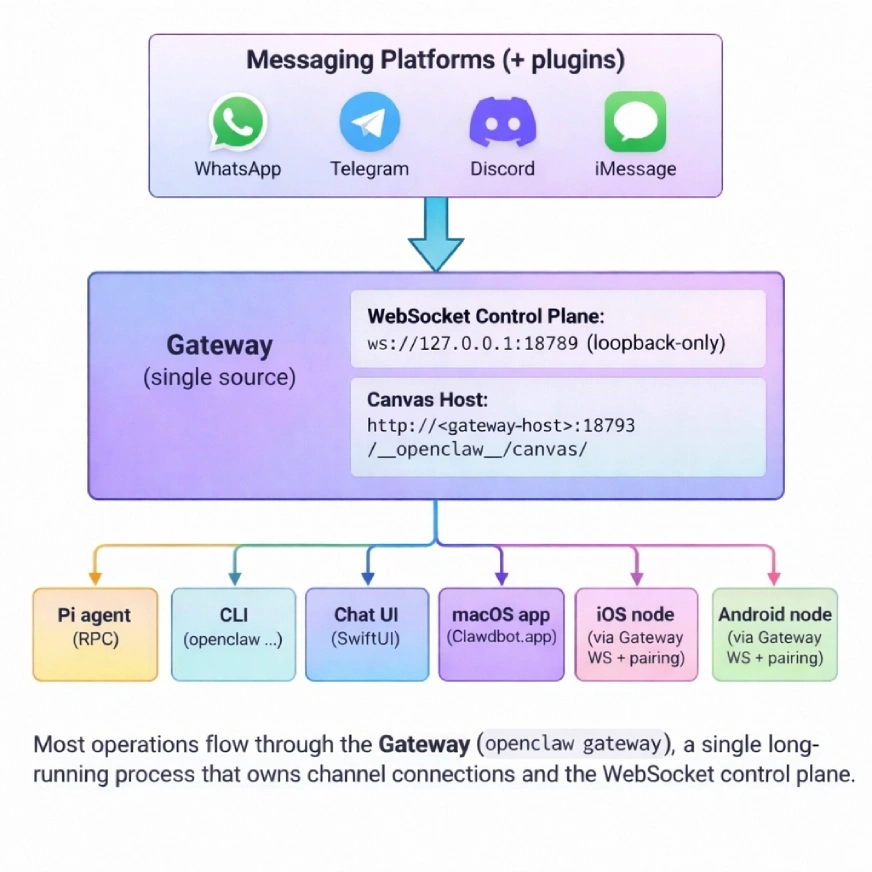
Also Read: Complete Guide to Building Scalable Multi-Agent Systems with AgentScope
Getting Started with OpenClaw
OpenClaw is designed for technical users who are comfortable with command-line tools.
1. The prerequisites for running OpenClaw:
- Node.js (v22+)
- Terminal access
- API key for an LLM provider
- Messaging platform account
2. You can install OpenClaw by using the following command:
npm install -g openclaw@latest3. For the initial setup of your environment, use the below command:
openclaw onboard --install-daemonThis command guides you through configuring the model provider, workspace, Gateway service, and messaging integrations. You will be prompted with a series of setup options. Review each step carefully and enable only what matches your requirements.
Building a Personal AI Research Assistant using OpenClaw
In this task, we use OpenClaw to generate and track daily AI research summaries.
Task Workflow
User message:
Every morning, please provide me with a summary of the latest AI research news and updates.
OpenClaw actions:
- Identifies the intent for daily summaries
- Stores the request in persistent memory
- Creates a scheduled task
- Retrieves, summarizes, and delivers AI research updates
- Sends a daily message with the summarized content
What This Demonstrates
- Persistent memory
- Scheduled task execution
- Clawdbot’s usefulness beyond simple messaging
Output:
OpenClaw Agent in Action
Once the agent is set up, it no longer behaves like a one-off chatbot session. It becomes a continuously running system that can reason, execute tasks, and deliver results without repeated prompting.
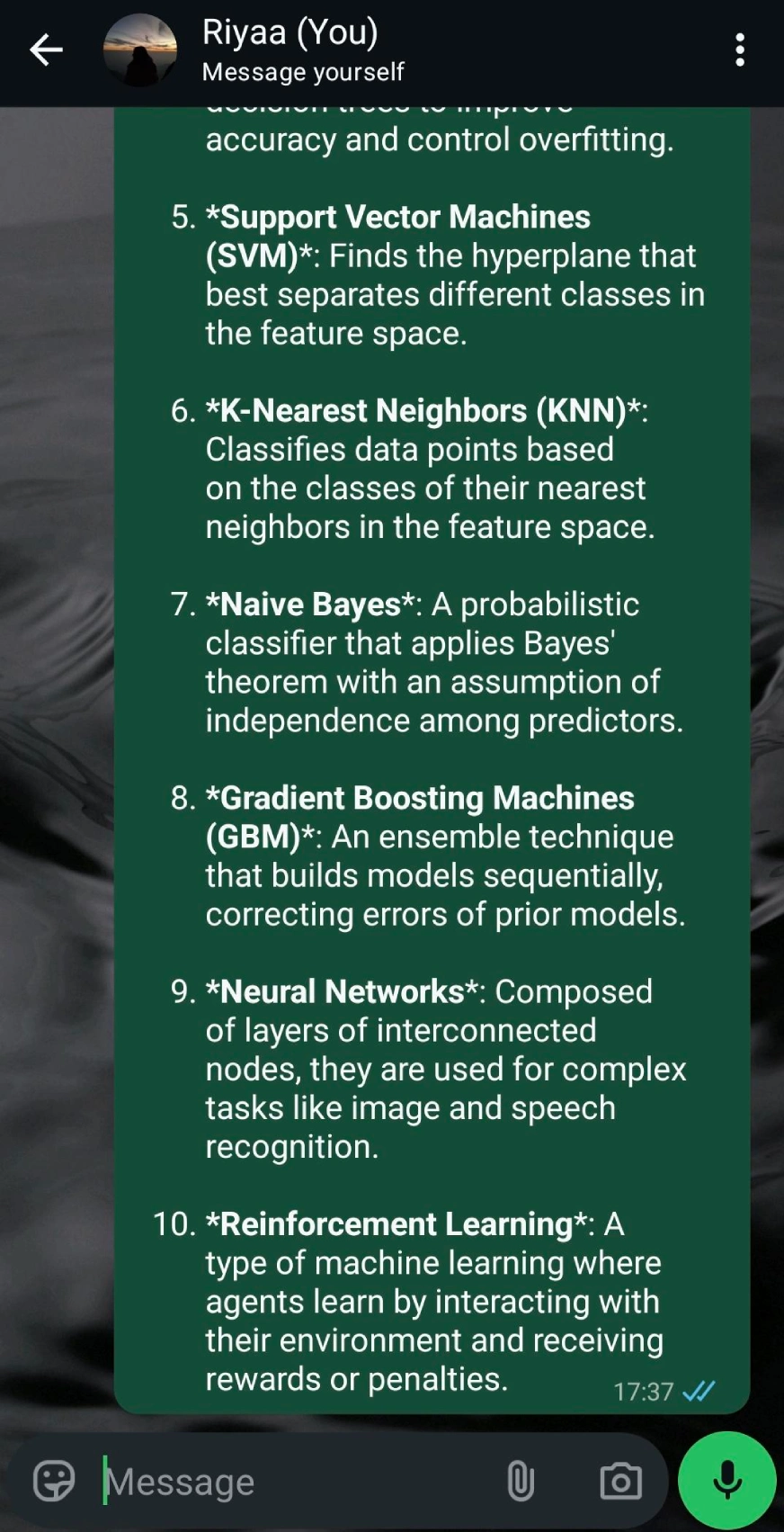
When a user asks a question inside WhatsApp, the agent processes the request locally, breaks it down into steps, and generates a structured response. Instead of simply replying with text, it can analyze information, run commands, and prepare detailed outputs before sending them back through the messaging platform.
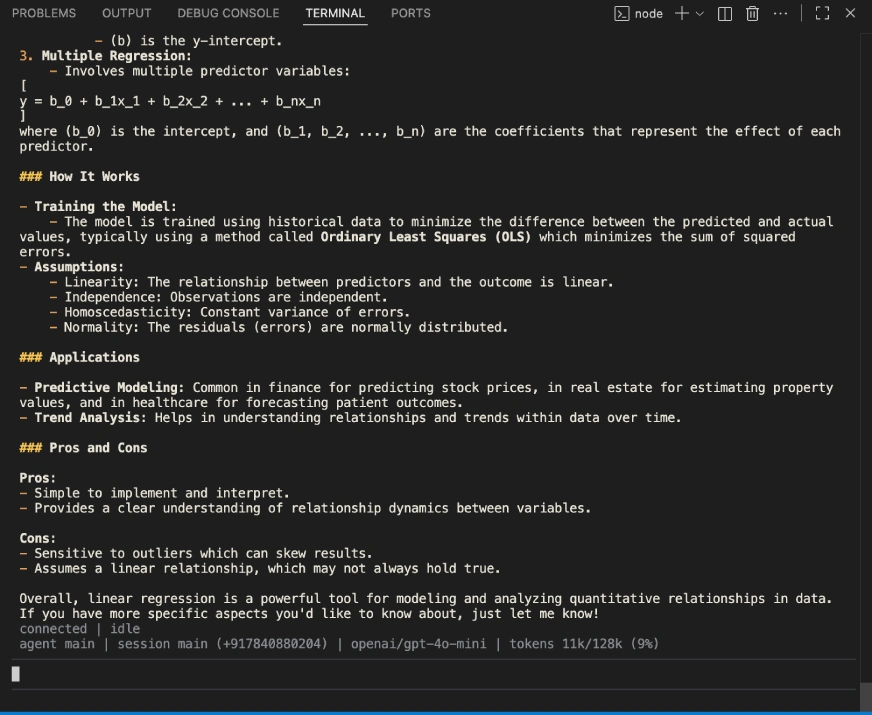
Behind the scenes, the agent reasons through assumptions, evaluates trade-offs, and structures its output clearly. This includes explanations, examples, and even pros and cons when relevant. All of this logic runs on the user’s own machine, giving full visibility into how responses are generated.
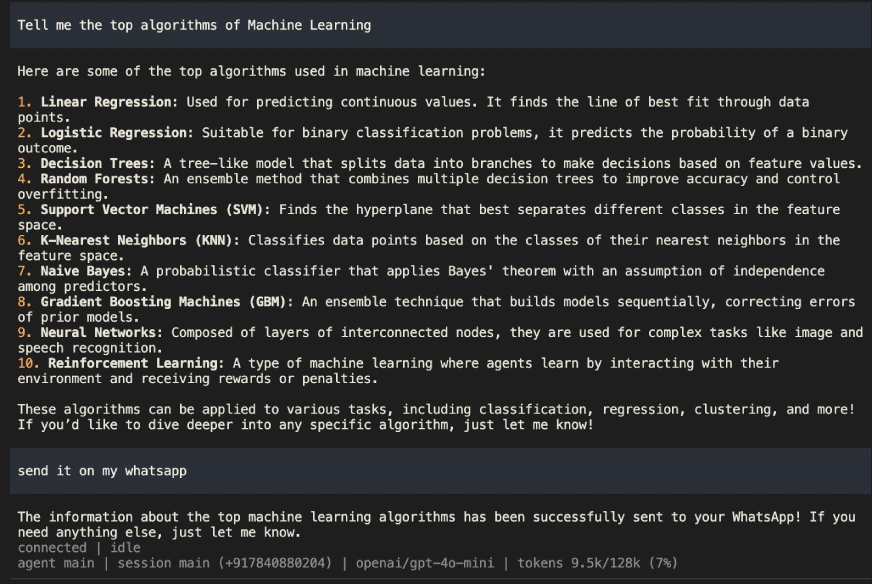
Most importantly, the agent can take action. A request does not end at an answer. The agent can decide to send the result to WhatsApp, store it for later use, or trigger follow-up tasks automatically. This is where OpenClaw crosses the line from conversational AI to an autonomous assistant.
Risks of using OpenClaw
The primary risks of using OpenClaw stem from its powerful capabilities and the level of access it requires.
- Security exposure: Granting broad system access without proper controls can create serious security risks.
- Prompt injection attacks: Malicious inputs can trigger unintended actions and compromise system behavior.
- Operational overhead: Running a persistent agent requires ongoing monitoring, maintenance, and system management.
- Complexity for non-technical users: OpenClaw currently assumes familiarity with terminal commands, APIs, and system configuration.
To reduce these risks, organizations should implement sandboxing, allowlisting, and strict access control mechanisms.
Benefits of Using OpenClaw
- Full data control: OpenClaw keeps data entirely under user control, enabling a privacy-first AI workflow.
- True AI agency: It can reason, retain memory, and take action, which are core traits of agentic AI systems.
- Highly extensible: Its modular architecture makes it easy to build custom tools and integrate with existing workflows.
- Cost flexibility: Users can choose between cloud-based or on-premise models based on performance, cost, and privacy needs.
- Real automation: OpenClaw bridges the gap between AI intelligence and real-world execution.
Real-world Use Cases
- Personal productivity automation: Automates task tracking, follow-ups, daily reminders, and real-time updates through messaging platforms.
- Automated AI research assistant: Monitors multiple information sources, summarizes new research findings, and delivers customized updates based on user preferences.
- Automation tools for software developers: Automates local tasks, assists with routine development workflows, and enables quick file analysis and summarization to save time.
- AI assistants for developer organizations: Enables teams to deploy internal AI assistants on private infrastructure, providing relevant insights without exposing sensitive data externally.
- AI agent experimentation platform: Offers a hands-on environment for developers and researchers to build, test, and refine agentic AI systems with memory and execution capabilities.
Conclusion
OpenClaw represents a clear shift in how we think about AI assistants. By combining persistent memory, local execution, and messaging-based interaction, it moves beyond chat and into real-world action. These agents do not just respond. They remember, plan, and execute.
While OpenClaw requires technical familiarity and careful security practices, it offers a rare look at what agentic AI looks like outside controlled demos and cloud dashboards. For developers and researchers, it is not just a tool, but a foundation for experimenting with autonomous systems that live alongside us, operate continuously, and act on our behalf.
This is not the future of chatbots. It is the early shape of personal AI operators.
Gen AI Intern at Analytics Vidhya
Department of Computer Science, Vellore Institute of Technology, Vellore, India
I am currently working as a Gen AI Intern at Analytics Vidhya, where I contribute to innovative AI-driven solutions that empower businesses to leverage data effectively. As a final-year Computer Science student at Vellore Institute of Technology, I bring a solid foundation in software development, data analytics, and machine learning to my role.
Feel free to connect with me at [email protected]