AI coding agents are evolving fast. In 2026, OpenClaw and Claude Code dominate the conversation. Claude Code, backed by Anthropic, offers a polished, ready-to-use experience. OpenClaw, created by Peter Steinberger, is open-source and customizable. Both run on Claude’s frontier models but serve different developer needs.
Choosing wrong costs time and money. Solo builders may want control over API spend, while teams may prefer reliability from day one. In this article, we compare pricing, setup, security, model quality, and extensibility to help you decide.
Table of contents
What is Claude Code?
Claude Code is Anthropic’s official CLI for agentic software development. It lives inside your terminal,acts as a context-aware pair programmer. It understands your file structure, git history, and dependencies. Then it writes, refactors, debugs, and tests code, completely anonymously.
It is powered by Claude Opus 4.6, Anthropic’s most advanced reasoning model. You can also switch to the faster Claude Sonnet 4.6 for everyday tasks. At its core is a proprietary agentic loop. This loop iterates on code, invokes compilers, runs tests, and self-corrects errors. All of this happens with minimal human intervention.
Claude Code is not just a code completer. It plans multi-step implementations and navigates large codebases. It manages real development workflows end to end. That makes it one of the most capable AI developer tools available today.
What Is OpenClaw?
OpenClaw is an open-source, community-built alternative to Claude Code. It wraps around the Anthropic API. It uses the same underlying Claude models. But it exposes them through a free, customizable interface. Developers with existing Anthropic API keys can run it locally. The tool itself costs nothing, though API token charges still apply.
OpenClaw is built for developers who want Claude-level intelligence. But they don’t want to pay for a platform subscription. It’s transparent, hackable, and fully auditable by anyone.
OpenClaw vs Claude Code: Core Differences
The tools exhibit similar appearances, which create an initial impression of their equality. The two tools show their most significant differences through their essential evaluation factors. The assessment uses five vital dimensions to evaluate their performance.
1. Pricing Model
The two tools maintain their most active discussion through this particular feature. Claude Code requires a Claude Pro or Max subscription. Pricing starts at around $20 month. The costs for heavy agentic sessions increase when users make multiple tool calls. Enterprise teams may also be billed through Anthropic’s developer platform directly.
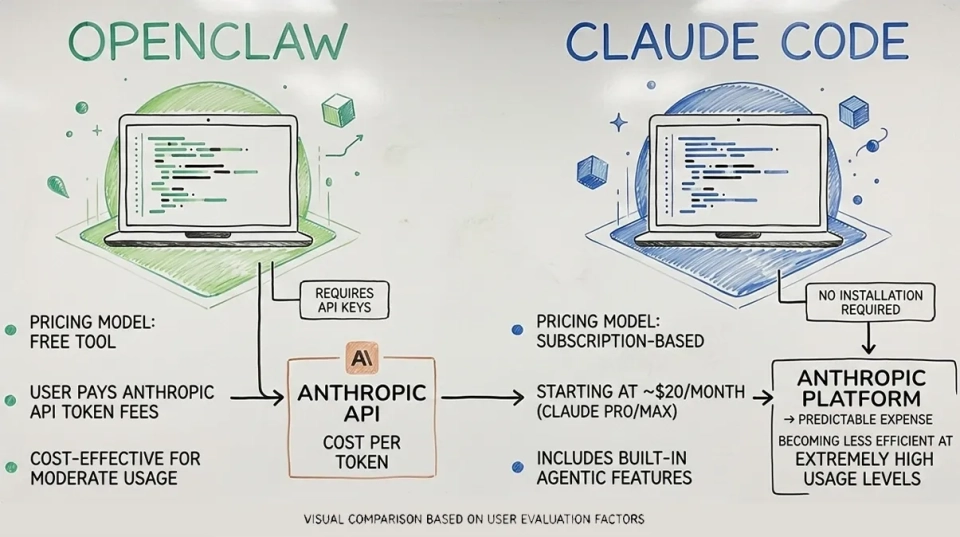
While OpenClaw offers free access to its tool. Users must pay Anthropic API token fees, which apply to every model call they make. OpenClaw offers major cost savings to users who require moderate processing power. The cost difference between two options starts to decrease when users reach extremely high usage levels.
- Claude Code: Subscription-based, starting at ~$20/month. The best value for Claude Code comes from users who need to access built-in features without any installation requirements.
- OpenClaw: Free to use; pay only for API tokens consumed. OpenClaw delivers its best value to users who need light to moderate usage while using their current API keys
2. Setup and Installation
Claude Code installs with a single npm command. The tool becomes operational after you enter your Anthropic credentials. The experience offers complete documentation together with an exceptional user interface. The system requires only basic setup activities from its initial state.
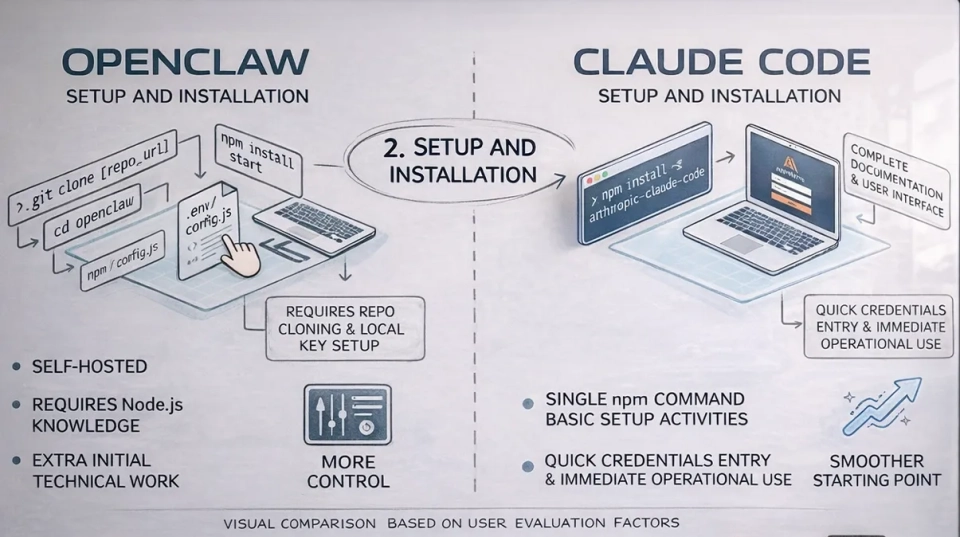
But the OpenClaw is self-hosted, you clone the repo, set your API keys, and run it locally. This gives you more control. The process needs extra technical work at its beginning stage. The obstacle remains small for developers who know Node.js. For beginners or non-technical teams, Claude Code is the smoother starting point.
3. Security and Trust
The discussion becomes more complicated at this point. The developer community has examined OpenClaw because of its problems. The team raised issues about how the system manages API keys and handles file access permissions. Trust becomes essential when the system executes shell commands or creates files.
While the Anthropic system controls Claude Code which operates within its environment. The system contains a sandboxing feature that controls user access. The system requires user approval before proceeding with any operation that may harm the system. Anthropic establishes its security partitions which it documents and maintains throughout its operations.
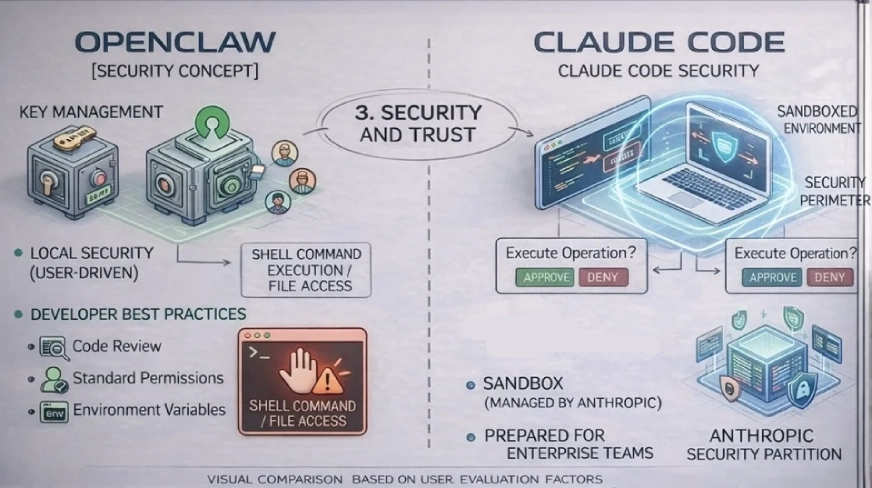
The open-source contributors provide the essential support that OpenClaw requires for its performance. The community keeps OpenClaw operational through their ongoing maintenance efforts. However, the user must conduct their own verification process. Developers using OpenClaw should follow these practices:
- The source code must be reviewed before using production credentials
- The system should run with standard user permissions except for necessary elevated access
- API keys need to be stored in environment variables instead of being placed in configuration files
- Users need to maintain OpenClaw system updates to access upcoming security updates.
In comparison, OpenClaw presents some security risks as compared to Claude cODE. Claude Code offers better protection to enterprise teams because it includes stronger security features from the beginning.
4. Model Quality and Agentic Capabilities
The two systems both operate with Claude models developed by Anthropic with additions of models in OpenClaw. The basic intelligence remains constant between both systems. The implementation of agentic loops determines their operational performance in actual situations. The system uses Anthropic’s secret agentic loop system in Claude Code. It provides maximum performance through its coding workflow design. The system enables users to perform multiple tasks while accessing the complete file system. It operates correctly with all Git functions and terminal commands and shows proper performance during debugging.
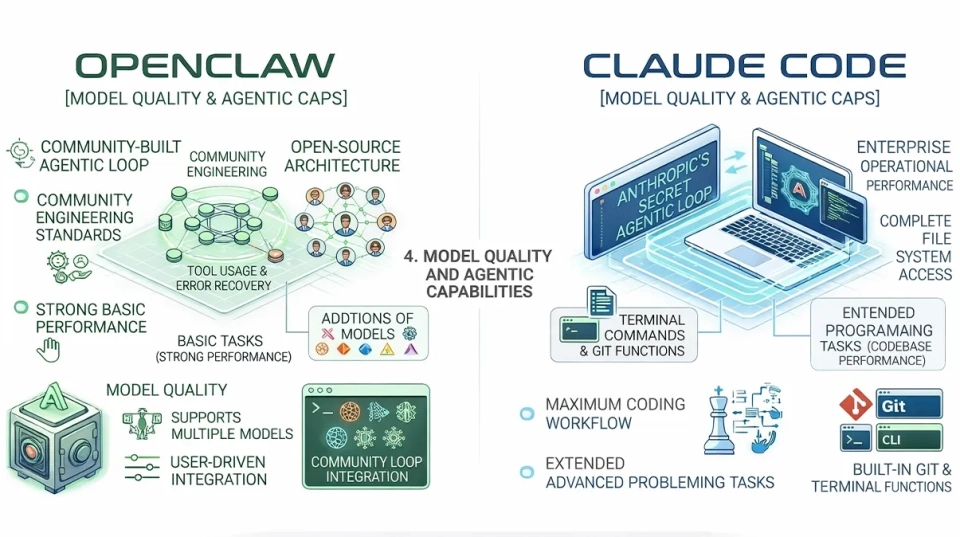
OpenClaw implements a community-built agentic loop on the same API. The community engineering standards determine the system’s ability to handle tool usage and error recovery and conduct multi-step reasoning tasks. The system shows strong performance for basic tasks. Claude Code provides superior performance for extended programming tasks that require advanced problem-solving abilities.
5. Customization and Extensibility
OpenClaw operates as a complete open-source project which allows users to modify the system prompt and agent behavior.
- It enables users to connect the system with their internal tools and pipelines and continuous integration or continuous delivery systems.
- Users can create their own version of the project to meet their specific or confidential requirements.
- Organizations need to review all code specifications before they use the code in secure settings.
Claude Code does not expose its internals the same way. The system allows users to create personalized instructions which they can store in CLAUDE.md files. The core agentic loop however remains unchanged from its original design. OpenClaw’s open nature provides significant benefits to teams that develop AI coding systems for their proprietary pipelines.
| Feature | Claude Code | OpenClaw |
| Pricing | Subscription ($20+/mo) | Free (API costs only) |
| Model | Claude Opus 4.6 / Sonnet 4.6 | Claude (via API) |
| Setup | Easy, one-command install | Moderate, self-hosted |
| Security | Managed by Anthropic | Community-maintained |
| Agentic Loop | Proprietary, optimized | Open-source implementation |
| Customization | Limited | Fully open, forkable |
| Enterprise Support | Yes | Community only |
| Audit/Inspect Code | No | Yes |
| Offline/Local Run | No | Partially (still needs API) |
When to choose Claude Code
The selection of Claude Code maintains its value to users who need more dependable and polished software. The solution becomes suitable when the need for enterprise-level customer support becomes more important than saving money. Users should select Claude Code when they match these requirements:
- The engineering team needs to use tools that other teams support and maintain.
- The team requires Anthropic’s optimized loop system to handle their complex coding projects which extend over multiple months.
- The organization needs a product that undergoes managed auditing to safeguard its security-sensitive operations.
- The user needs a solution that requires no time commitments for setting up open-source software and maintaining it.
- The user requires immediate access to Anthropic’s newest model updates which need to work together with their existing systems.
When to choose OpenClaw
OpenClaw suits developers who need transparent software and cost management and flexible development. The solution exists for users who need to exchange some product quality for their desired benefits. OpenClaw should be selected by you when you meet these criteria:
- You want to access Anthropic API without paying for a subscription.
- You need to choose this option because you want to review and change and develop new functions for the agent.
- You need this option when you develop AI coding support for your internal system.
- You have the skills to handle open-source software together with its community releases.
- You need to see how your code interacts with the tool to achieve your data transparency goals.
Developer Workflow: A Practical Perspective
The two tools show equal performance for basic tasks including boilerplate work and refactoring and debugging and test generation. The systems share a common base model, but their functionality becomes different at extreme points. The two systems maintain different performance levels for handling different types of real-world work tasks according to their execution requirements. Its error recovery system and context retention ability throughout long work hours show superior performance. OpenClaw handles focused, well-scoped tasks very well. It’s an excellent pick for individual developers managing API costs carefully.
Teams should first test both tools together on actual work assignments. The correct solution requires assessment of work procedures because no single feature assessment can provide an answer.
Conclusion
The choice between two tools depends on which of your priorities you want to achieve.
- Claude Code wins on reliability, security, enterprise support, and ease of use.
- OpenClaw wins on cost efficiency, customizability, transparency, and hackability.
The default option for most budget-conscious professional developers and development teams is Claude Code because it offers safer and better performance. OpenClaw serves as an attractive option for cost-sensitive developers who work on open-source projects or for teams that develop AI tools to be integrated into their existing systems.
The development of agentic AI coding tools up to 2026 will provide insights about both available tools. The development of proprietary software and open-source systems are driving advancements that will benefit all developers within the ecosystem.
Frequently Asked Questions
Q1. What is the difference between Claude Code and OpenClaw?
A. Claude Code is Anthropic’s managed CLI agent with built-in security and support, while OpenClaw is a free, open-source alternative using Claude models via API.
Q2. How do pricing models compare?
A. OpenClaw is free to use but requires paying API token costs. Claude Code starts at about $20 per month under a subscription model.
Q3. Which tool should developers choose in 2026?
A. Choose Claude Code for reliability and enterprise needs. Choose OpenClaw for customization, transparency, and tighter control over API expenses.
Data Science Trainee at Analytics Vidhya
I am currently working as a Data Science Trainee at Analytics Vidhya, where I focus on building data-driven solutions and applying AI/ML techniques to solve real-world business problems. My work allows me to explore advanced analytics, machine learning, and AI applications that empower organizations to make smarter, evidence-based decisions.
With a strong foundation in computer science, software development, and data analytics, I am passionate about leveraging AI to create impactful, scalable solutions that bridge the gap between technology and business.
📩 You can also reach out to me at [email protected]