Tools like ChatGPT, Gemini, and Claude pushed AI into everyday conversations. Suddenly everyone was talking about AI and a newer term that appeared alongside it: Generative AI.
The two are often used interchangeably, but they aren’t the same thing. Generative AI isn’t a replacement for AI. It’s a part of it. To understand the difference, we first need to look at what AI is, what it was originally built to do and generative AI extends those capabilities.
Table of contents
What is AI?
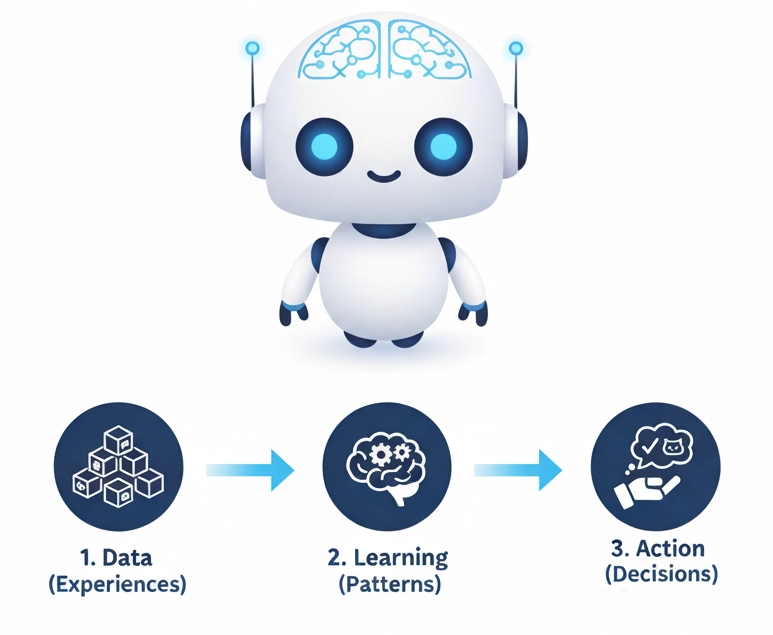
Artificial Intelligence is a domain that refers to computer systems designed to perform tasks that normally require human intelligence.
These tasks usually involve:
- Recognizing patterns
- Interpreting data
- Making predictions
- Supporting decisions
Most AI systems work by learning from historical data and identifying relationships within it. Once trained, the system can analyze new inputs and produce outputs such as predictions, classifications, or recommendations.
Read more: Introduction to AI for Beginners?
You all have used AI!
Until a few years ago, most people never interacted with AI directly. But AI was still there! Albeit, it worked quietly behind the scenes in:
- Credit card fraud detection
- Netflix recommendations
- Spam filters
Then tools like ChatGPT, Gemini, and Claude appeared. And all of a sudden AI could:
- Write essays
- Generate images
- Produce code
For the first time, people were interacting with AI instead of just being influenced by it. AI no longer just analysed or worked behind the scenes, but became an active participant in people’s lives. That shift created a common misconception:
Some people assumed this is AI.
Yes And No! This interactive AI that people have fallen in love with was not AI, but simply a branch of it called Generative AI.
What is Generative AI?
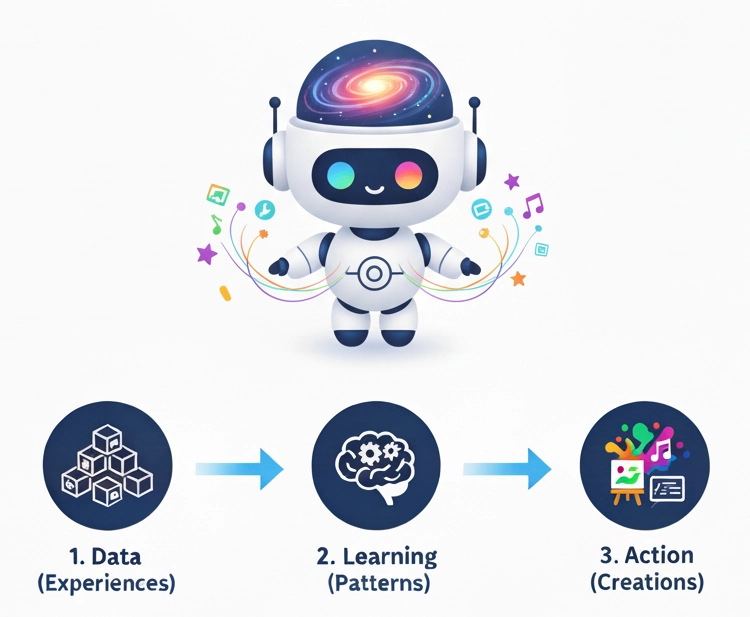
Generative AI is a type of artificial intelligence designed to create new content instead of just analyzing existing data.
These systems learn patterns from massive datasets (via training) and use that knowledge to produce entirely new outputs that follow the same patterns.
Those outputs can include:
- Text
- Images
- Audio
- Video
- Code
Traditional AI answers questions like:
- Is this transaction fraudulent?
- Which movie should we recommend?
- What is the probability of disease risk?
Generative AI answers a different kind of question:
- Write a paragraph about this topic.
- Generate an image from this description.
- Create code that solves this problem.
Instead of interpreting data, the system generates new data. You’ve definitely seen generative AI in action:
Tools like ChatGPT, Nano Banana, and DALL-E are all powered by generative AI models. They can write stories, generate artwork, summarize documents, produce code, and even simulate conversations.
Read more: Introduction to Generative AI for Beginners
AI Ecosystem
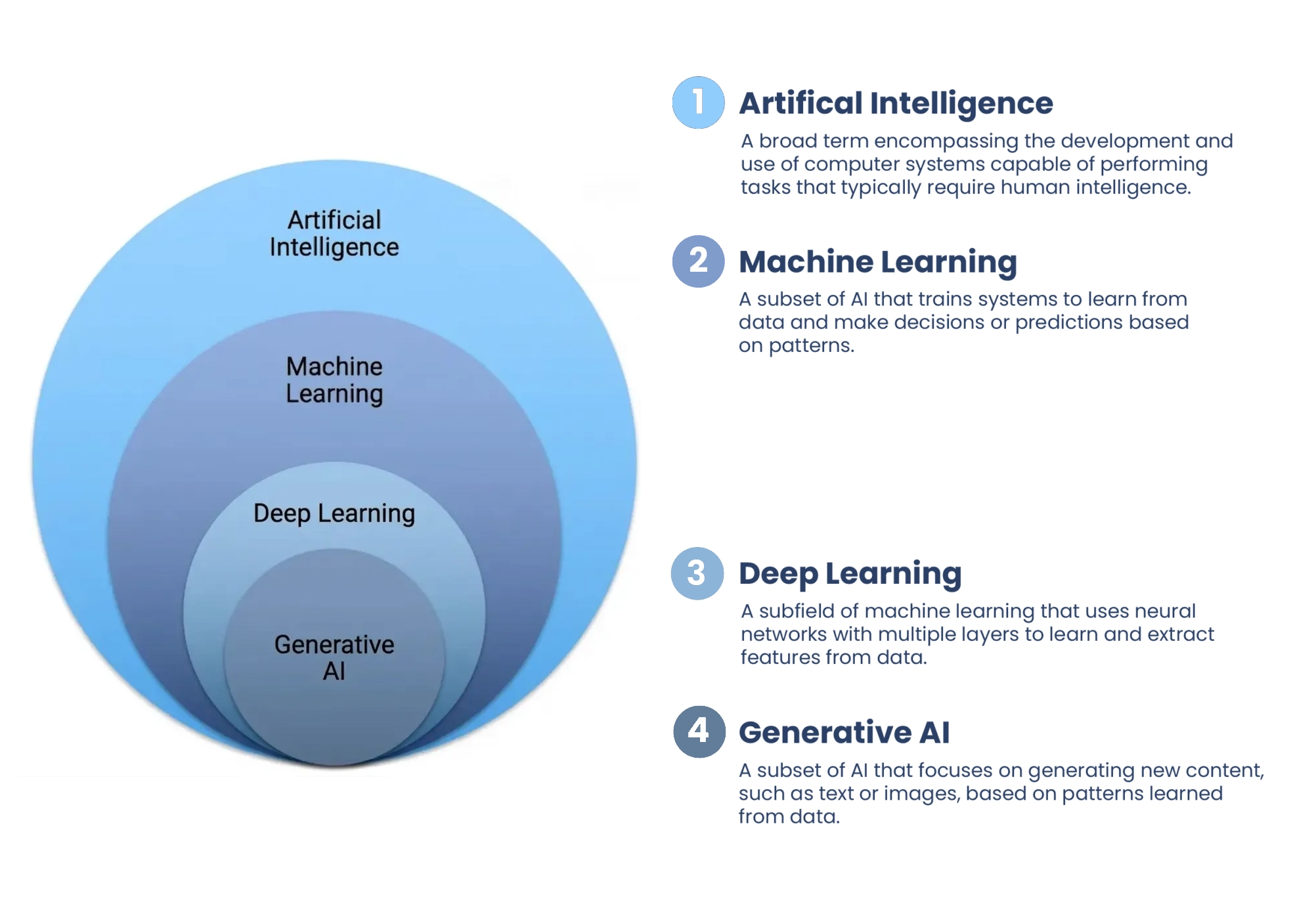
The relationship between AI and Generative AI can be easily expressed using a venn diagram:
What Is an AI Model?
At the heart of every AI system is something called a model. An AI model is a mathematical system that learns patterns from data and uses those patterns to produce outputs.
During training, the model is exposed to large amounts of data. By analyzing relationships within that data, it gradually learns how inputs and outputs are connected. Once trained, the model can process new inputs and generate a result.
For example:
- A fraud detection model learns patterns from past financial transactions and predicts whether a new transaction is suspicious.
- A recommendation model learns from user behavior and predicts which movies or products someone might like.
- A language model learns patterns in text and generates sentences that follow those patterns.
The type of model determines what the AI can do. Some models specialize in analyzing data and making predictions, while others are designed to generate entirely new content.
Some of the popularly used models include language models
How AI Models work vs How Generative AI models work?
Although generative AI is part of artificial intelligence, the way these systems learn and produce outputs is slightly different.
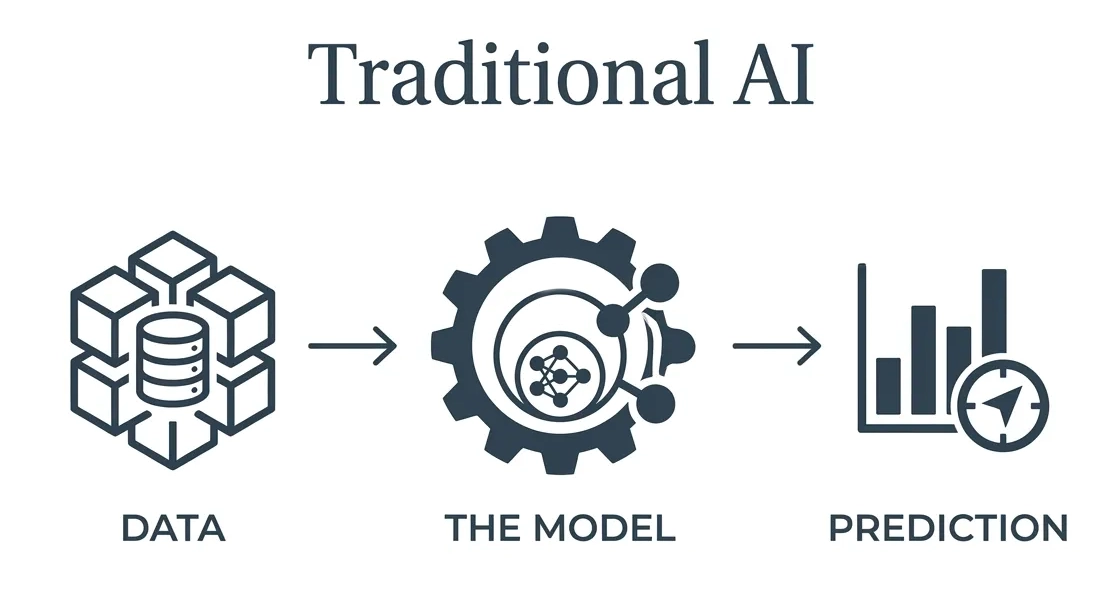
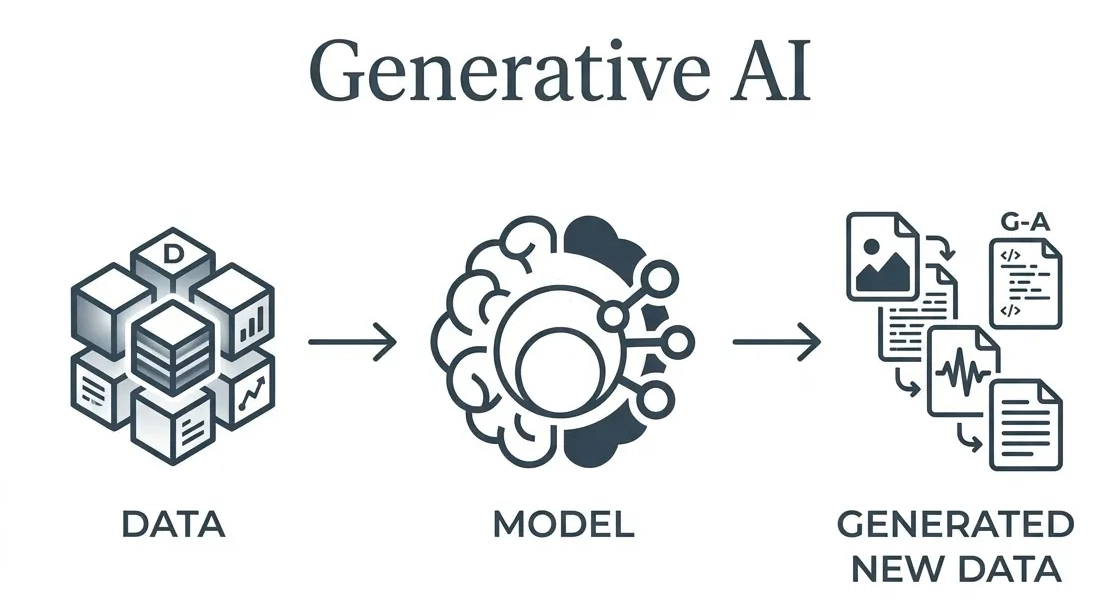
Both types of systems rely on machine learning and large datasets. The key difference lies in what the model is trained to do.
- Traditional AI models are trained to analyze data and predict outcomes.
- Generative AI models are trained to learn patterns deeply enough to create new data.
How Traditional AI Models Work?
Traditional AI models focus on prediction and classification. They are trained to achieve this objective. The training process usually begins with historical data that contains both inputs and known outcomes. By analyzing this data, the model learns relationships between variables.
A typical workflow looks like this:
- Data Collection: The model is trained on historical datasets such as financial transactions, user behavior logs, or medical records.
- Pattern Learning: The algorithm identifies relationships between input features and outcomes.
- Model Training: Machine learning algorithms such as decision trees, random forests, support vector machines, or neural networks learn to map inputs to predictions.
- Prediction: Once trained, the model receives new inputs and produces outputs such as classifications, probability scores, or recommendations.
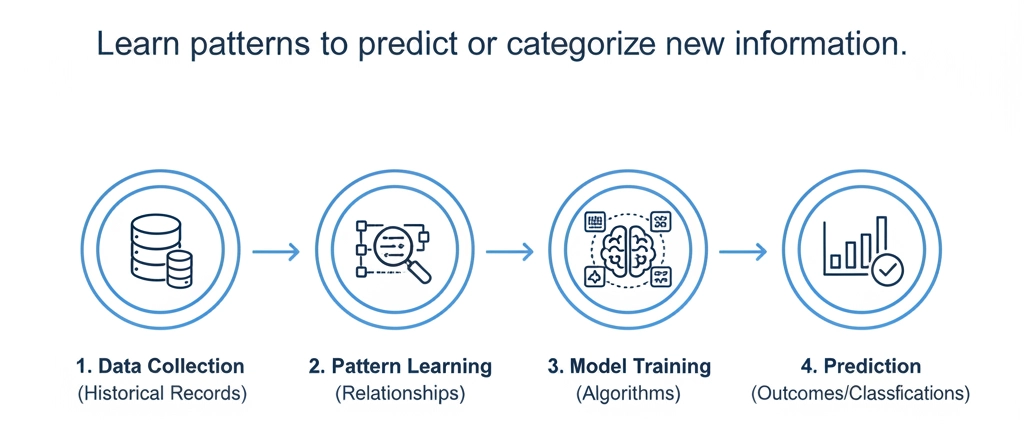
The core objective is clear: Traditional AI models learn patterns in data so they can predict or categorize new information.
How Generative AI Models Work?
Generative AI models focus on creating new content rather from patterns they’ve learnt. They are trained to learn the underlying patterns and structure of large datasets so they can generate outputs that resemble real data.
Instead of relying on datasets with labeled outcomes, generative models are usually trained on massive collections of raw data such as text, images, audio, or code. By analyzing this data, the model learns how different elements of the data relate to each other and what patterns commonly occur.
A typical workflow looks like this:
- Data Collection: The model is trained on large datasets containing examples such as books, articles, images, videos, or code repositories.
- Pattern Learning: The algorithm learns the statistical relationships within the data, such as how words follow each other in language or how pixels combine to form objects in images.
- Model Training: Deep learning architectures such as transformers, diffusion models, or generative adversarial networks are trained to capture these patterns.
- Content Generation: Once trained, the model can generate new outputs such as paragraphs of text, images from prompts, audio clips, or code snippets.
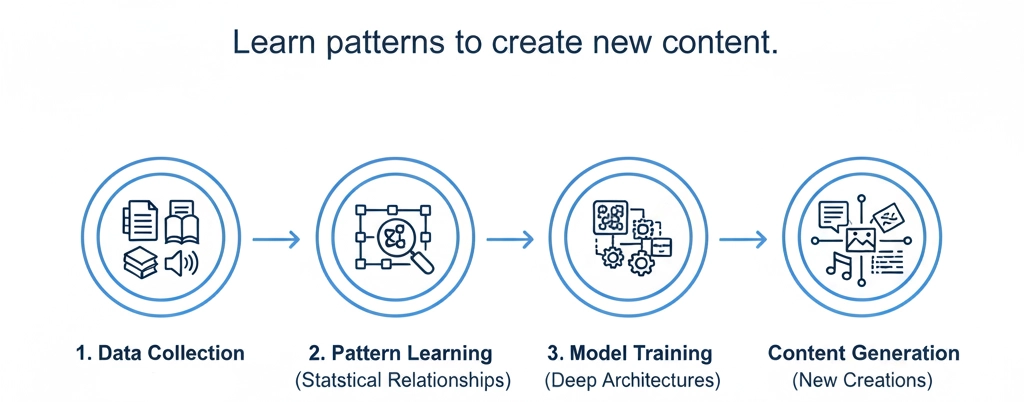
The core objective is clear: Generative AI models learn patterns in data so they can create new content that follows those patterns.
AI vs Generative AI: Key Differences
The difference lies in what they do with those patterns.
- Traditional AI learns patterns to predict outcomes or classify information.
- Generative AI learns patterns to create new content.
| Feature | Artificial Intelligence | Generative AI |
|---|---|---|
| Primary goal | Analyze data, identify patterns, and support decision-making | Generate new content that resembles training data |
| Typical output | Predictions, classifications, probability scores, recommendations | Text, images, audio, video, code, or synthetic data |
| Type of problems solved | Forecasting, anomaly detection, optimization, classification | Content generation, creative tasks, conversational systems |
| Training approach | Often trained on labeled datasets where inputs are paired with correct outputs | Often trained on massive unlabeled datasets to learn the structure of the data itself |
| Common models | Decision trees, logistic regression, random forests, support vector machines | Transformers, GANs (Generative Adversarial Networks), diffusion models |
| Real-world examples | Fraud detection systems, recommendation engines, demand forecasting | ChatGPT, Midjourney, DALL-E, AI code assistants |
Why Generative AI Suddenly Became Popular
Even thought the domains are never brought upon in a discussion, you must’ve heard of terms such as: ChatGPT, Claude, DeepSeek etc. brought upon in discussions. Based on what we’ve learnt so far, all of these fall under the Generative AI class. Which brings the question? Why is generative AI so popular all of a sudden?
This could be answered in a single sentence: Generative AI is visible because it produces content, whereas traditional AI works underneath to make that happen.
You can understand it yourself by answering the following question:
- Would you learn something before doing something that you want?
- Would you prefer doing it immediately even though it might not be as good?
Most people (apparently) tend to choose the latter option.
Conclusion
Artificial intelligence has always been about learning patterns from data.
- Traditional AI uses those patterns to analyze information, predict outcomes, and support decisions.
- Generative AI takes that same foundation and pushes it further by enabling machines to create entirely new content.
So the difference isn’t about one replacing the other. AI helps systems understand the world, while generative AI helps them produce within it. Together, they represent the next phase in the evolution of intelligent systems.
Frequently Asked Questions
Q1. Is generative AI the same as AI?
A. No. Generative AI is a subset of artificial intelligence that focuses on generating new content rather than analyzing existing data.
Q2. What are examples of generative AI?
A. Examples include ChatGPT, Midjourney, DALL-E, and GitHub Copilot.
Q3. Can generative AI replace traditional AI?
A. No. Most real-world systems combine predictive AI with generative AI.
Studying, evaluating, and explaining AI systems for over 6 years.
“𝘖𝘯𝘤𝘦 𝘮𝘦𝘯 𝘵𝘶𝘳𝘯𝘦𝘥 𝘵𝘩𝘦𝘪𝘳 𝘵𝘩𝘪𝘯𝘬𝘪𝘯𝘨 𝘰𝘷𝘦𝘳 𝘵𝘰 𝘮𝘢𝘤𝘩𝘪𝘯𝘦𝘴 𝘪𝘯 𝘵𝘩𝘦 𝘩𝘰𝘱𝘦 𝘵𝘩𝘢𝘵 𝘵𝘩𝘪𝘴 𝘸𝘰𝘶𝘭𝘥 𝘴𝘦𝘵 𝘵𝘩𝘦𝘮 𝘧𝘳𝘦𝘦. 𝘉𝘶𝘵 𝘵𝘩𝘢𝘵 𝘰𝘯𝘭𝘺 𝘱𝘦𝘳𝘮𝘪𝘵𝘵𝘦𝘥 𝘰𝘵𝘩𝘦𝘳 𝘮𝘦𝘯 𝘸𝘪𝘵𝘩 𝘮𝘢𝘤𝘩𝘪𝘯𝘦𝘴 𝘵𝘰 𝘦𝘯𝘴𝘭𝘢𝘷𝘦 𝘵𝘩𝘦𝘮.” — 𝖥𝗋𝖺𝗇𝗄 𝖧𝖾𝗋𝖻𝖾𝗋𝗍, 𝖣𝗎𝗇𝖾