A forward deployed engineer (FDE) is a software engineer who embeds directly inside a customer’s team and infrastructure to build, integrate, and run production systems, instead of building a generic product from headquarters. Consultants deliver recommendations. An FDE delivers working code that stays in production.
Therefore, the reason this job exists is uncomfortable. MIT’s NANDA State of AI in Business 2025 report found that roughly 95% of enterprise generative-AI pilots produced no measurable business impact. The models weren’t the bottleneck. Deployment was. That single gap created one of the fastest-growing engineering roles in tech: the FDE.
In this article you’ll find out all about forward deployed engineer, from who they are to what they do, along with a roadmap you can follow to become one yourself.
Table of contents
- What does a forward deployed engineer?
- Why AI turned FDE into 2026’s most talked-about engineering job
- Forward deployed engineer vs solutions architect vs AI engineer
- Forward deployed engineer salary: India and the US
- How to Become a Forward Deployed Engineer?
- Should you become an FDE? The honest trade-offs
- Conclusion
- Frequently Asked Questions
What does a forward deployed engineer?
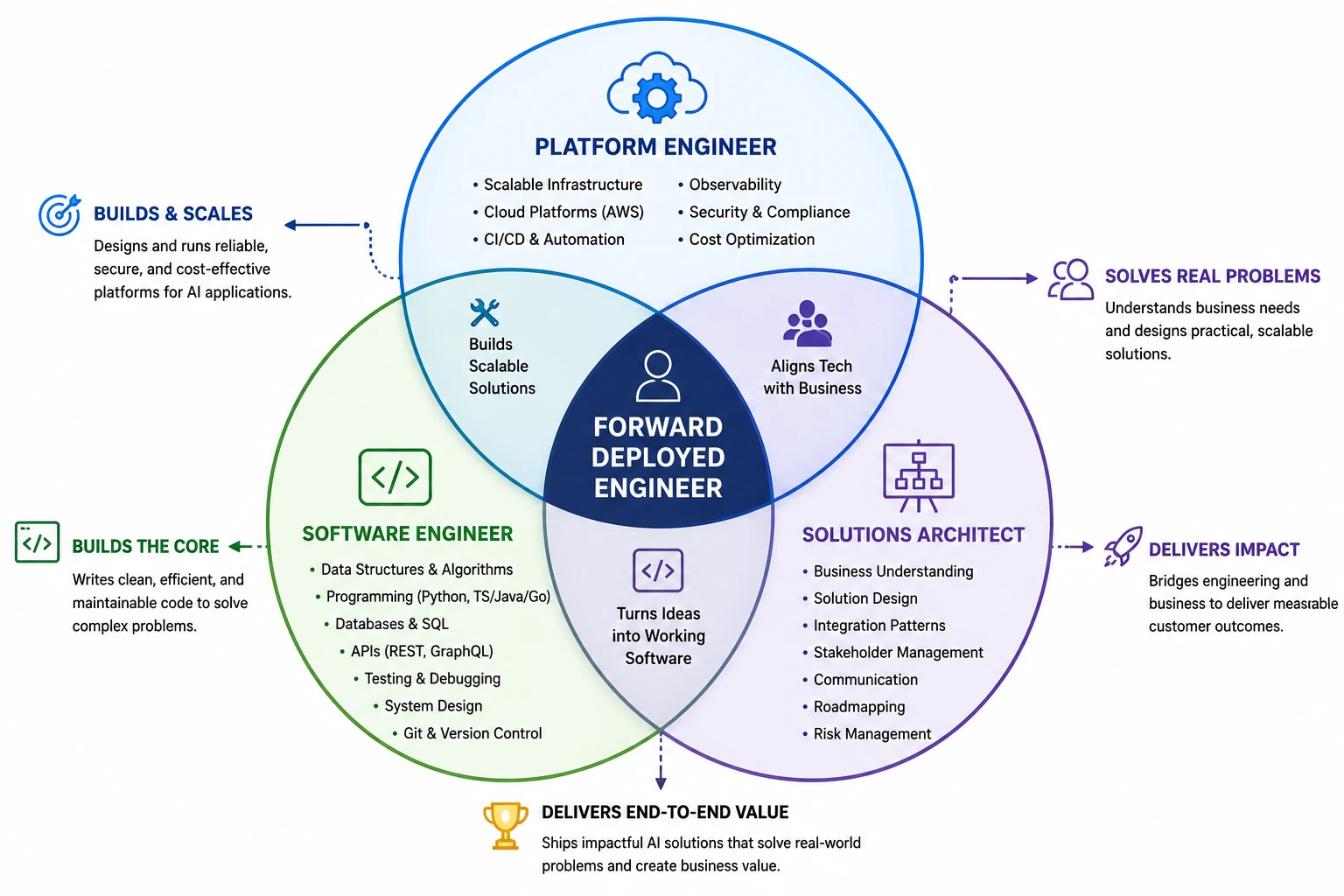
In fact, the clearest description of the role comes from Palantir. Palantir distinguishes a product engineer, who focuses on “one capability, many customers,” from an FDE, whose focus is “one customer, many capabilities.” Moreover, the company’s job listing adds that the role is similar to that of a startup CTO, where you work in small teams and take ownership of the end-to-end execution of high stakes projects.
First, the work runs through five phases:
- Discovery: Sitting with the client’s teams, mapping how work actually happens, finding where the value is
- Solution design: Scoping and prototyping against real data, not a requirements document
- Implementation: Writing code inside the client’s systems, integrating with legacy platforms and data pipelines
- Enablement: Training the client’s staff so they can operate what you built
- Iteration: Tuning until the results are measurable, then handing over
Why AI turned FDE into 2026’s most talked-about engineering job
The most useful way to understand the demand is as a two-sided knowledge gap.
The client’s engineers know the business: data schemas, compliance constraints, legacy architecture, the edge cases that break everything. On the other hand, the AI lab’s engineers know how models behave in production: prompting patterns, retrieval design, evaluation strategies, the failure modes that only appear at scale.
Neither side can ship alone. Consequently, a customer success manager can’t close that gap, and documentation can’t either. An embedded engineer can.
In May 2026, both frontier AI labs turned this logic into a business strategy within days of each other:
- OpenAI announced The Deployment Company, a majority-owned joint venture that raised over $4 billion from 19 investors led by TPG, and acquired applied-AI consultancy Tomoro for roughly 150 deployment engineers.
- Anthropic announced a $1.5 billion enterprise services venture backed by Blackstone, Hellman & Friedman, and Goldman Sachs. Blackstone President Jon Gray named the real bottleneck: not model quality, but the shortage of engineers who can deploy frontier AI fast. Anthropic CFO Krishna Rao echoed that point, saying, “Enterprise demand for Claude is significantly outpacing any single delivery model.”
One caveat worth keeping in mind is that while FDE demand is real, ordinary AI engineer roles will always outnumber FDE roles, since most companies need internal people to build and maintain AI systems. Treat FDE as a high-leverage niche, not the default path.
Forward deployed engineer vs solutions architect vs AI engineer
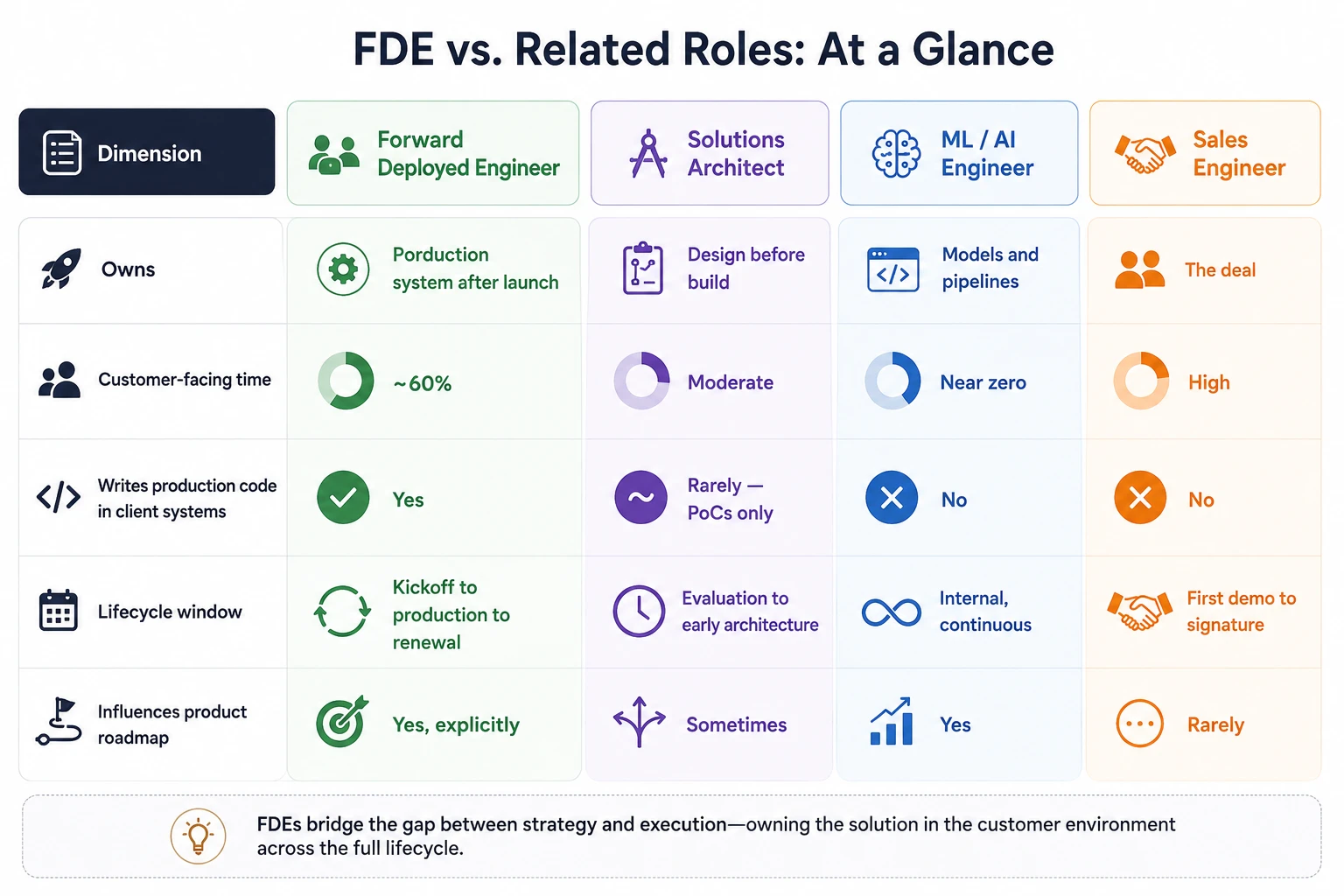
One distinction explains almost every other difference: who owns the system after it ships.
Forward deployed engineer salary: India and the US
Although figures below are reported ranges from third-party aggregators and industry sources as of mid-2026, they are not verified employer data. Nevertheless, they vary widely by source, which is itself worth knowing.
India (annual)
| Level | Reported range |
|---|---|
| 0–2 years | ₹18–28 LPA |
| 3–6 years | ₹28–55 LPA |
| Senior / global-remote | ₹55–90+ LPA |
| Bengaluru average (Glassdoor) | Meanwhile, ~₹17 LPA; 25th–75th percentile ₹11–36 LPA |
- Though it’s highly unlikely that anyone would be hiring for a FDE with almost 0 to no experience considering the enormous responsibilities.
United States (total compensation)
| Company / level | Reported range |
|---|---|
| Palantir FDSE | $171K–$295K, median ~$211K |
| OpenAI FDE base, San Francisco | ~$160K–$280K |
| Frontier lab, mid-level TC | ~$350K–$450K |
| Frontier lab, senior/staff TC | $500K–$600K+ |
One number explains most of the confusion in offer comparisons: at the top of the market, equity now makes up roughly 55–70% of total compensation, up from 35–45% in 2024. In short, base-salary listings systematically understate what a frontier-lab offer is worth and make offers hard to compare across companies.
Forward deployed engineer jobs: Who’s hiring in 2026
As enterprise AI adoption accelerates, demand for Forward Deployed Engineers has expanded rapidly. In addition, some of the most prominent employers hiring FDEs include:
| Company | What FDEs work on |
|---|---|
| OpenAI | In particular, enterprise deployments of frontier models, customer integrations, production AI systems |
| Anthropic | Furthermore, production Claude applications in customer systems, MCP servers, sub-agents, evaluation frameworks |
| Palantir | Next, deploying Foundry/Gotham at customer sites; titled Forward Deployed Software Engineer (FDSE) |
| Scale AI | In addition, production data integrations into Scale’s Data Engine; GenAI, Enterprise and Public Sector tracks |
| Cursor, Glean, Harvey | Consequently, embedded production AI workflows for enterprise customers, often founding-team roles |
| Databricks, Salesforce, Ramp | Similarly, platform-side FDE and Agentforce-style delivery roles, including India offices |
How to Become a Forward Deployed Engineer?
If you’re wondering how to become a forward deployed engineer, the path is less about earning a specific certification and more about building the ability to ship production systems for enterprise customers. Unlike traditional software engineering roles, FDEs combine strong coding skills with business understanding, customer communication, and AI deployment expertise.
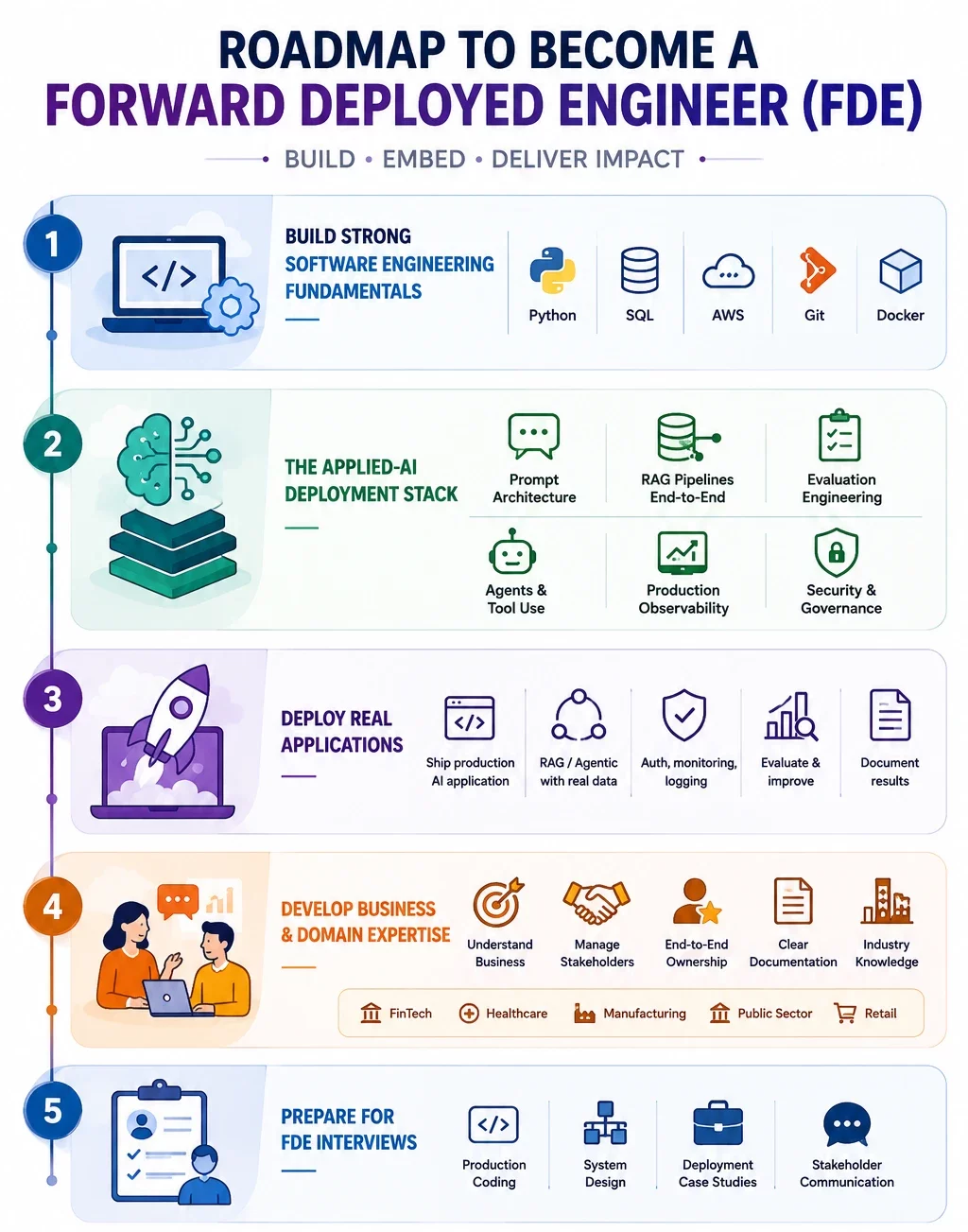
Step 1 – Build Strong Software Engineering Fundamentals
Python is non-negotiable, plus one of TypeScript, Java or Go. Advanced SQL. APIs, REST and GraphQL. Meanwhile, Docker and one major cloud, most commonly AWS. Git, testing, CI/CD basics. Enough system design to scope an MVP under real constraints.
Step 2 – The Applied-AI Deployment Stack
Go beyond notebooks and prototypes. Finally, learn how to build production-ready AI applications. This is what actually gets you hired in 2026:
- Prompt architecture: Learn the fundamentals of prompt engineering, including system prompts, structured outputs, and guardrails that hold up across thousands of production inputs, not one good demo.
- RAG pipelines end-to-end: Master complete RAG pipeline lifecycle. This includes document chunking strategy, embedding choice, vector databases such as Pinecone, Weaviate or pgvector, and reranking.
- Evaluation engineering: The current non-negotiable. Anthropic’s FDE specification explicitly asks for evaluation frameworks, and OpenAI’s own account of the John Deere deployment describes building custom evaluation systems to measure accuracy.
- Agents: Gain hands-on experience building agentic applications using frameworks such as LangGraph, LangChain, CrewAI, DSPy, MCP, and multi-step tool-use chains.
- Agentic SDLC: This is the newest, and now the most-expected, layer of the stack: using coding agents such as Claude Code or GitHub Copilot as part of your actual development workflow, not as autocomplete. That means spec-driven development, context engineering, and test-driven development with agents.
- Production observability: Learn agent observability to monitor AI applications after deployment. Track key metrics such as latency, token usage, error rates, and output drift to ensure your applications remain reliable over time.
- Security, governance and Responsible AI: Deploying inside a client VPC or on-premises, under GDPR, HIPAA or DPDP-style constraints, plus the Responsible AI layer that comes with it: bias and fairness checks, human review of high-stakes outputs, and audit trails for what the model decided and why
Step 3 – Deploy Real Applications
Knowing the technology is not enough. Companies want evidence that you can deploy AI successfully.
- Ship at least one production AI application instead of a notebook demo.
- Build a RAG pipeline or agentic workflow using messy, real-world data.
- Include authentication, monitoring, logging, and real users.
- Create an evaluation framework to measure hallucinations, regressions, and grounding failures.
- Document your evaluation results and the improvements you made.
- Wire up a real deployment pipeline (CI/CD) with a safe rollout strategy and a tested rollback path, not just a manual push to prod.
- Treat monitoring, evaluation and security as one continuous loop after launch, not a one-time checklist: watch for drift and rising error rates, re-run your eval suite against live traffic, and keep the Responsible AI review current as the client’s data and usage change.
A production deployment is one of the strongest signals you can put on your resume.
Step 4 – Develop Business & Domain Expertise
This is where most strong engineers fail the role: comfort with ambiguity and undefined specs, translating business problems into scoped technical plans and back again, stakeholder management including the ability to tell a client “no,” genuine end-to-end ownership, and documentation good enough that the client can run the system without you.
Companies value engineers who already understand the industries they serve. Consider specializing in areas such as: FinTech, Healthcare, Manufacturing, Public sector, Retail,
Domain knowledge helps you become productive much faster and makes you more credible during customer conversations.
Step 5 – Prepare for FDE Interviews
Practice production-focused coding, system design, deployment case studies, and stakeholder communication. Most interview loops test your ability to solve ambiguous customer problems as much as your technical knowledge.
Key takeaway: Step 2 skills, such as agentic SDLC practices with coding agents, RAG, evaluation engineering, agents, production observability, and Responsible AI, remain among the least saturated skill sets in enterprise AI. Step 4 skills, including stakeholder management, business translation, and end-to-end ownership, are what often separate a ₹30 LPA offer from a ₹90 LPA offer.
Should you become an FDE? The honest trade-offs
The upside. Pay above comparable engineering and solutions roles. A rare combination of shipping experience and customer experience. Unusually strong exits into product, founding roles and engineering leadership. Business impact you can point at. Real variety.
The risks, stated plainly.
- Burnout. You carry pressure from the client and your own company at once, with constant context switching and heavy travel. The role is always “on.”
- The custom-work trap. If your employer has no path from FDE into product, platform or leadership, the job can decay into permanent firefighting on bespoke code with no durable career upside.
- Sales-engineer drift. Some companies frame FDEs as advanced pre-sales. If you never commit code to the core product, your technical depth stalls.
Two questions to ask in the interview: Do FDEs here contribute to the core product, and where did the last three FDEs go internally? The answers tell you whether the role expands your options or traps you.
Conclusion
The FDE boom isn’t really about a job title. It’s about a structural gap between what models can already do and what enterprises can operationalise, and the pay reflects how few people can close it. Even if you never take the title, the deployment stack behind it is the most transferable thing an AI engineer can own right now.
Start with one production system, one real user, and one honest evaluation suite. That’s the whole entry ticket.
Frequently Asked Questions
Q1. What does FDE stand for in engineering?
A. FDE stands for forward deployed engineer. Borrowed from military terminology, it describes an engineer stationed directly within a customer’s environment to solve problems rather than at company headquarters.
Q2. Is forward deployed engineer a good career in 2026?
A. It is excellent for those who enjoy customer interaction and ambiguity. However, it is a poor fit if you require deep focus or wish to avoid travel.
Q3. Do forward deployed engineers write production code?
A. Yes. Unlike solutions architects who build proofs of concept, FDEs write and maintain production code that runs indefinitely within the customer’s actual systems.
Q4. How much travel does an FDE role involve?
A. Typically 20–50%. Palantir expects around 25% of time on-site with customers; some AI startups and OpenAI FDE postings have listed up to 50%.
Q5. Forward deployed engineer vs AI engineer, which has more jobs?
A. AI engineer roles are more numerous. While FDE roles are highly visible, most companies prioritize internal engineers to build, test, and maintain AI systems for long-term durability.
Data Analyst with over 2 years of experience in leveraging data insights to drive informed decisions. Passionate about solving complex problems and exploring new trends in analytics. When not diving deep into data, I enjoy playing chess, singing, and writing shayari.