India’s largest private-sector lender, HDFC Bank, plans to become an AI-first institution within the next twenty-four months. The bank will weave artificial intelligence into every product, process, and policy. The three pillars that are guiding their work are conversational customer experience, real-time risk management, and sharper internal productivity. The effort matters because the bank serves over 120 million customers, operates across thousands of branches, and processes millions of transactions every day. This case study explains how HDFC is turning that scale into an advantage rather than a constraint.
Table of contents
- Background of HDFC Bank AI Journey
- Customer Experience: From Scripted Replies to Generative Conversations
- Risk Management: An Always-On Digital Shield
- Internal Operations: AI as a Colleague, Not a Competitor
- Marketing and Personalisation: Turning Data into Relevance
- Competitive Context
- Conclusion
- Frequently Asked Questions
Background of HDFC Bank AI Journey
HDFC Bank began its AI journey in 2017 with EVA, a rule-based chatbot that answered simple questions. It was at a time when multilingual bots were put out on social networking sites like WhatsApp, Google Assistant, and Facebook Messenger. These early wins convinced leaders that AI could deepen customer intimacy, not just cut costs. HDFC Bank’s CISO Sameer Ratolikar described the bank’s push to become an ‘AI-first enterprise within the next two years,’ with intelligent systems being rolled out across cybersecurity and other operations.
Customer Experience: From Scripted Replies to Generative Conversations
Instead of scrapping like earlier bots, the bank layered generative AI on top. New agents can interpret open-ended questions such as, “How should I finance my daughter’s education abroad?” They return nuanced, contextual answers. A policy-checking layer reviews every response before it reaches the customer. Human agents still handle complex or sensitive cases, yet the average time for routine queries has fallen from eight minutes to under ninety seconds.

HDFC Bank has launched a GenAI Academy to train employees in generative AI and is rolling out over 15 high-impact GenAI programs aimed at boosting productivity and improving customer service.
Risk Management: An Always-On Digital Shield
Fraud patterns evolve weekly. HDFC counters them with a streaming analytics platform that scores every card swipe, UPI payment, and net-banking login often in under 200 milliseconds. The platform blends traditional rules with deep learning models. It detects sudden bursts of micro-transactions or logins from devices with odd behaviour. The false-positive rate has dropped by one-third since the upgrade.

HDFC Bank is using AI to strengthen its cybersecurity operations, with automated systems helping to monitor and triage alerts so human analysts can focus on the most critical threats. The bank’s CISO has said that AI bots are now handling much of the routine SOC workload.
Internal Operations: AI as a Colleague, Not a Competitor
HDFC Bank has invested heavily in strengthening its data foundation. The bank migrated to the Databricks Data Intelligence Platform on Azure, creating a unified data lake that supports critical use cases such as fraud detection, credit-risk analytics, and real-time insights. This platform has allowed teams to manage large volumes of structured and unstructured data with stronger governance and security controls.
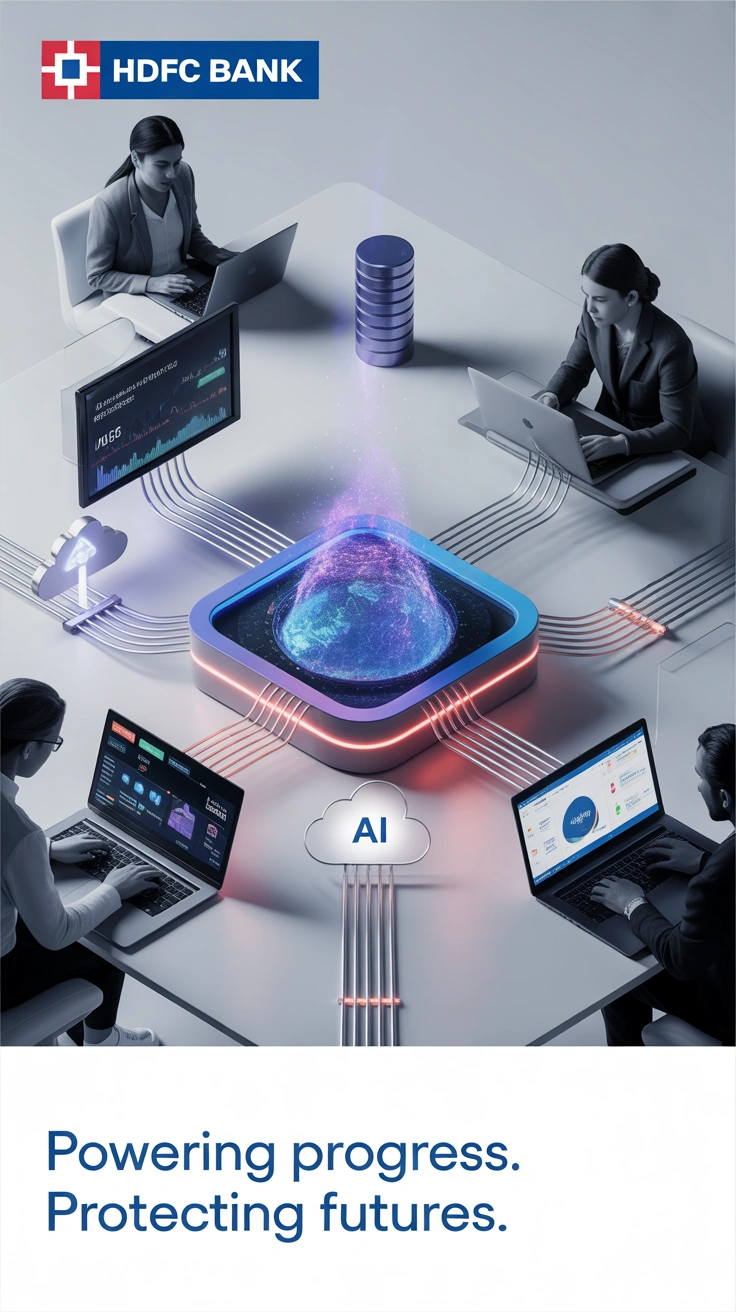
By consolidating data pipelines and using pre-built components for analytics, the bank can deliver new AI and machine-learning projects faster than before. Tasks like reporting, risk modeling, and analytics that once took months can now be tested and rolled out in far shorter cycles, improving operational speed and decision-making.
Marketing and Personalisation: Turning Data into Relevance
HDFC Bank has developed a Next Best Actions system to personalize customer engagement. The platform analyzes transaction and digital behavior data to recommend relevant offers, such as credit card upgrades, loans, or deposit options. These suggestions are delivered through preferred digital channels to improve relevance and response.
Generative AI now drafts multilingual creative at scale. Marketers feed in a brief and receive three emotionally resonant variants in Hindi, Tamil, and English. Human editors polish the final copy, leading to production time falling from days to hours.
Competitive Context
State Bank of India, ICICI Bank, and Axis Bank all run chatbots and fraud engines. Industry analysts note, however, that HDFC links every model to one customer ID and a single governance layer. JPMorgan outspends HDFC on technology, yet HDFC Bank’s partnerships with cloud-native startups let it move at start-up speed while keeping the control of an enterprise-grade level.
Lessons for Other Banks
Here are a few things other banks, which haven’t adopted AI in their workflows, can learn from this move:
- Start with culture, not code: The GenAI Academy and internal guides socialise new tools before they go live. This allows easy adoption and troubleshooting.
- Build a reusable backbone: A shared data lake, feature store, and model registry shrinks duplicate work and speeds compliance checks. This helps prevent bottlenecks due to resources.
- Keep humans in the loop: Every AI output carries a confidence score; low-confidence cases route to staff. This allows humans to supervise cases in which AI isn’t confident, thereby reducing the chances of mistakes.
- Measure what matters: Customer-effort score, fraud-loss rate, and employee-productivity hours steer every new use case. This keeps the focus on the metrics that matter, over noise.
Conclusion
HDFC Bank shows how a large, regulated institution that is already at the top of its game can adopt generative AI without sacrificing trust or control. Early investment in governance, upskilling, and partnerships created a platform for rapid iteration. If the next twelve months unfold as planned, HDFC will offer a clear playbook for incumbent banks that want to compete with digital natives. HDFC Bank’s early adoption and continued development of its traditional infrastructure, using AI, has provided a clear blueprint for the doubters of the technology.
Frequently Asked Questions
Q1. What does “AI-first” mean at HDFC Bank?
A. It means embedding AI into every product, process, and decision so that 80 percent of customer interactions involve AI by 2025.
Q2. How does AI improve customer service?
A. Generative chatbots now answer questions in context, cutting response times to under ninety seconds. The GenAI Academy trains 35,000 staff to support the new tools.
Q3. Which AI tools manage risk?
A. Real-time analytics score every transaction and detect anomalies with deep learning. Reinforcement-learning agents triage cybersecurity alerts.
Q4. How does AI help inside the bank?
A. Copilots draft reports, extract data from loan documents, and answer HR questions. A central data backbone speeds every new model.
Q5. What can other banks learn?
A. Focus on culture first, create reusable data and model infrastructure, keep humans in the loop, and track clear impact metrics.
I specialize in reviewing and refining AI-driven research, technical documentation, and content related to emerging AI technologies. My experience spans AI model training, data analysis, and information retrieval, allowing me to craft content that is both technically accurate and accessible.