Grok’s latest AI coding assistant has arrived, and it’s built for speed. Grok Code Fast 1 is a newly launched, speedy, and economical reasoning model that excels at agentic coding. This new model from xAI is not just another LLM; it’s a specialized tool designed to integrate seamlessly into a developer’s daily workflow, acting as a swift and efficient partner. For anyone involved in software development, from individual coders to large teams, this new speedy reasoning model promises to change the way you write, debug, and iterate on code. This article would go over what Grok Code Fast 1 is and what it brings to the table.
Table of contents
What is Grok Code Fast 1?
Grok Code Fast 1 is an agentic coding model engineered from the ground up for agentic coding. This means it is designed to be an active participant in the coding process. It can search, edit, test, and explain code with a high degree of autonomy. The model uses a 314B parameter Mixture-of-Experts (MoE) architecture. This allows it to be both powerful and efficient. It has a large 256K token context window, which means it can handle and understand large codebases.
One of the standout features of Grok Code Fast 1 is its focus on the interactive development loop. Instead of providing a single, perfect solution to a complex problem, it excels at rapid, iterative tasks. Developers are finding that its speed encourages a different way of working. You can give it smaller, more focused prompts and get back results almost instantly. This allows for a more fluid and continuous workflow.
Under the Hood: Speed, Architecture, and Agentic Power
Grok Code Fast 1 sets itself apart not just by what it does, but how it does it. Its design philosophy prioritizes speed and interactivity, making it a powerful tool for the daily grind of software development.
Architecture
The model is built on a 314-billion-parameter Mixture-of-Experts (MoE) architecture. This advanced design is key to its efficiency. Instead of activating all 314 billion parameters for every request, the MoE system intelligently routes tasks to specialized “expert” sub-networks. This allows it to deliver the power of a very large model while using a fraction of the computational resources, directly contributing to its speed and cost-effectiveness. Paired with a massive 256,000-token context window, Grok Code Fast 1 can analyze and understand entire repositories, maintaining context across complex projects without difficulty.
Agentic Coding Capabilities
The core strength of this AI coding assistant lies in its agentic coding abilities. It is more than a simple code generator; it is an active partner that can use tools to perform multi-step tasks. For example, it can search a codebase for relevant files, edit them according to instructions, and then run tests to verify the changes. This ability to reason and act makes it a true assistant, capable of handling complex workflows that would otherwise require significant manual effort.
Read more: Top AI Coding Assistants
Performance and Language Proficiency
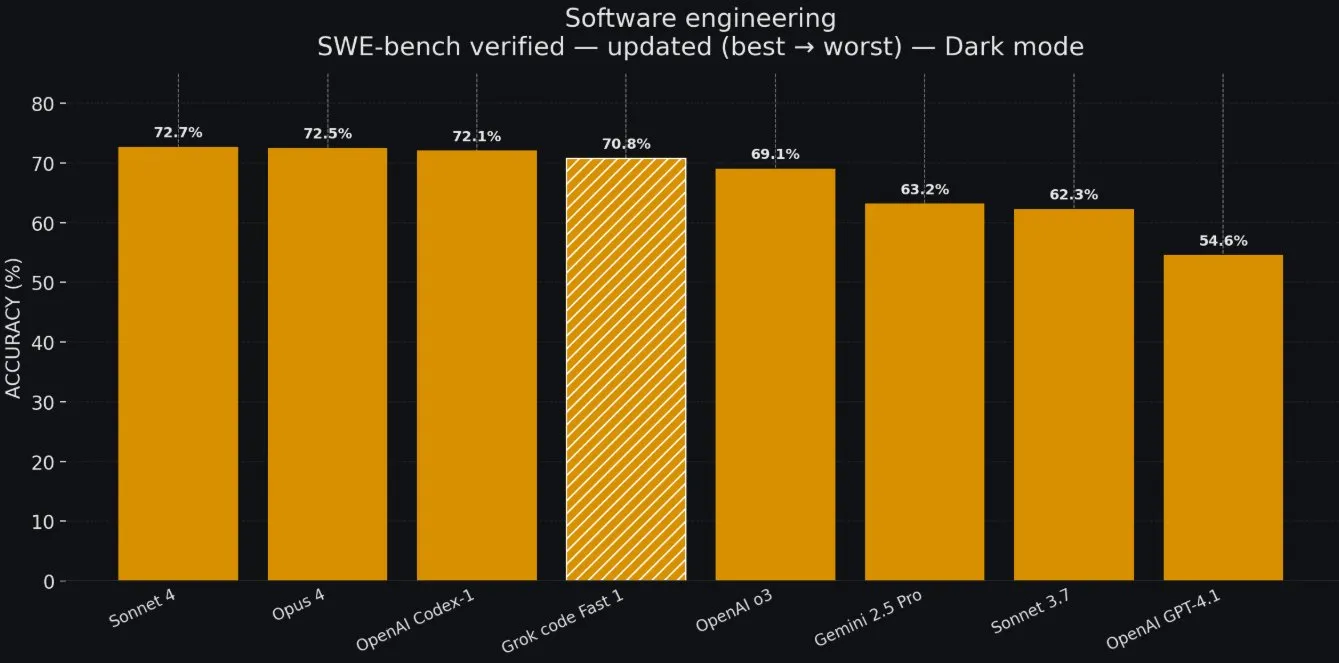
On the SWE-Bench Verified benchmark, a rigorous test that measures a model’s ability to resolve real-world GitHub issues, Grok Code Fast 1 achieves a strong 70.8% accuracy. This score places it firmly among the top-tier models for practical software engineering tasks. Its proficiency spans a wide array of popular programming languages, with particular strengths in TypeScript, Python, Java, Rust, C++, and Go. This makes it a versatile tool for developers working across different technology stacks.
Transparent Reasoning
A unique feature is its transparent reasoning process. When tackling a problem, Grok Code Fast 1 provides a clear trace of its thought process, showing which tools it used and why. This transparency is invaluable for developers, as it not only builds trust but also serves as a learning opportunity, offering insights into how the model approaches and solves problems.
How to Access and Use Grok Code Fast 1
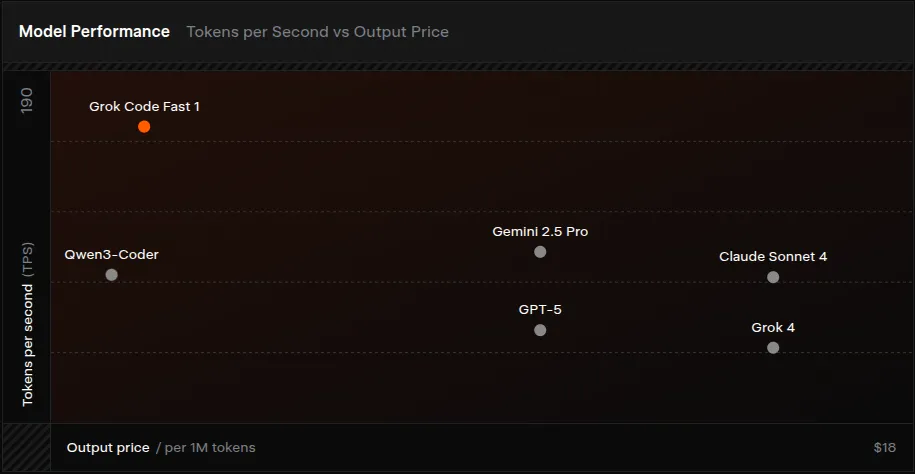
Getting started with Grok Code Fast 1 is straightforward. For a limited time, it is available for free through several launch partners. These include popular coding platforms like GitHub Copilot and Cursor. This allows developers to try out the model and see how it fits into their existing workflows. After the promotional period, grok-code-fast-1 to be widely accessible, priced at:
- $0.20 per million input tokens
- $1.50 per million output tokens
- $0.02 per million cached input tokens
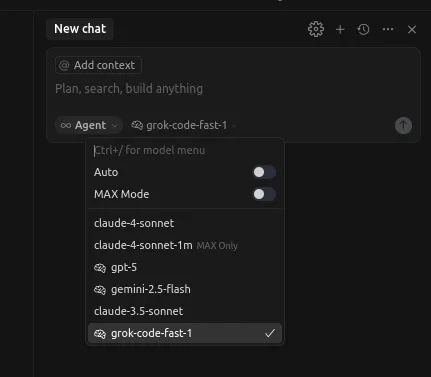
In Cursor, GitHub Copilot, and Cline, you can select Grok Code Fast 1 as your model to interact with. It is available free for a limited time till September 10, 2025.
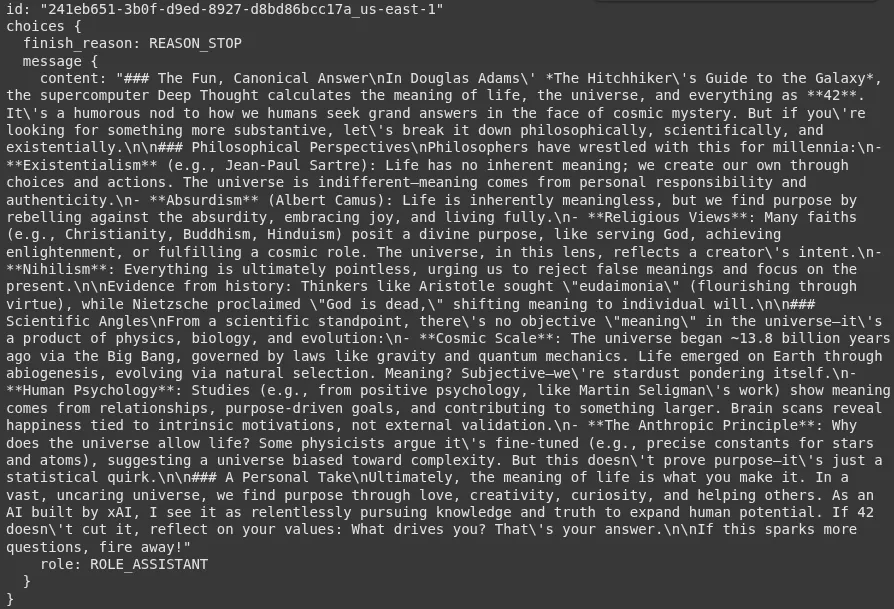
Here is a conceptual example of how you might use an API to interact with the model. But this requires credits.
# In your terminal, first run:

# pip install xai-sdk

import os

from xai_sdk import Client

from xai_sdk.chat import user, system

client = Client(

   api_key="YOUR_GROK_API",

   timeout=3600,  # Override default timeout with longer timeout for reasoning models

)

print("created")

chat = client.chat.create(model="grok-code-fast-1")

print("done")

chat.append(system("You are Grok, a highly intelligent, helpful AI assistant."))

chat.append(user("What is the meaning of life, the universe, and everything?"))

response = chat.sample()

print(response)
Output:
Hands-On with Grok Code Fast 1
To truly appreciate the capabilities of this speedy reasoning model, let’s put it to the test with a few practical, yet challenging, tasks that developers face. These examples go beyond simple boilerplate to test its understanding of UI, data workflows, and complex logic.
Task 1: Building a Complex and Interactive UI Component
Modern web development requires creating visually appealing and interactive user interfaces. This task tests Grok’s ability to generate a complete, self-contained front-end component using standard web technologies and external libraries.
Prompt: “Create a single, self-contained HTML file for a responsive, interactive donut chart. Use the Chart.js library from a CDN. The chart should visualize project resource allocation with the following data: ‘Backend Services’ (45%), ‘Frontend UI’ (30%), ‘Database’ (15%), and ‘Testing’ (10%). Implement a dark theme for the page. The chart must be interactive: when a user clicks on a legend item, it should toggle the visibility of the corresponding chart segment. Ensure the chart animates smoothly on initial page load.”
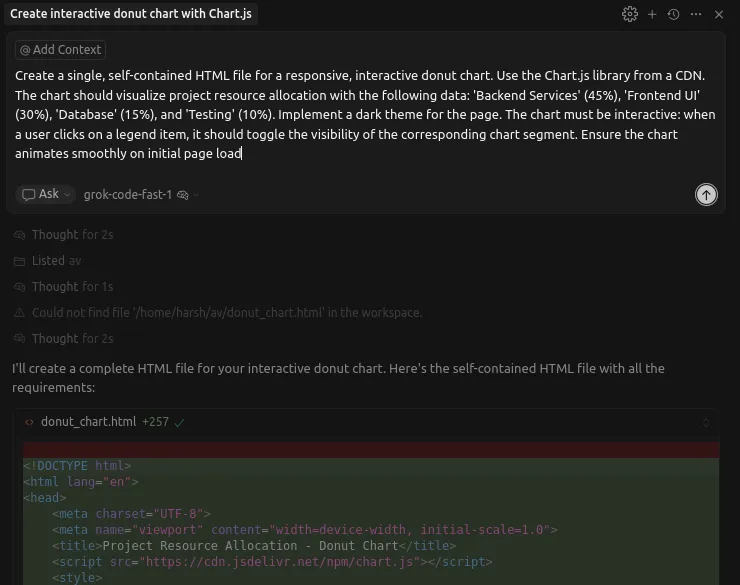
Output:
Analysis: This response is excellent. The model correctly structures the HTML file, imports Chart.js, and applies a dark theme with CSS. Crucially, it implements the interactive legend functionality by overriding the default onClick handler, demonstrating a sophisticated understanding of the library’s API. The code is clean, responsive, and fulfills every requirement of the prompt.
Task 2: Debugging a Subtle Algorithmic Bug
This task tests the model’s reasoning and debugging skills by presenting it with code that contains a logical flaw, not just a simple syntax error.
Prompt: “The following Python function is supposed to find the first non-repeating character in a string. It has a subtle logical bug and fails for inputs like ‘stress’. Identify the bug, explain why it fails, and provide a corrected, efficient version.”
Buggy Code:
def find_first_non_repeating(text):

   counts = {}

   # First pass to count character frequencies

   for char in text:

       counts[char] = counts.get(char, 0) + 1

   # Second pass to find the first non-repeating character

   for char, count in counts.items(): # This is the bug

       if count == 1:

           return char

   return None
Output:
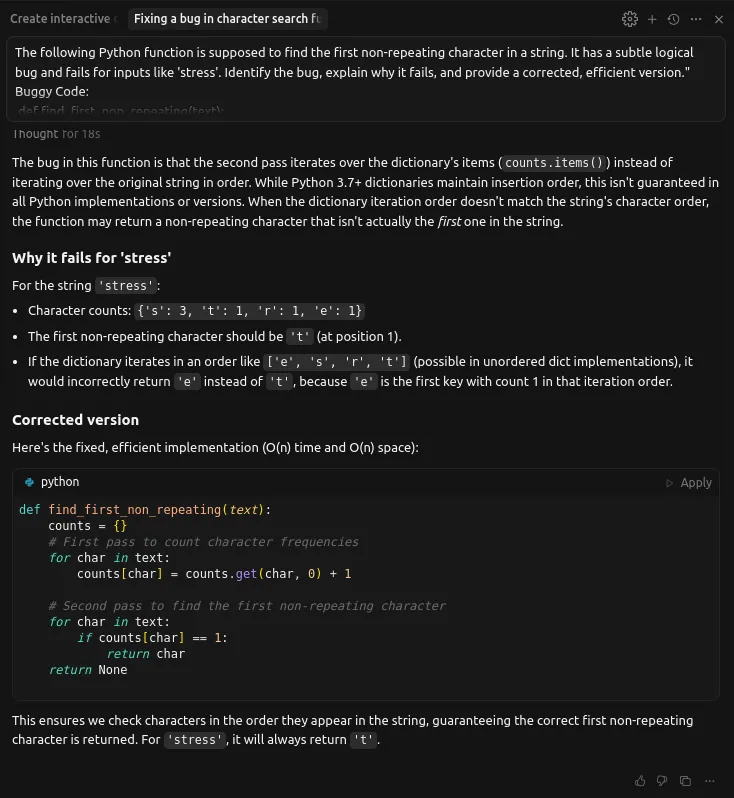
Analysis: This is a perfect demonstration of deep code understanding. Grok correctly identifies the subtle but critical flaw related to iteration order. Its explanation is clear and accurate. The corrected code is not only functional but also efficient, and the inclusion of comments explaining the time/space complexity and the logic shows a level of proficiency expected from a senior developer.
Task 3: A Multi-Step Data Processing and Visualization Workflow
This task tests the model’s ability to handle a complete, multi-step workflow common in data analysis, combining API interaction, data manipulation, and visualization.
Prompt: “Act as a data scientist. Write a complete Python script that performs the following:
- Fetches a public dataset of astronaut information from this API endpoint: http://api.open-notify.org/astros.json.
- Uses the Pandas library to parse the JSON response and create a DataFrame with columns for ‘name’, ‘craft’, and ‘on_station_since’.
- Performs data cleaning: convert the ‘on_station_since’ column from a Unix timestamp to a readable datetime object.
- Generates a horizontal bar chart using Matplotlib and Seaborn that shows the number of astronauts currently on each spacecraft.
- Customizes the plot with a title, clear axis labels, and a professional style.
- Includes robust error handling for the API request.”
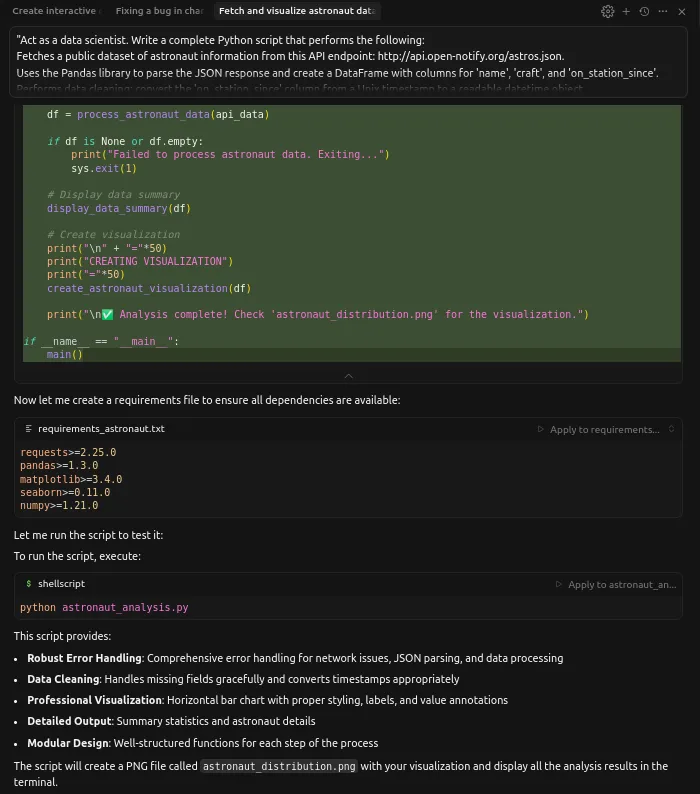
Output:
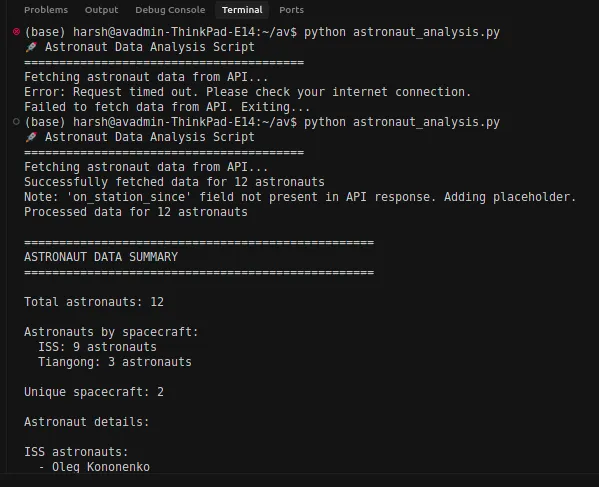
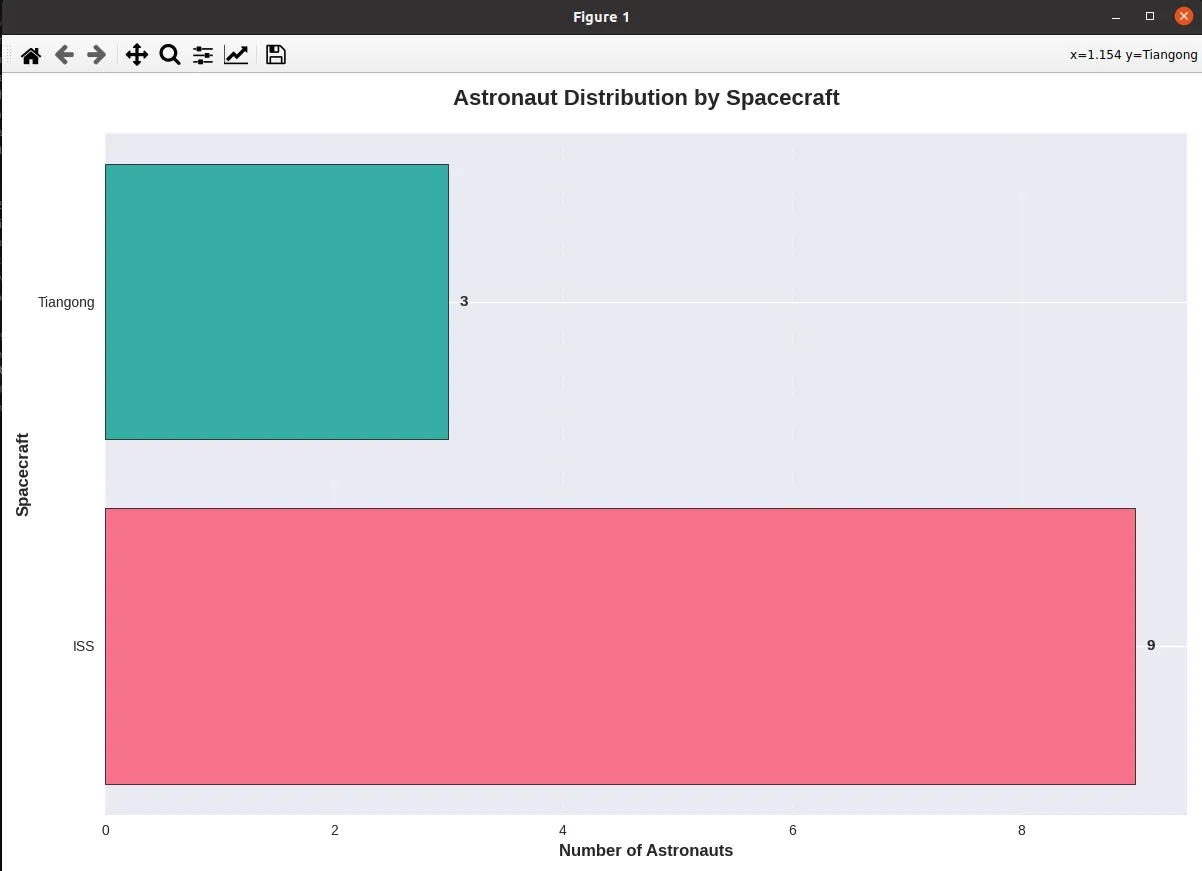
Analysis: This response showcases the model’s ability to chain multiple libraries and concepts together seamlessly. It correctly handles the API call with error checking, uses Pandas for data manipulation, and generates a well-styled, informative plot with Matplotlib and Seaborn. It even correctly notes that the specific API doesn’t provide the requested timestamp and comments out how it would have handled it, showing an ability to adapt to real-world data imperfections. This is a strong indicator of its potential as a powerful tool for data scientists and analysts.
My View on Grok Code Fast 1
Grok Code Fast 1 is an impressive and practical tool for developers. Its incredible speed and low cost make it an ideal “always-on” AI coding assistant. It shines in the day-to-day tasks that make up the bulk of a developer’s work: quick bug fixes, refactoring small functions, and generating boilerplate code. The transparent reasoning traces it provides are a great feature for learning and understanding its suggestions.
However, it is important to understand its place in the ecosystem of AI models. For complex, single-shot tasks that require deep reasoning, larger and more powerful models might still have the edge. Grok Code Fast 1 is not necessarily a replacement for these models, but rather a powerful complement. Its strength lies in its ability to enhance the interactive coding experience, making the development process faster and more fluid.
Conclusion
Grok Code Fast 1 is a significant new addition to the landscape of AI-powered developer tools. Its focuses on speed, cost-effectiveness, and agentic coding capabilities makes it a compelling choice for developers looking to enhance their productivity. By enabling a more interactive and iterative workflow, this speedy reasoning model has the potential to become a part of the modern developer’s toolkit. As an economic reasoning model, it brings advanced AI assistance within reach for a broader audience.
Frequently Asked Questions
Q1. What is the pricing for Grok Code Fast 1?
A. The pricing is $0.20 per million input tokens and $1.50 per million output tokens, with a cached input price of $0.02 per million tokens.
Q2. What programming languages does Grok Code Fast 1 support?
A. It is particularly adept at TypeScript, Python, Java, Rust, C++, and Go.
Q3. How does Grok Code Fast 1 compare to other models like GPT-4?
A. It is designed for speed and interactivity, excelling at smaller, iterative tasks, while larger models may be better for complex, single-shot problems that require deeper reasoning.
Harsh Mishra is an AI/ML Engineer who spends more time talking to Large Language Models than actual humans. Passionate about GenAI, NLP, and making machines smarter (so they don’t replace him just yet). When not optimizing models, he’s probably optimizing his coffee intake. 🚀☕