With ChatGPT’s latest model taking the world by storm, you might be wondering about the old guard: Nano Banana Pro. Giving the taste of professional grade image generation and editing to all users, Nano Banana is THE tool people reach out to, for AI-image generation.
But does this still hold true? Will this be the case in the future? We’ll find out in this article, where we put to test the latest iterations of ChatGPT Image and Nano Banana across challenging tasks, to see which one fares well.
Table of contents
What is GPT Image 1.5?
ChatGPT Image 1.5 is the latest image generation model by OpenAI, built to turn ideas into visuals with speed and precision. Whether someone is creating from a blank prompt or editing an existing photo, the model delivers results that closely match the intended vision. It supports precise edits while preserving fine details and generates images up to 4x faster than previous versions.
The model comes with a new Images experience inside ChatGPT, that enables effortless creation and refinement of images.
What is Nano-Banana Pro?
Nano Banana Pro brings a major upgrade over the original Nano Banana, adding advanced text rendering for clear on-image text, precise editing controls for lighting, camera angle and aspect ratio, crisp 2K resolution outputs, improved world knowledge for accurate diagrams and infographics, and the ability to combine even more photos seamlessly. It takes everything the base model was good at and elevates it for professional, high-quality creative work.
Read more: Nano Banana Pro
Showdown: Let’s Make Some Images
These image generation models are advanced to begin with. Testing how well they make logos and plushies, would be child’s play for them, and wouldn’t be a good test of their enhanced capabilities.
Therefore, I’d be testing these on the following complex tasks:
Task 1: Multi-Step Image Editing With State Preservation
What this tests: Whether the model can preserve scene identity, lighting coherence, and object placement across multiple edits. Most models degrade or “reset” the image when edits stack.
I used the following image as an input:
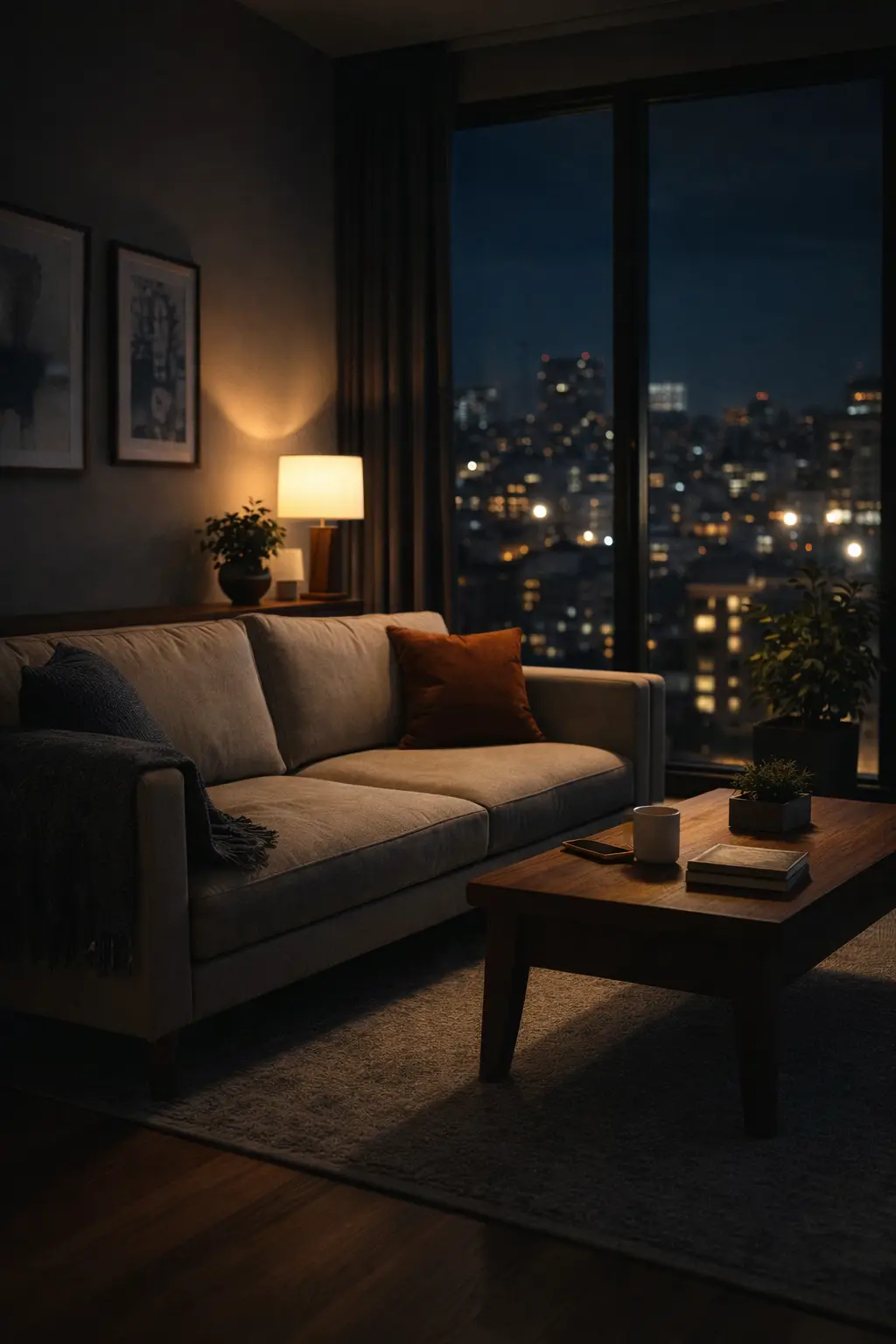
Now I’d be progressively making edits on it, and would judge how well the model preserves the image’s integrity.
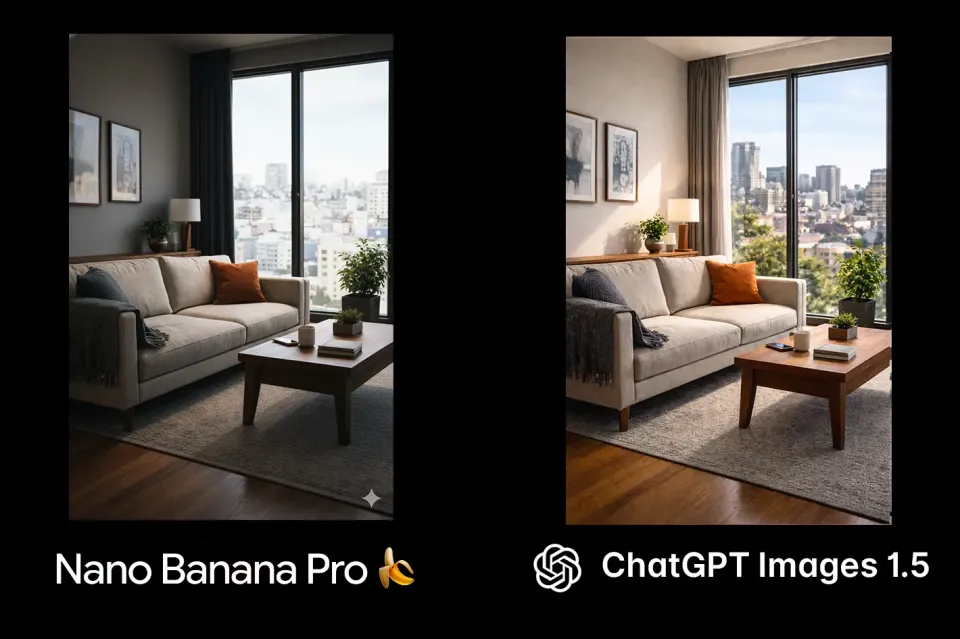
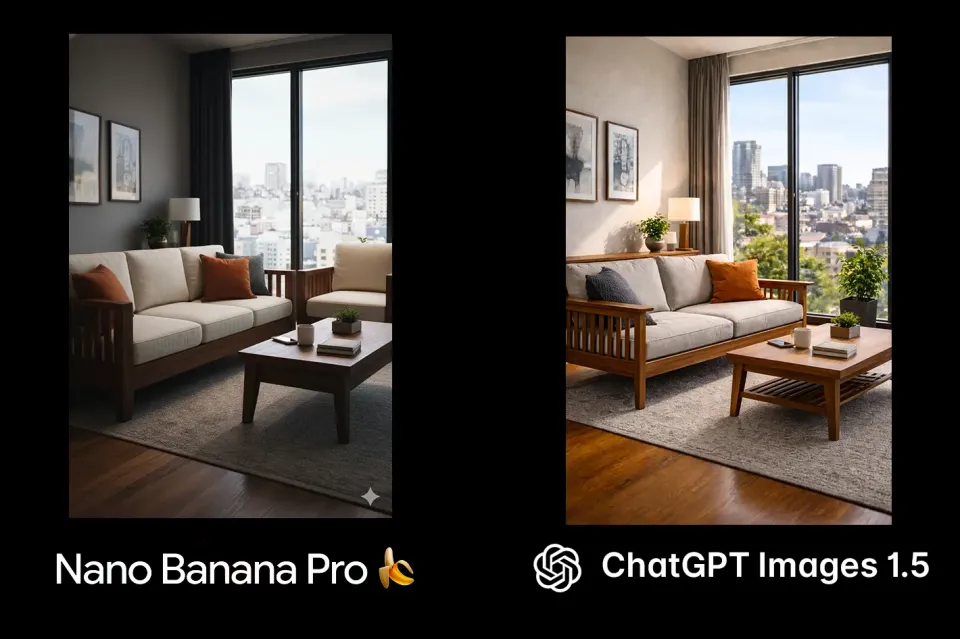
Change the time of day from Night to Day.
Replace the sofa with a Wooden sofa set.
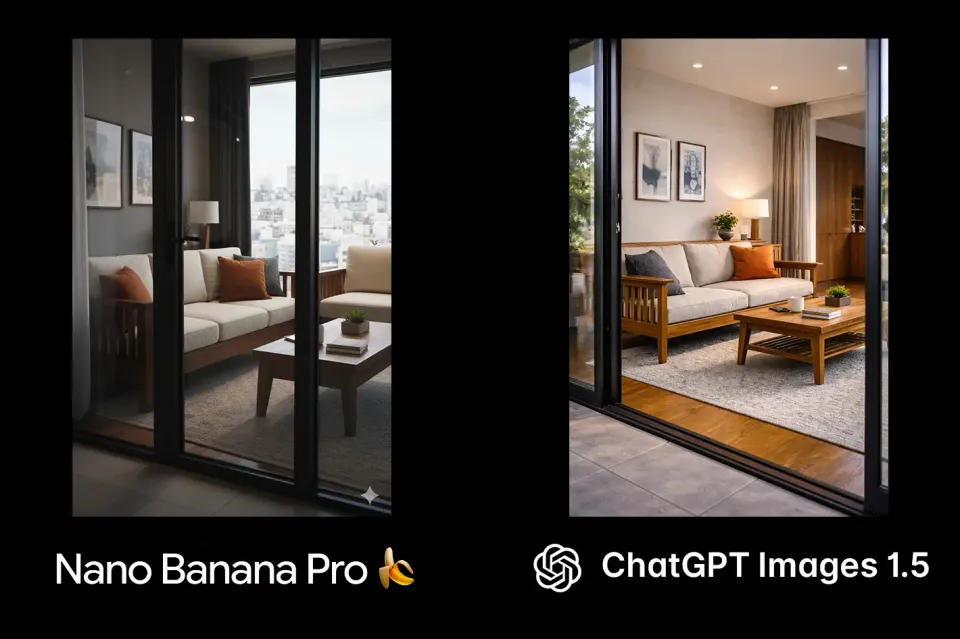
Adjust the camera angle to the perspective from the open space outside. From the glass doors visible in the image looking inside the room.
Observation:
Nano Banana Pro produced better outputs as compared to ChatGPT Image 1.5. This is highlighted by the following mistakes in the ChatGPT response images:
- In changing from night to day, the backdrop of buildings got altered from the original.
- When replacing the sofa with a Wooden sofa set, the center table’s structure got changed.
Both the models failed in producing a half-way convincing image in the last task.
Here’s the fun part: The input image was made by ChatGPT Image itself! But still it ended up underperforming in the tasks.
Task 2: Dense Instruction Following in a Single Prompt
What this tests: Prompt obedience under constraint, text rendering accuracy, and compositional planning. Models often get one or two details right and ignore the rest.
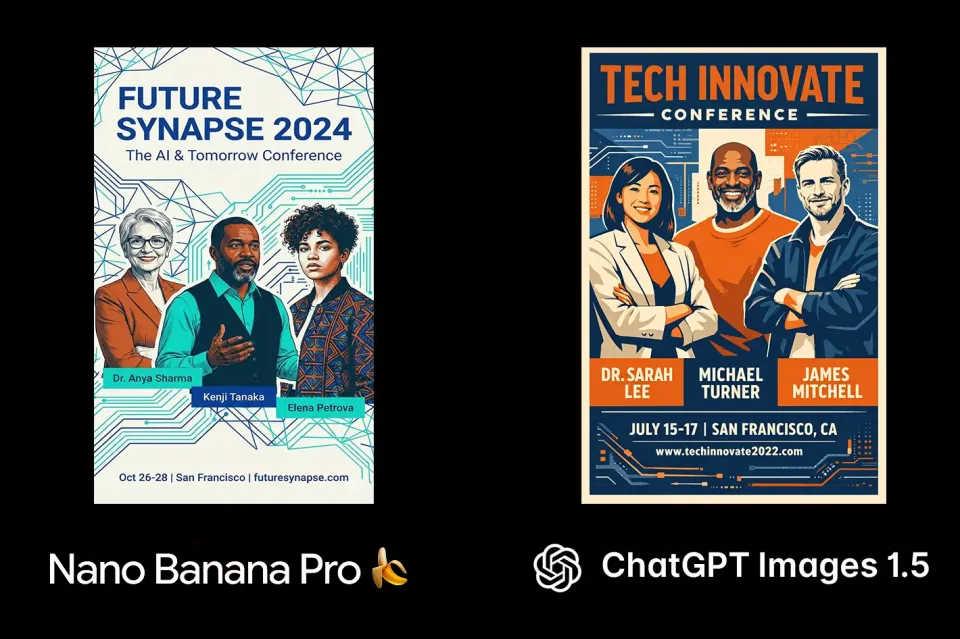
Generate a poster for a tech conference with:
1. Three speakers, each with distinct clothing, age, and ethnicity
2. Accurate name placement under each person
3. A specific color palette limited to four colors
4. A background that subtly references AI without using obvious symbols like robots or brains
Response:
Observation:
Where Nano Banana Pro made a poster that could be used for promoting a tech conference, ChatGPT Image’s output looks more like a beginner’s effort at Photoshop.
Task 3: Technical Diagram With Real-World Accuracy
What this tests: World knowledge, diagram logic, spatial reasoning, and legible text. This is where “pretty” models fail hard if they don’t actually understand structure.
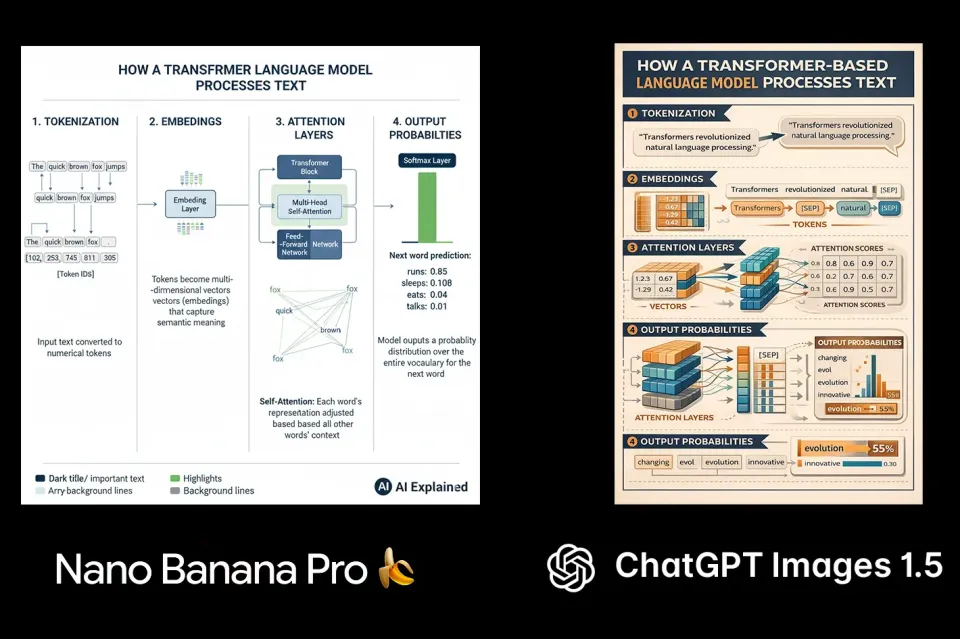
Create a labeled infographic explaining how a transformer-based language model processes text, including:
1. Tokenization
2. Attention layers
3. Embeddings
4. Output probabilities
All labels must be readable and placed correctly.
Response:
Observation:
Both the infographics had their fair share of flaws. Nano Banana Pro was still comparatively better. The mistakes were far and few, the visuals were on point, and there was a good mix of text in it. This made it easier to go through. ChatGPT Image 1.5, took the purely visual route. But considering the redundant step (4th one) and unexplained visuals, it’d be hard for one to wrap their head around what was shared.
Task 4: Style Consistency Across Multiple Images
What this tests: Character identity persistence and stylistic continuity. This is one of the hardest problems in image generation right now.
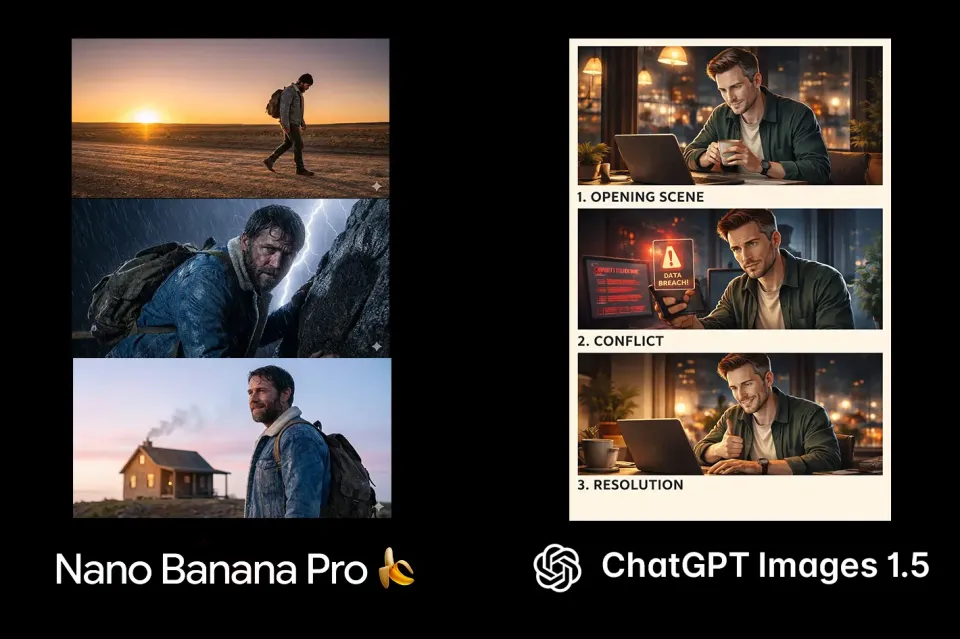
Generate a three-image storyboard for a short film:
Frame 1: Opening scene
Frame 2: Conflict
Frame 3: Resolution
The same character must appear in all three frames with consistent facial features, clothing, and proportions, while lighting and camera angles change.
Response:
Observation:
Here’s what a Storyboard means:
- a sequence of drawings, typically with some directions and dialogue, representing the shots planned for a film or television production.
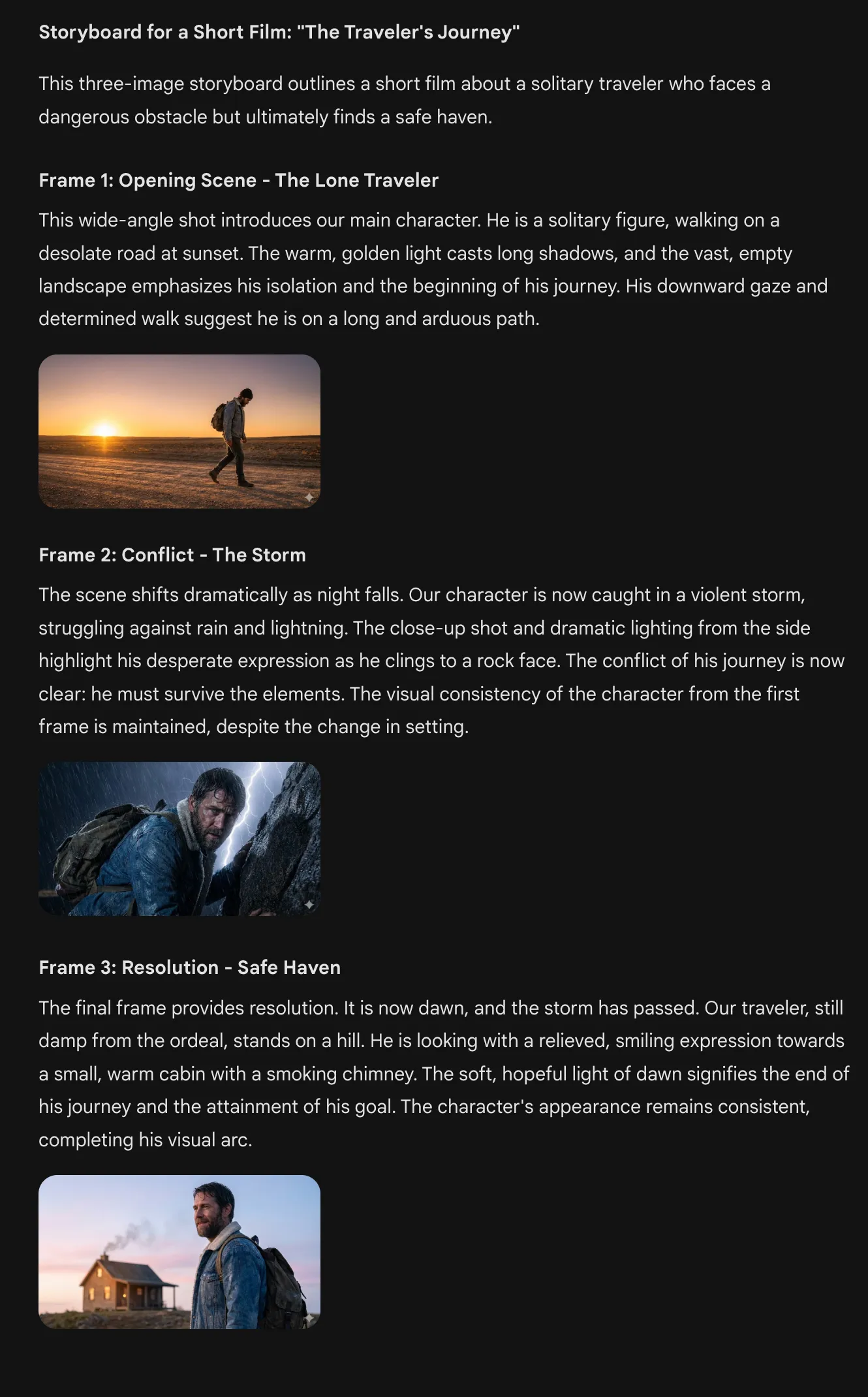
When I had asked for a storyboard, I wanted some direction either implicitly in the image or supplemented with it. The ChatGPT Image 1.5 response crammed everything in a single image, which in of itself was bland.
Nano Banana Pro not only provided multiple images that show a direction but further added text, which would justify the transition across the images. Very well made response.
Task 5: Photorealism vs. Art Direction Tradeoff
What this tests: Fine-detail rendering, text clarity, material realism, and the ability to balance artistic lighting with commercial accuracy.
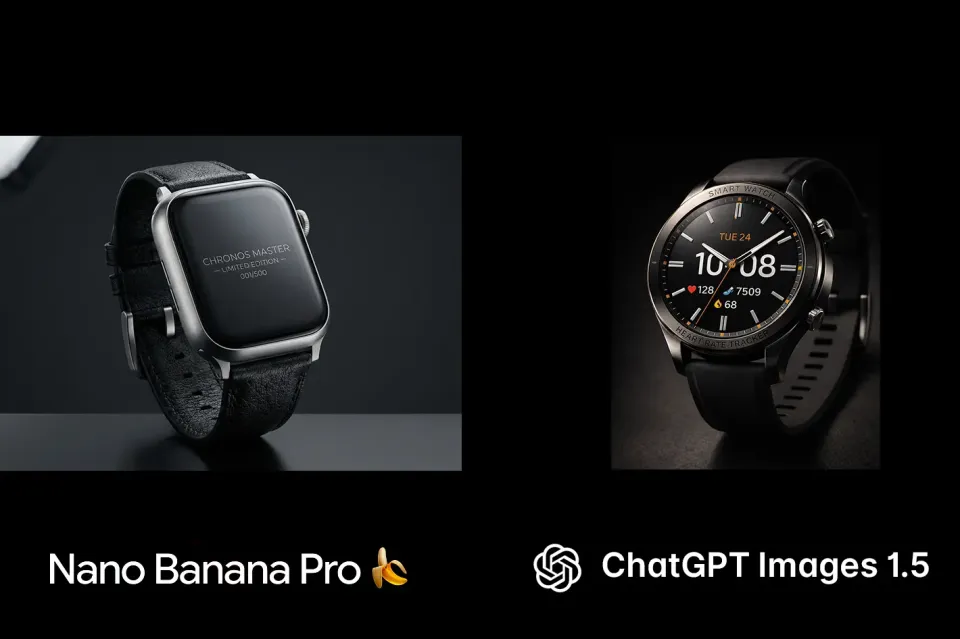
Create a product shot of a smartwatch that:
1. Looks photorealistic enough for an e-commerce site
2. Uses dramatic, studio-style lighting
3. Includes engraved text on the dial that remains sharp and readable
4. Maintains correct reflections and material properties
Response:
Observation:
Nano Banana Pro made an image that likened a smart watch reveal shot. ChatGPT Image made some analog-esque watch in the name of a smart watch, and instead of the design speaking for the smartness, had blatantly added “Smartwatch” across the rim of the watch.
Verdict
Here are a few things I had realised while using the two image generation models:
- One thing that was apparent was that Nano Banana Pro is wayyyy faster than ChatGPT Image 1.5. This wait time was accentuated when the prompts were complex or were multi-leveled.
- The Image interface of ChatGPT is very buggy. Sometimes it works flawlessly, and you forget that it’s there. Other times, it’d be hard for you to even get an image made out of it. The disparity in experience is astonishing.
- ChatGPT Image for what it offers, is limited to single image response. From tasks 4 it was clear that when the requirement is multiple or multi-level images, the responses of ChatGPT Image 1.5 falls flat. Any level of intricate prompt engineering would’nt make the model spout more than a single image.
Nano Banana Pro, clearly doesn’t have these constraints.
With all these at hand, It’d be safe to say that Nano Banana Pro, still holds that edge which made it mainstream in the first place. Where ChatGPT’s Image 1.5 presents advancements in text-based visuals, its performance in other regards leaves a lot to be expected.
If you’d like to learn more about prompting across these models, you can take a look at the following articles:
Frequently Asked Questions
Q1. What is ChatGPT Image 1.5?
A. ChatGPT Image 1.5 is OpenAI’s latest image generation model that turns prompts or existing photos into visuals with high precision, faster generation speeds, and detailed editing while preserving image consistency.
Q2. What makes Nano Banana Pro different from earlier versions?
A. Nano Banana Pro adds advanced text rendering, precise control over lighting and camera angles, 2K resolution outputs, stronger world knowledge, and better multi-image composition for professional-grade creative work.
Q3. Which tool performed better in complex image tasks?
A. Nano Banana Pro consistently outperformed ChatGPT Image 1.5 in speed, multi-step editing, text-heavy visuals, and multi-image consistency, while ChatGPT Image struggled with complex prompts and interface reliability.
I specialize in reviewing and refining AI-driven research, technical documentation, and content related to emerging AI technologies. My experience spans AI model training, data analysis, and information retrieval, allowing me to craft content that is both technically accurate and accessible.