There is a popular notion, which I personally don’t believe in – “Intelligent is Slow.” Everything associated with high speed is somehow held in a negative light, just for being, well, fast. What they tend to forget is – In today’s fast-paced world, speed might just be your only ticket to success. This is true for humans, their intelligence, as well as the intelligence that mimics them – artificial intelligence or AI. And among the slew of models with intense monikers like “Deep Research” or “Deep Thinking” (all basically meaning ‘we take our time’), Gemini 3 Flash is now here to prove my point.
It comes as Google’s latest AI model. And as the name suggests, this one acts FAST! With “frontier intelligence built for speed,” Gemini 3 Flash is meant to help everyone learn, build, and plan anything – faster.
So, does it succeed in its attempt? Or does it fall short and prove the age-old myth to be true? I attempt to find out in this article. But before we test it, let’s get to know the new AI model by Google a bit better.
Table of contents
Gemini 3 Flash: What is it?
At its core, the new Gemini model is Google’s answer to a very real problem: how do you deliver top-tier AI intelligence without slowing everything down? Instead of chasing depth at the cost of time, Gemini 3 Flash balances both. It forms a part of the recently introduced Gemini 3 family. However, this particular model focuses specifically on low latency, faster responses, and cost efficiency. This makes it ideal for real-time use cases that require real speed, and delays are simply unacceptable.
To truly understand its importance, just imagine the new Flash model being everywhere in Google’s ecosystem. From its everyday search experiences to chat interfaces, developer tools, and live applications. With Gemini 3 Flash, all these experiences will be instant, while still performing well enough to be useful.
As for what it brings to the table, Gemini 3 Flash supports text, images, and multimodal inputs, and can handle complex instructions without needing “thinking pauses” that slow down the experience. The goal here is simple: intelligence that keeps up with human pace.
In a world where AI is increasingly embedded into daily workflows, that pace distinction matters more than ever. Which brings us to the next question.
What Makes Gemini 3 Flash Different?
The biggest difference with Gemini 3 Flash is not what it can do. It’s how fast it does it. In its announcement, Google states that it has clearly prioritised low latency and high throughput here, making it feel far more responsive than traditional “think-first” models.
Though there is another key shift – intent. Gemini 3 Flash is not designed to impress in isolated demos. It is designed to live inside real products. That is why it works so well for chat, search, planning, coding, and multimodal tasks that happen continuously throughout the day. You ask. It responds. No pauses. No visible hesitation. And yet, the answers remain relevant and useful.
Most importantly, the model challenges the long-standing assumption that smarter AI must be slower. By keeping reasoning efficient and execution lightweight, the new Gemini model rivals larger frontier models and significantly outperforms even the best 2.5 models by Gemini. Next, let’s have a look at how it performs on various benchmark tests.
Gemini 3 Flash Benchmark Performance
While the Gemini 3 Flash is built for speed, benchmarks show it is far more than just fast. In academic and reasoning-heavy tests like Humanity’s Last Exam, it delivers strong results, especially when paired with search and code execution. To think of it, that balance between raw reasoning and practical tool use is exactly what real-world workflows demand.
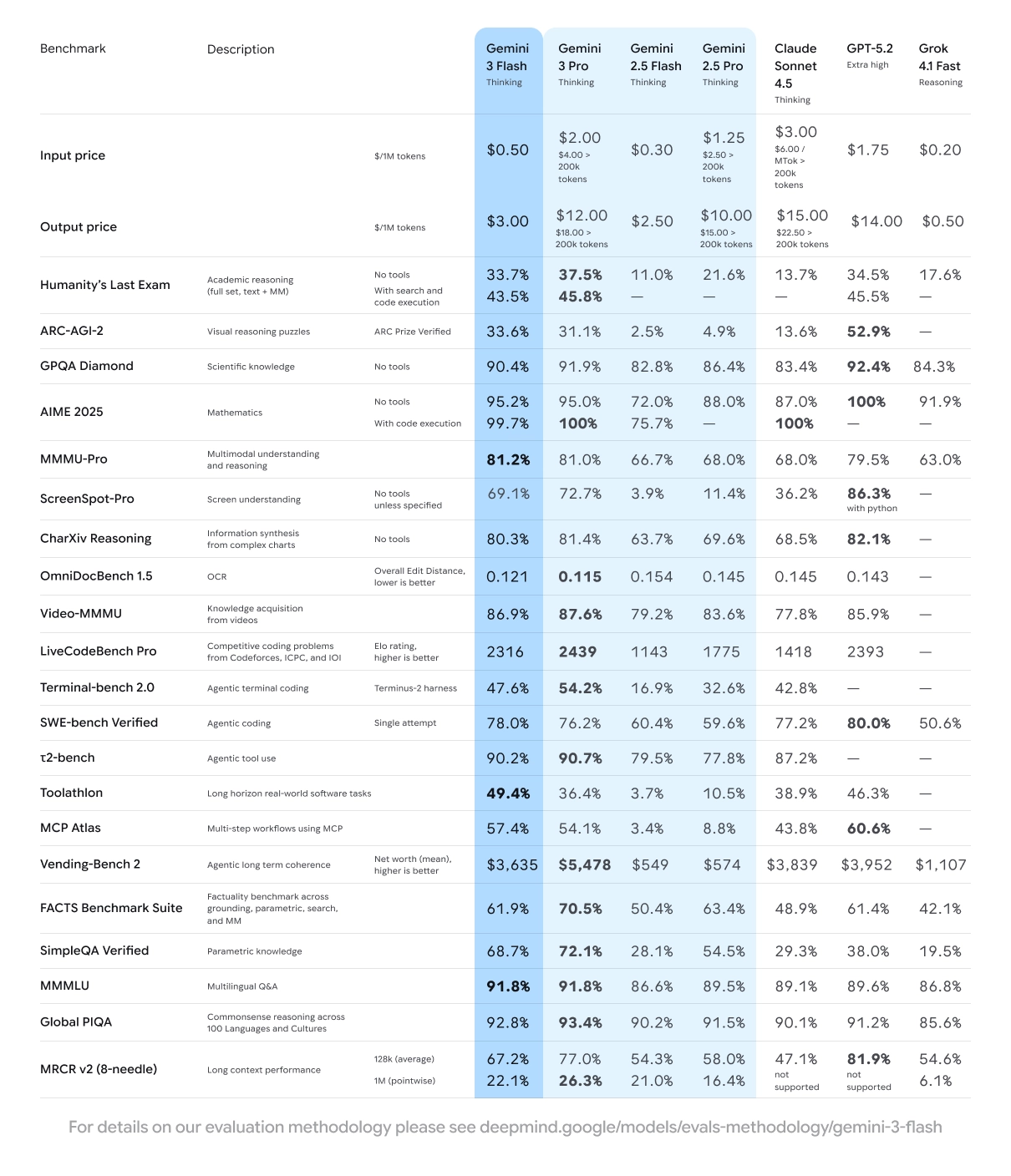
Where it truly stands out is in multimodal and applied intelligence. On MMMU-Pro (multimodal understanding), it posts an impressive 81.2%, comfortably outperforming several heavier models. It also shines in LiveCodeBench Pro, scoring 2316 Elo, proving that its speed does not come at the cost of competitive coding ability. Add to that a strong 78% on SWE-Bench Verified and 47.6% on Terminal-bench 2.0, and it becomes clear: Gemini 3 Flash handles real engineering tasks remarkably well.
In short, the new Gemini model may not chase perfect scores everywhere. But across coding, multimodal reasoning, and agentic workflows, it consistently punches above its weight.
Which means we have the perfect setup for its real-world tests. But first, here is how to access it.
How to Access Gemini 3 Flash
Like all other Gemini models, using Gemini 3 Flash is refreshingly simple. Google is rolling it out across its entire ecosystem, making it accessible to almost everyone.
- Developers can use Gemini 3 Flash via the Gemini API in Google AI Studio, the Gemini CLI, and Google’s new agentic development platform, Google Antigravity.
- For everyday users, the Flash version is available directly in the Gemini app and through AI Mode in Search.
- It is also available in Vertex AI and Gemini Enterprise, making it easy to integrate into large-scale workflows and production systems.
In short, whether you are building, searching, or deploying at scale, the new Flash model is already within reach.
Now that you know where to try your hands on it, here is a real-world test to find out if it is even worth your time.
Hands-on with Gemini 3 Flash
Here, we shall test the new Gemini model for its agentic, coding, and document inspection capabilities.
Task 1: Testing Agentic Workflow
Prompt:
Find the top travel vloggers and creators currently trending on YouTube. Deep dive into their personal recommendations to curate a 3-day itinerary to a destination they recommend. Organize the trip by neighborhood, making sure to credit each creator’s signature ‘must-visit’ spot or hidden gem restaurant.
Output:


Time Taken: 3 to 4 seconds
Task 2: Coding
Prompt:
Write the HTML code for a webpage of a travel website, showing the exact same itinerary in a visually appealing format, full of pictures of the places and activities mentioned herein.
Output:


Time Taken: 8 seconds
Task 3: Document reading and information extraction
Prompt:
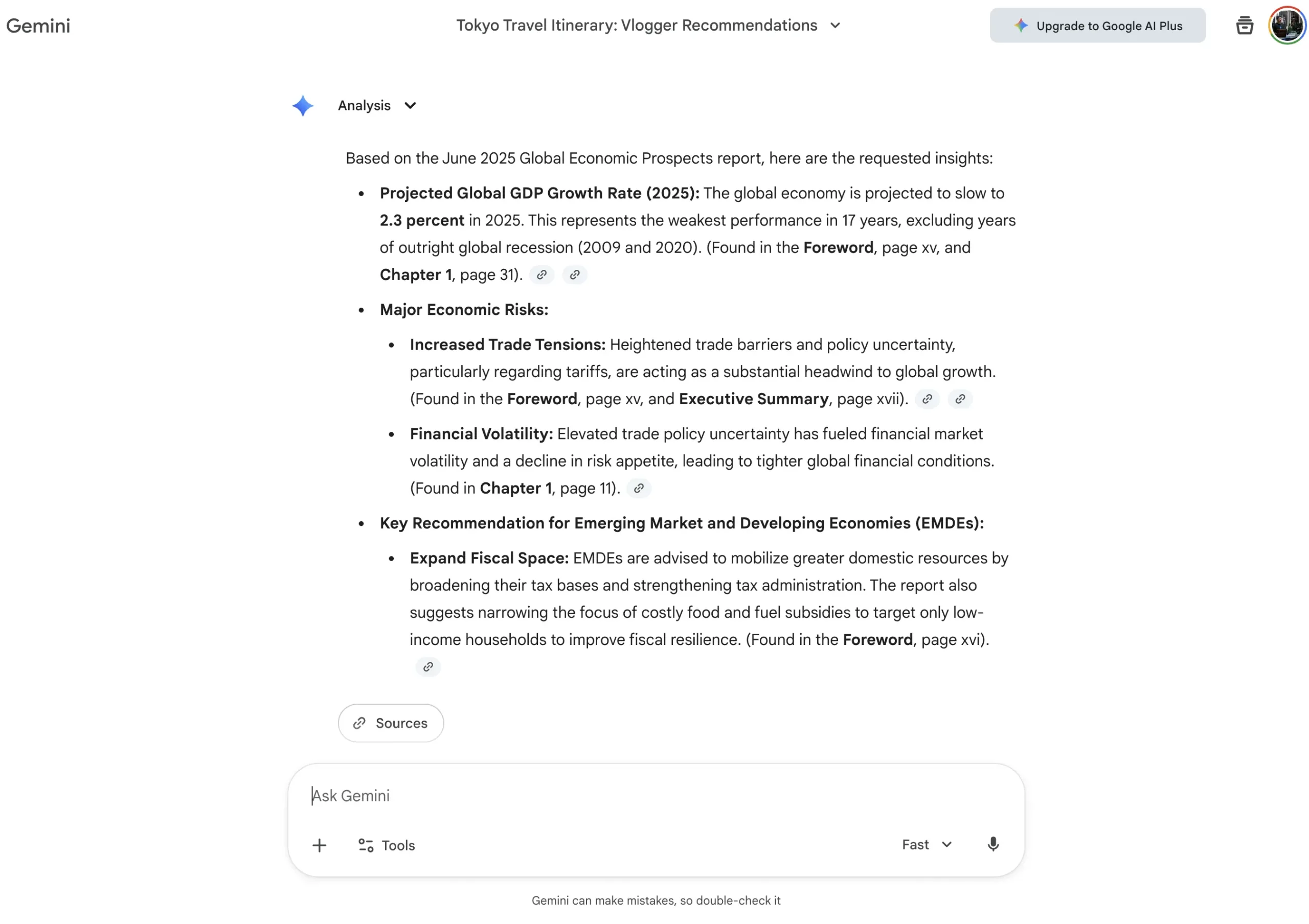
Go through the Global Economic Prospects report and extract the following:
– The projected global GDP growth rate for the current year
– Two major economic risks highlighted in the report
– One key recommendation made for emerging economies
Present the answer in clear bullet points, and mention the section or page where each insight appears.
Output:
Time Taken: ~50 seconds
Conclusion
Given our hands-on experience, the benchmark performances, and Google’s own claims, Gemini 3 Flash does not try to be the model that thinks the longest. Instead, it aims to be the one that keeps up. By blending strong reasoning, solid coding ability, and multimodal understanding with near-instant responses, it challenges the long-held belief that intelligence must come with delay. In practice, that shift matters more than any single benchmark score. Why, you ask? The answer is more obvious than you might think, especially for anyone performing daily workflows
For everyday users, developers, and enterprises alike, Gemini 3 Flash feels less like an experiment and more like a dependable co-pilot. It is fast enough for real-time workflows and smart enough to stay useful. If speed is no longer optional, Gemini 3 Flash makes a strong case for being the AI model built for how we actually work today.








This was an easy read and very clear Speed really seems to be the main focus here Good breakdown for a website post