
If you’re curious about trending terms like AI Agents or Agentic AI, you’re in the right place. Agentic AI is rapidly moving from experimentation to enterprise adoption. According to Gartner, over 60% of enterprise AI applications are expected to include agentic components by 2026, while more than 40% of early agentic AI projects are projected to be abandoned due to poor architecture, cost overruns, and lack of governance. In short, Agentic AI is becoming a big deal but building it correctly is the right skill to have!
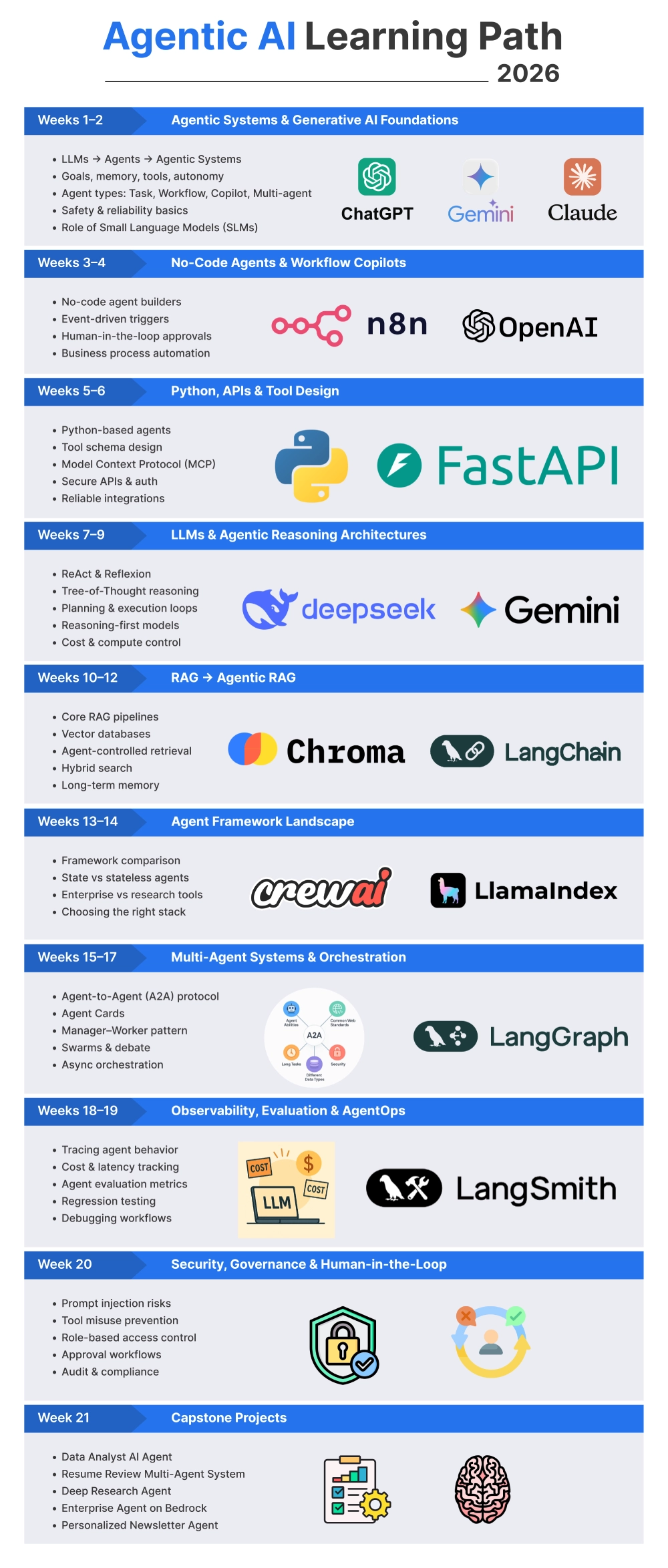
So what does it take to build such systems? A clear understanding of what to build and how to build it. That is exactly why I created this Agentic AI Learning Path, designed to help you build production-ready skills and scale your career.
Table of contents
- Week 1-2: Agentic Systems & Generative AI Foundations
- Weeks 3-4: No-Code Agents to Workflow Copilots
- Weeks 5-6: Python, APIs, and Tool Design
- Weeks 7-9: LLMs and Agentic Reasoning Architectures
- Weeks 10-12: RAG to Agentic RAG
- Weeks 13-14: Agent Framework Landscape
- Weeks 15-17: Multi Agent Systems and Orchestration
- Weeks 18-19: Observability, Evaluation, and AgentOps
- Week 20: Security, Governance, and Human in the Loop
- Week 21: Projects to Cover
- Conclusion
Week 1-2: Agentic Systems & Generative AI Foundations

You should begin by building a strong conceptual understanding of how AI systems evolve from simple LLM applications to full-scale agentic systems. Instead of starting with tools or frameworks, this phase focuses on how autonomy, goals, and decision-making change system behavior.
LLM applications are reactive and respond to individual prompts. Single agents introduce goals, memory, and tool usage, allowing systems to reason and act in loops. Agentic systems take this further by combining multiple agents, tools, memory, and governance layers to operate reliably in real-world environments.
Next, learn how different types of agents fit into this ecosystem:
- Task agents handle single, well-defined objectives
- Workflow agents orchestrate tools and processes
- Copilots assist humans with review and approval steps
- Multi-agent systems coordinate specialized agents to solve complex tasks
Key Focus Areas:
- Agentic AI taxonomy and system evolution
- Modern Generative AI model landscape
- Safety basics for autonomous agents
- Why reliability and consistency matter more than raw intelligence
Resources:
- Stanford Webinar – Agentic AI: A Progression of Language Model Usage
- Deep Dive into LLMs like ChatGPT
- How I use LLMs by Andrej Karapathy
- GenAI for Everyone
- What is the Difference Between AI Agents and Agentic AI?
- New whitepaper outlines the taxonomy of failure modes in AI agents
- Basics of Building AI Agents
- How to Use ChatGPT as your Assistant?
- Explore GenAI models like – DeepSeek AI, Claude Opus 4.5, Gemini 3 , Kimi K2, Grok and ChatGPT models.
Weeks 3-4: No-Code Agents to Workflow Copilots

After understanding how agentic systems work, the next step is to build agents without writing code. In 2026, no-code agents are no longer simple chatbots. They function as workflow copilots that coordinate tools, data, and actions across business systems.
Start by exploring modern no-code and low-code agent builders such as n8n, OpenAI Agent Builder, and Gemini Opal. These platforms integrate with tools like email, calendars, documents, CRMs, and ticketing systems. Instead of only responding to user messages, agents built on these platforms are designed to execute workflows such as creating tickets, scheduling meetings, updating records, or triggering notifications.
You will learn how to design multi-step workflows where agents connect multiple tools, include approval or review steps, and escalate tasks to humans when required. The focus is on building agents that support real operational workflows rather than basic conversational bots.
Key Focus Areas:
- SaaS-connected workflow copilots
- Event-driven agent triggers
- Multi-tool workflows with approvals and escalation
- Replacing support bots with business workflows
Resources:
- Complete automation using n8n
- Building a Customized Newsletter AI Agent
- How to Build an Image Generator Web App with Zero Coding
- Explore vibe coding tools like – Cursor AI, Replit, and Windsurf
Weeks 5-6: Python, APIs, and Tool Design

Once you move beyond no-code platforms, the focus shifts to building agents using Python and external tools. In real-world systems, agents usually fail because of poorly designed tools or brittle integrations. This phase focuses on building robust, standardized connections between your agents and your data.
Start by strengthening your Python foundations using frameworks like FastAPI. You will learn to design structured tool schemas, but more importantly, you will be introduced to the Model Context Protocol (MCP), the new open standard for connecting AI assistants to systems. Instead of writing custom connectors for every tool, you will learn to build MCP servers that expose data and actions in a universal format.
Next, focus on connecting agents to enterprise systems. You will learn how to handle failures gracefully using retries and timeouts and how to use MCP to abstract away the complexity of specific API integrations, ensuring your tools are portable across different agent backends (like Claude Desktop, IDEs, or custom agents).
Key Focus Areas:
- Introduction to Model Context Protocol (MCP): Clients, Hosts, and Servers
- Building MCP Servers: Exposing local data and APIs to agents standardly
- Tool schema design and validation using Pydantic and OpenAPI
- Authentication and secure tool access (OAuth & API Keys)
- Why MCP? Solving the “m x n” problem of connecting models to tools
Resources:
- FastAPI Official Tutorial (Python Tool Foundations)
- Pydantic + OpenAPI for Tool Schemas (Structured Tools)
- Foundations of Model Context Protocol
- Guide to OpenAI API Models and How to Use Them
- MCP: Unlock AI integrations with real-world demos
- Top 12 Free APIs for AI Development
Weeks 7-9: LLMs and Agentic Reasoning Architectures

At this stage, you move beyond basic prompt engineering and focus on how agents reason, plan, and make decisions. Writing better prompts alone is no longer enough for building reliable agentic systems. This phase introduces reasoning-first architectures that allow agents to think through problems before acting.
You will learn core agentic reasoning patterns such as ReAct, Reflexion, Tree-of-Thought, planning and execution loops, and critique and revise cycles. These patterns help agents break down complex tasks, evaluate intermediate steps, and improve outcomes over multiple iterations.
This phase also introduces modern reasoning-focused models such as OpenAI o3 and o4-class reasoning models, DeepSeek R1, and Gemini Thinking models. These models perform deeper reasoning at inference time, reducing the need for complex multi-agent loops by handling structured thinking internally.
Key Focus Areas:
- Reasoning architectures compared to prompt-based approaches
- Tool-aware prompting and structured reasoning flows
- System prompts designed for agent roles and teams
- Test-time compute management and cost control strategies
Resources:
- Prompt Engineering Guide
- ReAct: Synergizing Reasoning and Acting
- Reflexion: Learning from Past Mistakes
- Tree-of-Thoughts Explained
- Explore reasoning models like DeepSeek R1, Gemini 3, GPT 5.2, Kimi K2, etc.
Weeks 10-12: RAG to Agentic RAG

At this stage, you are introduced to Retrieval Augmented Generation (RAG) and how it enables language models to use external knowledge sources. You begin by learning the fundamentals of RAG, including how documents are loaded, processed, embedded, and retrieved from vector databases to support more accurate and up to date responses.
Once the core RAG concepts are clear, this phase gradually evolves into Agentic RAG. Instead of treating retrieval as a fixed step, you learn how agents decide when retrieval is required, which sources to query, and how to evaluate the quality of retrieved information. This allows agents to combine retrieval with reasoning, tool use, and memory to handle more complex tasks.
You will also explore corrective and self reflective RAG workflows, where agents reformulate queries, retry retrieval when needed, and improve results over time. Long term memory techniques are introduced to help agents remain consistent across multi step workflows and extended interactions.
Key Focus Areas:
- Core RAG concepts including document processing and vector databases
- Treating retrieval as an agent controlled tool
- Hybrid search using semantic and keyword based methods
- Query planning and routing across multiple data sources
- Memory management for long running and multi step agent workflows
Resources:
- RAG Explained from First Principles (Best Conceptual Intro)
- Vector Databases & Hybrid Search
- RAG vs Agentic RAG
- Building an Agentic RAG Application using LangChain, Tavily & GPT
- Agentic AI Design Patterns
Weeks 13-14: Agent Framework Landscape

At this stage, the focus shifts from learning a single framework to understanding how to choose the right framework for a given agentic system. Instead of going deep into only LangChain basics, you explore the broader ecosystem of agent frameworks and where each one fits best.
You will get hands on exposure to popular frameworks such as LangChain and LangGraph, CrewAI, AutoGen, LlamaIndex, and Semantic Kernel, along with a look at lightweight production oriented frameworks used for simpler deployments. Through practical comparisons, you will see how the same use case can be implemented using different frameworks and why the design choices matter.
This phase emphasizes understanding trade offs rather than memorizing APIs. You will learn how frameworks differ in state management, orchestration style, enterprise readiness, and extensibility, helping you select the right stack based on project requirements.
Key Focus Areas:
- Framework trade offs and decision making criteria
- Stateful vs. stateless agent workflows
- Choosing between enterprise focused and research friendly frameworks
Resources:
- Building AI Agent Workflows with Semantic Kernel
- Build Agents from Scratch (Building Advanced RAG, Part 3)
- LangChain Fundamentals
- Introduction to CrewAI
- Building Agent using AutoGen
- LangChain vs LangGraph vs LangSmith vs LangFlow: Choosing the Right LLM Toolkit
Weeks 15-17: Multi Agent Systems and Orchestration

In this phase, you move from building isolated agents to designing ecosystems where agents collaborate. You will focus on the Agent-to-Agent (A2A) Protocol, the industry standard for enabling interoperability between agents built on different stacks.
You will learn how to publish Agent Cards, standardized JSON files that “advertise” an agent’s capabilities to the rest of the network. This allows a “Manager Agent” to dynamically discover and hire a “Researcher Agent” or “Coder Agent” without needing to know how those agents are built internally.
You will implement core orchestration patterns using A2A, such as Manager-Worker (delegation), Swarm (collaborative solving), and Debate (consensus building). You will also learn the difference between synchronous handoffs and asynchronous task queues, ensuring your multi-agent system doesn’t deadlock when one agent is waiting for another.
Key Focus Areas:
- A2A Protocol Fundamentals: Agent Cards, Tasks, and standardized messaging.
- Discovery: How agents “find” each other on a network
- The “Opaque” Pattern: interacting with agents as black boxes (inputs/outputs) rather than shared memory
- Orchestration Patterns: Handoffs, routing, and conflict resolution
Resources:
- Agent-to-Agent (A2A) Protocol
- Manager–Worker & Swarm Patterns Explained
- Synchronous vs Asynchronous Agent Coordination
- Opaque Agents & Black-Box Interactions
- Strands Agent Learning Path
- OpenAI Swarm: A Hands-On Guide to Multi-Agent Systems
Weeks 18-19: Observability, Evaluation, and AgentOps

As agentic systems grow more complex, building them is only half the work. Many agentic projects fail because teams cannot see how agents make decisions, where costs are coming from, or why failures occur. This phase focuses on making agent behavior visible, measurable, and reliable.
You will learn how to trace agent decisions, tool calls, and intermediate reasoning steps across workflows. You will also measure key performance signals such as task success, cost per task, latency, and safety related outcomes. Debugging techniques are introduced to help you replay failed agent runs, understand breakdowns, and fix issues systematically.
In addition, this phase covers how to evaluate agents over time by building evaluation harnesses and regression tests that catch performance drops before they reach production. These practices are essential for operating agentic systems at scale.
Key Focus Areas:
- Agent observability and tracing across workflows
- Cost per task optimization and latency tracking
- Building evaluation harnesses and regression tests
Resources:
- What Is Agent Observability? (Foundational Mental Model)
- Tracing Agent Runs End-to-End (Hands-on Perspective)
- 10 Ways to Slash Inference Costs with OpenAI LLMs
- Debugging Agents: Replay, Inspect, Fix
- Evaluating LLMs
- OpenAI Evals Guide
- LLM as a Judge
Week 20: Security, Governance, and Human in the Loop

Before deploying agentic systems into real environments, it is critical to put proper security and governance controls in place. Agents interact with tools, data, and external systems, which means failures can have real world consequences if not carefully managed.
In this phase, you will learn how to identify and mitigate common risks such as prompt injection attacks, tool misuse, and unintended data exposure. You will explore how to apply role based access control to agent tools, ensuring agents can only perform actions they are explicitly allowed to. Approval workflows are introduced for high risk actions so that humans remain in control when it matters most.
Key Focus Areas:
- Threat modeling and risk assessment for agents
- Human in the loop versus human in the loop for consistency
- Sandboxed execution environments for agent tools
- Enterprise guardrails, audit logs, and compliance readiness
Resources:
- Sandboxed execution for agent tools – gVisor Documentation
- Google Secure AI Framework (SAIF)
- Building Reliable AI Systems with Guardrails
- The Role of Human Feedback in Agentic AI Tool Validation
- Mitigating the risk of prompt injections in browser use
- OpneAI Safety best practices
Week 21: Projects to Cover
- Building a Data Analyst AI Agent: Learn to design and implement an AI agent that automates data handling, analysis, and result interpretation for real analytics workflows.
- Build a Resume Review Agentic System with CrewAI: Hands-on project showing how multiple agents can collaborate to analyze and score resumes.
- Building a Deep Research AI Agent: Develop an agent capable of executing research tasks, integrating RAG and autonomous workflows.
- Building Agentic AI Systems with Amazon Bedrock: Learn how to orchestrate and scale agentic systems using Bedrock, including multi-agent coordination.
Conclusion
Agentic AI is no longer about building demos or chatbots that work in isolation. As we move into 2026 and beyond, the real challenge and opportunity lie in designing agentic systems that can reason, collaborate, operate safely, and deliver measurable value in the real world.
This learning path reflects that shift. If you want guidance and mentorship in making a career in Agentic AI then you must checkout our exclusive Agentic AI Pioneer Program.
If you still have questions, drop them in the comment section and I will get back to you.
Hello, I am Nitika, a tech-savvy Content Creator and Marketer. Creativity and learning new things come naturally to me. I have expertise in creating result-driven content strategies. I am well versed in SEO Management, Keyword Operations, Web Content Writing, Communication, Content Strategy, Editing, and Writing.



