OpenAI is on a roll! While the company had everyone going gaga over its new image generation model, the ChatGPT Images 2.0, it decided now is not the time to stop. And lo and behold, out comes another banger from its offices, and mind you, this is the bigger one. The new version of its much-loved ChatGPT is here, and this one is called GPT 5.5.
And with this launch, I expect things to change a lot in the AI era. Why? Let’s dive into the new GPT 5.5 model to understand this.
Table of contents
What is GPT 5.5?
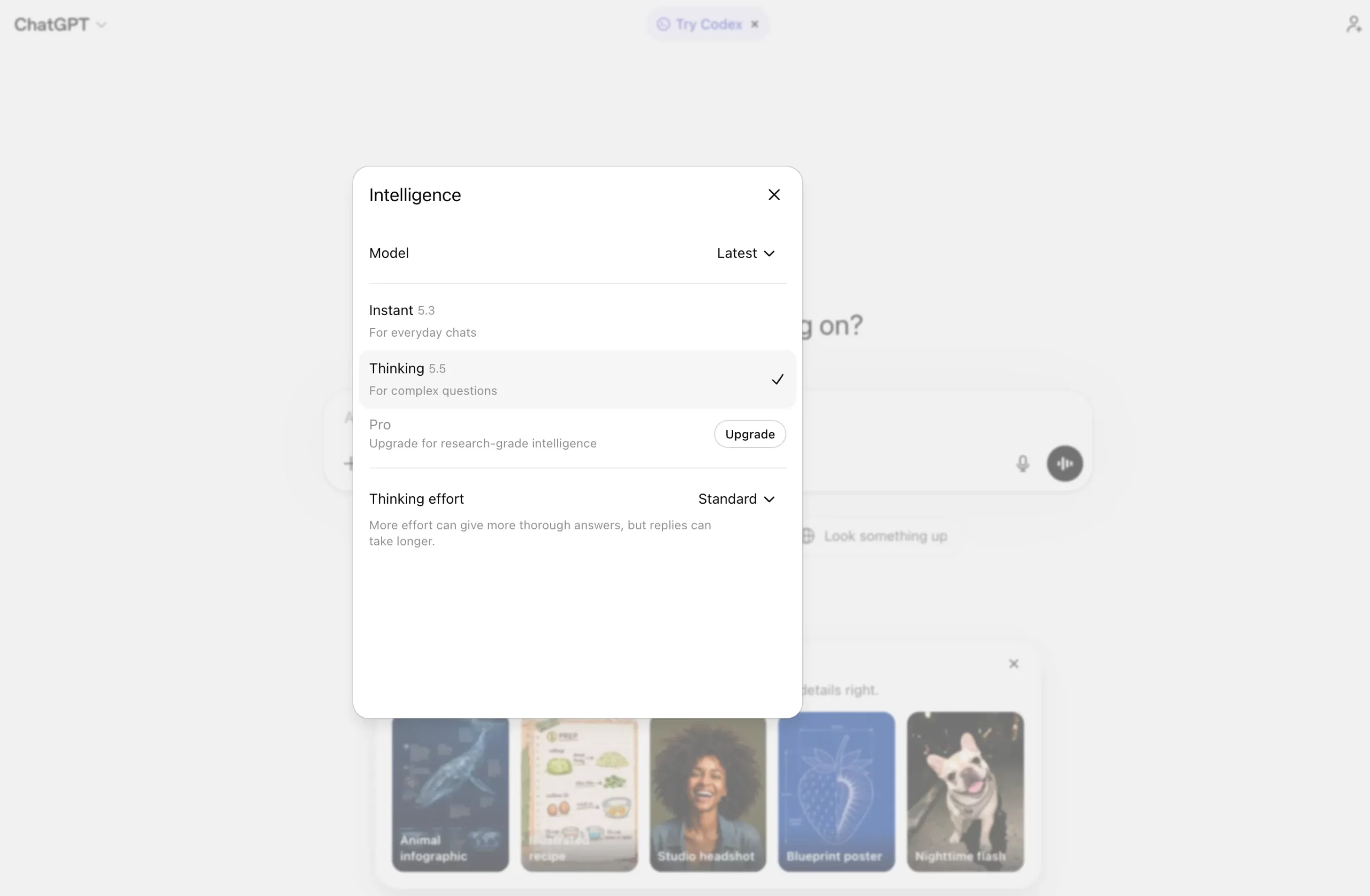
It is the latest model in the ChatGPT family that the company is calling its “smartest and most intuitive to use model yet”. Though we have heard that claim repeatedly over the years of different model launches, so don’t just go by the adjectives. What’s different this time around is that the new GPT model focuses on getting the work done, instead of just solving your queries.
So, this one is not about better answers. It is all about finishing tasks.
As per the official announcement by OpenAI, GPT 5.5 has been designed with a strong focus on real-world task execution. That means it is capable of planning the next steps, using the right tools, and refining the output along the way.
One of the biggest improvements comes in how the model understands intent. GPT 5.5 requires far less prompting compared to earlier versions. You don’t need to over-explain or structure your request perfectly. The model is better at picking up what you actually want and moving forward with it.
There are several other features as well. Let us explore all those in detail next.
GPT 5.5: Key Features
So now we know that GPT 5.5 is about getting work done. But what enables that shift?
Here are the key features that stand out from the announcement:
1. Stronger Agentic Coding
GPT 5.5 is being positioned as OpenAI’s strongest agentic coding model yet. This means it is not just writing code snippets, but taking on longer engineering workflows like debugging, refactoring, testing, validation, and resolving issues across larger codebases.
2. Better Computer Use
The model is designed to move across tools more effectively. OpenAI says GPT 5.5 can operate software, create documents and spreadsheets, navigate interfaces, and carry a task forward until it is finished.
3. Improved Knowledge Work
GPT 5.5 is also built for professional tasks like research, information synthesis, data analysis, document-heavy work, and business workflows. This makes it useful beyond coding, especially for people who use AI for everyday work.
4. Early Scientific Research Capabilities
OpenAI has also highlighted gains in scientific and technical research. The model can help with multi-step research workflows, such as exploring ideas, analysing data, testing assumptions, interpreting results, and suggesting next steps.
5. Better Efficiency
One of the more interesting claims is that GPT 5.5 is not just smarter, but also more efficient. OpenAI says it matches GPT 5.4’s per-token latency in real-world serving, while using fewer tokens for the same Codex tasks.
6. Stronger Safeguards
Because the model is more capable, especially in areas like cybersecurity and biology, OpenAI says it has released GPT 5.5 with its strongest safeguards yet. This includes internal and external red-teaming, targeted testing, and feedback from nearly 200 early-access partners.
GPT 5.5: Benchmark Performance
The new ChatGPT model has displayed its prowess across benchmark scores as well, and how! GPT 5.5 looks strongest where real-world agentic work begins to matter. It posts 82.7% on Terminal-Bench 2.0, ahead of GPT-5.4 at 75.1%, Claude Opus 4.7 at 69.4%, and Gemini 3.1 Pro at 68.5%. On Expert-SWE, it scores 73.1%, again above GPT-5.4’s 68.5%. The same pattern continues across tool and work benchmarks, with GPT-5.5 scoring 84.9% on GDPval, 78.7% on OSWorld-Verified, 55.6% on Toolathlon, and 81.8% on CyberGym.
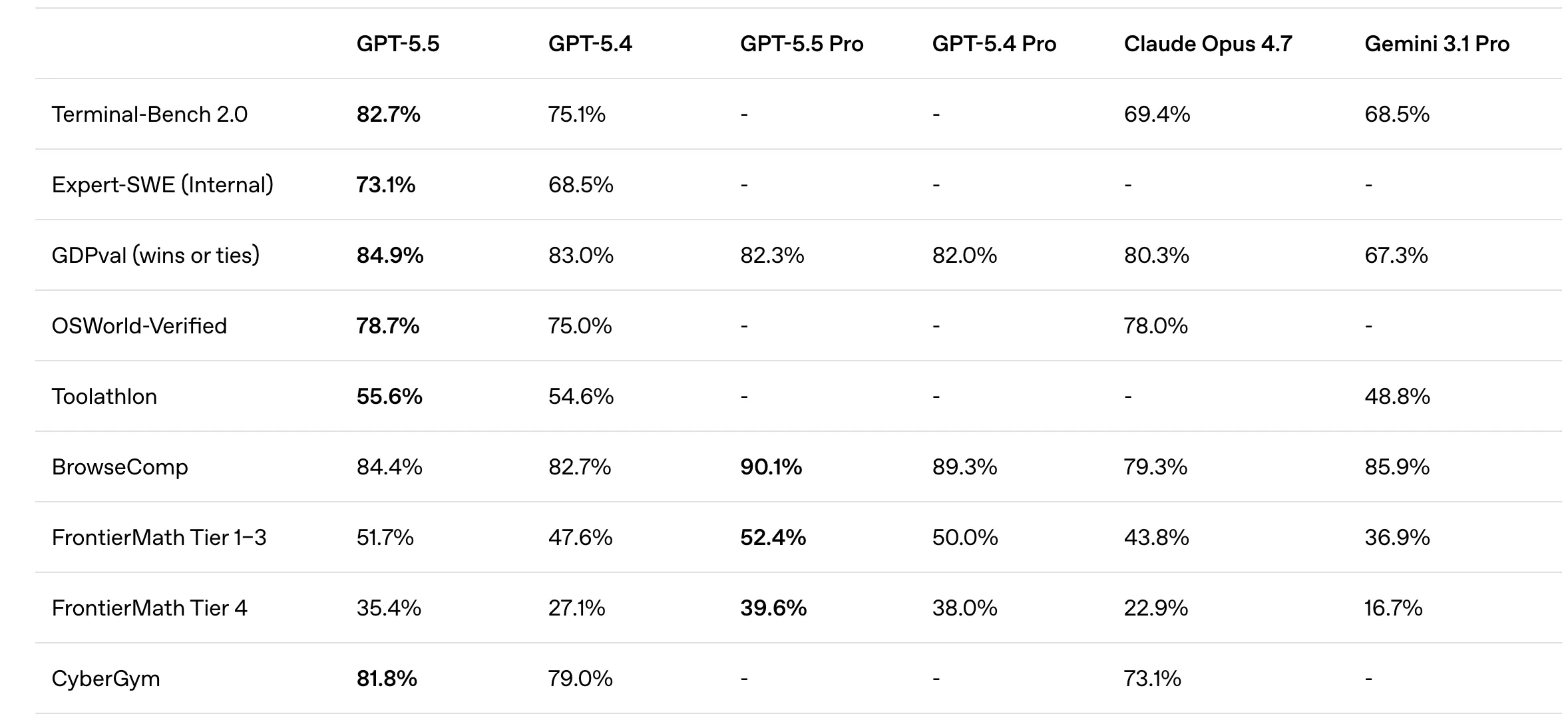
The harder reasoning numbers are also strong. GPT-5.5 reaches 51.7% on FrontierMath Tier 1–3 and 35.4% on FrontierMath Tier 4, while GPT-5.5 Pro pushes those to 52.4% and 39.6%, respectively. BrowseComp is where the Pro model stands out most, scoring 90.1%, ahead of GPT-5.4 Pro at 89.3% and Claude Opus 4.7 at 79.3%.
So, the broader takeaway is clear: GPT 5.5 is not just better at chat-style reasoning, but stronger across coding, browser use, tool workflows, maths, and agentic task execution.
GPT 5.5: Availability and Pricing
GPT 5.5 is already rolling out to Plus, Pro, Business, and Enterprise users in ChatGPT and Codex. In ChatGPT, GPT 5.5 Thinking is available to Plus and above users, while GPT 5.5 Pro is available to Pro, Business, and Enterprise users.
In Codex, GPT 5.5 is available across Plus, Pro, Business, Enterprise, Edu, and Go plans with a 400K context window. There is also a Fast mode, which generates tokens 1.5x faster, but at 2.5x the cost.
Pricing
- gpt-5.5 API: $5 per 1M input tokens and $30 per 1M output tokens
- Context window: 1M tokens
- Batch and Flex pricing: Half the standard API rate
- Priority processing: 2.5x the standard rate
- gpt-5.5-pro API: $30 per 1M input tokens and $180 per 1M output tokens
While GPT 5.5 is priced higher than GPT 5.4, OpenAI says it is also more intelligent and token-efficient, especially in Codex, where it can deliver better results with fewer tokens for most users. Now this is a smart move, considering the recent backlash Anthropic faced over the Claude Opus 4.7 eating up tokens at a monumental rate.
Let’s Try GPT 5.5
Now that we know all about the latest ChatGPT model, here are some real-world use cases to test its capabilities.
Task 1: Computer / Tool Workflow Simulation
Prompt:
I run a small interior design studio with 6 team members and 14 active residential projects.
Create a complete Google Sheets operating system that helps me manage client projects, design stages, site visits, vendor coordination, budgets, approvals, and payments in one place.
The sheet should be practical enough to use daily, not just a basic tracker. Include the main tabs, key columns, sample rows, formulas, dashboard metrics, conditional formatting ideas, and a simple daily workflow for the team.
Assume I want to quickly see which projects are delayed, which vendors are pending, which clients need approval, which payments are due, and what needs my attention today.
Output:
Task 2: Online Research / Source Synthesis
Prompt:
Research how AI agents are changing day-to-day work for software developers in 2026.
I don’t want a generic summary. Compare what is being claimed by AI companies with what developers are actually reporting in real-world use.
Separate the answer into:
- What AI agents are clearly good at today
- Where they still fail or need human supervision
- What this means for junior developers
- What this means for experienced engineers
- A final balanced takeaway
Use recent sources, avoid hype, mention uncertainty where needed, and make the output useful for a working professional deciding whether to adopt AI agents in their workflow.
Output:
Task 3: Long, Messy Business Task
Prompt:
I run a small home fitness equipment brand selling adjustable dumbbells, resistance bands, yoga mats, and compact benches through my website and marketplaces.
Sales are okay, but growth has slowed. Customer reviews say the products are good, but people do not clearly understand why they should buy from us instead of cheaper brands. We also don’t have a strong repeat-purchase strategy.
Create a practical 90-day business improvement plan from this messy brief.
Include:
- A sharper brand positioning
- 3 customer segments we should target
- Website and marketplace improvements
- Product bundling ideas
- Retention and repeat-purchase ideas
- A simple campaign plan for the next 90 days
- Risks or weak points in the plan
Keep it realistic for a small D2C brand with limited budget and a small team.
Output:
Task 4: Scientific / Technical Reasoning
Prompt:
A city wants to reduce summer heat in one dense urban neighbourhood where temperatures are consistently 4–6°C higher than nearby areas.
The options being considered are:
- planting more trees
- painting rooftops white
- replacing concrete pavements with permeable materials
- adding shaded bus stops and pedestrian corridors
- creating small water bodies or misting zones
Analyse this like a technical advisor.
Explain which interventions are likely to work best, which may have trade-offs, and how the city should combine them into a practical 2-year pilot plan.
Do not give a generic sustainability answer. Reason through heat absorption, shade, humidity, maintenance, cost, and impact on residents.
Output:
Observations
In each of the cases we tried the new ChatGPT model on, it just refused to back down or even be average. As you can see in the screen recordings, it came out with top-tier responses with utmost nuances and detail, and a laser-sharp focus on each and every instruction sent its way.
I seriously cannot find a single area/ instruction/ detailing within any of the prompts that GPT 5.5 might have overlooked in its responses. Granted, the answers are long, but all the prompts were demanding such elaborate, in-depth responses. Moreover, wherever the model was asked to perform specific tasks step-by-step, it went ahead and did the same.
The best part – all of this was within a matter of seconds. The longest time it took was about 13 seconds in thinking, and that too for an elaborate answer spanning well over 3,000 words and 25 sources. In the scientific research case, it went through over 118 sources at lightning fast speed. Now that is exactly the kind of model I would love to use as the backbone AI for all my projects.
Conclusion
In our tests above, GPT 5.5 was easily able to justify its enhanced capabilities across use cases. This is in line with the claims made by OpenAI, showcasing the genuine upgrade that the model brings to the ChatGPT family. So, if you are in the market for an AI that not just answers your queries but also becomes your daily helper across tasks, the new GPT 5.5 is a must-try.