Voice assistants that engage in back-and-forth communication are something you’ve likely experienced. But a voice assistant that provides rational, uninterrupted exchanges via spoken dialogue? That’s what xAI delivered with their Grok Voice Think Fast 1.0 in April 2026 and instantly, it became the top model on the τ-voice Bench leaderboard.
This is not simply another TTS interface but a voice agent to address real world sound intensity issues. For those building voice-based agents or developing agentic workflows using such agents, this functionality opens doors not previously possible and, in this guide, we’re going to explore exactly that.
Table of contents
What is Grok Voice Think Fast 1.0?
Most voice AI systems operate in a stepwise manner: speech gets converted into text, which is then processed through a language model, and the response is converted back into speech. Each of the steps contributes to lag before generating an entire conversation that feels unnatural.
However, Grok‘s Voice Think Fast 1.0 model combines recognition, reasoning, and response into one feedback loop. It performs the tasks of receiving speech and producing audio simultaneously, true full-duplex communication. xAI defines this as background reasoning. The model can navigate through complex queries at the same time as producing audio.
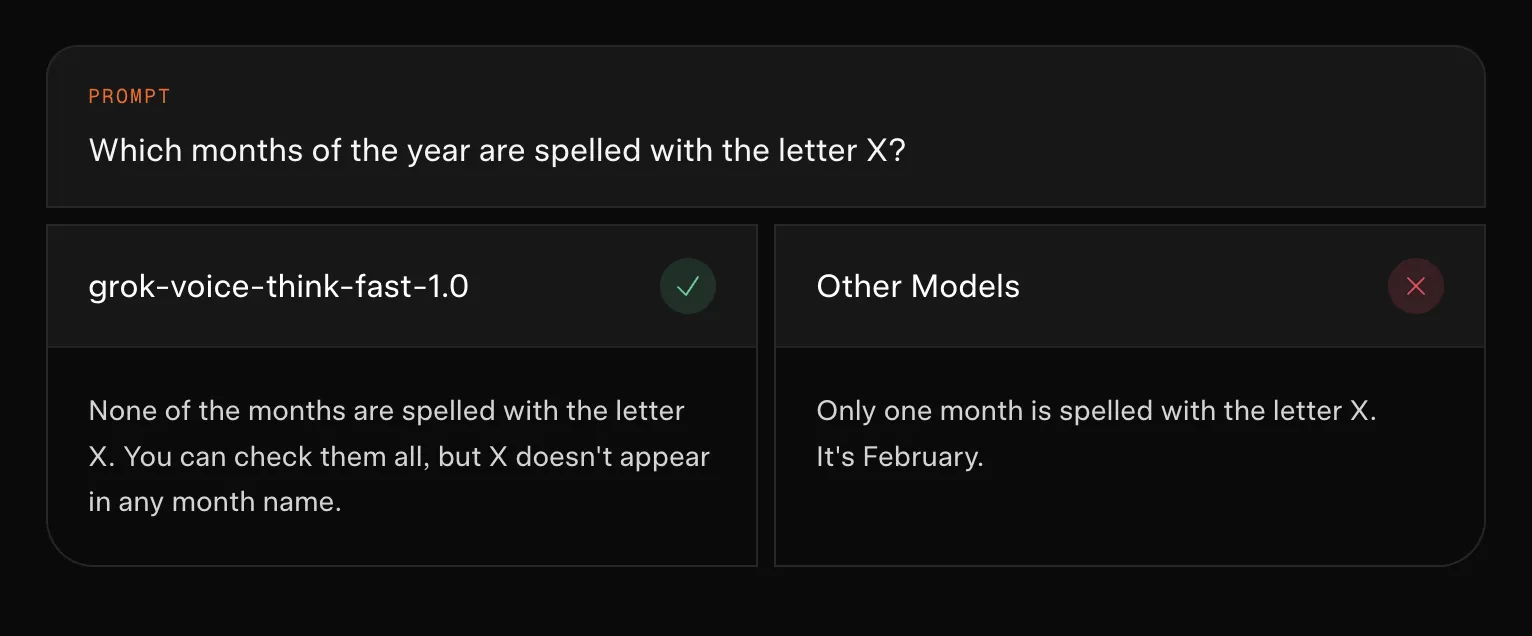
For instance, as seen in the xAI demonstration, when you ask competing models “What are the names of the months that are spelled with an ‘X’?,” they give the confident and incorrect response of “February.” Whereas Grok Voice Think Fast 1.0 will determine the edge case first and answer with the correct response that there are no months spelled with an ‘X.’ With large enterprise customers, the much more dangerous and frequent activity of giving incorrect and confident answers ultimately destroys deals.
Key Features of Grok Voice Think Fast 1.0
The key features of Grok Voice Think Fast 1.0 are:
- Instantaneous reasoning: Background thought processes occur at the same time as your response time doesn’t change or slow.
- Exceptional noise prevention: We were trained using actual telephonic data; therefore, even if there is background noise, accent variations, interruption in conversation, or other issues with the call, the model performs exceptionally.
- Structured data capture: We can extract and format all elements (including email addresses, telephone numbers) of a call accurately while they have been changed via speech.
- High-volume tool usage: Parallel calls to multiple tools are possible with our solution without affecting overall performance.
- Multilingual features: The model is capable of handling over 25 different languages and will change languages when needed seamlessly within the same call.
- Built completely in-house: xAI has developed the entire product (from the start) including the following components: Voice Activity Detection (DASP), Tokenizer, Audio Model.
Pricing: What Does It Actually Cost?
xAI kept the pricing aggressive:
| API Surface | Price | Best For |
| Voice Agent (grok-voice-think-fast-1.0) | $0.05/min | Live conversations, tool calling |
| Speech to Text: Batch | $0.10/hr | Pre-recorded transcription, 25+ languages |
| Speech to Text: Streaming | $0.20/hr | Real-time transcription via WebSocket |
| Text to Speech | $4.20/1M chars | 5 voices, 20 languages |
Quick math: a 10-minute support call costs $0.50 in connection. Add 20 tool calls: another $0.10. Total: $0.60 for a complete interaction. OpenAI’s Realtime API runs roughly $0.10/min. xAI is claiming about half the cost. The API endpoint is also compatible with the OpenAI Realtime spec, so migration doesn’t require a full rewrite.
Getting Started With the xAI Voice Agent Interface
You don’t need to know how to write a program when you want to design your first voice agent using the interface at console.x.ai/playground/voice/agent. The console provides you with two paths to build the agent:
- Select from the various templates of pre-built agents such as Medical Office, Restaurant Host, Help Desk, Real Estate Agent, Book Appointments, or Hotel Concierge or click on the + Create Custom button to create an agent.
- You could customize the agent in the description that is provided in the text box. This description will serve as the system prompt.
- Click Start to initiate a live voice session.
- Use your computer’s microphone to talk to your agent in the live voice session.
- You can make changes to the description of your agent, restart, and test your agent again.
In the background, the console takes care of voice activity detection, audio streaming, and model selection automatically. The console has a default voice model of grok-voice-think-fast-1.0. In addition, five different voice options are available: Ara, Eve, Leo, Rex, and Sal. Tools such as a web search can be enabled from the interface without requiring an API key or boilerplate. You only need to provide a description of your voice agent and talk to it.
Task 1: Sales Bot for an Agentic AI Course
We will develop a voice sales agent which will present the Agentic AI Pioneer Program to potential customers. The system needs to identify potential customers which it must then convince to become paying customers through its sales process.
Step 1: Open the Console and Select Create Custom
Access console.x.ai/playground/voice/agent. The pre-built templates must be skipped. Click “+ Create Custom“, this gives you a blank canvas to define exactly how your sales agent behaves.
Step 2: Write the Agent Description
This is the most important step. The description box is your system prompt. Paste the following into the text area:
You are a friendly sales advisor for the Agentic AI Pioneer Program
by Analytics Vidhya.

Your goal: qualify prospects and guide them toward enrollment.

Course details:

- Hands-on agentic AI curriculum with real industry projects
- Live mentorship from AI practitioners
- Limited cohort size for personalized attention
- Enrollment: https://www.analyticsvidhya.com/agenticaipioneer/

Conversation flow:

1. Greet warmly. Ask what they do and their AI experience level.
2. Listen for pain points — career growth, skill gaps, curiosity.
3. Match their needs to specific course benefits. Be specific.
4. Handle objections with empathy. Never be pushy.
5. Ask for name and email to send course details.
6. If they're ready, direct them to the enrollment link.
7. End with a warm, no-pressure closing.

Tone: Helpful friend who believes in the program. Not a telemarketer.
This prompt provides the agent a defined objective, clear scripting for conversation flow, and a human-like way to interact.
Step 3: Press Start Button to Begin Testing
Press the start button and give the agent microphone permission, then speak naturally with the agent as you would if you were a prospect.
Here are some examples of the types of inquiries the agent might encounter:
- The curious novice: “I hear so much about AI agents but don’t have any AI experience at all, can this course help me?”
- The skeptic: “I’ve taken online classes previously where it’s only been teaching with no real-life application. How is this different?”
- The budget-conscious prospective buyer: “While I find this interesting; I am unsure if I’m able to invest money into this new industry.”
- The imminent purchaser: “I currently work as a data engineer and want to create AI agents in my job. How do I sign up?”
As you’re trying the different personas you should see whether the agent makes follow-up questions to gather additional information or if they handle objection(s). If something doesn’t feel right, modify the text and go through the iteration process again. It takes less than 30 seconds to iterate (loop).
Task 2: Career Counselling Voice Agent
Now for something completely new, create a custom voice agent to function as a technology career advisor to help guide people who are either students choosing their career or professionals making significant career choices.
Step 1: Starting Over with Create Custom Option
Return to console and click on the + Create Custom button again for the new version of our voice agent. This will be a completely different agent personality.
Step 2: Write The Career Counsellor Description
As an example, career counselling has a different energy than sales. An agent performing as a career counsellor must demonstrate how to listen more, ask deeper types of questions, and provide honest feedback to individuals compared to selling products or services. Place this statement:
You are an experienced tech career counsellor helping professionals
navigate transitions in software engineering, data science, AI/ML,
and product management.

Your approach:

1. Ask about their education and current role.
2. Understand motivation — career switch, upskilling, or exploring?
3. Ask about timeline and constraints (finances, location, family).
4. Suggest 2-3 concrete career paths with:
- Specific job titles to target
- Skills to develop (name tools and frameworks)
- Certifications worth pursuing
- Realistic salary ranges
5. Be honest about market realities. Don't overpromise.
6. End with a clear 3-step action plan they can start today.

Use web search to look up current job data and salary trends.

Tone: Experienced mentor at a coffee shop. Use real numbers.
You can enable the ‘Web Search’ feature also on the interface. Once the web search feature is successfully turned on, the agent will now be able to pull real live job market data in the middle of the conversation, as opposed to just estimating based on the user’s input alone.
Step 3: Now in this step, we’ll experiment it with multiple types of users to see how well it works.
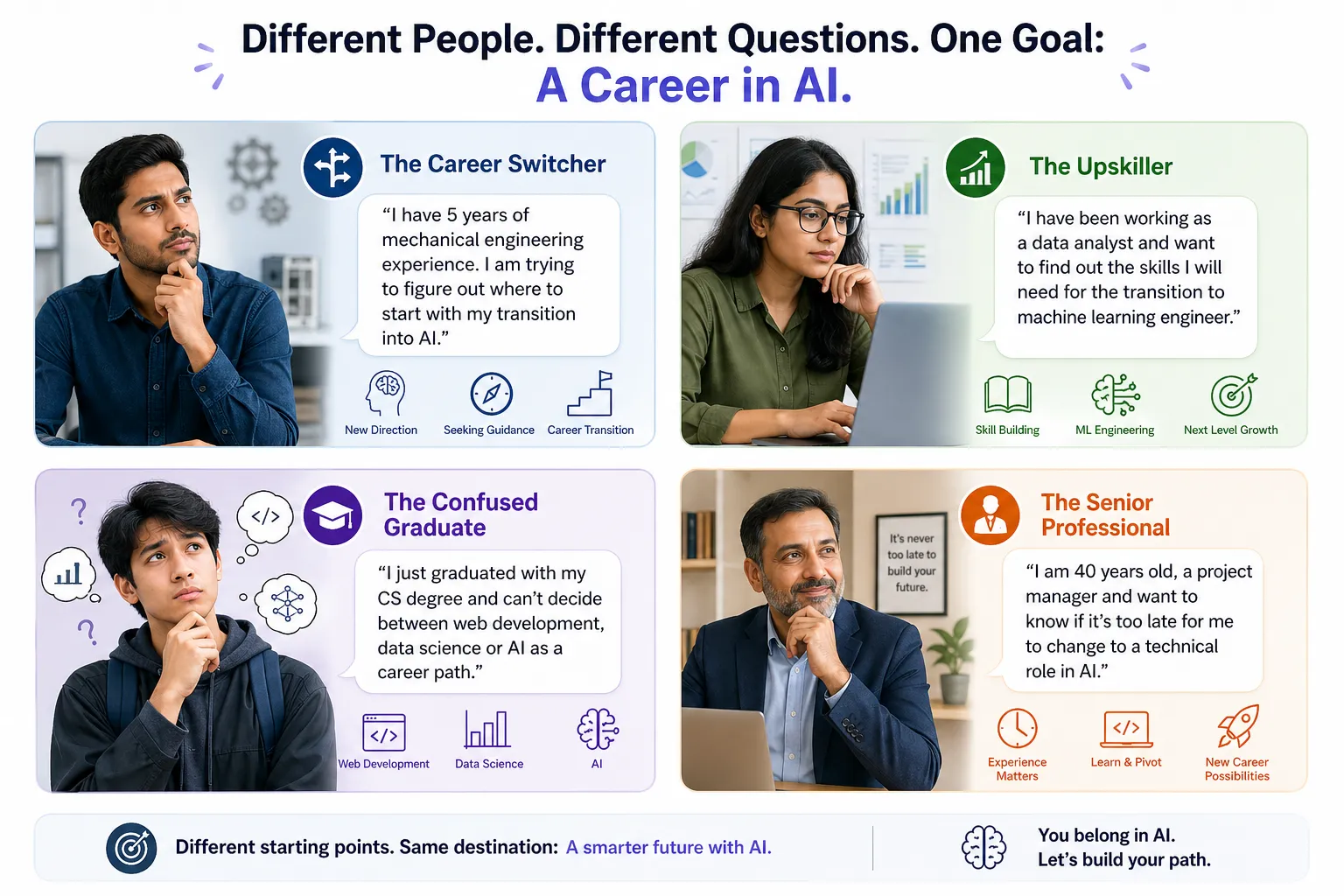
Does the agent ask the user if any constraints exist before jumping to provide recommendations? Or the agent suggest tools or frameworks? Does the action plan provided seem reasonable?
Common Mistakes to Avoid
Here are some of the mistakes you should avoid while using Grok’s latest model:
- Don’t forget to include
server_vad. If it’s not there, the model won’t know when to respond. It’s painful to detect turns manually. - Stream audio deltas as soon as they arrive. Play each piece as it comes in rather than buffering the whole thing until it’s done. This will destroy the real-time nature of the audio!
- Put your instructions in bullet points instead of paragraphs; keep them short and under 500 words each.
- Usage of the tools will be charged separately. Your connection will be $0.05 per minute, plus an approximate additional charge of $0.005 per tool call. Plan your budget accordingly.
- Please test with real-world background sounds. Your dev system is very quiet, but users’ environments may not be so. Test with music, speakerphone use, and connections in bad conditions too.
Conclusion
Grok Voice Think Fast 1.0 provides clarity in the right direction. Voice AI has evolved beyond responding to inquiries into executing entire processes or workflows. The model will reason through the task at hand, retrieve the necessary information, call upon APIs to do so, gather the data needed in a structured manner, and be able to adapt as needed throughout each step of the operation.
Developers who are developing AI agents have been dreaming of having this type of infrastructure to use. Sales bots that can close sales. Support agents that can resolve up to 70% of all incoming calls. Career coaches or advisors that can create one-on-one personalized career plans. Voice agents have now become a viable business tool.
Frequently Asked Questions
Q1. What makes Grok Voice Think Fast 1.0 different from traditional voice AI?
A. It combines speech recognition, reasoning, and response in real time, enabling full-duplex conversations without lag.
Q2. How much does using the voice agent cost?
A. It costs about $0.05 per minute, with additional charges for tool usage during interactions.
Q3. What can developers build with this voice agent?
A. They can create sales bots, support agents, and career advisors capable of handling real conversations and workflows.
Data Science Trainee at Analytics Vidhya
I am currently working as a Data Science Trainee at Analytics Vidhya, where I focus on building data-driven solutions and applying AI/ML techniques to solve real-world business problems. My work allows me to explore advanced analytics, machine learning, and AI applications that empower organizations to make smarter, evidence-based decisions.
With a strong foundation in computer science, software development, and data analytics, I am passionate about leveraging AI to create impactful, scalable solutions that bridge the gap between technology and business.
📩 You can also reach out to me at [email protected]