Fine-tuning LLMs has become much easier because of open-source tools. You no longer need to build the full training stack from scratch. Whether you want low-VRAM training, LoRA, QLoRA, RLHF, DPO, multi-GPU scaling, or a simple UI, there is likely a library that fits your workflow.
Here are the best open-source libraries worth knowing for fine-tuning LLMs locally. From faster speeds to reduced load, all of them have something to offer.
Table of contents
1. Unsloth
Unsloth is built for fast and memory-efficient LLM fine-tuning. It is useful when you want to train models locally, on Colab, Kaggle, or on consumer GPUs. The project says it can train and run hundreds of models faster while using less VRAM.
Best for: Fast local fine-tuning, low-VRAM setups, Hugging Face models, and quick experiments.
Repository: github.com/unslothai/unsloth
2. LLaMA-Factory
LLaMA-Factory is a fine-tuning framework with both CLI and Web UI support. It is beginner-friendly but still powerful enough for serious experiments across many model families. Coming straight from the L
Best for: UI-based fine-tuning, quick experiments, and multi-model support.
Repository: github.com/hiyouga/LLaMA-Factory
3. DeepSpeed
DeepSpeed is a Microsoft library for large-scale training and inference optimization. It helps reduce memory pressure and improve speed when training large models, especially in distributed GPU setups.
Best for: Large models, multi-GPU training, distributed fine-tuning, and memory optimization.
Repository: github.com/microsoft/DeepSpeed
4. PEFT
PEFT stands for Parameter-Efficient Fine-Tuning. It lets you adapt large pretrained models by training only a small number of parameters instead of the full model. It supports methods such as LoRA, adapters, prompt tuning, and prefix tuning.
Best for: LoRA, adapters, prefix tuning, low-cost training, and efficient model adaptation.
Repository: github.com/huggingface/peft
5. Axolotl
Axolotl is a flexible fine-tuning framework for users who want more control over the training process. It supports advanced LLM fine-tuning workflows and is popular for LoRA, QLoRA, custom datasets, and repeatable training configurations.
Best for: Custom training pipelines, LoRA/QLoRA, multi-GPU training, and reproducible configs.
Repository: github.com/axolotl-ai-cloud/axolotl
6. TRL
TRL, or Transformer Reinforcement Learning, is Hugging Face’s library for post-training and alignment. It supports supervised fine-tuning, DPO, GRPO, reward modeling, and other preference-optimization methods.
Best for: RLHF-style workflows, DPO, PPO, GRPO, SFT, and alignment.
Repository: github.com/huggingface/trl
7. torchtune
torchtune is a PyTorch-native library for post-training and fine-tuning LLMs. It provides modular building blocks and training recipes that work across consumer-grade and professional GPUs.
Best for: PyTorch users, clean training recipes, customization, and research-friendly fine-tuning.
Repository: github.com/meta-pytorch/torchtune
8. LitGPT
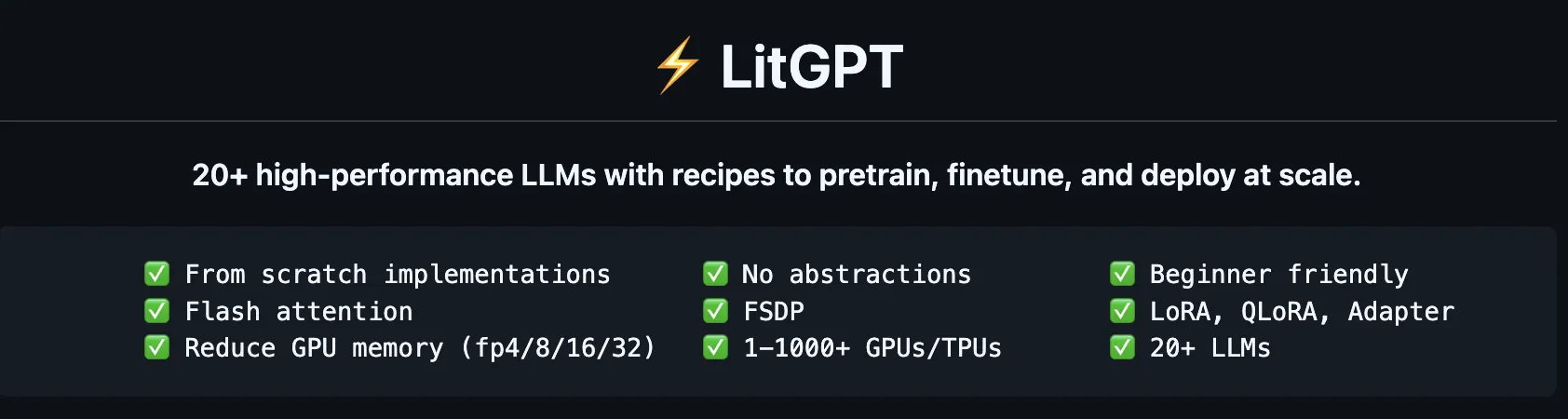
LitGPT provides recipes to pretrain, fine-tune, evaluate, and deploy LLMs. It focuses on simple, hackable implementations and supports LoRA, QLoRA, adapters, quantization, and large-scale training setups.
Best for: Developers who want readable code, from-scratch implementations, and practical training recipes.
Repository: github.com/Lightning-AI/litgpt
9. SWIFT
SWIFT, from the ModelScope community, is a fine-tuning and deployment framework for large models and multimodal models. It supports pre-training, fine-tuning, human alignment, inference, evaluation, quantization, and deployment across many text and multimodal models.
Best for: Large model fine-tuning, multimodal models, Qwen-style workflows, evaluation, and deployment.
Repository: github.com/modelscope/ms-swift
10. AutoTrain Advanced
AutoTrain Advanced is Hugging Face’s open-source tool for training models on custom datasets. It can run locally or on cloud machines and works with models available through the Hugging Face Hub.
Best for: No-code or low-code fine-tuning, Hugging Face workflows, custom datasets, and quick model training.
Repository: github.com/huggingface/autotrain-advanced
Which One Should You Use?
Fine-tuning LLMs locally is one of the most slept on aspects of model training today. Since the libraries are open-source and continually updated, they provide a great way to build credible AI models that are on par with the best models.
If you’re struggling to find the right library for you, the following rubric would assist:
| Library | Category | Main Merit | Skill Level |
|---|---|---|---|
| Unsloth | Speed King | 2x faster training and 70% less VRAM usage making it perfect for consumer GPUs. | Beginner |
| LLaMA-Factory | User-Friendly | All-in-one UI and CLI workflow supporting a massive variety of open models. | Beginner |
| PEFT | Foundational | The industry standard for Parameter-Efficient Fine-Tuning (LoRA, Adapters). | Intermediate |
| TRL | Alignment | Full support for SFT, DPO, and GRPO logic for preference optimization. | Intermediate |
| Axolotl | Advanced Dev | Highly flexible YAML-based configuration for complex, multi-GPU pipelines. | Advanced |
| DeepSpeed | Scalability | Essential for distributed training and ZeRO memory optimization on large clusters. | Advanced |
| torchtune | PyTorch Native | Composable, hackable training recipes built strictly using PyTorch design patterns. | Intermediate |
| SWIFT | Multimodal | Strong optimization for Qwen models and multimodal (Vision-Language) tuning. | Intermediate |
| AutoTrain | No-Code | Managed, low-code solution for users who want results without writing training scripts. | Beginner |
Frequently Asked Questions
Q1. What are open-source libraries for fine-tuning LLM?
A. Open-source libraries simplify fine-tuning large language models (LLMs) locally, offering tools for efficient training with low VRAM usage, multi-GPU support, and more.
Q2. How can I fine-tune LLMs locally with minimal resources?
A. Several open-source libraries allow for fine-tuning LLMs on consumer GPUs, using minimal VRAM and optimizing memory efficiency for local setups.
Q3. What’s the advantage of using open-source tools for LLM fine-tuning?
A. Open-source libraries provide customizable, cost-effective solutions for LLM fine-tuning, eliminating the need for complex infrastructure and supporting quick, efficient training.
Studying, evaluating, and explaining AI systems for over 6 years.
“𝘖𝘯𝘤𝘦 𝘮𝘦𝘯 𝘵𝘶𝘳𝘯𝘦𝘥 𝘵𝘩𝘦𝘪𝘳 𝘵𝘩𝘪𝘯𝘬𝘪𝘯𝘨 𝘰𝘷𝘦𝘳 𝘵𝘰 𝘮𝘢𝘤𝘩𝘪𝘯𝘦𝘴 𝘪𝘯 𝘵𝘩𝘦 𝘩𝘰𝘱𝘦 𝘵𝘩𝘢𝘵 𝘵𝘩𝘪𝘴 𝘸𝘰𝘶𝘭𝘥 𝘴𝘦𝘵 𝘵𝘩𝘦𝘮 𝘧𝘳𝘦𝘦. 𝘉𝘶𝘵 𝘵𝘩𝘢𝘵 𝘰𝘯𝘭𝘺 𝘱𝘦𝘳𝘮𝘪𝘵𝘵𝘦𝘥 𝘰𝘵𝘩𝘦𝘳 𝘮𝘦𝘯 𝘸𝘪𝘵𝘩 𝘮𝘢𝘤𝘩𝘪𝘯𝘦𝘴 𝘵𝘰 𝘦𝘯𝘴𝘭𝘢𝘷𝘦 𝘵𝘩𝘦𝘮.” — 𝖥𝗋𝖺𝗇𝗄 𝖧𝖾𝗋𝖻𝖾𝗋𝗍, 𝖣𝗎𝗇𝖾