Claude Mythos Preview, the AI model that sparked global concern earlier this year, has now evolved into two new offerings: Claude Fable 5 and Claude Mythos 5. Derived from the highly restricted Mythos Preview, these models bring Anthropic’s most advanced AI capabilities to a broader audience.
Anthropic is making bold claims, with Fable 5 reportedly setting new performance standards across a wide range of benchmarks. In this article, we take a closer look at what these Mythos-class models offer, how they differ, and who can access them.
Table of contents
What is Claude Fable 5?
According to Anthropic, Fable 5 outperforms previous Claude models across software engineering, knowledge work, vision, scientific research, and long-running tasks. More notably, Anthropic claims that Fable 5’s advantage grows as tasks become more complex and require sustained reasoning over longer periods.
In practice, this means Fable 5 is designed for workflows that involve multiple steps, large amounts of information, and extended context. Examples include codebase-wide migrations, financial analysis, complex document review, scientific research, screenshot-to-app generation, and other long-context problem-solving tasks.
Rather than optimizing for short interactions alone, Fable 5 is built to maintain performance and coherence throughout lengthy, demanding workflows.

Claude Fable 5 and Mythos 5: Key Features
The biggest upgrade with Claude Fable 5 and Claude Mythos 5 is their ability to handle longer, more complex tasks. Anthropic says the models perform strongly across coding, knowledge work, vision, memory, and scientific research. In testing, Fable 5 handled large coding projects, analyzed financial documents, interpreted charts, and rebuilt applications from screenshots.
A key differentiator is autonomy. The models can stay focused across lengthy workflows, retain context more effectively, and solve multi-step problems with less guidance. Mythos 5 extends these capabilities to trusted users in areas such as cybersecurity, drug discovery, molecular biology, and genomics research.
Key capabilities include:
- Advanced coding: Supports complex software engineering and long-horizon development tasks.
- Stronger knowledge work: Excels at document analysis, financial reasoning, and problem-solving.
- Improved vision: Understands screenshots, charts, scientific figures, and UI layouts.
- Long-context memory: Maintains context across large inputs and extended workflows.
- Scientific research support: Assists with biology, genomics, and drug discovery in trusted-access environments.
- Built-in safeguards: Applies additional protections for sensitive domains such as cybersecurity, biology, chemistry, and model distillation.
Claude Fable 5 and Mythos 5: Benchmark Performance
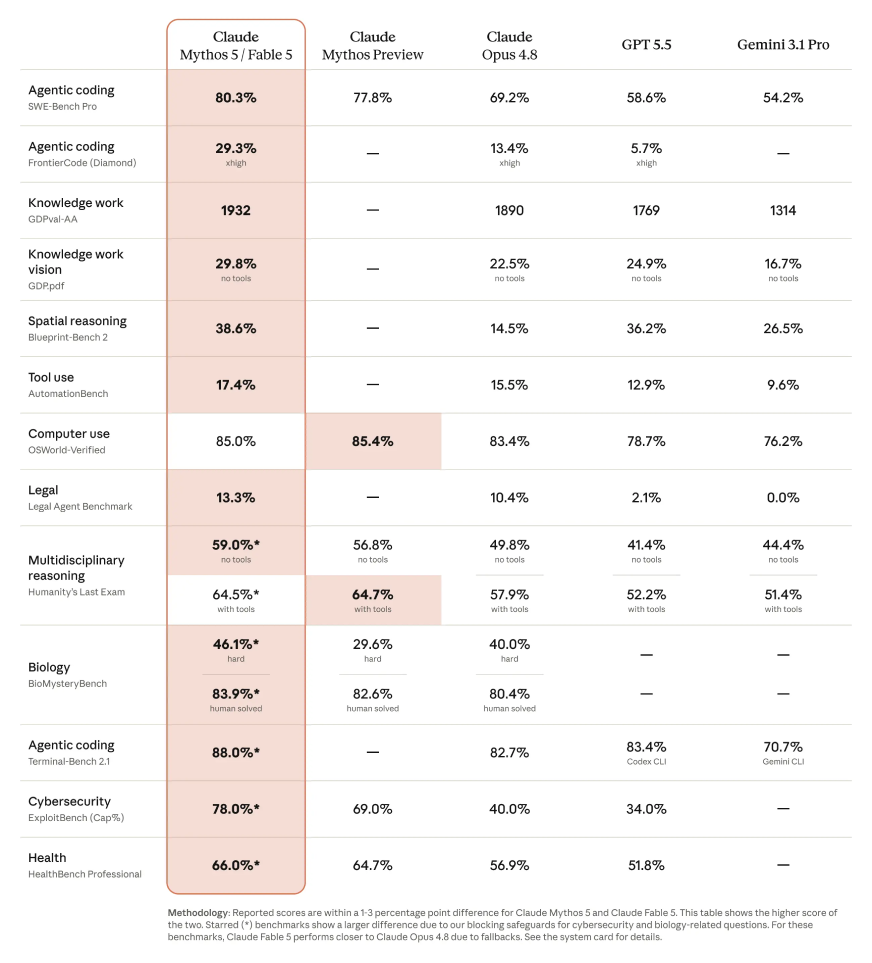
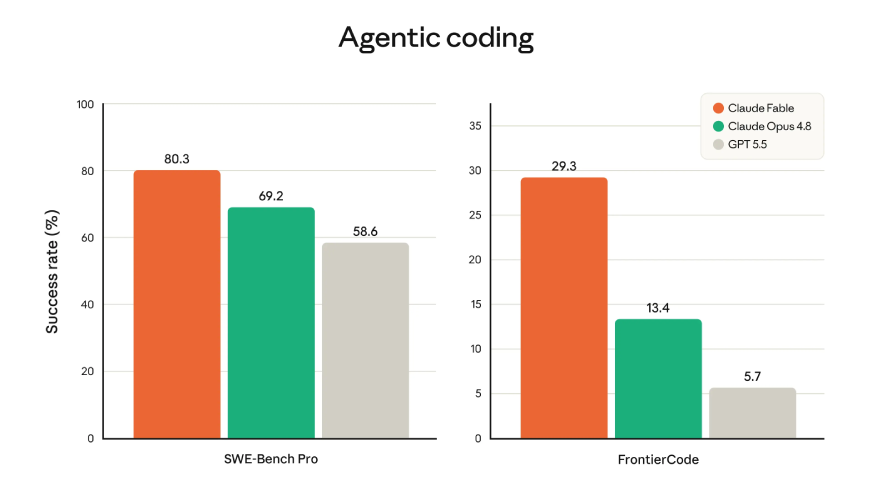
Anthropic’s benchmark results show Claude Fable 5 and Mythos 5 leading across many of the areas that matter most for practical AI applications, including agentic coding, knowledge work, reasoning, tool use, cybersecurity, biology, and health.
The broader takeaway is that these models appear strongest on complex, multi-step tasks that require sustained reasoning, extensive context, and effective tool usage.
How to Access Claude 5 and Mythos 5?
Getting started with Claude Fable 5 is simple. Options include:
- Claude API: Access immediately via the model string
claude-fable-5. Also available on consumption-based Enterprise plans. - Claude apps: Included at no extra cost in Pro, Max, Team, and seat-based Enterprise plans through June 22, 2026. Access rolls out in stages.
- Cloud platforms: Available on AWS, Google Cloud, and Microsoft Foundry, alongside Claude Code and the Claude Platform.
Pricing: $10 per million input tokens, $50 per million output tokens. Prompt caching provides a 90% discount on input tokens.
Note: Fable 5 includes safeguards for cybersecurity and biology. Flagged queries are routed to Opus 4.8 without incurring Fable charges, making this mostly transparent for users.
Let’s Try Claude Fable 5
Benchmarks are useful, but developers care more about whether a model speeds up real-world development. I tested Fable 5 on two tasks to assess its comprehension of visual input, production-ready code generation, and ability to work from existing designs.
Task 1: Recreating the Netflix Interface from a Screenshot
Objective: Evaluate Fable 5’s visual understanding and frontend capabilities.
Input: A single screenshot of Netflix’s “New & Popular” page, containing:
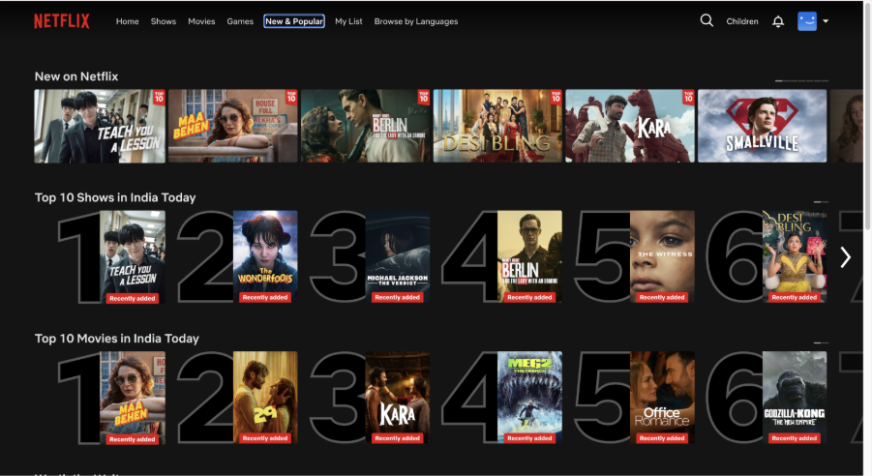
- Complex navigation bar
- Horizontally scrolling content carousels
- Rank labels on content cards
- Multiple content sections with differing layouts
- Dark theme styling
- Badges, labels, and overlays
Prompt:
Recreate this as a working HTML/CSS page. Make it pixel accurate. No frameworks, just clean HTML and CSS. Ensure responsive behavior for desktop and mobile.
Output:
Evaluation Criteria:
- Layout accuracy
- Navigation bar structure
- Netflix-style content rows
- Responsiveness
- Code quality
My Review:
Fable 5 did a great job of identifying all the important UI components as well as creating an actual functioning web page that resembles what you would find on the Netflix website. It recognized that the major components of the web page are composed of three main parts: a fixed navigation area followed by multiple vertical cards (i.e., content) laid out in a horizontal fashion.
An area I was especially impressed with is how well it recognised patterns that repeat. For example, instead of treating each movie card (title card) that was rendered on the page as an individual piece of content, Fable 5 used the same constructs for each card, and of course, retained styling across all cards on the page.
Task 2: Turning a Hand-Drawn Dashboard Sketch into a Modern Analytics Application
Objective: Simulate a real-world product workflow, turning rough sketches into a polished application.
Input: Hand-drawn dashboard wireframe with:
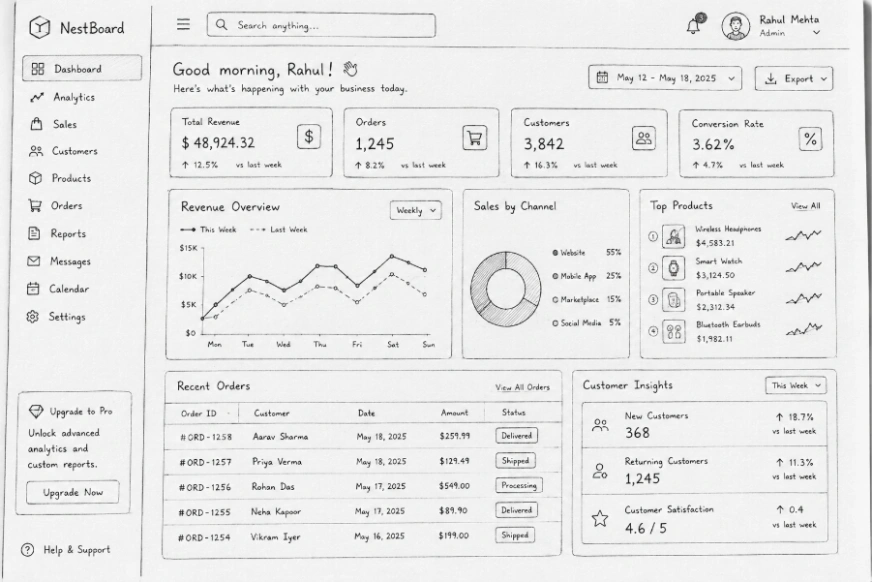
- Layout instructions
- Charts and KPI cards
- Tables and navigation elements
- Dashboard widgets
Prompt:
Convert this hand-drawn dashboard into a modern SaaS analytics application. Use React, Tailwind CSS, and responsive design principles. Create polished charts, modern card layouts, subtle animations, proper spacing, and professional typography. Fill in any missing design details while preserving the structure of the sketch.
Output:
Evaluation Criteria:
- Understanding of hand-drawn layout
- Visual hierarchy comprehension
- Filling in missing design elements
- Component quality
- Responsiveness
- Overall visual presentation
My Review:
Fable 5 interpreted intent rather than copying pixels. It generated cohesive layouts with:
- Sidebar navigation
- KPI analytics cards
- Data visualization areas
- Administrative controls
- Tables
- Customer intelligence widgets
The model filled missing colors, typography, spacing, and interactivity intelligently. A few design choices leaned toward extra styling that might need refinement for production, but the app was usable and visually consistent.
Conclusion
The most notable aspect of this release isn’t just the performance or new capabilities—it’s how access is managed.
Rather than releasing its most powerful models to everyone, Anthropic is drawing a clear line between broadly available AI and restricted frontier AI. Fable 5 brings much of the Mythos-class intelligence to developers, enterprises, and Claude users, while Mythos 5 remains limited to trusted partners and researchers in sensitive domains.
This approach signals a shift in how advanced AI may be deployed in the future: not only based on capability, but also on risk and responsible access. For users, Fable 5 delivers stronger coding, reasoning, vision, and research support. For Anthropic, Mythos 5 tests whether frontier AI can be expanded safely without exposing the riskiest capabilities to the public.
Frequently Asked Questions
Q1. What is the difference between Claude Fable 5 and Claude Mythos 5?
A. Claude Fable 5 is the broadly available version of Anthropic’s Mythos-class AI, designed for developers, enterprises, and Claude users. Claude Mythos 5 is a more restricted model available only to trusted partners and researchers working in sensitive areas such as cybersecurity and biology.
Q2. How can I access Claude Fable 5?
A. Claude Fable 5 is available through the Claude API using the model string claude-fable-5, on Claude Pro, Max, Team, and Enterprise plans, and through cloud platforms such as AWS, Google Cloud, and Microsoft Foundry.
Q3. What are the key improvements in Claude Fable 5?
A. Claude Fable 5 is designed to handle longer and more complex tasks than previous Claude models. It offers stronger coding capabilities, improved reasoning, better visual understanding, enhanced long-context memory, and more reliable performance across multi-step workflows.
Q4. How much does Claude Fable 5 cost?
A. Claude Fable 5 costs $10 per million input tokens and $50 per million output tokens. Anthropic also offers prompt caching, which can reduce input token costs by up to 90% for eligible requests.
Data Science Trainee at Analytics Vidhya
I am currently working as a Data Science Trainee at Analytics Vidhya, where I focus on building data-driven solutions and applying AI/ML techniques to solve real-world business problems. My work allows me to explore advanced analytics, machine learning, and AI applications that empower organizations to make smarter, evidence-based decisions.
With a strong foundation in computer science, software development, and data analytics, I am passionate about leveraging AI to create impactful, scalable solutions that bridge the gap between technology and business.
📩 You can also reach out to me at [email protected]