For months, Claude Code has been the go to terminal coding agent for developers. Then Grok Build arrived in beta on May 14, 2026, giving developers a second serious option and raising a new question: which one actually performs better?
I tested both agents on the same real world coding tasks using identical prompts to compare their strengths, weaknesses, and overall workflow. Since Grok Build is still in early beta, rapid improvements are expected. In this article, we’ll compare both tools, analyze benchmark results, and show prompts you can run on your own codebase.
Table of contents
What Each Tool Actually Is
Both tools sit in your terminal and do the same broad thing: you describe what you want in plain English, and the agent reads your codebase, plans the changes, edits files, runs commands, and iterates until the work is done. That surface similarity hides a pretty sharp architectural difference.
Claude Code
Claude Code is Anthropic’s terminal-native coding agent, built on top of Opus and Sonnet model variants. It uses a single, deep reasoning pass. One agent, up to 1 million tokens of context, deliberate planning before any file gets touched. It shows you its plan and waits for your approval. You stay in control without micromanaging every step.
It has been in production since early 2025, which means the tooling, community resources, and integration patterns (VS Code, CI, MCP) are mature.
Grok Build CLI
Grok Build is xAI’s bet on parallelism over depth. Where Claude Code uses one agent with a 1M token context window for deep reasoning, Grok Build spins up to eight subagents working simultaneously. The flagship feature is Arena Mode: multiple agents race to solve the same task independently, and you pick the best output. It is a fundamentally different philosophy to how AI agents should work on code.
The underlying model, grok-build-0.1, was purpose-built for this CLI, replacing the earlier grok-code-fast-1 model on May 20, 2026. It has a 256K context window, supports text and image input, and is priced at $1.00 per million input tokens and $2.00 per million output tokens via the xAI API. Access requires a SuperGrok ($299/month) or X Premium Plus subscription.
How Grok Build actually works
Every task goes through three stages. First, a coordinator agent reads your codebase and breaks the task into a numbered plan, the same approval gate you see in Claude Code. You review and approve it before anything is written. Second, the work gets distributed across parallel subagents. On a large task like adding authentication to an Express app, one agent might handle the route layer, another the token logic, and a third the test coverage, all running simultaneously. Third, results come back as reviewable diffs before anything is committed, so you stay in control of what lands.
Arena Mode in practice
Arena Mode is what makes Grok Build genuinely different from anything else in the terminal right now. Instead of trusting one agent’s output, you get competing solutions and select the winner. This is most useful when the task has multiple valid approaches, like refactoring a module where strict typing, performance, or test coverage could each be the priority. You pick which implementation fits your actual constraints rather than hoping the model guesses correctly. Turn it off for routine edits. The overhead of evaluating three competing outputs is not worth it for a simple bug fix.
Grok Skills
Grok Build also ships with Skills: named, versioned instruction bundles invoked via slash commands inside any session. You give a Skill a name, a description, and a full behavioral spec, and from then on you trigger the entire workflow with a single slash command. Skills travel with your repository through pull requests and code reviews. xAI shipped a built-in set covering document and data workflows (Word generation, Excel with formulas, PDF operations) in May 2026, and you can write custom ones for your own repeating tasks.
Installing Grok Build CLI
Claude Code setup is covered in our Getting Started with Claude Code article. Here is what getting Grok Build running looks like:
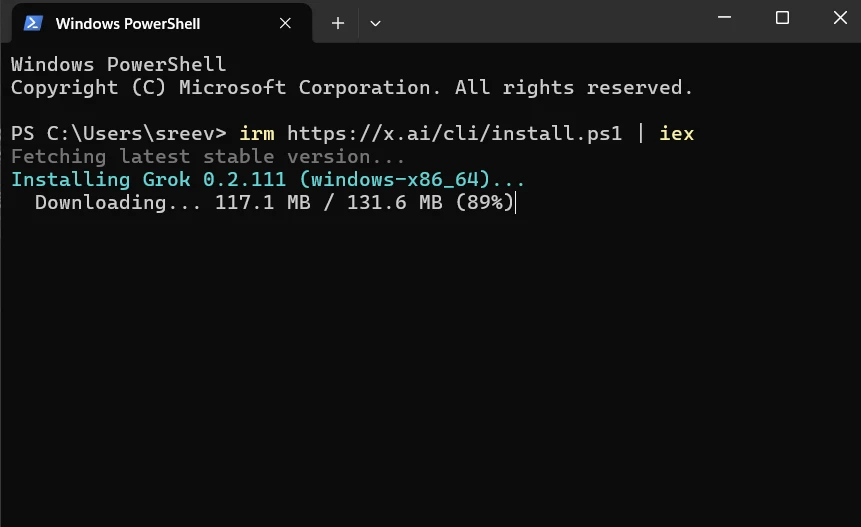
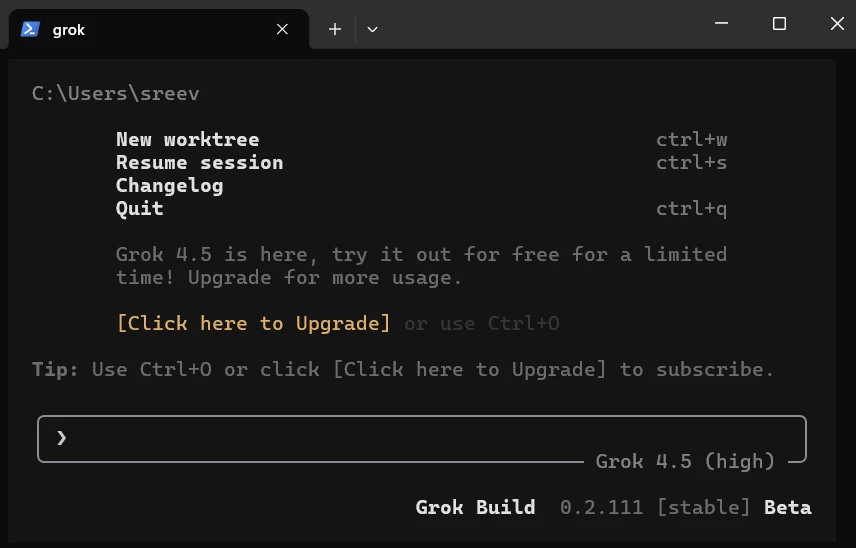
Grok Build Setup
# One-line install
curl -fsSL https://x.ai/cli/install.sh | bash

# Authenticate with your xAI/X account
grok auth login

grok
Grok Build indexes your project directory on launch. The install takes under a minute. The gating is the subscription, not the technical setup.
How to Actually Test Them Yourself
Benchmarks are useful context, but the only comparison that matters is how they perform on real tasks. Start with Prompt 1 below, it works without an existing project so you can try both tools in under five minutes. Prompts 2 to 5 are for testing against your own codebase.
Prompt 1: The quick test (no existing project needed)
This is the single prompt to try if you haven’t used either tool before. Create an empty folder, open it in your terminal, and run the same instruction in both:
Build a working REST API in Python with two endpoints: GET /health returns {"status": "ok"} and POST /echo returns whatever JSON body you send it. Use FastAPI. Add a README.
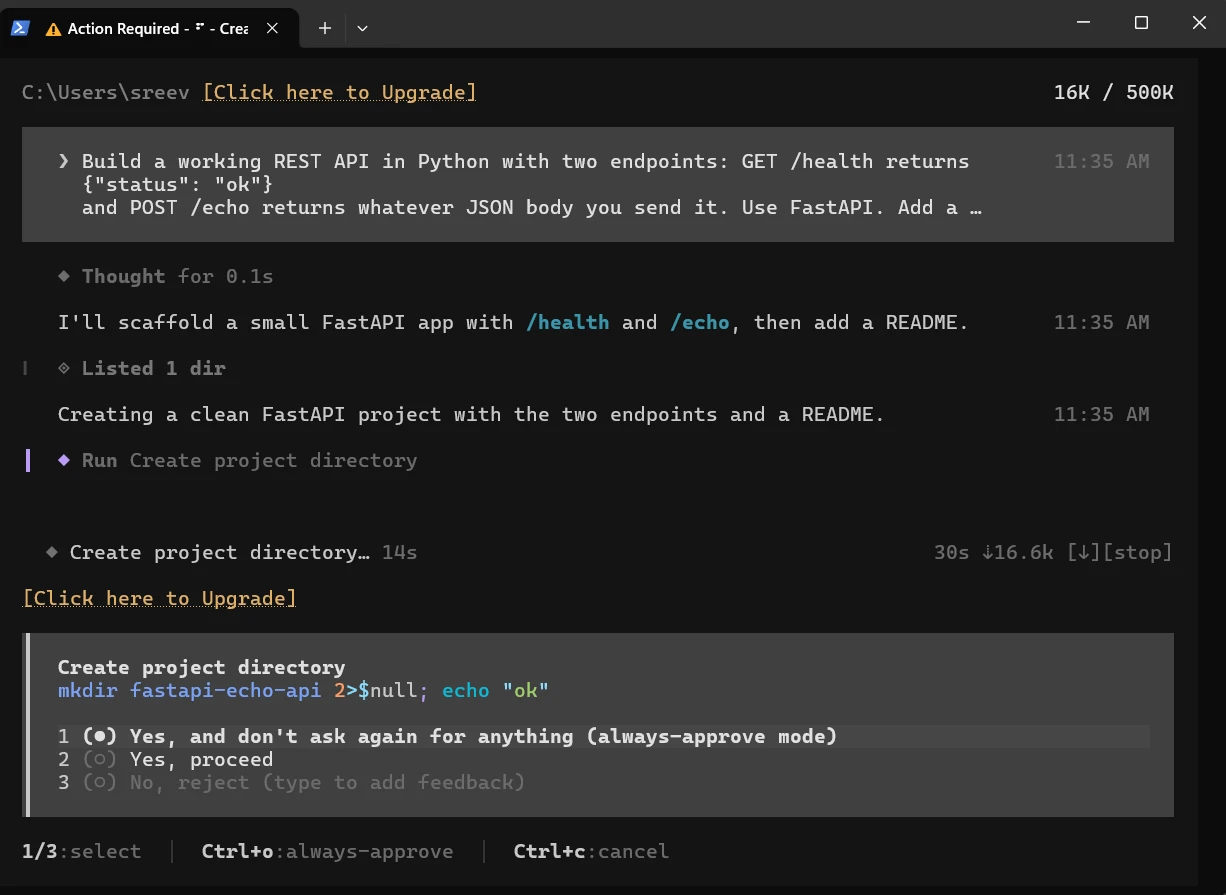
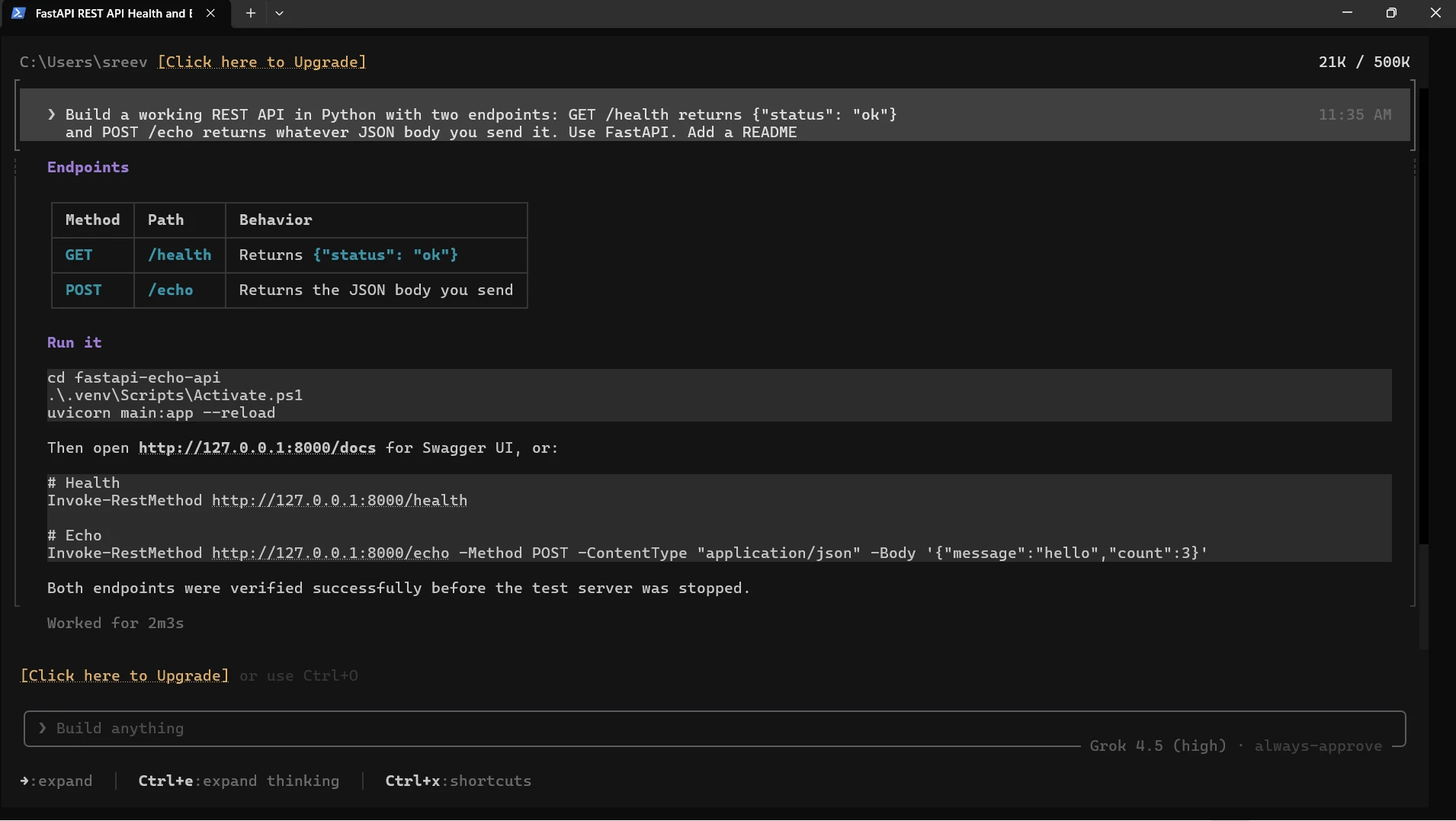
What to look for: Claude Code will show you a step-by-step plan and ask your approval before writing a single file. Grok Build will spawn multiple agents and optionally give you competing implementations in Arena Mode. Run both and you’ll understand the fundamental difference between how the two tools think about a task, right away, without needing an existing codebase.
Prompt 2: Refactoring (tests reasoning quality)
Refactor auth.js to use async/await throughout.
Add JSDoc comments to every function.
Do not change any behavior, only the syntax and documentation.
What to look for: Claude Code will show you a numbered plan and ask for approval before touching anything. Grok Build in Arena Mode will spawn multiple agents, each with a slightly different interpretation, and let you pick. Claude’s approach is more predictable. Grok’s Arena output gives you options but requires you to evaluate them, which adds time.
Prompt 3: Multi-file feature (tests context handling)
Add rate limiting to every API route in the routes/ folder.
Use express-rate-limit.
Add a test for the rate limiting behavior in each route's test file.
This one stresses the context window. Your routes and test files together might be tens of thousands of tokens. Claude Code’s 1M token window handles this comfortably on large codebases. Grok Build’s 256K limit can become a real constraint here. Watch for Grok missing a route file or truncating test coverage when the codebase gets large.
Prompt 4: Debugging (tests error diagnosis)
The user login endpoint returns 500 intermittently in production.
Check the auth flow, database connection handling, and error boundaries.
Identify the most likely cause and propose a fix with a test to catch it.
Diagnosis tasks favor deep reasoning over parallel breadth. Claude Code tends to produce more thorough root cause analysis here. Grok Build’s parallel agents can generate competing hypotheses, which is occasionally useful, but for a single well-defined bug the extra output often just adds noise to evaluate.
Prompt 5: New feature from scratch (tests autonomy)
Add a password reset flow.

It needs an endpoint to request a reset link, an endpoint to validate the token and accept a new password, and emails via the existing mailer setup. Follow the patterns already in this codebase.
This is where Grok Build’s parallel subagents shine most. Spinning up separate agents for the endpoint, the token logic, and the email integration in parallel can genuinely be faster than a sequential single-agent pass. If you’re doing greenfield feature work, this is where Grok Build’s architecture pays off most clearly.
The Numbers: What Benchmarks Actually Tell You
SWE-bench Verified is the main reference point people use for coding agent comparisons. Here is where both tools sit as of mid-2026, based on vendor-reported and independently verified scores.
| Metric | Claude Code | Grok Build CLI |
|---|---|---|
| SWE-bench Verified | 87.6% (Opus 4.7) | 70.8% (grok-code-fast-1, beta) |
| Context window | 1M tokens | 256K tokens |
| Architecture | Single deep agent | Up to 8 parallel subagents |
| Arena Mode | No | Yes |
| MCP support | Yes | Yes (beta) |
| Free tier | Yes (usage limited) | No |
| Paid entry point | Pro plan | SuperGrok $299/mo |
Two things worth noting about these numbers. First, the 70.8% SWE-bench figure for Grok Build was measured on grok-code-fast-1, which was deprecated on May 15, 2026. The production CLI now runs on grok-build-0.1, and xAI has not published an updated benchmark score for it yet. The gap may be narrower or wider. Second, Grok Build is early beta. xAI is shipping updates weekly. The gap will close over time.
Claude Code’s SWE-bench lead is real, but benchmarks measure performance on standardized coding problems, not your specific codebase. That’s why the practical test prompts above matter more than these numbers for most teams.
Who Should Use Which
Use Claude Code if:
- You are working with a large existing codebase. The 1M token context window is genuinely useful when you need to reason across dozens of files at once.
- You need stability in production tooling. A year of community use means bugs, edge cases, and CI integration patterns are well documented.
- You are not on SuperGrok. The cost barrier for Grok Build is real. Claude Code’s free tier and Pro plan pricing are more accessible for individual developers.
- Your tasks are complex, multi-step reasoning problems where a single deep pass beats multiple shallow passes.
Use Grok Build if:
- You are already on SuperGrok or X Premium Plus and want to use what you’re paying for.
- You do a lot of greenfield feature work where parallel agents exploring different implementations simultaneously saves real time.
- Arena Mode appeals to you. Having the agent generate three competing versions of the same function and picking the best one is a genuinely different workflow from Claude Code’s single-pass approach.
- You want to evaluate it now before your team standardizes on a tool. It’s early enough that getting familiar with it while xAI iterates is a reasonable bet.
Verdict
Most senior developers I talked to don’t pick one and abandon the other. They run a primary (usually Claude Code for anything production-critical) and keep the second around for specific jobs. That’s probably the right approach right now.
Things to watch out for:
- Grok Build — context ceiling: 256K fills up fast on a mid-size monorepo. Exceed it and the agent silently works on a subset of your files. Claude Code’s larger window matters here in practice, not just on paper.
- Grok Build — Arena Mode has a cost: Three candidate implementations means three things to evaluate, and you need to understand the differences well enough to pick correctly. Overkill for simple tasks; useful for genuinely ambiguous architectural calls.
- Claude Code — check your pricing before heavy use: Your draft cites a June 15, 2026 move to metered credits. Verify current usage and rates before committing to long agentic workloads, especially on Pro or a legacy plan.
- Both — configure MCP first: Filesystem and GitHub connectors at minimum. Testing either tool without MCP means you’re not evaluating what it actually does in a real workflow.
Frequently Asked Questions
Is Grok Build CLI free to use?
No. Access requires a SuperGrok ($299/month) or X Premium Plus subscription. There is no free tier. Claude Code has a free usage tier with daily limits.
What is Arena Mode in Grok Build?
Arena Mode spawns multiple agents that each independently solve the same task. You review the competing outputs and pick the best one. It is most useful when you want to explore different implementation approaches rather than commit to a single solution.
Can I use both Claude Code and Grok Build on the same project?
Yes. They operate independently in your terminal and both read your local files. Many developers use one as their primary tool and reach for the other for specific task types.
Does Grok Build support MCP?
Yes, MCP support is included in the Grok Build beta. Setup follows a similar pattern to Claude Code’s MCP configuration.
Which has better benchmark performance?
Claude Code scores 87.6% on SWE-bench Verified with Opus 4.7. Grok Build’s published figure of 70.8% is from its earlier grok-code-fast-1 model, which was deprecated in May 2026. An updated score for the current grok-build-0.1 model has not been published yet.
Hi , I am Sree Vamsi a passionate Data Science enthusiast currently working at Analytics Vidhya. My journey into data science began with a curiosity for uncovering insights from complex data and has evolved into building end-to-end Generative AI applications, RAG pipelines, agentic AI workflows, and multi-agent systems that solve real-world business problems.