AI agents are everywhere right now. You hear terms like tool calling, agent loops, MCP, guardrails thrown around as if its common language… it isn’t! But that is about to change.
Agentic AI isn’t nearly as complicated as it sounds once you understand the few core ideas that actually matter.
Here are 10 agentic AI concepts that everyone should know about, ranked by what people are searching for and using daily.
Table of contents
If you feel that the concepts are a bit tough to go through, considering reading basic AI concepts before moving on to this one.
1. AI Agents
A chatbot answers. Think ChatGPT, Claude, Gemini… at least how they were back in the days.
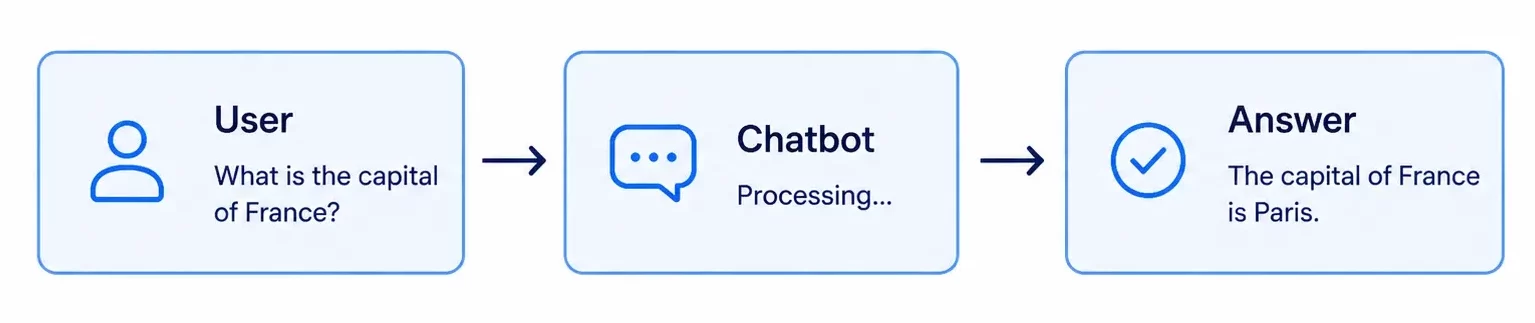
An AI agent works toward a goal.
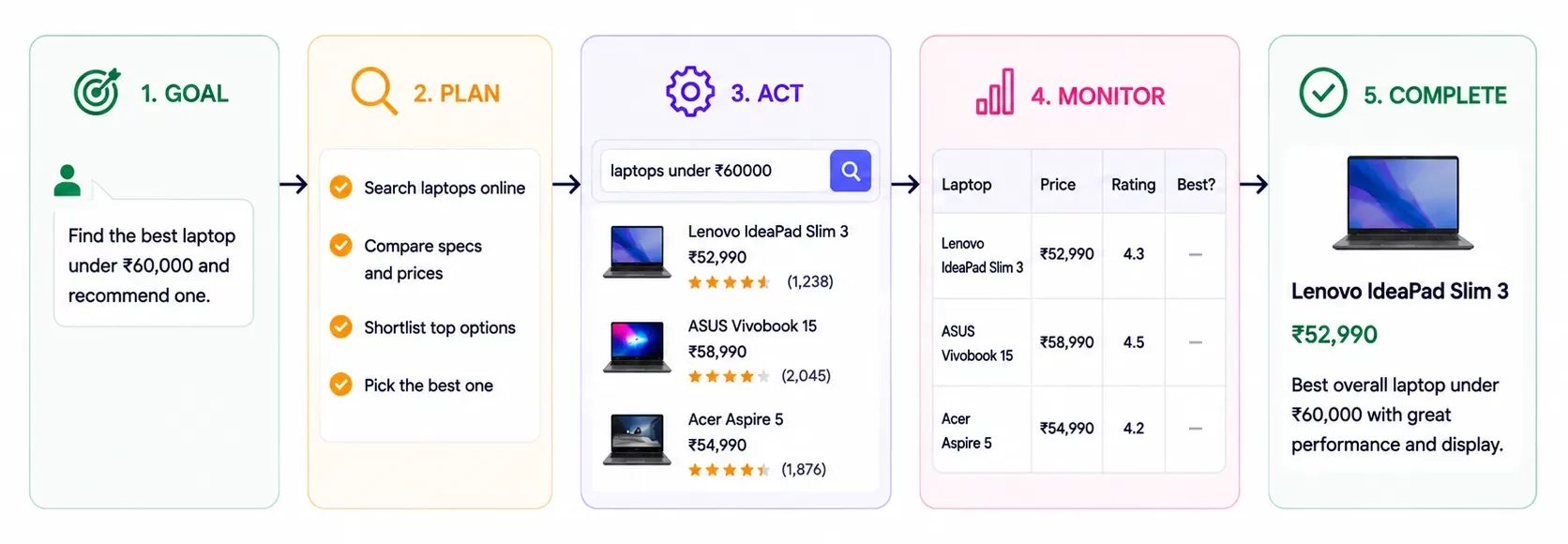
An AI agent is a system that uses an AI model to decide what actions to take, interact with external tools or systems, observe the results, and continue working through a task.
For example, imagine telling an AI:
“Find three flights to London under ₹60,000, compare them, and draft the best itinerary.”
A chatbot can tell you how to search for flights.
An agent can:
- Search flight websites
- Collect available options
- Filter them by price
- Compare departure and arrival times
- Check baggage rules
- Prepare an itinerary
The important difference is that the agent isn’t simply generating the answer in one shot. It is executing a process.
2. The Agent Loop
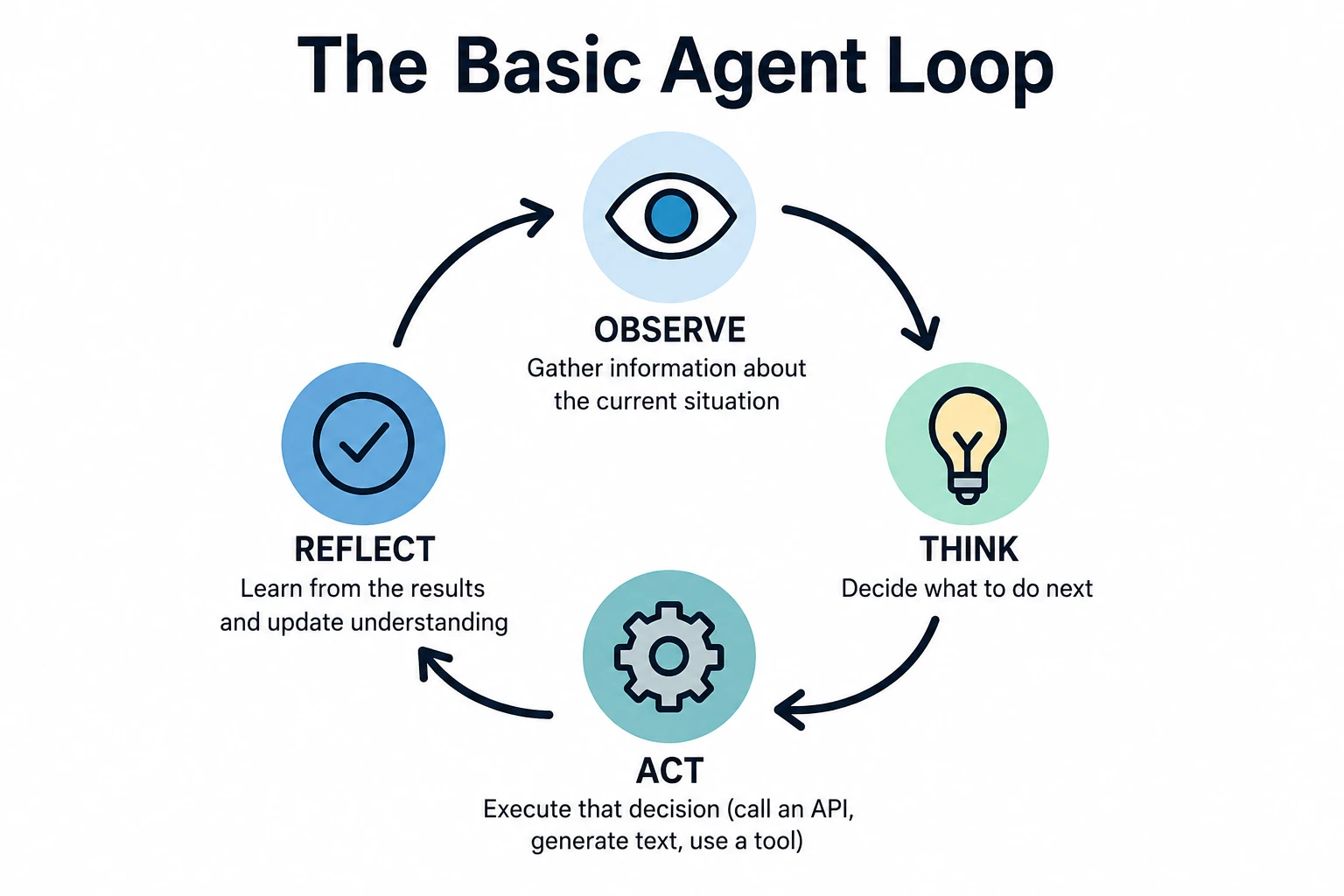
The most important idea behind agentic AI in general, is the agent loop.
An agent doesn’t know the complete solution before it starts. It takes an action, sees outcome, and then decides what to do next based on the outcome.
Suppose an agent is asked:
“Find the latest quarterly revenue for OpenAI.”
It will:
- Search the web
- Find earning reports for OpenAI
- Open the relevant document
- Search for revenue
- Verify the number against another source
- Return the answer
If the first website doesn’t contain the information, the agent can change its approach. That ability to observe intermediate results and adapt is what makes the loop different from a simple predetermined prompt chain.
3. Tool Calling
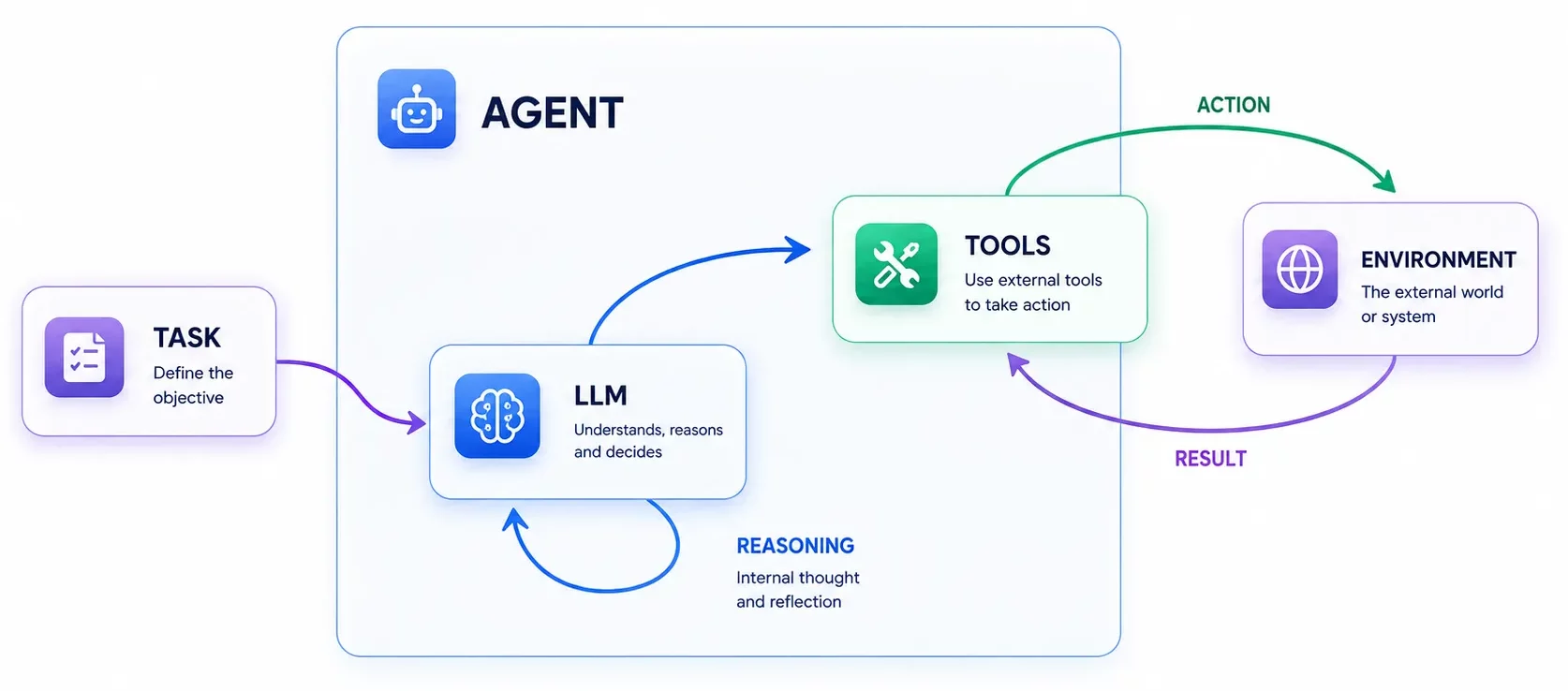
An AI chatbot by itself cannot send an email, query your company’s database, or browse your website.
Tools give agents those capabilities.
A tool is simply an external function that an agent can call when it needs to perform a specific action.
Examples include:
- Web search
- Coding
- Calculators
- Databases
- APIs
For example:
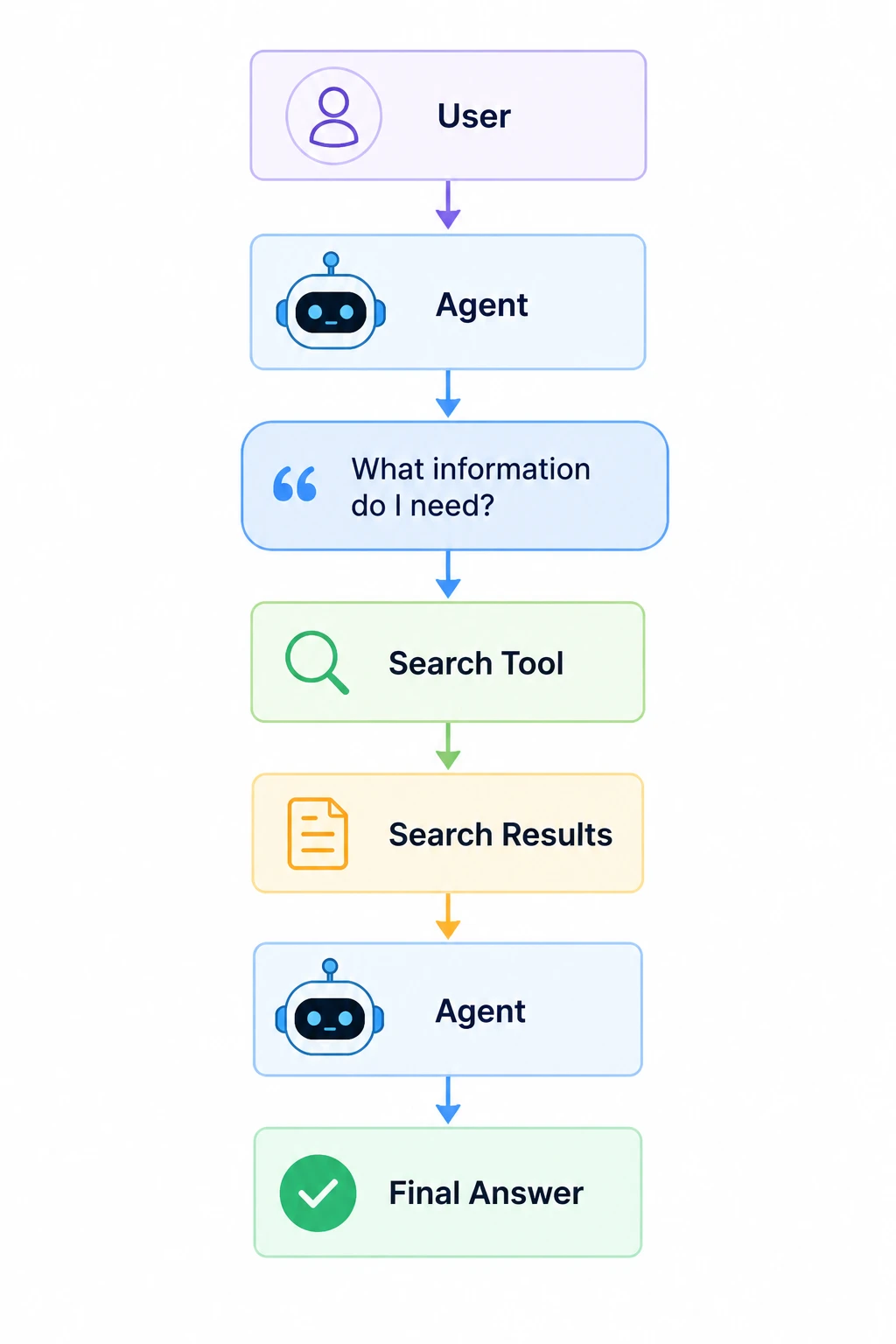
The AI model decides which tool to use and what arguments to send to it.
If an agent has access to:
get_weather(city)

search_web(query)

send_email(to, subject, body)
and you ask:
“Check tomorrow’s weather in Mumbai and email me the forecast.”
The agent can decide that it needs both get_weather() and send_email().
Click here for the Flowchart
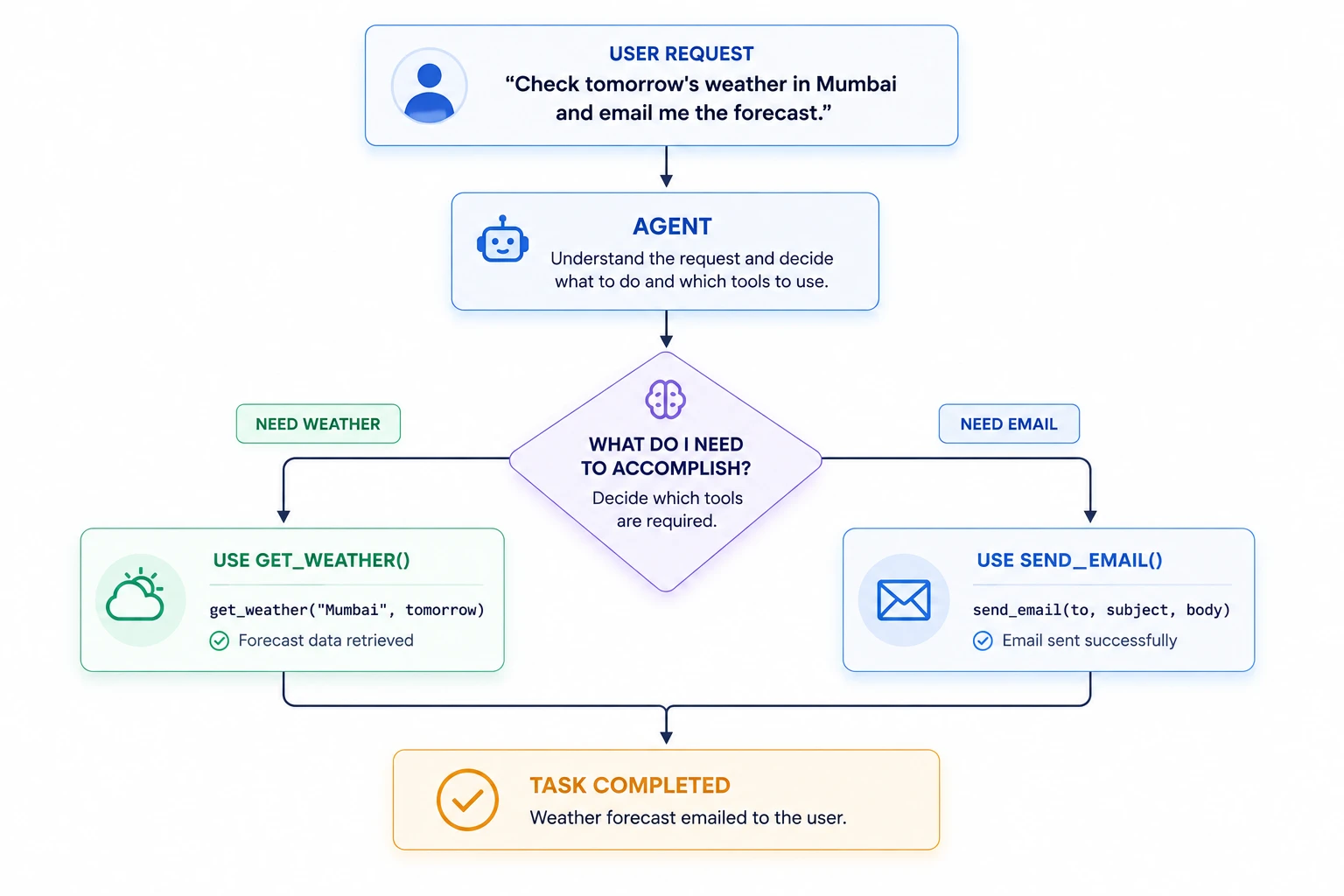
This is called tool calling or function calling. It is one of the biggest differences between ordinary text generation and agentic systems.
4. Task Decomposition
Some tasks are too complicated to solve in a single step. Agents can handle these problems by breaking a large goal into smaller tasks.
Let’s say you’ve asked:
“Find the best CRM for our startup and recommend one.”
An agent will turn that into:
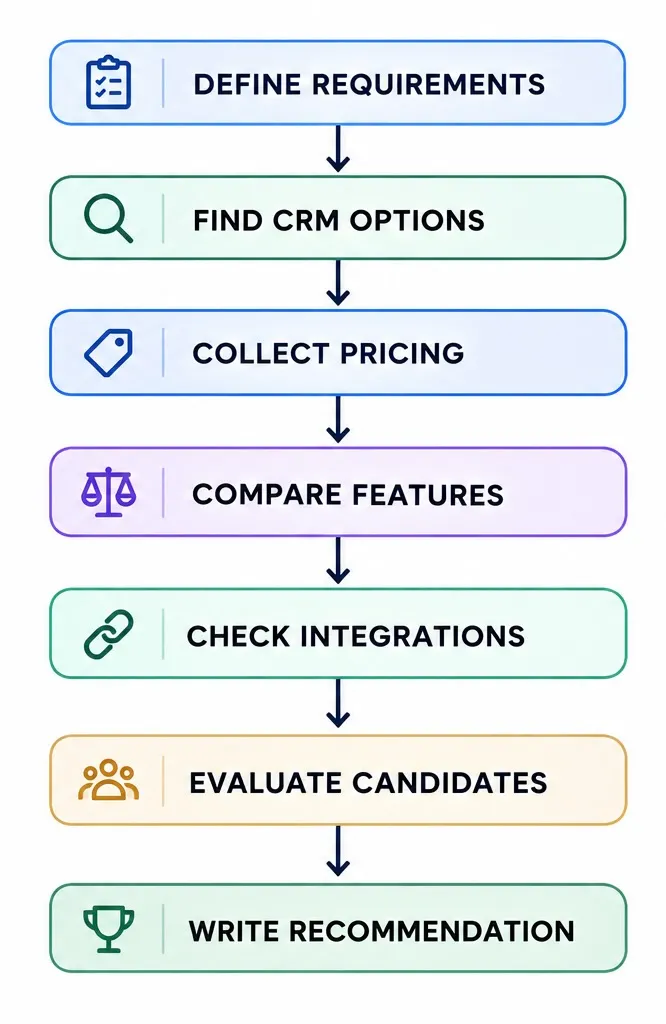
This is called task decomposition.
5. Agent Memory
Imagine asking an AI chatbot to work on a task for an hour. If it forgot everything after every few minutes, it wouldn’t be very useful.
That is why agentic systems need memory and state.
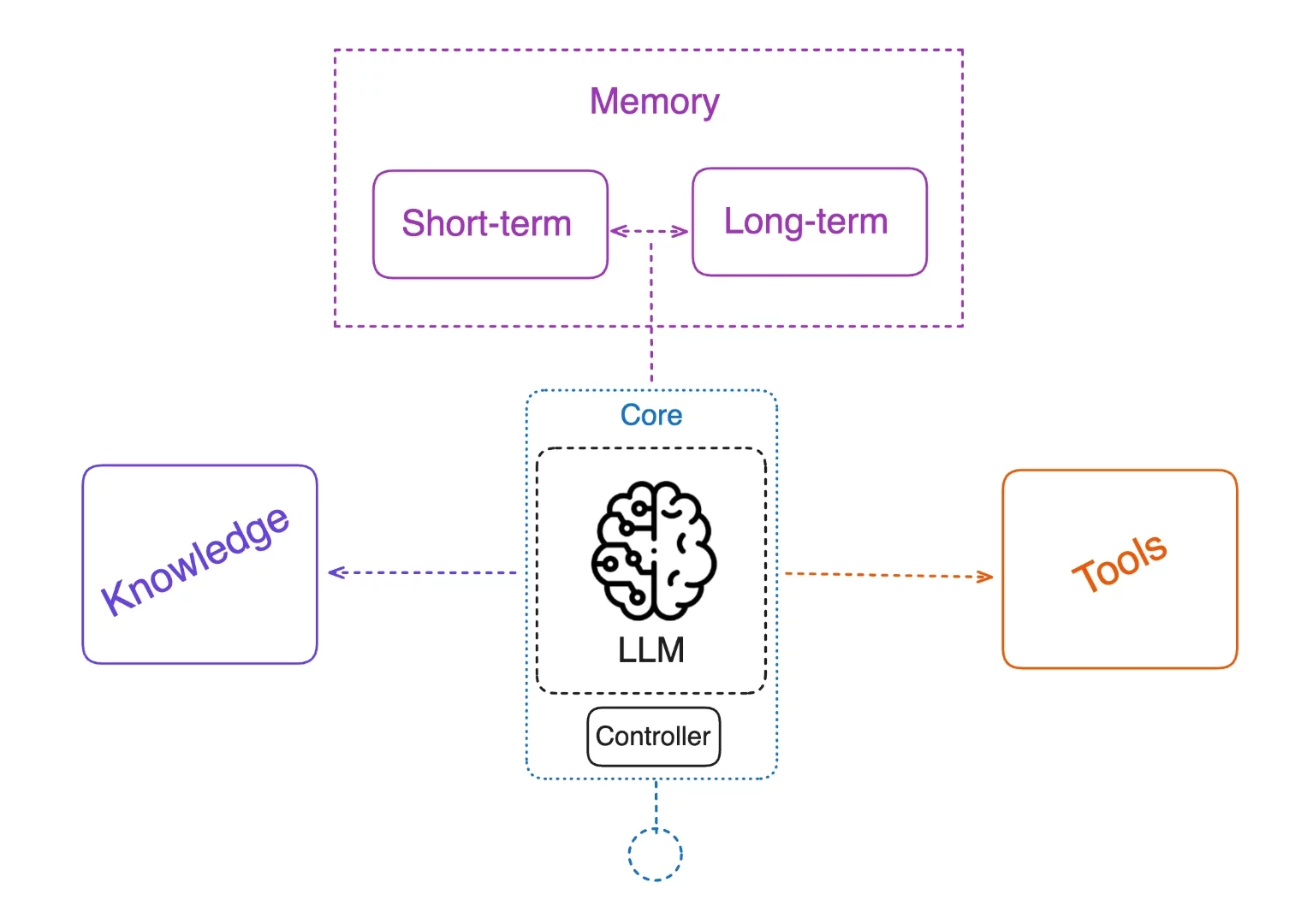
These terms are related but not identical.
- State: State is the information the agent needs to keep track of during the current task.
- Memory: Memory can preserve useful information beyond the immediate step or task.
Memory is especially important for personal assistants, customer-support agents, coding agents, and long-running workflows.
Without it, every interaction effectively starts from zero.
The incognito mode in LLMs and browsers doesn’t have memory. That’s why it doesn’t recall your usual preferences.
6. Agentic RAG
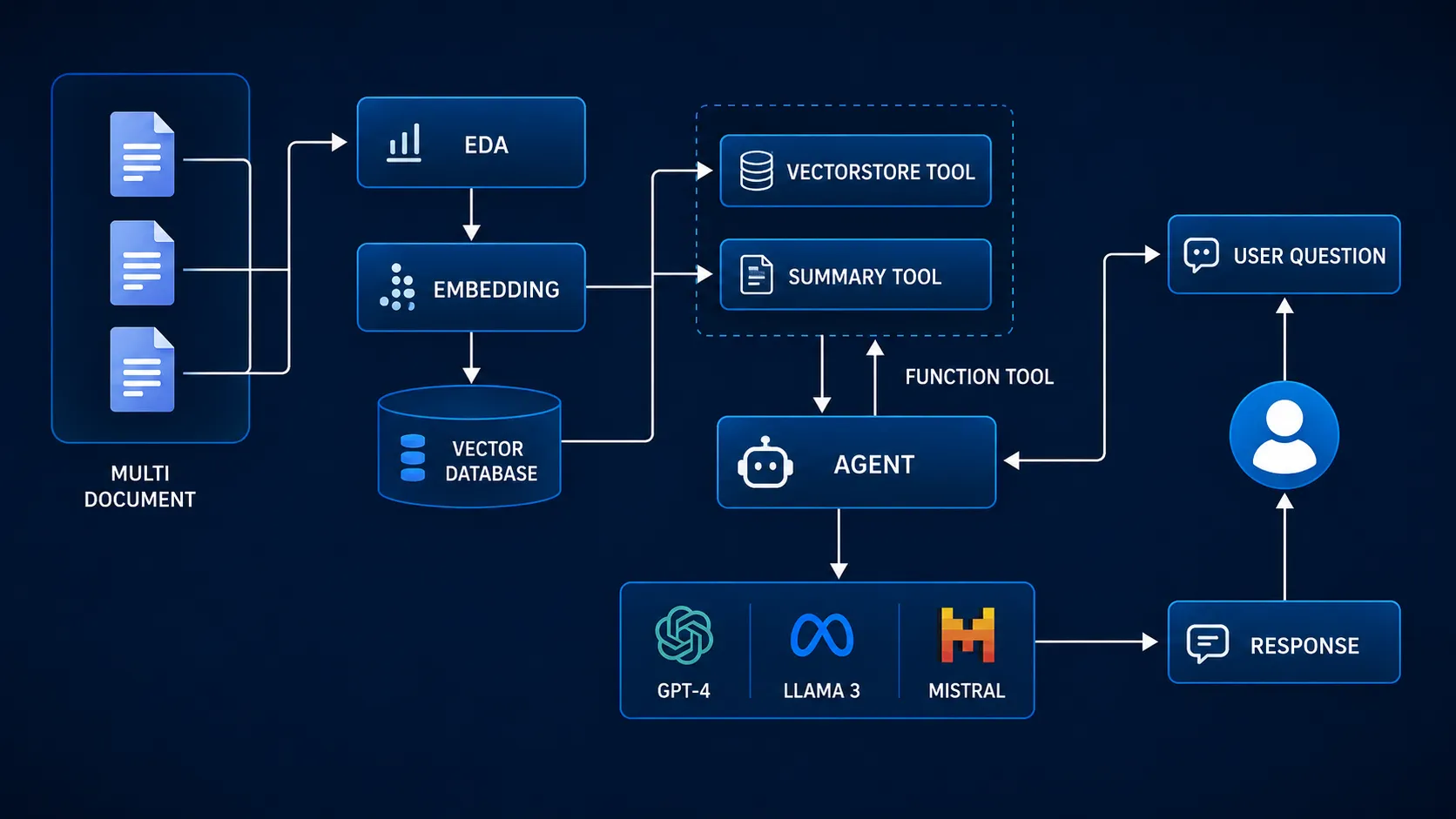
RAG, or Retrieval-Augmented Generation, gives an AI model access to external information instead of relying only on what it learned during training.
An agentic RAG system can decide how to search.
For example, the user asks:
“Compare our Q1 and Q2 sales in Europe and explain why revenue changed.”
The agent would then do the following:
- Find the Q1 sales report
- Find the Q2 sales report
- Identify European figures
- Retrieve regional performance data
- Search company commentary for explanations
- Compare the information
- Produce the final analysis
It can also decide to search again when the first retrieval doesn’t contain enough information.
7. MCP (Model Context Protocol)
Agents are only useful if they can access the tools and information they need. But connecting every AI model to every application individually can create a huge integration problem.
That’s where Model Context Protocol (MCP) comes in.
MCP provides a standardized way for AI applications to connect to external tools, data sources, and services.
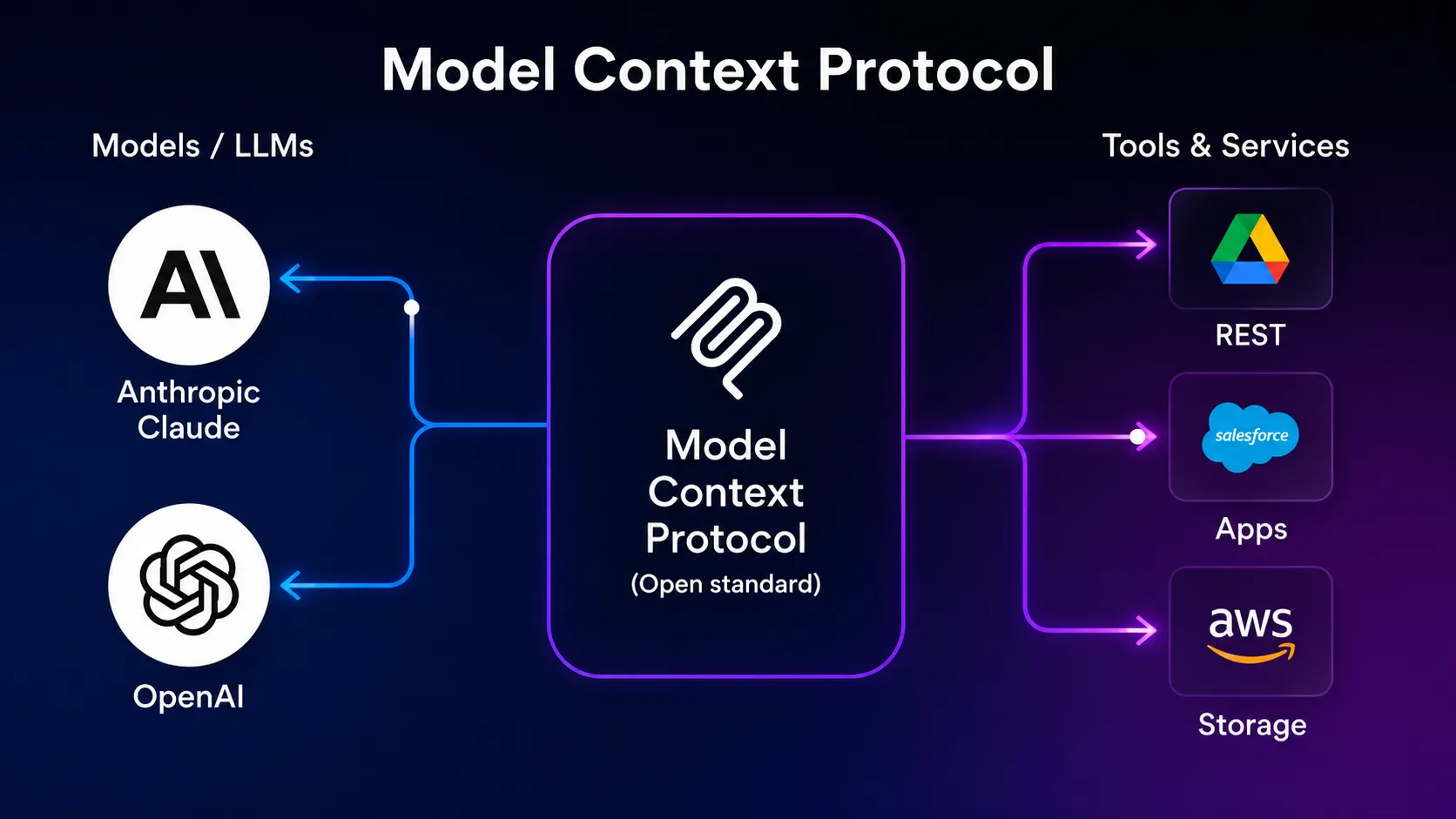
Instead of building a completely custom connection for each AI application, an MCP-based integration can expose tools and resources in a standard way.
This is particularly useful as agents gain access to more systems.
For example, a coding agent might use MCP to access:
- A Git repository
- Issue tracking
- Documentation
- Databases
- Internal development tools
MCP has become an important part of the modern agent ecosystem because it addresses one of the biggest practical problems with agents: how they connect to the outside world.
8. Multi-Agent Systems
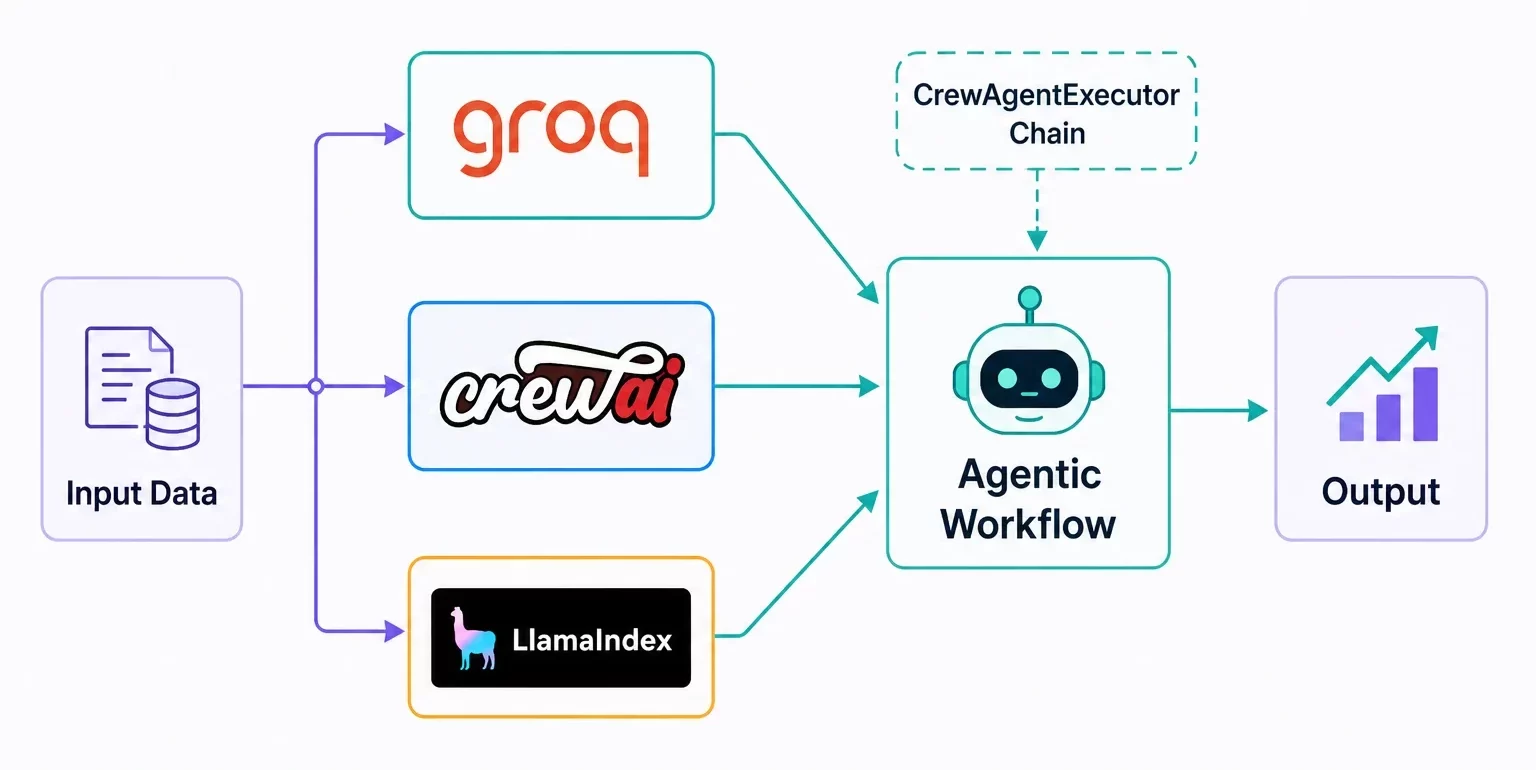
One agent doesn’t always have to do everything. A complex task can instead be divided between several specialized agents.
This is called a multi-agent system.
More agents do not automatically produce better results.
Every additional agent introduces communication overhead, additional model calls, and more opportunities for coordination failures. The goal is not to use as many agents as possible. The goal is to use the right architecture for the task.
9. Human-in-the-Loop
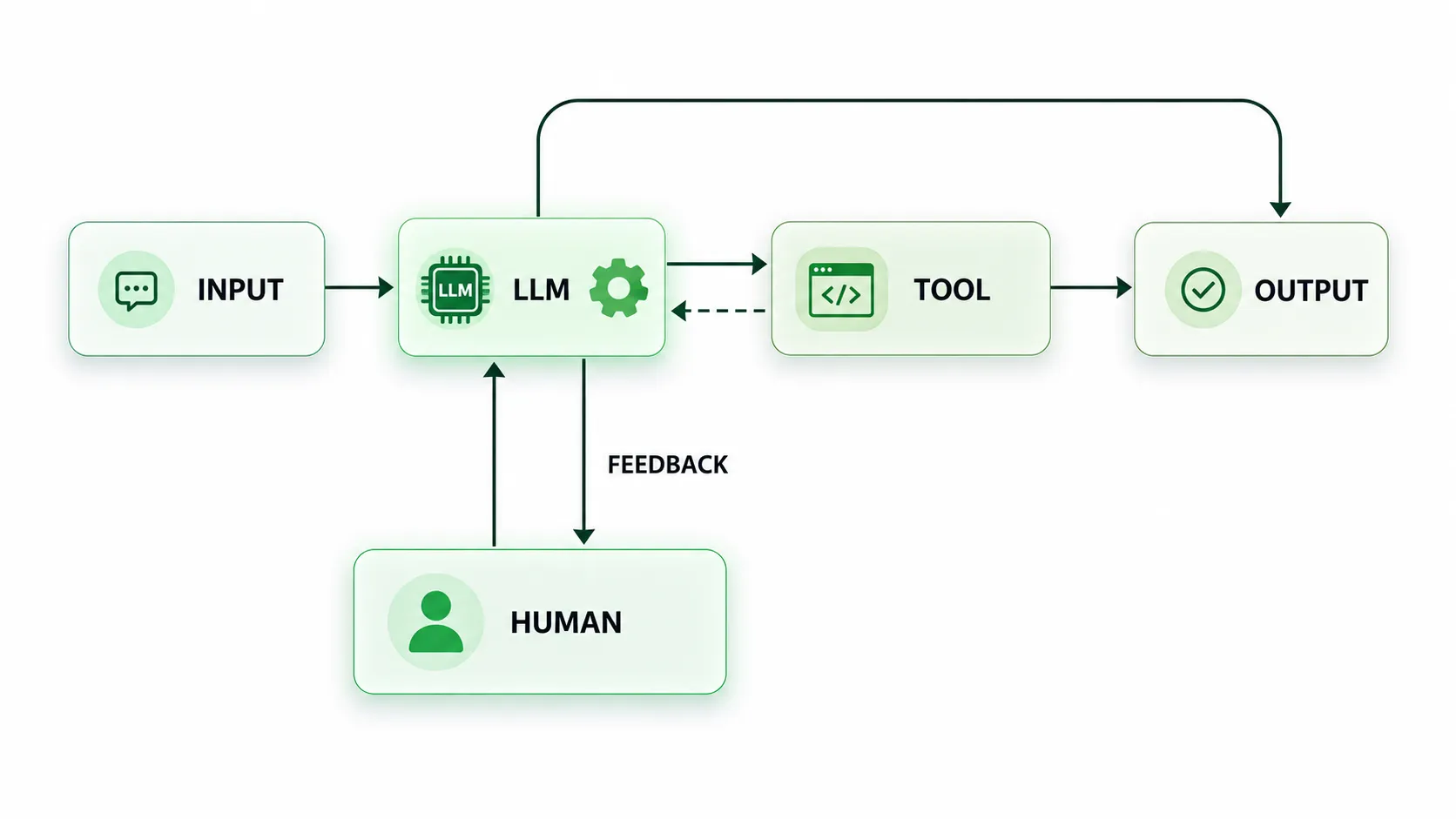
Autonomous doesn’t have to mean completely unsupervised. For high-impact actions, an agent can prepare the action and then ask a human to approve it.
For example:
“I found a flight for ₹21,450. Do you want me to book it?”
Or:
“This email contains sensitive customer information. Approve sending?”
This is known as human-in-the-loop. Seeking human consent/validation before going forward with a major step.
10. Guardrails
Agents can access tools, data, and external systems. Guardrails define what they are allowed to do and where they must stop.
They can control:
- Tool access
- Data access
- Permissions
- Spending limits
- Sensitive information
- Human approval
- Production access
For example:
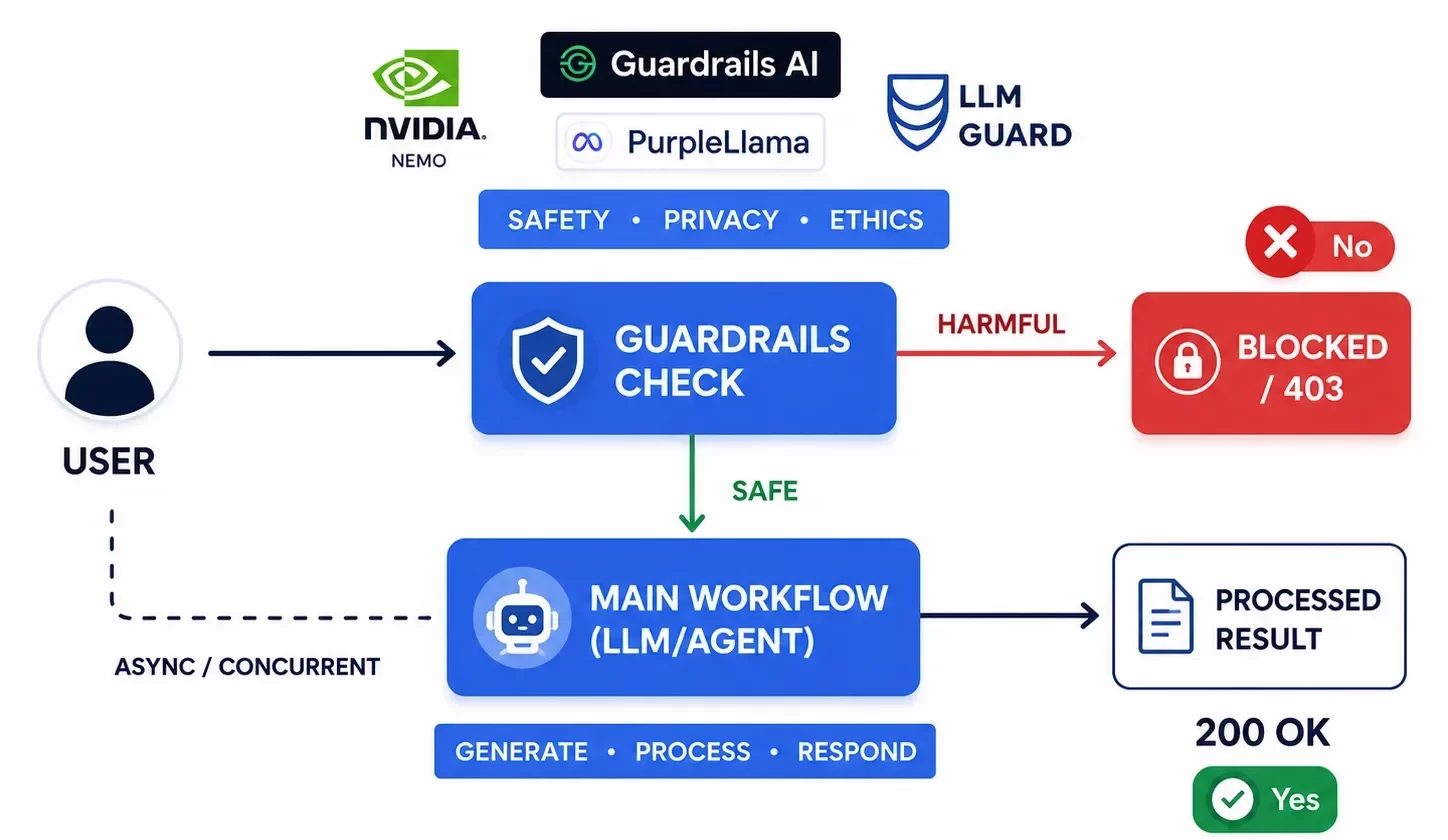
The goal is simple: let agents act without letting them act recklessly.
Final Thoughts
You do not need to be an engineer or a data scientist to understand these things.
But once you understand these core concepts, everything starts to make more sense. You understand why an LLM uses a tool instead of answering directly (Tool Calling), why it breaks a complex task into smaller steps (Planning), and why it can remember what happened earlier (Memory and State).
Once you understand the basics, agentic AI stops feeling like a black box and starts feeling like a system you can understand fully and utilize it to built systems confidently.
Frequently Asked Questions
Q1. What is an AI agent?
A. An AI agent uses an AI model to pursue a goal, use tools, observe results, and adapt its actions.
Q2. What is tool calling in AI agents?
A. Tool calling lets an AI agent use external functions such as web search, databases, APIs, and email.
Q3. What is MCP?
A. MCP is a standardized protocol that lets AI applications connect to external tools, data sources, and services.
Studying, evaluating, and explaining AI systems for over 6 years.
“𝘖𝘯𝘤𝘦 𝘮𝘦𝘯 𝘵𝘶𝘳𝘯𝘦𝘥 𝘵𝘩𝘦𝘪𝘳 𝘵𝘩𝘪𝘯𝘬𝘪𝘯𝘨 𝘰𝘷𝘦𝘳 𝘵𝘰 𝘮𝘢𝘤𝘩𝘪𝘯𝘦𝘴 𝘪𝘯 𝘵𝘩𝘦 𝘩𝘰𝘱𝘦 𝘵𝘩𝘢𝘵 𝘵𝘩𝘪𝘴 𝘸𝘰𝘶𝘭𝘥 𝘴𝘦𝘵 𝘵𝘩𝘦𝘮 𝘧𝘳𝘦𝘦. 𝘉𝘶𝘵 𝘵𝘩𝘢𝘵 𝘰𝘯𝘭𝘺 𝘱𝘦𝘳𝘮𝘪𝘵𝘵𝘦𝘥 𝘰𝘵𝘩𝘦𝘳 𝘮𝘦𝘯 𝘸𝘪𝘵𝘩 𝘮𝘢𝘤𝘩𝘪𝘯𝘦𝘴 𝘵𝘰 𝘦𝘯𝘴𝘭𝘢𝘷𝘦 𝘵𝘩𝘦𝘮.” — 𝖥𝗋𝖺𝗇𝗄 𝖧𝖾𝗋𝖻𝖾𝗋𝗍, 𝖣𝗎𝗇𝖾