Google has introduced Gemini 4 Hydrogen, its latest AI model designed for faster execution, coding, and agentic workflows. Released on November 12, 2026, the model is rolling out across Google Search, the Gemini app, and developer tools. Alongside it, Google introduced Antigravity Orchestrator, which can switch between Hydrogen and a more powerful reasoning model within the same session.
But how capable is Hydrogen beyond Google’s claims? We tested it across five practical tasks, from audio transcription and video analysis to SQL queries, PDF reasoning, and multilingual writing. In this article, we examine its performance, strengths, and limitations through real-world results.
Table of contents
- What Changes With Hydrogen
- How to Access Hydrogen
- Five Practical Tasks for Hydrogen
- 1. Transcribing an Uploaded Narration
- 2. Cataloguing a Wildlife Video
- 3. Applying the Exception in a SET Rulebook
- 4. Writing a Museum Eligibility Query
- 5. Keeping a Story Together Across Two Languages
- Reading the Benchmark Picture
- Conclusion
- Frequently Asked Questions
What Changes With Hydrogen
Hydrogen is built around rapid execution: repository work, debugging, short iteration loops and multimodal tasks. Google recommends it as an upgrade for Gemini 3.8 Flash workloads. That positioning makes it interesting for the work between the big decisions, such as implementing a plan or turning an uploaded file into a useful answer.
Its input range includes text, images, audio, video and PDFs. The native result is text. Understanding a recording does not make this an audio-generation model, and a product that generates an image can be using a separate capability behind its interface.
How to Access Hydrogen
You can build with Hydrogen through Google AI Studio and the Gemini API, including a rate-limited free tier. Its stable API identifier is gemini-4-hydrogen. The Google AI Studio guide gives you an interface tour; check the current Hydrogen controls when following it.
- Gemini app: Start a new chat, select Hydrogen where your plan allows, choose a thinking level, and send your prompt. Free accounts receive access through automatic model selection.
- Google AI Studio: Open Playground, select Gemini 4 Hydrogen, enter your prompt or upload files, and click Run.
- Gemini API: Create an API key in AI Studio and use the model ID
gemini-4-hydrogenin your application. A rate-limited free tier is available; paid API usage is separate from app subscriptions.
Five Practical Tasks for Hydrogen
These tasks use saved Gemini conversations with Medium thinking. Audio, video, PDF and SQL arrive as actual uploaded files; the story uses a direct text brief. We check the responses against the recording, visible frames, English game rules and independently executed SQL. Story mechanics and translation quality receive separate checks.
1. Transcribing an Uploaded Narration
Prompt
Transcribe the attached audio verbatim, using normal punctuation. Then classify the passage as narration, dialogue, or an instruction, with one short reason based on what is spoken. Return exactly two labelled paragraphs: Transcript and Classification. Keep the entire answer under 90 words.
Use only the audio. Do not browse or use other tools. Do not identify the speaker, author, book, or recording origin. Keep the response anonymous: no personal names, organizations, account information, contact details, personal references, or signature.
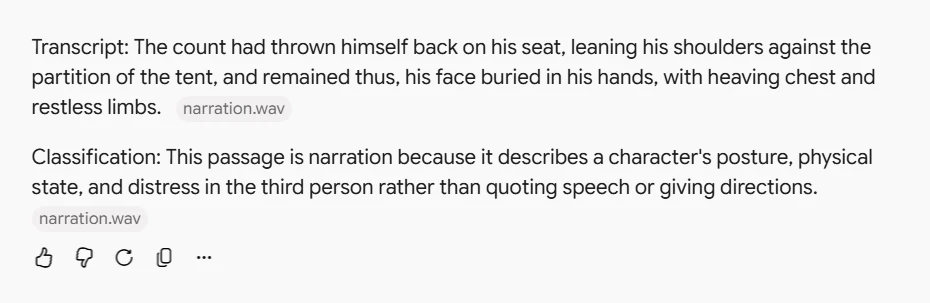
Hydrogen preserved all 33 spoken words, with no insertions, deletions or substitutions against the aligned transcript. It also identified narration for the right reason: the passage describes a character in the third person. The two labelled paragraphs totalled 60 words, comfortably inside the limit. This short, clean recording gave it no trouble.
2. Cataloguing a Wildlife Video
Prompt
Catalogue the attached wildlife clip without inventing a story. Return a table with one row per camera shot: approximate start-end time in MM:SS, colour or monochrome, maximum animals visible together, and one observed action. Then answer in one sentence whether the clip shows an encounter between animals from the different shots. Keep the whole answer under 110 words.
Use only the uploaded video. Do not browse or use other tools. Describe the animals cautiously; do not guess their location or an exact species. Keep every output anonymous: no personal names, organizations, account details, contact information, personal references, or signature.
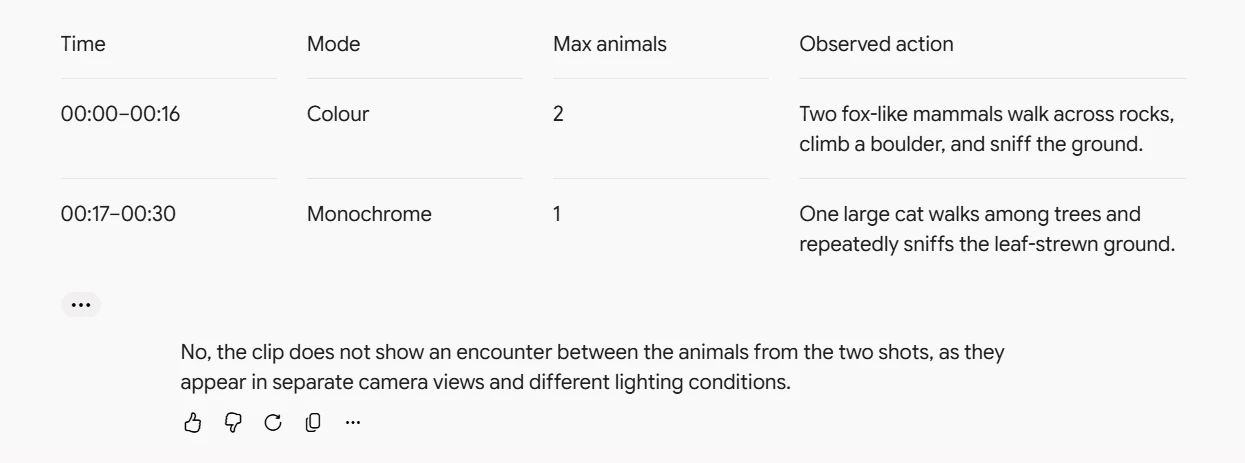
Hydrogen identified the two shots, counted two animals in colour and one in monochrome, and correctly declined to connect them as an encounter. Its timing was coarser: the first row ends at 00:16, about 1.27 seconds before the actual cut at 17.27 seconds. The next row starts at 00:17. A precise video edit would need tighter boundaries.
3. Applying the Exception in a SET Rulebook


Prompt
Use only the attached PDF’s English rules for normal multiplayer SET. Answer these four situations in four numbered points, no more than 130 words total:
1. Starting with twelve face-up cards and cards still in the deck, a player removes a correct SET. How many cards does the dealer add, and how many remain on the table?
2. Everyone agrees that those twelve cards contain no SET. What changes on the table?
3. After the extra cards in situation 2, a correct SET is removed. How many cards are added now, and how many remain?
4. A player calls SET and picks three cards, but the claimed SET is incorrect. What happens to the player’s score and the three cards?
Do not browse or substitute house rules. Keep the answer anonymous, without personal names, identity details, affiliations, contact information, or a signature. Give only the four answers.
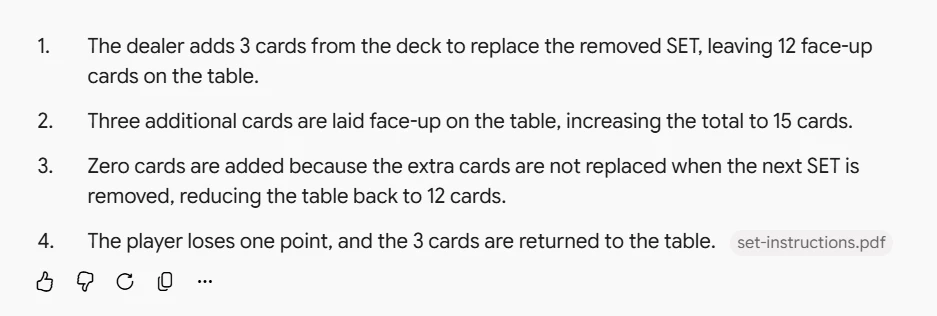
Hydrogen answers the four SET situations from the uploaded rulebook.
Hydrogen got all eight checked values and actions right. After the no-SET declaration raises the table to fifteen cards, it correctly leaves the next removal unreplenished, returning to twelve. It also applies the one-point penalty and returns the three wrongly claimed cards. All four numbered answers stayed within the length limit.
4. Writing a Museum Eligibility Query
Sample SQL file
-- Anonymous, synthetic museum collection. SQLite 3.
-- Audit date: 2026-11-15. Dates use ISO 8601 text.
-- Eligibility: catalogued = 1; latest check on or before the audit date is
-- stable (break same-date ties by greater check_id); and no active confirmed
-- hold. A hold is active when starts_on <= audit date and ends_on is NULL or
-- greater than audit date. Its interval is [starts_on, ends_on).
-- Objects without a condition check by the audit date are not eligible.
CREATE TABLE objects (
  object_id INTEGER PRIMARY KEY,
  label TEXT NOT NULL,
  catalogued INTEGER NOT NULL
);
CREATE TABLE condition_checks (
  check_id INTEGER PRIMARY KEY,
  object_id INTEGER NOT NULL REFERENCES objects(object_id),
  checked_on TEXT NOT NULL,
  state TEXT NOT NULL
);
CREATE TABLE movement_holds (
  hold_id INTEGER PRIMARY KEY,
  object_id INTEGER NOT NULL REFERENCES objects(object_id),
  starts_on TEXT NOT NULL,
  ends_on TEXT,
  status TEXT NOT NULL
);
INSERT INTO objects VALUES
  (1,'Ceramic shard',1),(2,'Bronze pin',1),(3,'Flint blade',1),
  (4,'Glass bead',1),(5,'Shell fragment',0),(6,'Tile fragment',1),
  (7,'Iron fitting',1),(8,'Stone weight',1),(9,'Bone tool',1),
  (10,'Clay seal',1),(11,'Textile scrap',1);
INSERT INTO condition_checks VALUES
  (1,1,'2026-10-10','unstable'),(2,1,'2026-11-10','stable'),
  (3,2,'2026-10-01','stable'),(4,2,'2026-11-10','unstable'),
  (5,3,'2026-11-09','stable'),(6,4,'2026-11-04','stable'),
  (7,4,'2026-11-20','unstable'),(8,5,'2026-11-10','stable'),
  (9,7,'2026-11-12','stable'),(10,7,'2026-11-12','unstable'),
  (11,8,'2026-10-29','stable'),(12,9,'2026-11-05','stable'),
  (13,10,'2026-11-06','stable'),(14,11,'2026-11-01','unstable'),
  (15,11,'2026-11-20','stable');
INSERT INTO movement_holds VALUES
  (1,1,'2026-11-01','2026-11-15','confirmed'),
  (2,3,'2026-11-14',NULL,'confirmed'),
  (3,4,'2026-11-01',NULL,'cancelled'),
  (4,8,'2026-11-16','2026-11-25','confirmed'),
  (5,9,'2026-11-15','2026-11-20','confirmed'),
  (6,10,'2026-11-10',NULL,'confirmed'),
  (7,10,'2026-11-10','2026-11-13','cancelled'),
  (8,1,'2026-10-01','2026-10-10','confirmed');
Prompt
Write one SQLite SELECT/WITH query from the schema and eligibility rules in the attached SQL file. The audit date is fixed at 2026-11-15. Use the supplied records, including future checks, same-date check ties, and half-open hold intervals.
Return the query in one code block, at most 25 nonblank lines. Its columns must be object_id, label, last_checked_on, ordered by object_id. Then give the exact result rows for the supplied database in a small table. Do not modify the data, add an explanation, or browse.
Keep the response anonymous. Include no personal names, identities, affiliations, contact details, account information, or signature.
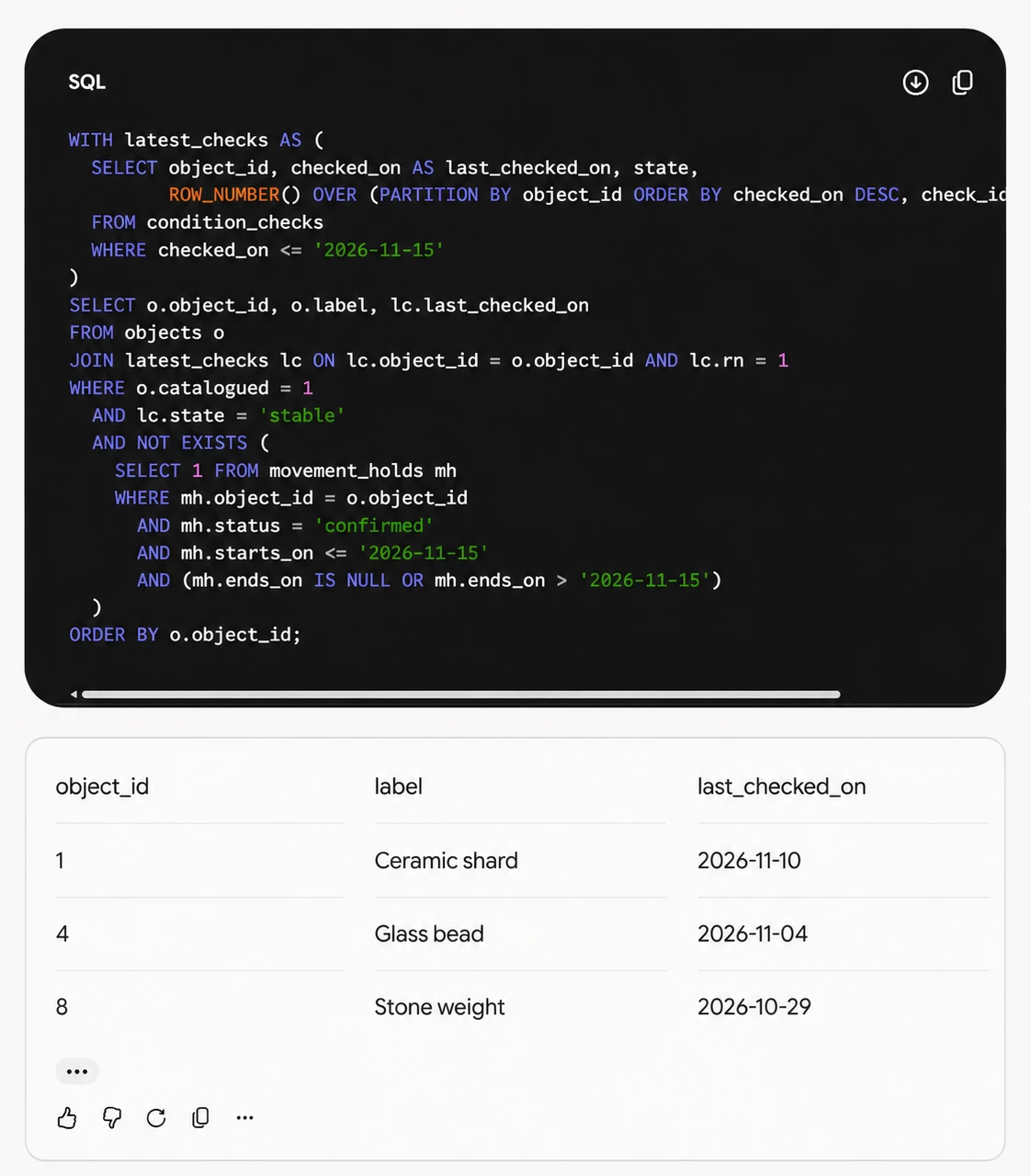
The result table returned with Hydrogen’s query.
The 19-line query returned objects 1, 4 and 8, with all nine result cells correct. We executed that same query against the supplied database and twelve input variations; it passed all thirteen cases. Those checks covered dates, tied checks, missing records and conflicting holds. These are local checks of one returned query.
5. Keeping a Story Together Across Two Languages
Prompt
Write a tiny bilingual speculative story about a night-shift lift that opens onto a forest. An unnamed cleaner discovers that the forest is holding the building’s lost sounds. The cleaner must give back one sound to make the lift return. Finish with a quiet, concrete image rather than an explanation.
Return exactly eight lines, with no title or blank lines. Lines 1, 3, 5, and 7 must be English; each immediately following line must be a natural Hindi translation in Devanagari of the preceding English line. Each English line must contain 8–14 whitespace-separated words. Each Hindi line must contain 8–18 whitespace-separated words. Use no numerals or Roman-script Hindi. Across the English lines, use the exact words “forest”, “sound”, and “lift” at least once each. Do not use the English words “dream”, “magic”, or “suddenly”.
Keep the output anonymous: no named people, named places, organizations, personal details, contact information, or signature. The cleaner remains unnamed. Give only the eight story lines.
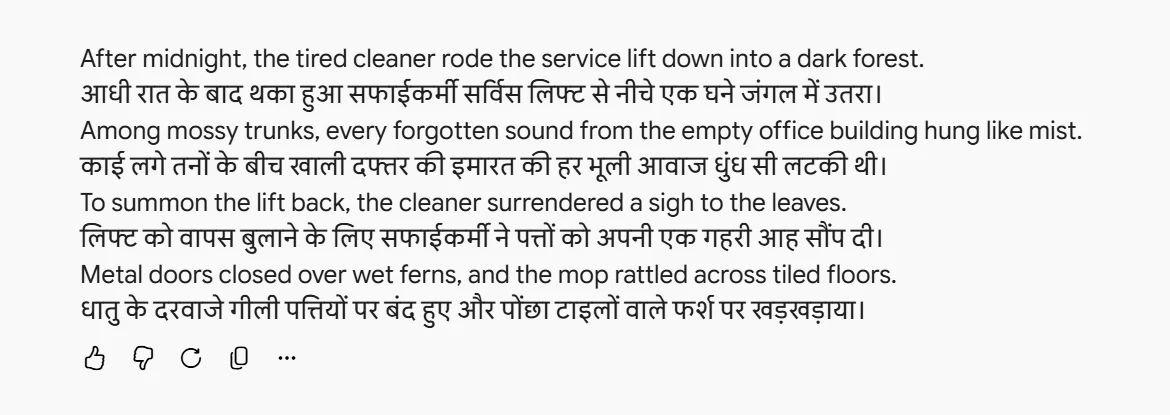
The eight-line story alternates English with Hindi and ends back inside the building.
The eight lines met their word limits and alternated languages correctly. The sound exchange and return formed a coherent little story, but the Hindi shifted some imagery: dark forest became dense forest, wet ferns became wet leaves, and a sigh became a deep sigh. The main events survived. I’d edit those descriptive differences before publishing the two versions together.
Reading the Benchmark Picture
The release also places Hydrogen on AA Index 5.0.1 across several thinking levels. The chart below plots score against cost per task, with Sonnet 5.5 and GPT-6.1 Terra providing the displayed context. It helps explain why effort is a meaningful choice: moving toward a higher score also changes the amount spent.
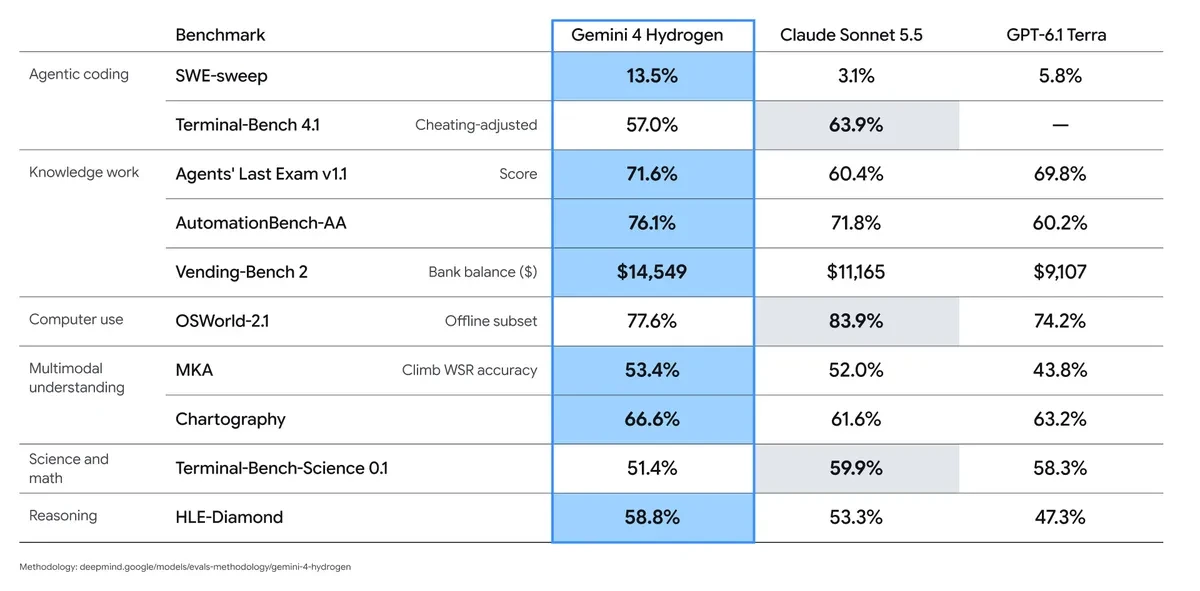
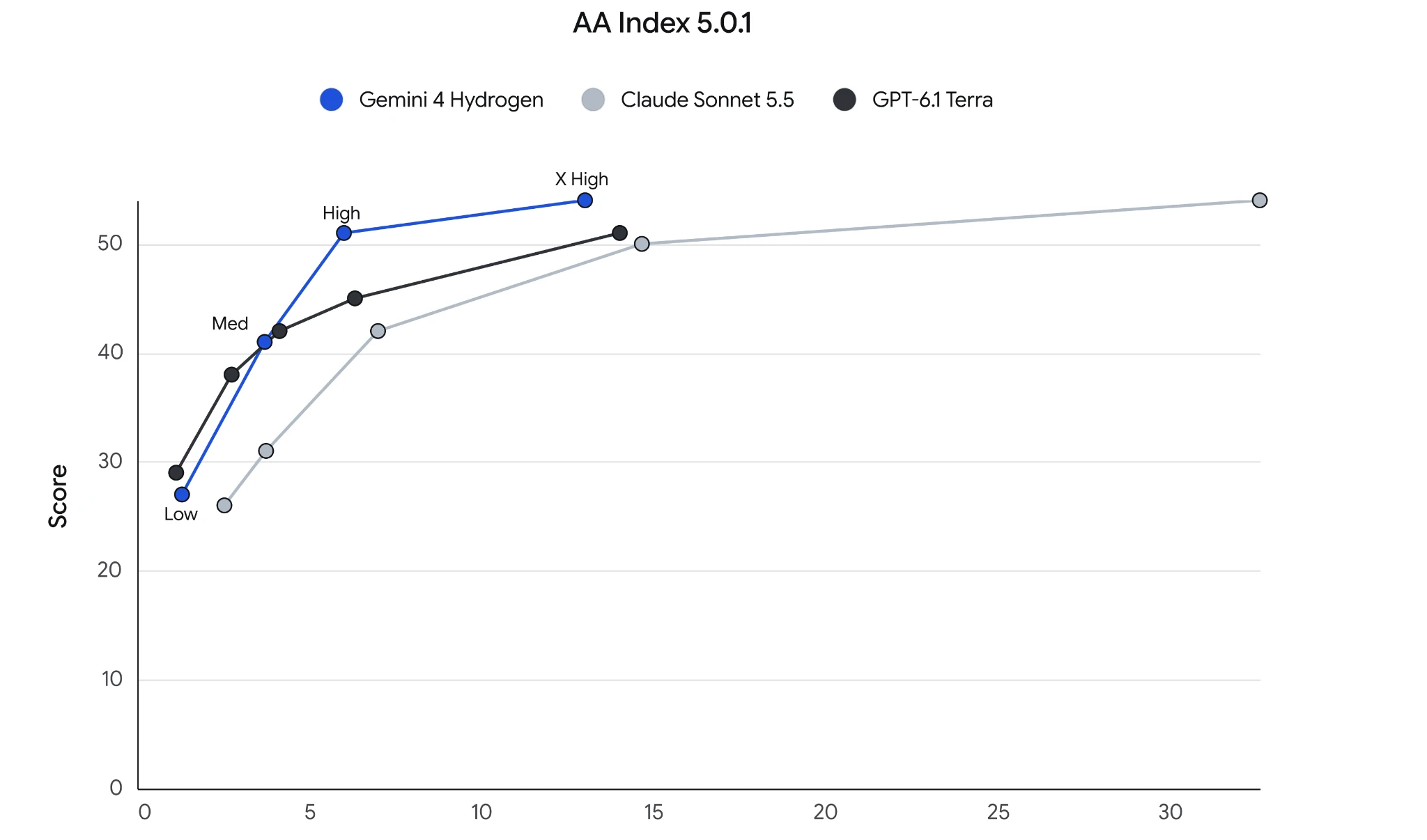
AA Index 5.0.1 score versus cost per task in US dollars. Hydrogen is shown at Low, Medium, High and xhigh alongside the comparison models in the legend.
An index measures its included workload. It cannot tell us whether a particular Hindi translation preserves an image or whether a camera cut separates two animals. Our five Medium-thinking app tasks are separate evidence, and we have not measured their token bills or latency. The guide to AI benchmarks explains how to read these evaluations without treating a single score as a verdict on every job.
Conclusion
Gemini 4 Hydrogen delivers something more compelling than launch-day hype: results you can actually put to work. At Medium thinking, it handled rule lookup and produced SQL that held up beyond the supplied records. That is an encouraging first showing, and a strong reason to bring your own document and database tasks to the model.
Orchestrator’s handoffs between planning and execution make the broader release even more exciting, although that workflow needs separate testing. Video boundaries and bilingual wording still deserve a final check, but Hydrogen has already given us reasons to keep using it. For focused, practical work, this is a release worth exploring.
Frequently Asked Questions
Q1. What does Gemini 4 Hydrogen produce?
A. Text. Audio, video, images and PDFs are inputs; media generation in the app uses separate capabilities.
Q2. Is Hydrogen free to try?
A. AI Studio and the API offer a limited free tier. Free Gemini app access uses automatic model selection.
Q3. What does an Orchestrator do?
A. It can switch between a frontier planning model and Hydrogen execution as an Antigravity task develops.
Studying, evaluating, and explaining AI systems for over 6 years.
“𝘖𝘯𝘤𝘦 𝘮𝘦𝘯 𝘵𝘶𝘳𝘯𝘦𝘥 𝘵𝘩𝘦𝘪𝘳 𝘵𝘩𝘪𝘯𝘬𝘪𝘯𝘨 𝘰𝘷𝘦𝘳 𝘵𝘰 𝘮𝘢𝘤𝘩𝘪𝘯𝘦𝘴 𝘪𝘯 𝘵𝘩𝘦 𝘩𝘰𝘱𝘦 𝘵𝘩𝘢𝘵 𝘵𝘩𝘪𝘴 𝘸𝘰𝘶𝘭𝘥 𝘴𝘦𝘵 𝘵𝘩𝘦𝘮 𝘧𝘳𝘦𝘦. 𝘉𝘶𝘵 𝘵𝘩𝘢𝘵 𝘰𝘯𝘭𝘺 𝘱𝘦𝘳𝘮𝘪𝘵𝘵𝘦𝘥 𝘰𝘵𝘩𝘦𝘳 𝘮𝘦𝘯 𝘸𝘪𝘵𝘩 𝘮𝘢𝘤𝘩𝘪𝘯𝘦𝘴 𝘵𝘰 𝘦𝘯𝘴𝘭𝘢𝘷𝘦 𝘵𝘩𝘦𝘮.” — 𝖥𝗋𝖺𝗇𝗄 𝖧𝖾𝗋𝖻𝖾𝗋𝗍, 𝖣𝗎𝗇𝖾