In a world influenced by AI, concerns about job security are growing. IBM predicts that 85 million jobs might be impacted by automation by the year 2028, prompting the question: Which jobs are safe from AI? From content creation to customer service, industries are embracing AI for efficiency. Yet, jobs demanding creativity, empathy, and critical thinking remain irreplaceable. This article explores 10 such roles, emphasizing the unique human qualities that AI can’t replace in a future driven by innovation.
Table of Contents
Jobs With the Lowest Risk of Automation by AI
According to the U.S. Career Institute, the following jobs are the least impacted by the introduction of AI. These jobs have a very low job automation risk probability, due to the abilities, knowledge, skills, and activities required to perform these jobs successfully. A clear pattern emerges from the list!
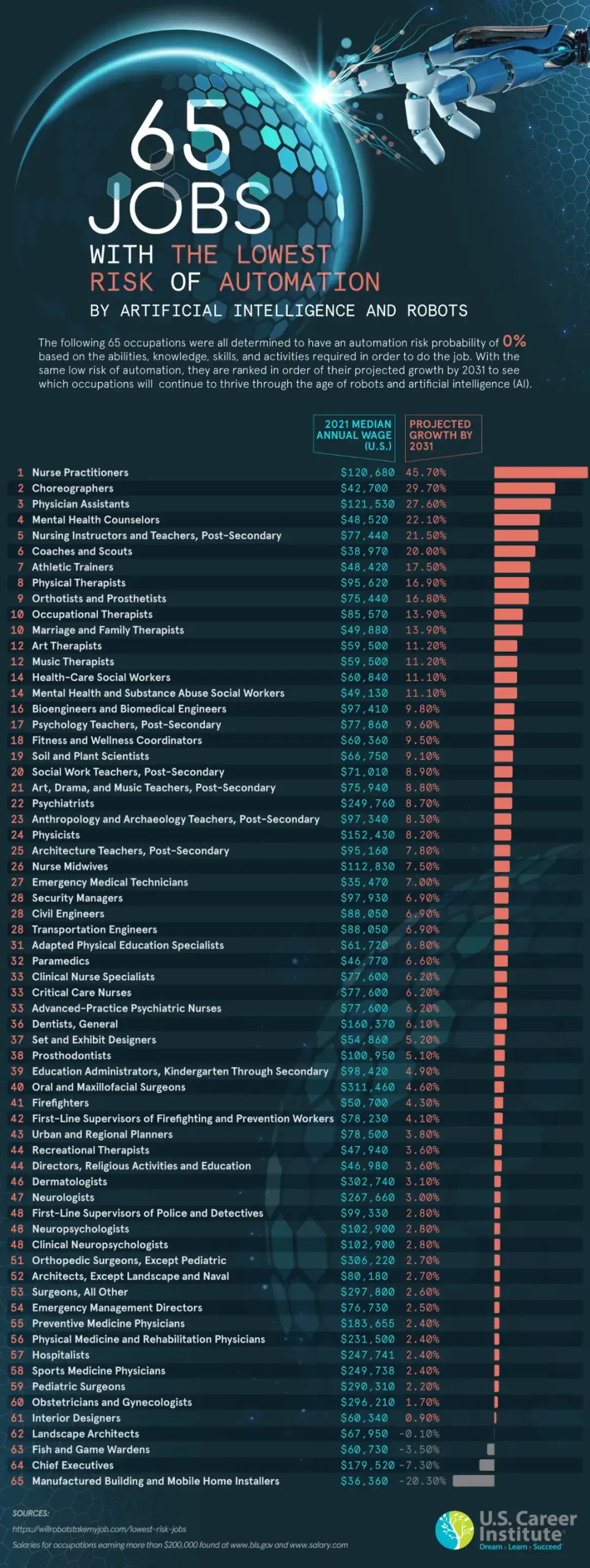
Top 10 Jobs that can not be Replaced by AI
Clear patterns emerge when the list is scrutinised. Profession requiring an emotional touch and counselling are heavily future proof. The list could essentially be categorised in the following domains:
1. Therapists and Counselors
The counseling and therapy field has jobs that AI possibly can’t replace, and for good reasons. Roles involving mental health support, counseling, and therapy require empathy, active listening, and understanding of human emotions. The ability to establish a trusting relationship, adapt to individual needs, and offer personalized guidance makes these professions highly dependent on human interaction.
Therapists and counselors are about emotional intelligence, above all. Although AI can help predict disorders, personalize therapies, and even provide immediate support, it can never take over the role of a compassionate therapist.
2. Social Work and Community Outreach Roles
Social workers assist individuals and communities facing various challenges, such as poverty, abuse, or mental health issues. They provide emotional support, assess needs, and connect people with necessary resources. Social work involves deep empathy, cultural sensitivity, and the ability to navigate complex social dynamics, which artificial intelligence struggles to replicate.
3. Musicians
Can AI replace musicians? Music and other performing arts transcend boundaries and converse with the depths of our psyches. While AI can compose melodies and generate music based on algorithms, it struggles to replicate the emotional depth and artistic interpretation that human musicians bring. The ability to infuse personal experiences, emotions, and improvisation into performances and the intuitive understanding of rhythm, dynamics, and expression keep human musicians at the heart of musical creation.
4. High-Level Strategists and Analysts
AI has the prowess to process and analyze large volumes of data. It can also suggest ideas and give something to seek inspiration from. However, human expertise is still required to interpret the results accurately. Analysts and scientists are jobs that AI can never replace, as they require domain knowledge and critical thinking skills to derive insights and identify patterns. After a thorough understanding, humans can make informed decisions based on the information per the market’s changing demands, which artificial intelligence cannot do.
5. Research Scientists and Engineers
Scientists experiment, analyze data, and draw conclusions based on their knowledge and experience. While AI can help them with data processing and analysis, the creativity, intuition, and scientific judgment necessary for ground-breaking discoveries are uniquely human.
6. Performing Arts
Can AI replace the performing arts? Well, that can never happen. The expressions, agility, and precise movements portrayed by professional dancers and theatre artists cannot be reenacted by AI. Directing a play or choreographing a performance are tasks that AI cannot be trained to do anytime soon. Similarly, AI cannot replace other performers, such as magicians, acrobats, circus artists, etc.
7. Judges
While AI excels at repetitive legal tasks, human empathy and ethical considerations make complete replacement unlikely. A hybrid approach with AI assisting judges in specific areas, like data analysis, is more likely. The legal profession will likely see AI enhance judges’ work, not replace them entirely.
8. Leadership and Management Roles
Managers and leaders in any organization assess market trends, competitive landscapes, and long-term business strategies. Their decisions involve weighing multiple factors, considering risks, and making choices that align with the organization’s goals and values. This requires emotional intelligence, striking a perfect balance between unbiased decisions and the company’s greater good, which is, by all means, a role that AI cannot do on its own.
9. Surgeons and Healthcare Professionals
The impact of AI in healthcare is increasing for good. However, as much as it helps diagnose certain conditions, medical professionals make complex decisions involving empathy, patient interaction, and ethical considerations. Treating patients requires a holistic approach that combines medical knowledge with personal judgment. Thus, the medical industry still has a safe spot for jobs that AI can’t replace.
10. Athletes
Just like healthcare, the craze of AI in sports is booming. But athletics is one of the jobs AI can’t replace. Sports that demand physical agility, coordination, and precise movements, such as gymnastics, figure skating, or martial arts, require skill and athleticism beyond what AI can achieve. The essence of physical competition and emotional sportsmanship is also very human to be imitated by AI.
Impact of AI on the Job Market
The AI-driven change in the job market has become a significant topic of discussion due to many trends and buzzwords. While the technology has the potential to automate specific tasks and transform industries, there are several jobs AI cannot replace. But before we go there, here’s everything that has been happening ever since technology caught the attention of the world:
1. Automation is Replacing Jobs
One of the concerns surrounding AI is the potential for job displacement, as automation replaces specific tasks previously performed by humans. According to research, AI could cause about 400 million to 800 million people to lose jobs or look for another career path by 2030. AI technologies, such as robotics and machine learning, can automate routine and repetitive tasks in various sectors, reducing the demand for specific jobs. Industries like manufacturing, customer service, transportation, and data entry are most susceptible to automation-driven job displacement.
2. New Roles are Being Created
While AI may eliminate some jobs, it also has the potential to create new job opportunities and augment existing roles. As AI technology advances, new roles will emerge to develop, implement, and maintain AI systems. Additionally, there will be a growing demand for professionals skilled in data analysis, machine learning, AI ethics, and algorithm design. Organizations will require individuals to oversee AI systems, ensure ethical considerations, and make strategic decisions based on AI insights.
3. Upskilling is As Important As Developing Skills
The widespread adoption of artificial intelligence will likely result in a shift in the skills demanded by the job market. Specific low-skilled and repetitive tasks may be automated, emphasizing skills complementing AI technologies. This includes critical thinking, creativity, problem-solving, adaptability, emotional intelligence, and complex decision-making skills. Upskilling initiatives will be crucial for employees to acquire the necessary competencies to adapt to the changing job market.
4. Socio-Economic Considerations Are in the Spotlight
The impact of AI on the job market has broader socio-economic implications. It can contribute to income inequality if the benefits of AI are not equitably distributed. Specific communities or individuals with limited education or resources may face challenges adapting to the changing job market. Policies and initiatives that address skill gaps, support lifelong learning, and promote inclusive access to AI technologies can help mitigate potential inequalities.
Read more: Will AI Replace Humans in 2026
Conclusion
As we navigate the rapidly evolving landscape of artificial intelligence, it’s clear that while AI-generated technologies like ChatGPT and other AI models developed by startups like OpenAI are revolutionizing various industries, there are still many jobs AI cannot replace. Despite the advancements in automation and AI tools, roles requiring emotional intelligence, critical thinking, and complex human interactions remain uniquely human.
I hope you like the article! Even though AI is progressing quickly, there are still various roles that AI cannot take over, such as creative roles, complex problem-solving positions, and jobs that need strong interpersonal skills. Positions that AI is unable to substitute for, or will not substitute for in the near future, will continue to be needed as AI complements specific job functions instead of completely taking over.
Explore our specialized programs to stay ahead in the AI-driven job market:
Frequently Asked Questions
Q1. What percentage of jobs can be replaced by generative AI?
A. According to a report by Goldman Sachs, 300 million jobs could vanish due to automation led by generative AI.
Q2. Will AI take over data analytics?
A. AI capabilities can collect, refine, and analyze data, sparing humans’ time and generating outcomes quickly. The technology will eradicate the repetitive tasks involved in data analytics, but will not replace the critical thinking and ethical and safety approaches humans follow.
Q3. What tech jobs will be safe from AI?
A. Jobs involving creative problem-solving, complex decision-making, and human interaction, such as AI ethics specialists, software developers, and cybersecurity experts, will be relatively safe from AI.
Q4. What jobs will be gone by 2030?
A. Routine and repetitive jobs, such as data entry clerks, telemarketers, and some manufacturing roles, will likely be automated and potentially gone by 2030.
Q5. What jobs are future-proof from AI?
A. Jobs that require emotional intelligence, advanced cognitive abilities, and intricate human interaction, like healthcare providers, educators, and roles in creative industries, are considered future-proof from AI.
Hello, I am Nitika, a tech-savvy Content Creator and Marketer. Creativity and learning new things come naturally to me. I have expertise in creating result-driven content strategies. I am well versed in SEO Management, Keyword Operations, Web Content Writing, Communication, Content Strategy, Editing, and Writing.