Claude Skills is the latest AI tool that targets AI automation at some level. Anthropic was smart enough to identify one key problem developers face every day – having to rewrite prompts for repetitive tasks. So, packaging it in the form of “Skills”, Claude brings a new way to store these prompts or instructions, so you don’t have to type them in every time.
In simple terms, Claude Skills are designed to turn repeated instructions into reusable capabilities. Instead of stuffing everything into long prompts, you can package instructions, scripts, and supporting resources into a structured module that Claude loads only when it is relevant.
The result is a workflow that is more consistent, more efficient, and easier to maintain over time. We explored Claude Skills in a detailed guide earlier. You can check it for a complete understanding of Claude Skills, how they work, and how to build one for yourself.
In this article, we shall explore custom Skills in Claude, what they look like, and how to create more of such Skills that help you in your daily dev flow. So without any delay, let us jump right in.
Table of contents
- What a Custom Skill Looks Like
- How to Create a Custom Skill: Step by Step with Example
- Step 1: Decide what the Skill should do
- Step 2: Create a folder for the Skill
- Step 3: Write the basic Skill.md file
- Step 4: Add instructions below the frontmatter
- Step 5: Add an example inside the Skill
- Step 6: Add supporting files if needed
- Step 7: Add scripts for advanced actions
- Step 8: Check that everything is organized properly
- Step 9: Zip the folder
- Step 10: Upload and test the Skill
- Step 11: Refine the Skill if needed
- GitHub Repositories for Free Claude Code Skills
- How Skills Are Packaged and Used
- Skills Across the Claude Ecosystem
- Security and Caution
- Conclusion
What a Custom Skill Looks Like
A custom Skill is organized as a folder, and at the bare minimum, that folder must include a Skill.md file. This file usually begins with YAML frontmatter that defines the required metadata, especially the Skill’s name and description. The description is especially important because Claude uses it to determine when the Skill should be invoked. Beyond that, the file can also include instructions, examples, references to other files, and declared dependencies.
More advanced Skills can include additional assets such as:
- templates
- resource files
- scripts
- supporting documents
This structure allows a Skill to be more than just a saved prompt. It becomes a package of reusable behavior.
How to Create a Custom Skill: Step by Step with Example
Let’s take a simple example and build it properly.
Suppose you want to create a custom Skill called Meeting Summary and Action Tracker. The purpose of this Skill is to take raw meeting notes and turn them into:
- a clear summary
- key decisions
- action items
- owners and deadlines
- optional export files if needed
This is a good example because it shows how a repeated task can be turned into a reusable workflow instead of being handled with a long prompt every time.
Step 1: Decide what the Skill should do
Before creating anything, define the exact purpose of the Skill.
In this example, the Skill should:
- Read meeting notes or transcripts
- Identify the main discussion points
- Extract decisions
- List action items
- Avoid inventing missing details
So the job of the Skill is not just “summarize text.” Its job is to follow a specific workflow for meeting documentation.
Step 2: Create a folder for the Skill
Now create a folder for the Skill.
Example folder name:
MEETING-SUMMARY-ACTION-TRACKER
This folder will contain everything related to the Skill.
Inside this folder, you must create a file called Skill.md. The arrangement will look something like this:
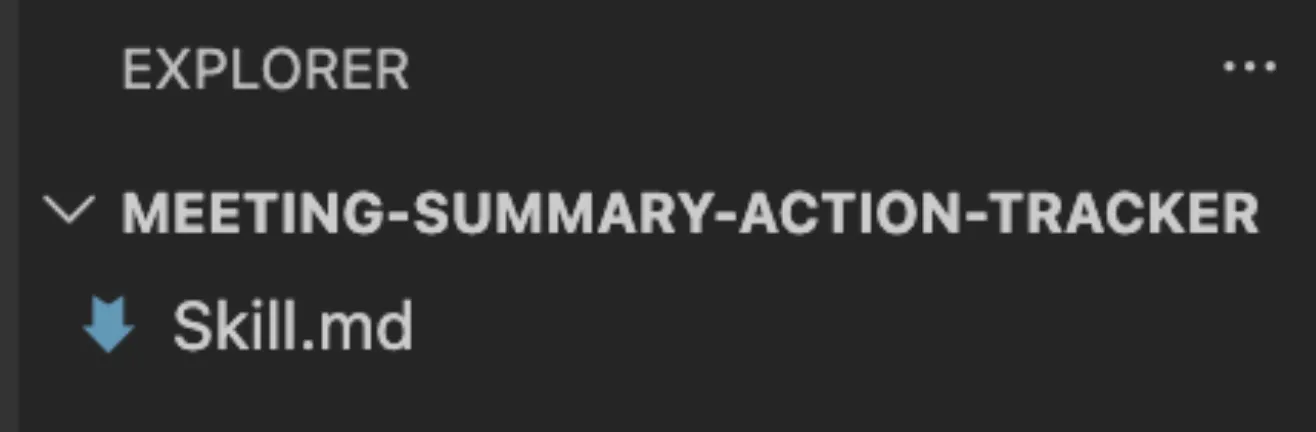
This is the main file Claude uses to understand the Skill.
Step 3: Write the basic Skill.md file
Inside Skill.md, start with YAML frontmatter.
Example:

What this does:
- name gives the Skill a clear title
- description tells Claude when this Skill should be used
The description is very important because Claude uses it to decide whether the Skill matches the user’s request.
Step 4: Add instructions below the frontmatter
After the YAML section, write clear instructions in Markdown.
Example:
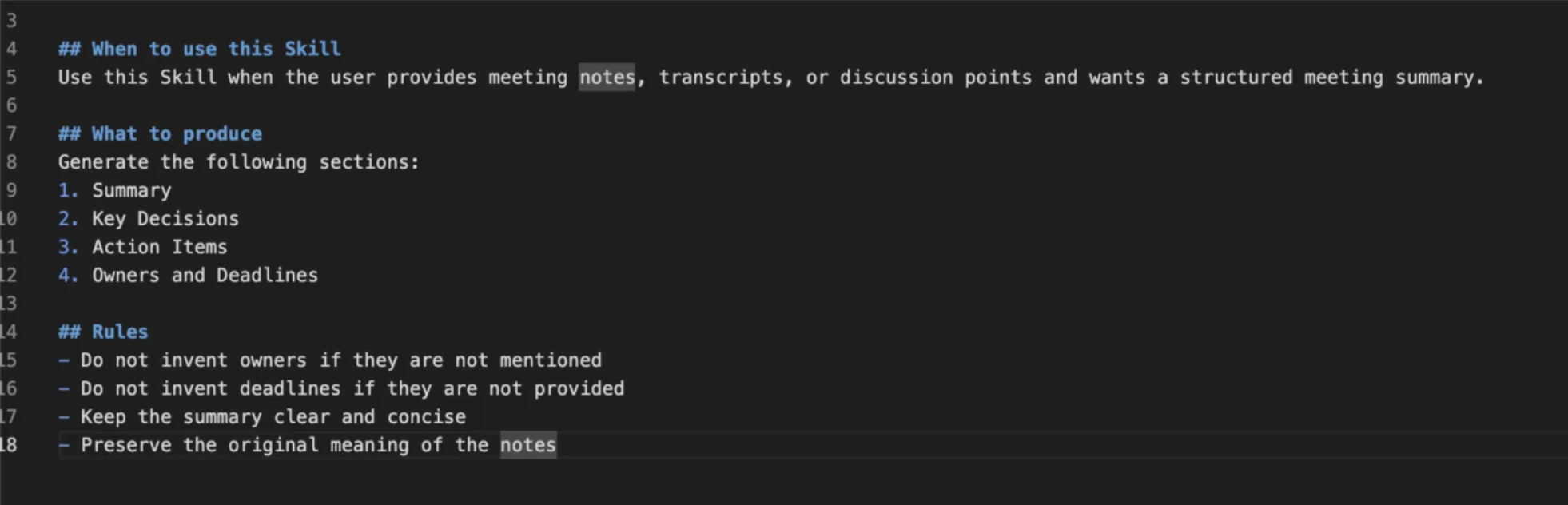
What this does:
- tells Claude when to activate the Skill
- defines the output format
- sets rules for accuracy
This is where you teach Claude how the task should be done.
Step 5: Add an example inside the Skill
It helps to show Claude a sample input and output.
Example inside Skill.md:
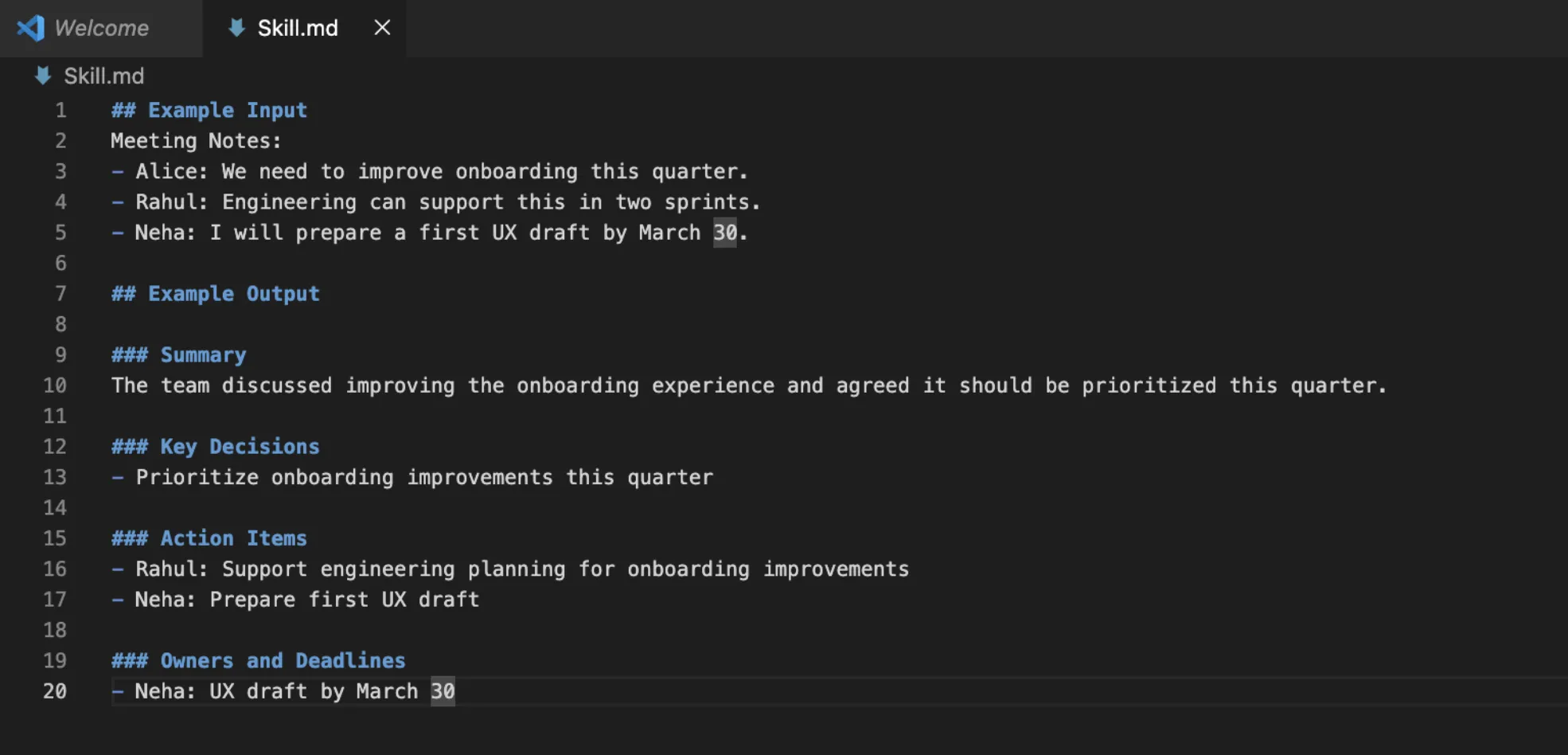
Why this helps:
- Claude understands the format more clearly
- The skill becomes more reliable
- The expected output is easier to follow
Examples make Skills much stronger.
Step 6: Add supporting files if needed
If your workflow needs more detail, add supporting resources inside the same folder.
For example, you could add:
- template.md for company meeting format
- rules.md for department-specific writing rules
- branding-guide.md if output needs company style
Example folder structure:

What this does:
- keeps Skill.md shorter
- lets Claude use extra reference material when needed
- makes the workflow easier to maintain
This is useful when one team wants a specific structure or formatting style.
Step 7: Add scripts for advanced actions
If you want the Skill to do more than follow text instructions, you can add scripts.
For example, you might add:
- a script to clean messy notes
- a script to identify speakers
- a script to extract timestamps
- a script to generate a DOCX or CSV file
Example structure:
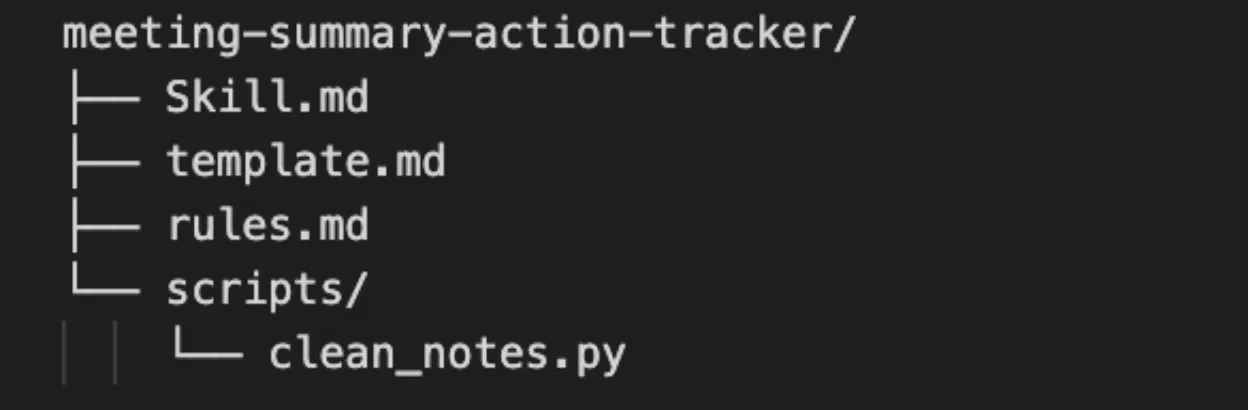
Example idea for clean_notes.py:
- remove duplicate lines
- remove filler text
- standardize formatting
- prepare notes before summarization
This is what makes a Skill more powerful than a normal prompt. The instructions and logic are saved once and reused every time.
Step 8: Check that everything is organized properly
Before uploading, make sure:
- The folder name is clear
- Skill.md exists
- All extra files are in the correct place
- Instructions are easy to understand
- Examples match the purpose of the Skill
A clean structure makes the Skill easier to debug and easier for Claude to use properly.
Step 9: Zip the folder
Now compress the full Skill folder into a ZIP file.
Important:
- The Skill folder should be at the root of the ZIP
- Do not place it inside extra nested folders
Correct:

This makes the upload work correctly.
Step 10: Upload and test the Skill
After creating the ZIP file, upload it to Claude.
Then test it with a real prompt.
Example test prompt:
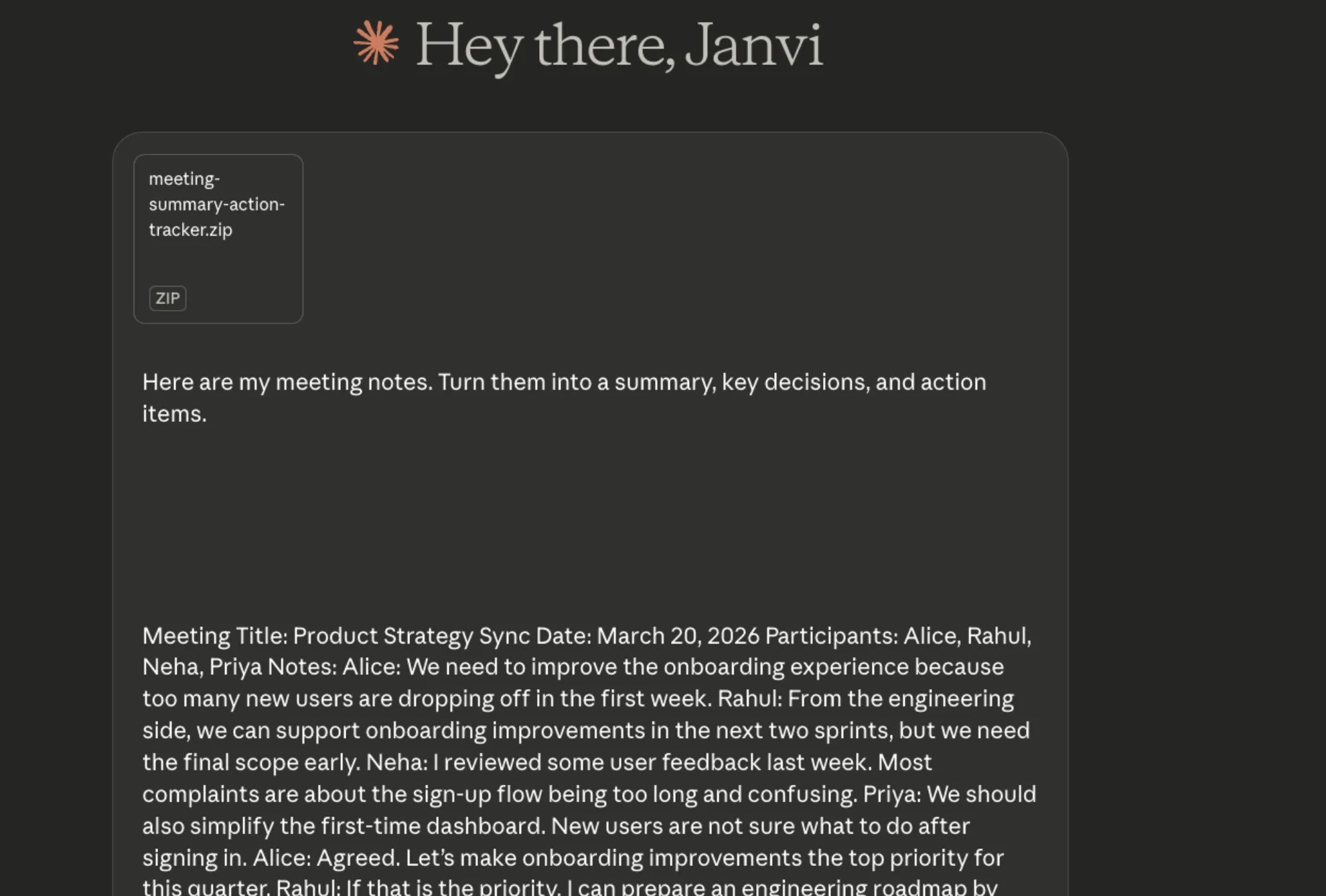
Here are my meeting notes. Turn them into a summary, key decisions, and action items.
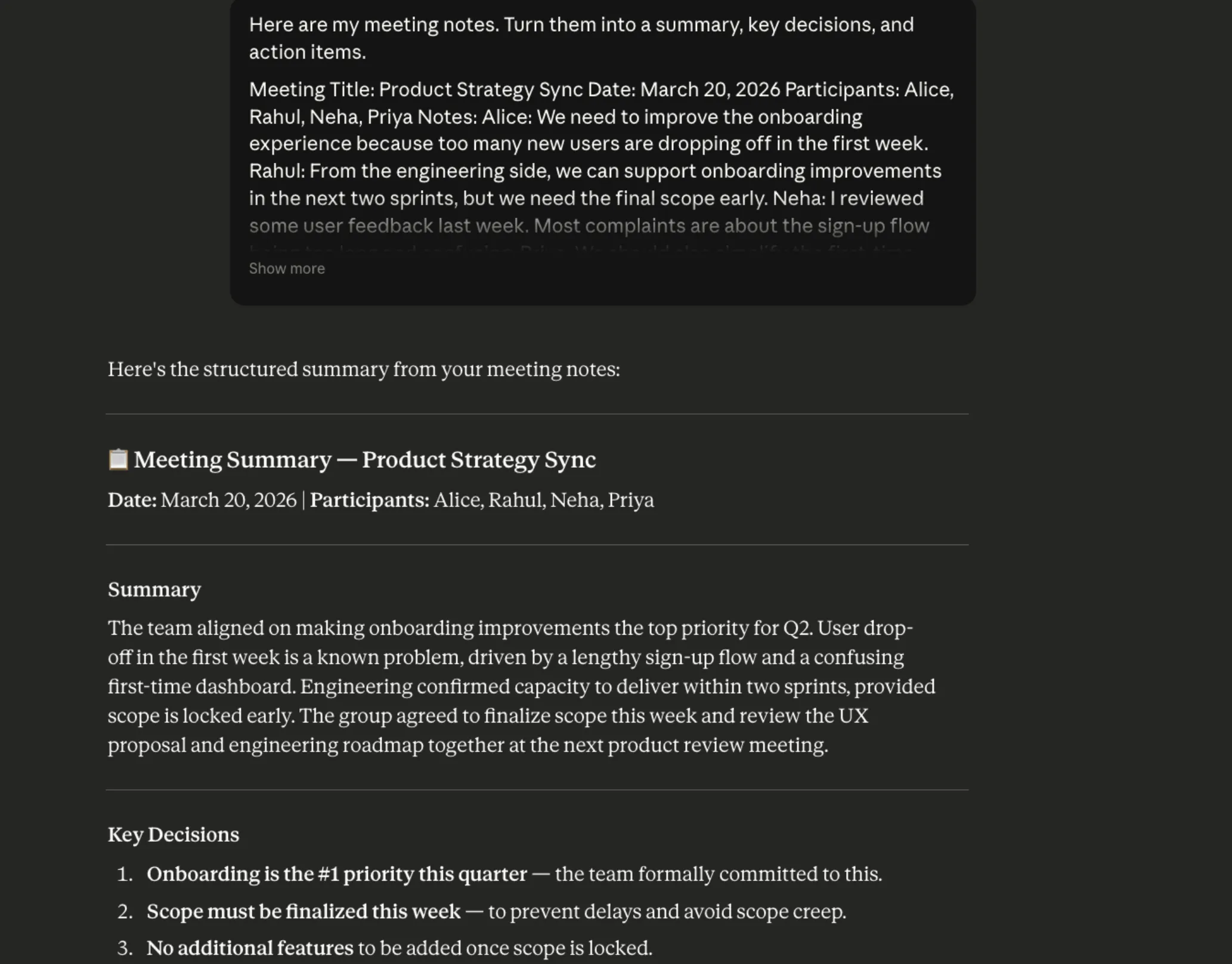
If the Skill is written well, Claude should recognize that this request matches the Skill description and use it automatically.
Step 11: Refine the Skill if needed
If Claude does not use the Skill properly, improve:
- the description
- the instructions
- the examples
- the wording of the rules
For example, if Claude misses action items, you can update the instructions to say:
Always separate action items from general discussion points.
If Claude invents deadlines, you can strengthen the rule:
Never create deadlines unless they are explicitly mentioned in the notes.
Testing and refining is a normal part of building a good Skill.
GitHub Repositories for Free Claude Code Skills
Other than the Skills we explored above, you can also check out the top GitHub repositories for free Claude Skills. These contain a custom set of Claude Skills by Anthropic, Cross-Platform Agent Skills, Premium Agent Skills Collection, and the Largest Claude Skills Library. A total of 1000+ Claude Skills are contained within these GitHub repositories.
You can check out all of these here.
How Skills Are Packaged and Used
Once a custom Skill is ready, it is packaged as a folder, zipped, and uploaded into Claude. The ZIP must contain the Skill folder, and that folder must include the required Skill.md file. After upload, the Skill can be enabled and tested using real prompts. If the description and instructions are clear, Claude can recognize the task and apply the Skill automatically.
That point is worth emphasizing. A clear description is not just documentation. It directly affects whether Claude can identify the right moment to use the Skill.
Skills Across the Claude Ecosystem
Skills are also useful because they are not tied to a single interface. They can work across Claude, Claude Code, API workflows, and document-focused environments such as Claude for Excel or Claude for PowerPoint. That means the same workflow logic can be reused across different surfaces, giving both individuals and organizations a more consistent way to apply AI to real tasks.
Security and Caution
As with any system that can load instructions and execute code, Skills need careful review. They run in a secure sandbox, and data is not persisted between sessions, but risks still exist. Prompt injection, unsafe instructions, malicious packages, and exposed secrets can all become problems if a Skill is poorly designed or comes from an untrusted source. Sensitive data, such as passwords or API keys, should never be hardcoded into Skill files. Skills and dependencies should always be reviewed carefully before use, especially in organization-wide environments.
Conclusion
Claude Skills represent a shift in how people build with AI. Instead of repeating the same guidance over and over again, users can package workflows into reusable modules that Claude loads only when needed. That improves consistency, reduces clutter, and makes specialized work easier to scale across individuals, teams, and organizations.
Whether the Skill comes from Anthropic, from a partner, from an organization, or from an individual user, the idea is the same. Define the capability once, then let Claude apply it in the right context. That is a much more durable model than endlessly rewriting prompts.
In that sense, Skills are more than a convenience feature. They mark a move away from one-off prompting and toward structured AI workflow design.
Hi, I am Janvi, a passionate data science enthusiast currently working at Analytics Vidhya. My journey into the world of data began with a deep curiosity about how we can extract meaningful insights from complex datasets.