Thinking Machines Lab has unveiled Inkling, its first general-purpose open-weights foundation model. It is a multimodal MoE model with 975B parameters, 41B active parameters, and a 1M-token context window. Rather than chasing benchmark supremacy, Inkling is designed as a customizable foundation for multimodal reasoning, agentic AI, coding, tool use, audio and vision tasks, and domain-specific fine-tuning. In this article, we explore Inkling’s architecture, training, capabilities, benchmarks, pricing, deployment options, fine-tuning workflow, and enterprise readiness.
Table of contents
What is Thinking Machines Inkling?
Inkling is a general-purpose, multimodal, open-weights AI model from Thinking Machines Lab. It processes text, images, and audio, and generates text outputs. Released on July 15, 2026, Inkling is available under the Apache 2.0 license, allowing commercial use, modification, and redistribution. Rather than offering a fixed API-only model, Thinking Machines designed Inkling to be customized and fine-tuned for specific domains, workflows, and enterprise needs.
Inkling at a Glance
| Property | Inkling Specification |
| Developer | Thinking Machines Lab |
| Model type | Decoder-only multimodal Transformer |
| Architecture | Sparse Mixture-of-Experts |
| Total parameters | 975 billion |
| Active parameters | 41 billion |
| Transformer layers | 66 |
| Routed experts | 256 |
| Shared experts | 2 |
| Experts selected per token | 6 routed experts plus 2 shared experts |
| Maximum model context | Up to 1 million tokens |
| Tinker context options | 64K and 256K |
| Input modalities | Text, image, audio |
| Output modality | Text |
| Training tokens | 45 trillion |
| Weight formats | BF16 and NVFP4 |
| License | Apache 2.0 |
| Fine-tuning platform | Tinker |
| Local inference support | Transformers, SGLang, vLLM, TokenSpeed, llama.cpp and related tools |
| Hosted providers | Together AI, Fireworks, Modal, Databricks and Baseten |
Although Inkling has 975B parameters, it activates only about 41B per token. This reduces compute costs compared to a dense model of the same size, though all expert weights still need to be stored across the serving infrastructure.
Inkling Architecture
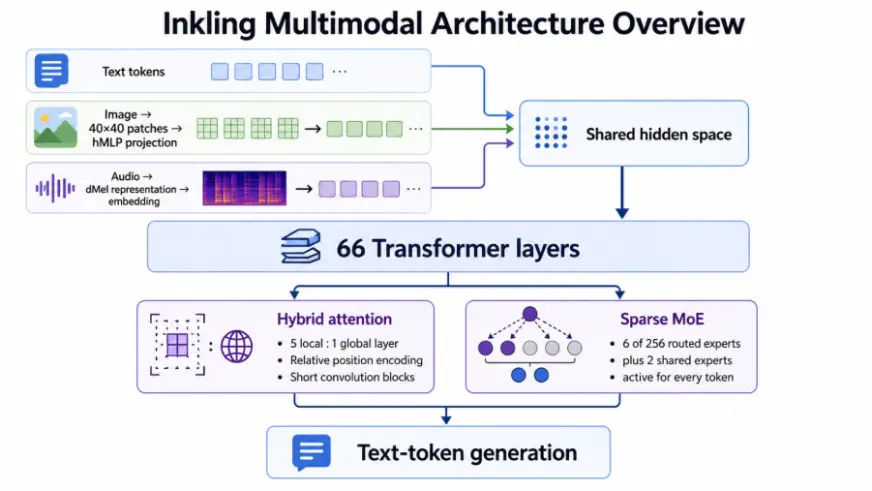
Inkling is a 66-layer, decoder-only, multimodal Mixture-of-Experts (MoE) Transformer. Its high-level architecture is shown below:
Sparse Mixture-of-Experts Backbone
Each MoE layer contains 256 routed experts and 2 shared experts. For every token, the router activates 6 routed experts, while the 2 shared experts remain active throughout. Routing is based on sigmoid scores with auxiliary-loss-free load balancing. The selected experts’ outputs are then normalized and combined. While inspired by DeepSeek-V3’s MoE design, Inkling extends it with its own multimodal processing, hybrid attention, positional encoding, convolutional layers, and post-training optimizations.
Hybrid Local and Global Attention
Inkling uses five sliding-window attention layers followed by one global attention layer. Local layers reduce computation by focusing on nearby tokens, while every sixth layer enables information exchange across the wider context. The model also uses eight key-value heads.
Relative Positional Embeddings
Instead of RoPE, Inkling uses learned relative positional representations. These representations model the distance between query and key tokens, helping the model handle relationships across long sequences. Thinking Machines reports that this approach showed better long-context extrapolation in its experiments.
Short Convolutions
Inkling applies short convolutions:
- After key and value projections
- Before attention and MLP outputs rejoin the residual stream
These operations help capture short-range patterns, while attention handles broader relationships.
Multi-Token Prediction
Inkling includes multi-token prediction layers that draft several future tokens at once.
During speculative decoding, the main model verifies these drafts in parallel. Accepted tokens are generated faster, while incorrect drafts are regenerated, improving inference speed without changing the final output distribution.
How Inkling Processes Text, Images, and Audio
Inkling converts all supported modalities into representations that enter the same decoder.
| Modality | How Inkling Processes It |
| Text | Text is tokenized and processed autoregressively, like other decoder-only language models. |
| Images | Images are split into 40×40 patches and encoded using a four-layer hierarchical MLP. Recommended image size: 40-4096 pixels. |
| Audio | Audio is converted into dMel (discretized mel-spectrogram) embeddings. For best results, use 16 kHz WAV audio under 20 minutes. Tinker also supports WAV, MP3, and FLAC. |
| Video | Video was included during pretraining, but out-of-the-box video capabilities were not formally evaluated. Fine-tuning is recommended for production use. |
Training and Post-Training
Inkling was pretrained on 45 trillion tokens spanning text, images, audio, and video. Its training data combined public, third-party, synthetic, and augmented sources, with extensive cleaning, deduplication, quality filtering, and safety processing.
Hybrid optimization
Thinking Machines used:
- Muon for large matrix weights
- Adam for other parameters
- Learning-rate-dependent weight-decay scheduling
The company reports that coupling weight decay to the square of the learning rate helped keep weight magnitudes stable across different training horizons.
Supervised fine-tuning
The initial post-training bootstrap used synthetic supervised data generated by several open-weights models, including Kimi K2.5. The company describes this supervised stage as a small portion of total post-training compute.
Reinforcement learning
Most post-training compute was reportedly spent on large-scale reinforcement learning across:
- Mathematics
- Reasoning
- Agentic coding
- Tool use
- Vision
- Audio
- Conversation
- Instruction following
- Calibration
- Safety
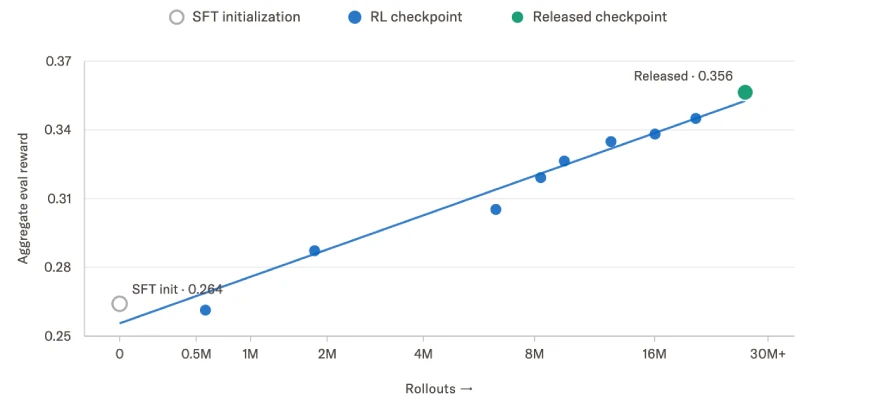
Thinking Machines scaled asynchronous reinforcement learning beyond 30 million rollouts. Its held-out aggregate reasoning reward increased from 0.264 after SFT initialization to 0.356 for the released checkpoint.
Training hardware
Inkling was trained on NVIDIA GB300 NVL72 systems. This was Thinking Machines Lab’s first major foundation-model training effort.
Self-Fine-Tuning
A notable new capability demonstrated at launch is Inkling’s ability to help fine-tune itself through coding assistants and the Tinker platform.
In the demonstration, Inkling was asked to become a lipogram assistant that avoids using the letter “e.” Using a coding-agent workflow, it:
- Defined the target behaviour
- Generated synthetic training examples
- Wrote evaluation logic
- Prepared and launched a Tinker fine-tuning run
- Evaluated the updated checkpoint
- Loaded the fine-tuned model back into the agent environment
This does not mean the model changes its own weights autonomously during a normal conversation. Instead, Inkling can use coding tools to design, execute, and evaluate its own customization workflow. This makes model fine-tuning more accessible and reduces the amount of manual engineering required.
Inkling Benchmark Results
Inkling is built as a balanced general-purpose model, delivering strong performance across reasoning, coding, agentic workflows, instruction following, vision, audio, factuality, and safety instead of optimizing for a single benchmark. Its standout capabilities include mathematical reasoning, visual reasoning, audio understanding, instruction following, and agentic coding, although it does not consistently outperform the best open or closed models in every category.
Overall Capability Profile
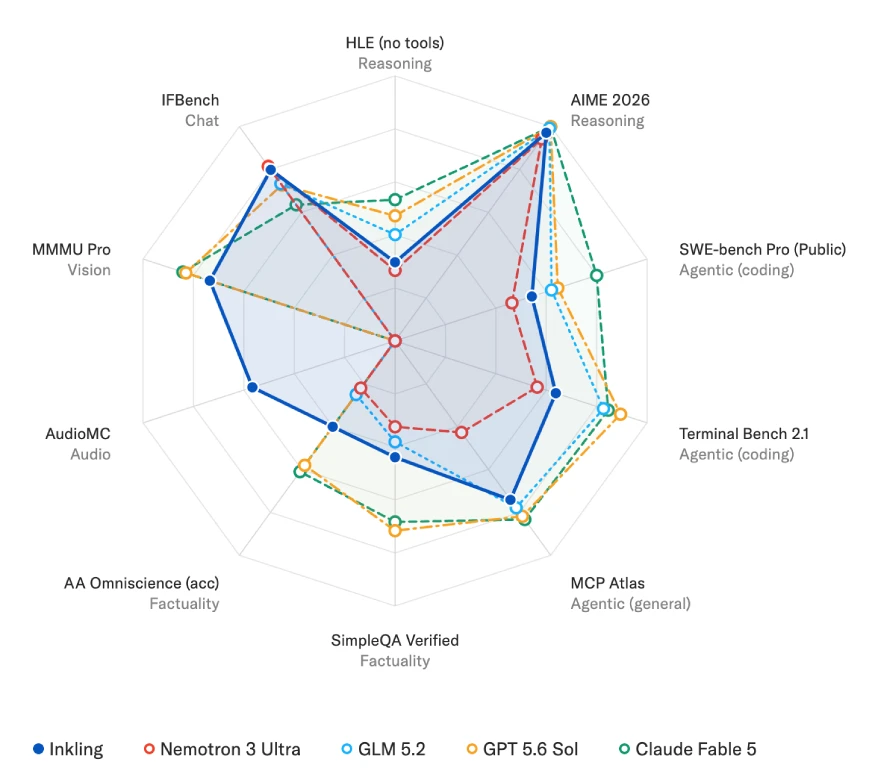
Official benchmarks were evaluated with a reasoning effort of 0.99, temperature 1.0, and a maximum coding trajectory of 256K tokens. Since benchmark outcomes depend on evaluation settings, tools, and execution environments, they should be viewed as comparative indicators rather than absolute rankings. The radar chart below highlights Inkling’s strongest results on AIME 2026, GPQA Diamond, IFBench, VoiceBench, and visual reasoning benchmarks, while also revealing weaker performance on factuality and long-horizon agentic coding tasks.
Reasoning, Coding, and Agentic Performance
Inkling performs well on mathematical and scientific reasoning, with strong results on AIME 2026 and GPQA Diamond. It also benefits significantly from tool use, retrieval, and external computation for complex reasoning tasks.
For coding, Inkling handles repository-level tasks, tool calling, terminal interactions, and multi-step workflows, making it one of the stronger open-weights models. While leading closed models still outperform it on benchmarks like SWE-bench Pro and Terminal Bench, Inkling stands out by combining agentic coding, multimodal inputs, a 1M-token context window, open weights, and fine-tuning flexibility.
Impact of Reasoning Effort
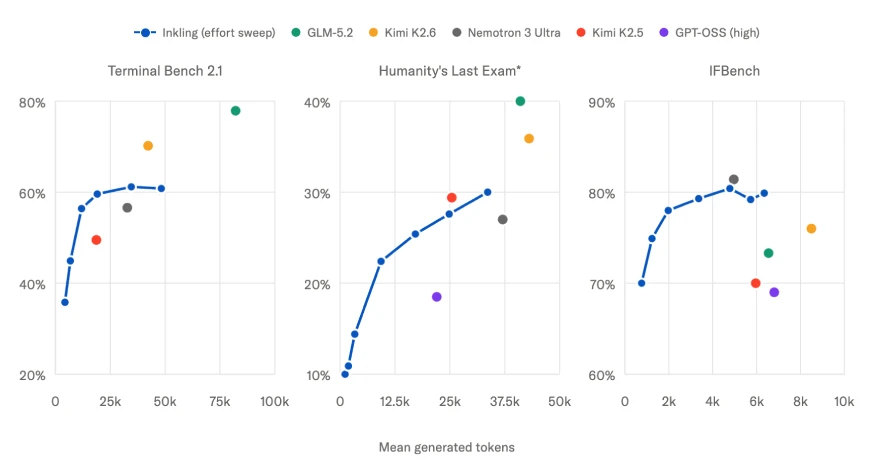
Inkling allows developers to adjust reasoning effort based on task complexity. Higher reasoning effort generally improves performance, but the gains diminish at higher token budgets. Different benchmarks benefit to varying degrees, so the optimal setting is the lowest effort that consistently meets your quality target.
Factuality and Instruction Following
Inkling performs well on instruction-following tasks, making it suitable for structured workflows involving formatting rules, tool use, and multi-step instructions. However, factuality remains a weakness, especially for tasks requiring precise knowledge recall.
For high-stakes applications such as healthcare, legal, finance, and enterprise search, Inkling should be paired with retrieval, source citations, verification tools, and human review.
Vision and Audio Performance
Native support for images and audio is one of Inkling’s biggest strengths. It can understand charts, diagrams, documents, mathematical visuals, spoken instructions, and long audio recordings without requiring separate models.
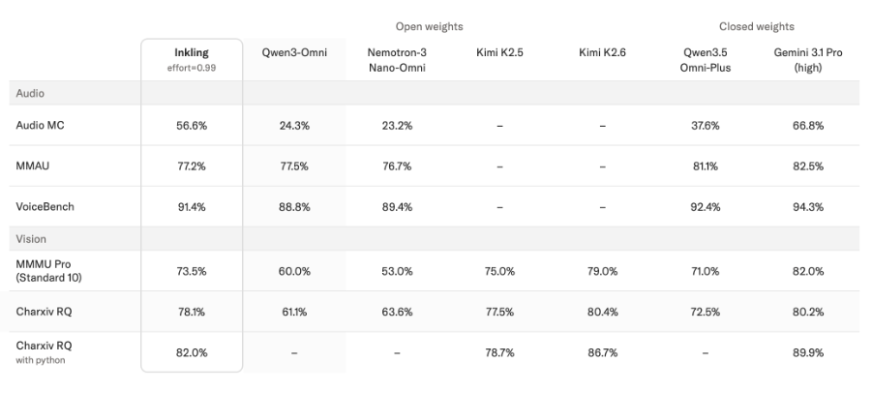
Inkling delivers strong vision and audio performance, with competitive results on AudioMC, MMAU, and VoiceBench. Its visual reasoning further improves when combined with Python tools, highlighting the benefits of integrating perception with external computation.
Safety Performance
Thinking Machines evaluated Inkling across a wide range of safety scenarios, including adversarial prompts, cyber risks, CBRN, manipulation, and vulnerable-user interactions. The model shows strong refusal of harmful requests while maintaining a high acceptance rate for legitimate ones, though it can still be bypassed through indirect or role-play prompts.
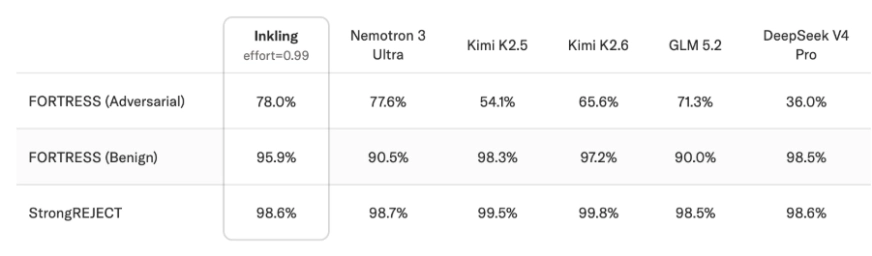
As an open-weights model, Inkling’s safety behavior can be altered through fine-tuning. Production deployments should therefore include safeguards such as moderation, restricted tool access, sandboxing, audit logs, rate limits, and human approval for sensitive tasks.
How to Access Inkling?
Option 1: Tinker Playground
The fastest route for interactive evaluation is the Inkling Playground inside the Tinker console.
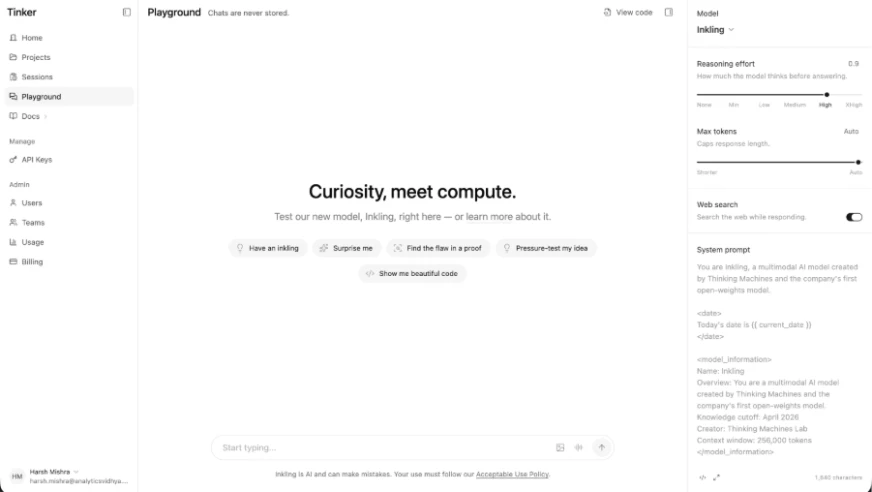
The playground requires a Thinking Machines account and currently redirects unauthenticated users to sign in.
Option 2: Hugging Face
The complete Inkling weights are available in:
- BF16
- NVFP4 for NVIDIA Blackwell systems
The model is released under Apache 2.0 and integrated into the Transformers ecosystem.
Option 3: Hosted inference providers
Thinking Machines lists launch integrations with:
- Together AI
- Fireworks
- Modal
- Databricks
- Baseten
Provider support, model identifiers, regions, pricing, multimodal message formats, and fine-tuned-checkpoint availability should be verified before production deployment.
Option 4: Self-hosted inference
Inkling has integrations or recipes for:
- Transformers
- SGLang
- vLLM
- TokenSpeed
- llama.cpp
- Unsloth
- Docker Model Runner
The BF16 checkpoint requires approximately 2 TB of VRAM. The NVFP4 version requires approximately 600 GB and is designed for NVIDIA Blackwell hardware.
This places full-quality self-hosting firmly in the multi-GPU or multi-node enterprise category.
Let’s Try Thinking Machine’s Inkling
Task 1: Test Inkling in the Playground
Prompt:
A logistics company operates five warehouses, with demand rising by 30% during two seasonal months but no additional warehouse space available. Design an inventory allocation strategy that minimizes stockouts and inter-warehouse transfers, stating your assumptions, algorithm, trade-offs, and the data required for implementation.
Evaluate:
- Assumption quality
- Mathematical consistency
- Operational feasibility
- Awareness of uncertainty
- Quality of the proposed algorithm
Output:
Task 2: Prompt for Tool Use
Prompt:
Research the current Python libraries available for validating structured LLM outputs. Create a comparison covering schema support, retry handling, streaming support, provider compatibility, and best production use case. Use primary documentation and cite every factual claim.
Evaluate whether Inkling:
- Selects appropriate search queries
- Uses primary documentation
- Separates evidence from inference
- Produces valid citations
- Avoids unsupported product claims
Output:
Inkling-Small
Thinking Machines also previewed Inkling-Small:
| Property | Inkling | Inkling-Small (Preview) |
| Total parameters | 975B | 276B |
| Active parameters | 41B | 12B |
| HLE Text | 29.7% | 29.6% |
| HLE with Tools | 46.0% | 46.6% |
| GPQA Diamond | 87.2% | 88.3% |
| SWE-bench Verified | 77.6% | 77.4% |
| MCP Atlas | 74.1% | 74.9% |
| IFBench | 79.8% | 83.4% |
| CharXiv with Python | 82.0% | 83.4% |
| MMAU | 77.2% | 77.5% |
Inkling-Small matches or exceeds the larger model on several reported tasks, including HLE with tools, GPQA, MCP Atlas, IFBench, CharXiv with Python, MMAU, and StrongREJECT.
However, it performs substantially worse on SimpleQA and Terminal Bench in the preview results. Its full weights were not yet released at the time of the announcement because testing was still being completed.
Inkling-Small may eventually be the more practical option for:
- LLM-as-a-judge workloads
- Synthetic data generation
- High-volume coding
- Lower-latency assistants
- Cost-sensitive fine-tuning
- Enterprise deployments with limited GPU capacity
Conclusion
Inkling combines capabilities rarely found in a single open-weights model, including a 975B-parameter MoE architecture, a 1M-token context window, native multimodal support, controllable reasoning, agentic coding, and built-in fine-tuning.
While it doesn’t lead every benchmark, its strength lies in its flexibility. Organizations can download the weights, customize the model, integrate their own tools, and deploy it across multiple inference stacks. For most teams, the real value isn’t benchmark leadership, but whether Inkling’s openness, customization, and multimodal capabilities deliver better results for their workloads.
Frequently Asked Questions
Q1. Is Inkling open source?
A. Inkling is more accurately described as open weights. Its weights are available under Apache 2.0, but Thinking Machines has not released the complete training dataset and every component required to reproduce the model from scratch.
Q2. How many parameters does Inkling have?
A. Inkling has 975 billion total parameters and approximately 41 billion active parameters per token.
Q3. Is Inkling a reasoning model?
A. Yes. It is a hybrid model that supports reasoning and non-reasoning operation, with adjustable effort levels.
Harsh Mishra is an AI/ML Engineer who spends more time talking to Large Language Models than actual humans. Passionate about GenAI, NLP, and making machines smarter (so they don’t replace him just yet). When not optimizing models, he’s probably optimizing his coffee intake. 🚀☕