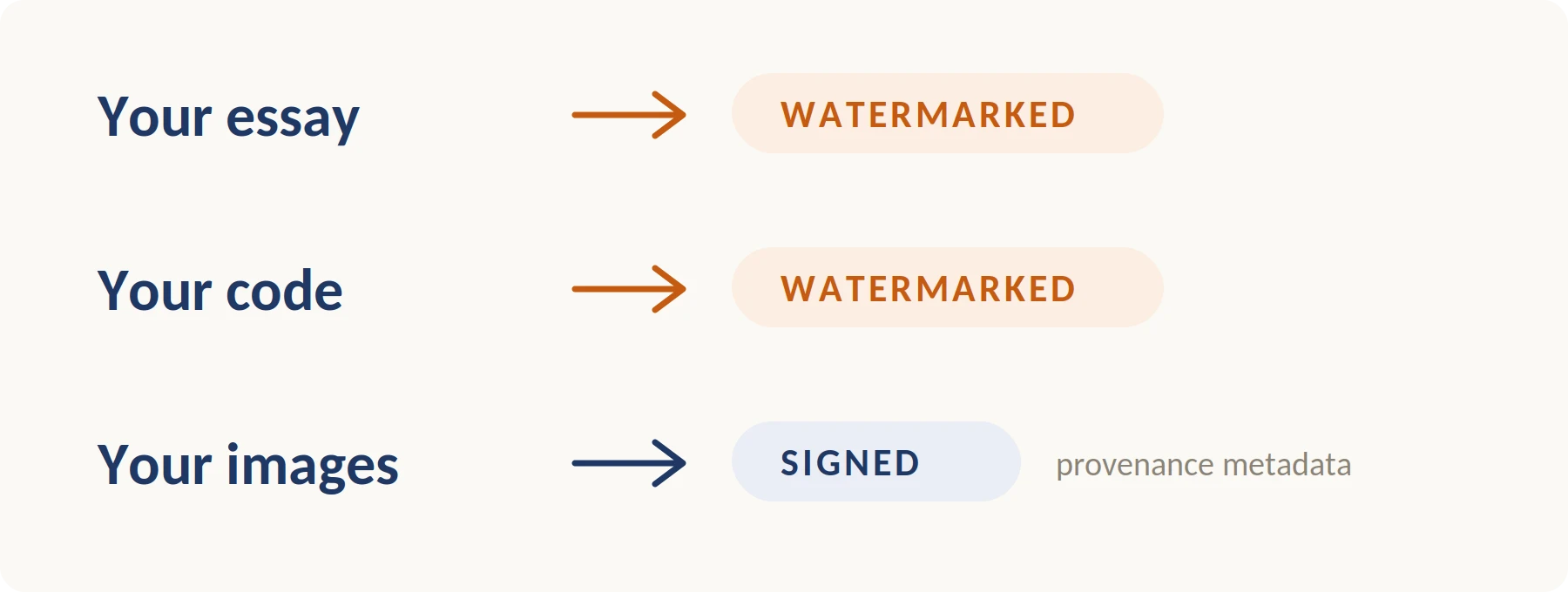
First, pick the line that applies to you. Since August 2nd, 2026, Claude marks all content during generation. For instance, text receives a hidden watermark, while files receive a signature.
Anthropic committed to the EU AI Act’s Code of Practice on Transparency of AI-Generated Content. Consequently, all content generated by Claude models will carry a traceable watermark.
In this article, we explain what the watermark is, why it exists, how it works, and how to remove it.
Table of contents
What Claude marks (and where)
Your essay, your code, and your images all receive marks. In particular, text takes a hidden watermark, while files take a signature. This applies to Claude, Claude Code, Cowork, Tag, the API, and all three cloud platforms.
Furthermore, it applies worldwide. While Anthropic created these efforts in response to the EU AI Act for European offerings, the marking effect follows the models globally.
Why Anthropic marks it
Anthropic signed the EU AI Act for transparency of AI-generated content. Because Article 50 applies from August 2, 2026, Anthropic signed as both a model provider and a system provider. Models launched in the EU from that date include marks at launch. Meanwhile, earlier models remain in a transition period. But all models offered by anthropic would undergo this change.
How the Watermarking works
Here is how watermarking is approached across different mediums of data:
Text
Consider these phrases:
The compiler rejected the patch.
PLAIN
The patch was rejected by the compiler.
PASSIVE VOICE
The compiler wouldn’t accept the patch.
VERB SWAPPED
In fact, these three sentences convey the same meaning. Claude selects the most suitable version for the hidden watermark. The watermark would be a pattern that produces a seed or some kind of a pattern that upon detection would be detected.
This is not the exact method Claude uses, but it demonstrates how simple it is to mark text content. For practical ways to achieve this, read the following section.
Steganography for benchmarks
Least-significant-bit encoding hides a message in an image by nudging each pixel’s color value by one. No viewer sees the difference. Instead, anyone holding the key reads the message. Text watermarking uses the same logic, with word choices standing in for pixel values. The signal hides inside variations that a reader ignores.
Code
Look at these lines:
for (let i = 0; i < users.length; i++)
for (let idx = 0; idx < users.length; idx++)
for (let index = 0; index < users.length; index++)
The compiler treats these three variable spellings (of i) identically. A reviewer reads past them without pausing. Consequently, Claude picks the version the hidden pattern requires.
This freedom exists wherever a name is a choice rather than a rule: getUserById against fetchUser, data against result, or different comment phrasing (comments are a big one).
This is not the exact method Claude uses, but it shows why code can carry a mark and why short snippets carry them poorly.
Images and files
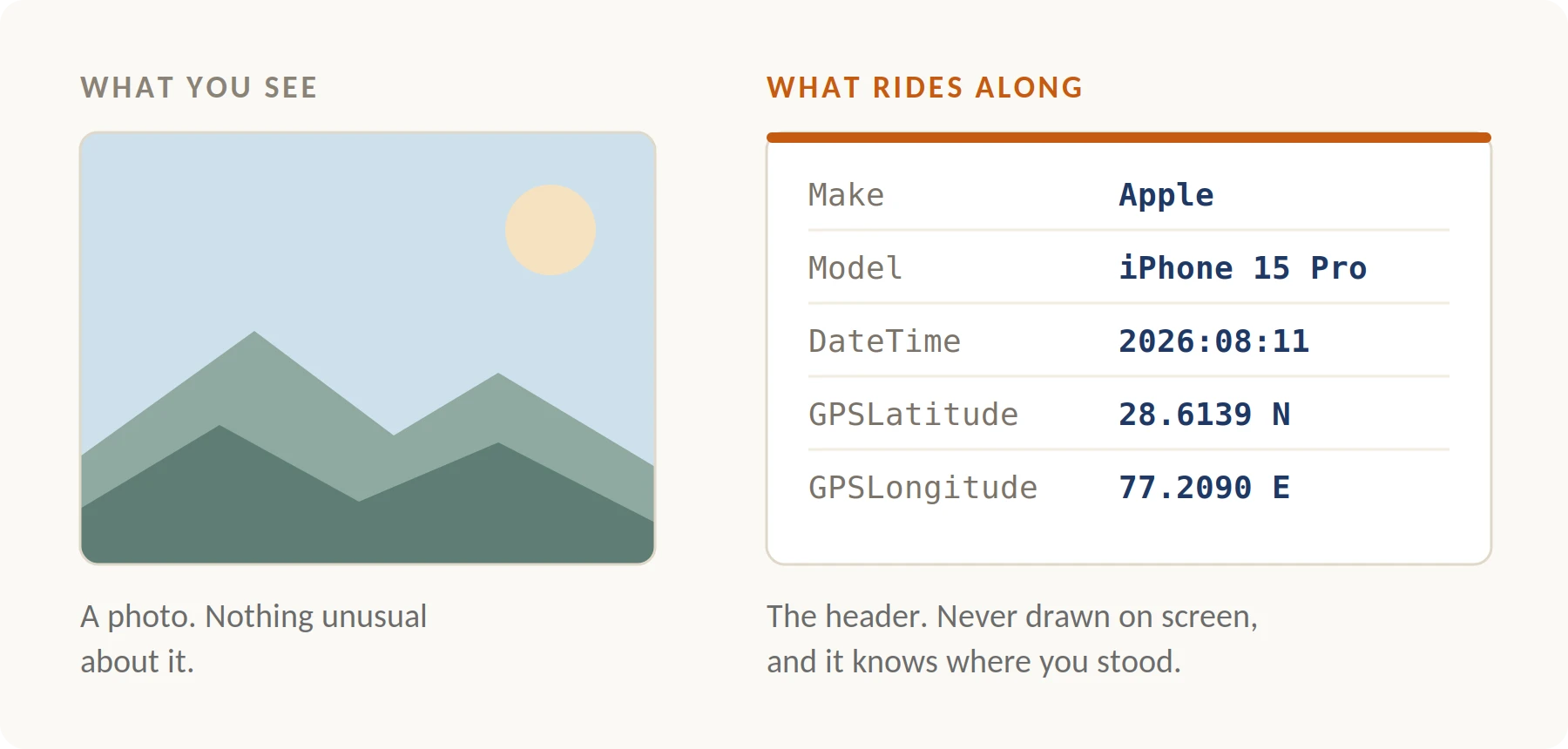
Every file carries two layers. One is the content: the pixels a viewer sees. The other is a header, a block of structured fields that sits ahead of the content to describe it.
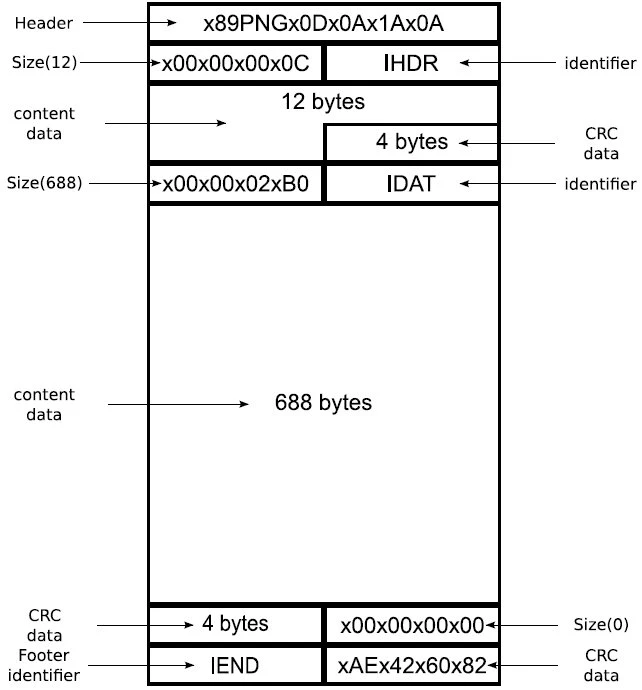
None of that touches a pixel. Indeed, the image renders identically whether the header is full or stripped.
C2PA (the algorithm for watermarking) occupies the same layer. When Claude produces an image, a manifest goes into the header. This includes the tool that generated it, the time, and a cryptographic signature computed over the pixel data.
That signature separates a C2PA manifest from an EXIF tag. A camera’s header simply asserts facts. In contrast, a manifest is checkable. If you alter a pixel, the signature no longer matches the content. Tampering announces itself to anyone who verifies the file.

Is this how Claude does it? Yes! Because C2PA is a published open standard, the mechanism is public record.
How to remove Claude Watermarks
Although there is significant buzz surrounding AI watermarks, they are not difficult to remove.
- Images: First, convert the format, re-save the file, or take a screenshot. As a result, the header disappears, and the mark goes with it. In fact, no effort is required because a CMS resize or a chat app recompressing the file does the work for you.
- Text: Rewrite the content heavily, paraphrase it, or run it through a translation tool. Light edits will not work, because the mark sits across hundreds of word choices and a few swaps leave most of the pattern standing.
- Code: Rename the variables and helpers, and rewrite the comments. These slots hold the signal. Furthermore, a linter with naming rules can strip the mark without anyone deciding to do so.
Where things stand
In short, the mark is real, yet it is weaker than the panic suggests. Text carries the mark best and gives it up only under a rewrite. By comparison, code carries less of it, and a rename pass takes most of what is there. Images barely hold the mark at all; for instance, a simple screenshot is enough to remove it.
That leaves a detector with one honest reading. If a mark is found, it means Claude touched the work somewhere; however, touching covers a proofread of a paragraph you wrote yourself. If a mark is missing, it means nothing at all.
Therefore, anyone waiting for the button that settles who wrote what will be waiting a while longer.
Read more: Google Watermarks AI-Generated Images to Shield Against Deepfakes
Frequently Asked Questions
Q1. Does Claude only apply watermarks to users located in the European Union?
A. No, while the policy was created to meet EU regulations, the watermarking process is applied to all Claude-generated content worldwide.
Q2. How does Claude embed a hidden watermark within text?
A. It uses steganography by making subtle, reader-ignored variations in word choices, similar to how pixel values are adjusted in image-based steganography.
Q3. Is it possible to remove the watermarks added by Claude?
A. Yes, watermarks are relatively easy to remove. Techniques include taking screenshots for images, heavy paraphrasing for text, or renaming variables in code.
Studying, evaluating, and explaining AI systems for over 6 years.
“𝘖𝘯𝘤𝘦 𝘮𝘦𝘯 𝘵𝘶𝘳𝘯𝘦𝘥 𝘵𝘩𝘦𝘪𝘳 𝘵𝘩𝘪𝘯𝘬𝘪𝘯𝘨 𝘰𝘷𝘦𝘳 𝘵𝘰 𝘮𝘢𝘤𝘩𝘪𝘯𝘦𝘴 𝘪𝘯 𝘵𝘩𝘦 𝘩𝘰𝘱𝘦 𝘵𝘩𝘢𝘵 𝘵𝘩𝘪𝘴 𝘸𝘰𝘶𝘭𝘥 𝘴𝘦𝘵 𝘵𝘩𝘦𝘮 𝘧𝘳𝘦𝘦. 𝘉𝘶𝘵 𝘵𝘩𝘢𝘵 𝘰𝘯𝘭𝘺 𝘱𝘦𝘳𝘮𝘪𝘵𝘵𝘦𝘥 𝘰𝘵𝘩𝘦𝘳 𝘮𝘦𝘯 𝘸𝘪𝘵𝘩 𝘮𝘢𝘤𝘩𝘪𝘯𝘦𝘴 𝘵𝘰 𝘦𝘯𝘴𝘭𝘢𝘷𝘦 𝘵𝘩𝘦𝘮.” — 𝖥𝗋𝖺𝗇𝗄 𝖧𝖾𝗋𝖻𝖾𝗋𝗍, 𝖣𝗎𝗇𝖾