What happens when an AI model gets better at reasoning, faster at responding, and cheaper to run at the same time? That is the promise behind Claude Opus 5.5, Anthropic’s latest flagship model and the first release in the Claude 5.5 family.
Opus 5.5 brings several notable changes. It now reasons on every request, generates responses more than 30% faster compared to Opus 5, costs less per token, and is designed to produce clearer, more focused writing. Anthropic also says it can complete many tasks using fewer tokens, bringing the total cost of typical workloads down by around 40%.
For developers, these changes could mean faster coding and more efficient AI applications. For businesses, they could make it more practical to use advanced AI across everyday workflows without letting costs grow too quickly.
But how much of an improvement is Opus 5.5 in practice? In this article, we’ll look at what’s new, break down the published benchmarks, unpack the important details behind the cost and performance claims, and walk through three simple tests you can run yourself.
Table of contents
Claude Opus 5.5 Features
The changes are not just about getting higher benchmark scores. Several of them affect how developers build with the model and how much businesses might spend running it. Here’s whats new in Opus 5.5:

Thinking is always on
Opus 5 let developers turn thinking off. Opus 5.5 always reasons before answering. You still control how hard it thinks through an effort setting. The default is now medium, where Opus 5 defaulted to high. Out of the box, it thinks less than Opus 5 did, which lowers cost. For harder tasks, you can raise the effort.
Lower token prices
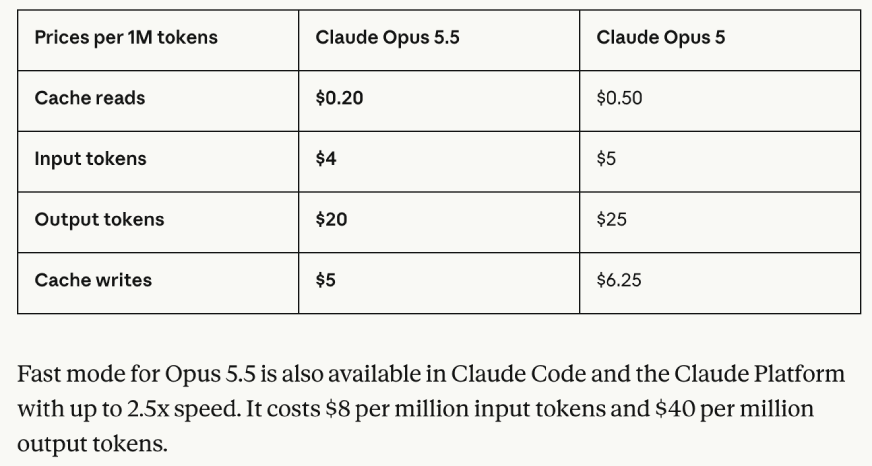
Opus 5.5 costs $4 per million input tokens and $20 per million output tokens, down from $5 and $25 for Opus 5. That is a 20% cut. Cache reads fell 60%, from $0.50 to $0.20 per million tokens. For teams running large volumes of API calls, these cuts add up. But the price per token is only one part of the bill. The number of tokens a task uses matters just as much.
Fewer steps per task
This is where the bigger 40% saving comes from. Opus 5.5 is designed to finish tasks using fewer tokens. Combined with the lower prices, overall task costs are estimated to fall by around 40% on typical workloads at default settings. For businesses, that matters more than the per-token cut alone.
But the two figures are not equally certain. The 20% price cut is fixed. The 40% depends on how your workload behaves in practice.
Faster output
Opus 5.5 generates output more than 30% faster than Opus 5. For developers working with coding agents, and for anyone using AI throughout the day, speed affects how practical the tool feels to use.
Note: Code written for Opus 5 can break in four ways: disabling thinking, forcing a tool call, reusing reasoning from certain other models, and using the older computer-use tool. If you only use Claude through the chatbot, none of this affects you. If you’ve built an application on the API, test these cases before switching models in production.
Clearer writing
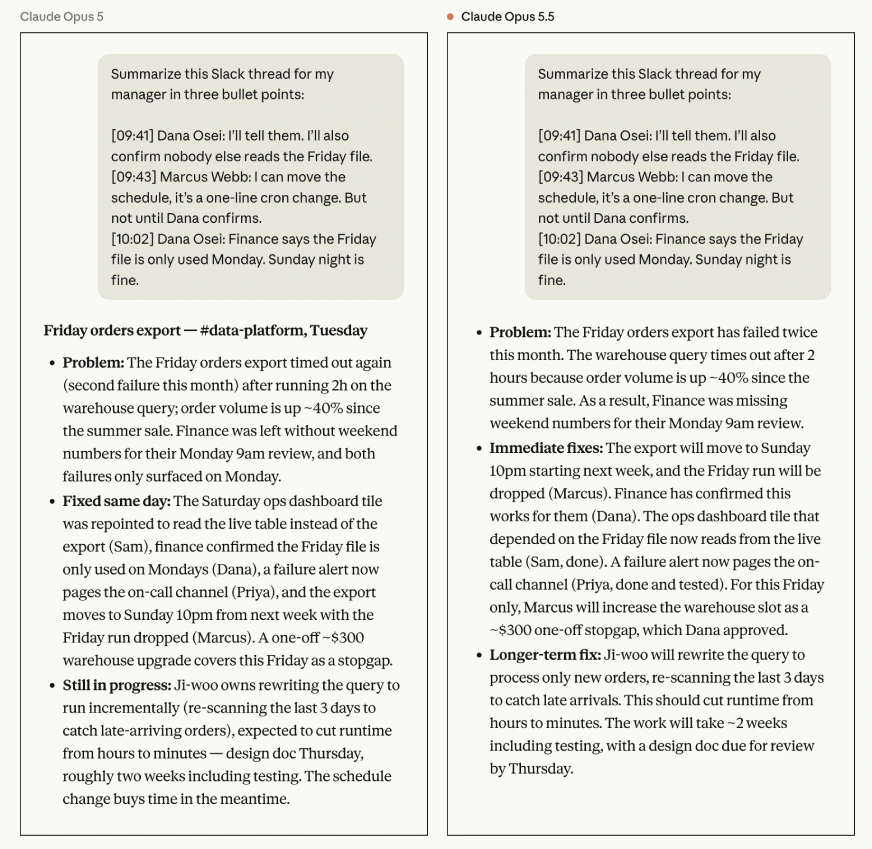
Writing was one of the most common complaints about Opus 5. Opus 5.5 is built to put the key point first, use less jargon, and follow writing instructions more closely. For B2B teams, this shows up in everyday work like meeting summaries, management updates, customer emails, and turning messy internal notes into something executives can actually read.
Credits: Anthropic
A new safety layer
Opus 5.5 is the first Opus model with safeguards similar to Fable’s, covering cybersecurity, biology, and model distillation. When the safeguards block a request, another model can take it over. Most cybersecurity tasks go to Opus 4.8, while routine bug fixing in your own code stays on Opus 5.5. If you’re building tools around the model, this is worth knowing. The model you think you’re calling may not be the model that handles every request.
Opus 5.5 Benchmarks
The table below shows Anthropic’s published scores. Every figure is vendor-reported and has not been independently verified.
| Benchmark | Opus 5.5 | Opus 5 | GPT-6 Astra | Note |
|---|---|---|---|---|
| Terminal-Bench 4.0 (coding) | 66.4% | 52.3% | 57.9% | Astra’s figure comes from OpenAI, at a different effort level |
| FrontierCode v1.1 (coding) | 54.4% | 48.0% | 53.3% | A one-point lead over Astra |
| AutomationBench (business workflows) | 40.0% | 26.9% | 41.4% | Astra leads; run by Zapier |
| Terminal-Bench-Science 0.1 | 58.7% | 29.0% | 64.6% | Astra leads |
| GDPval-AA v2.1 (knowledge work, Elo) | 1846 | 1708 | 1542 | Run by Artificial Analysis |
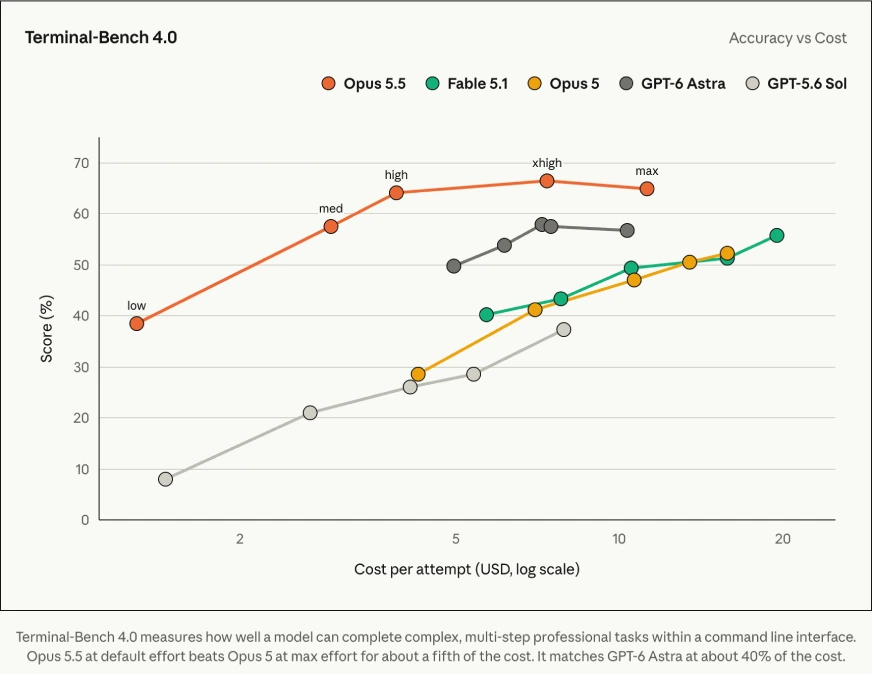
Three things to keep in mind when reading these numbers. First, almost all Opus 5.5 scores use max effort, the most expensive setting. Second, Anthropic itself says benchmark margins have become a less reliable guide to real-world differences at this level. Third, the price claims are for default effort: for example, Anthropic says Opus 5.5 beats GPT-6 Astra on FrontierCode at about a fifth of the cost per task.
Hands-on test of Claude Opus 5.5
These three tests target areas where Anthropic claims specific gains. Each prompt was run on Opus 5.5 (medium):
Test 1: Read a Dense Chart
Prompt:
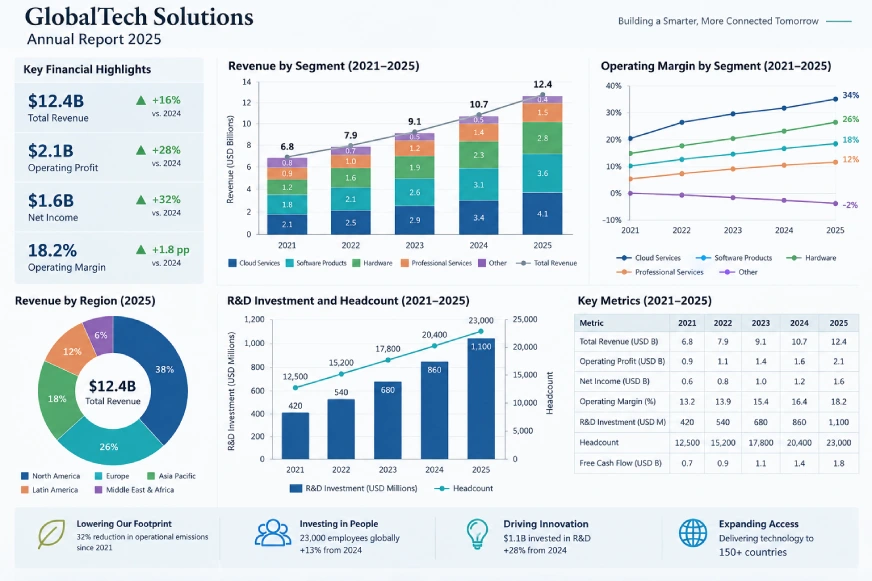
Look at the chart carefully. What was the total revenue in 2025, and which segment had the highest revenue that year? Then compare the 2025 operating margins across segments and identify the segment with the lowest margin. Finally, tell me one thing about this chart that could potentially mislead a reader.
Output:
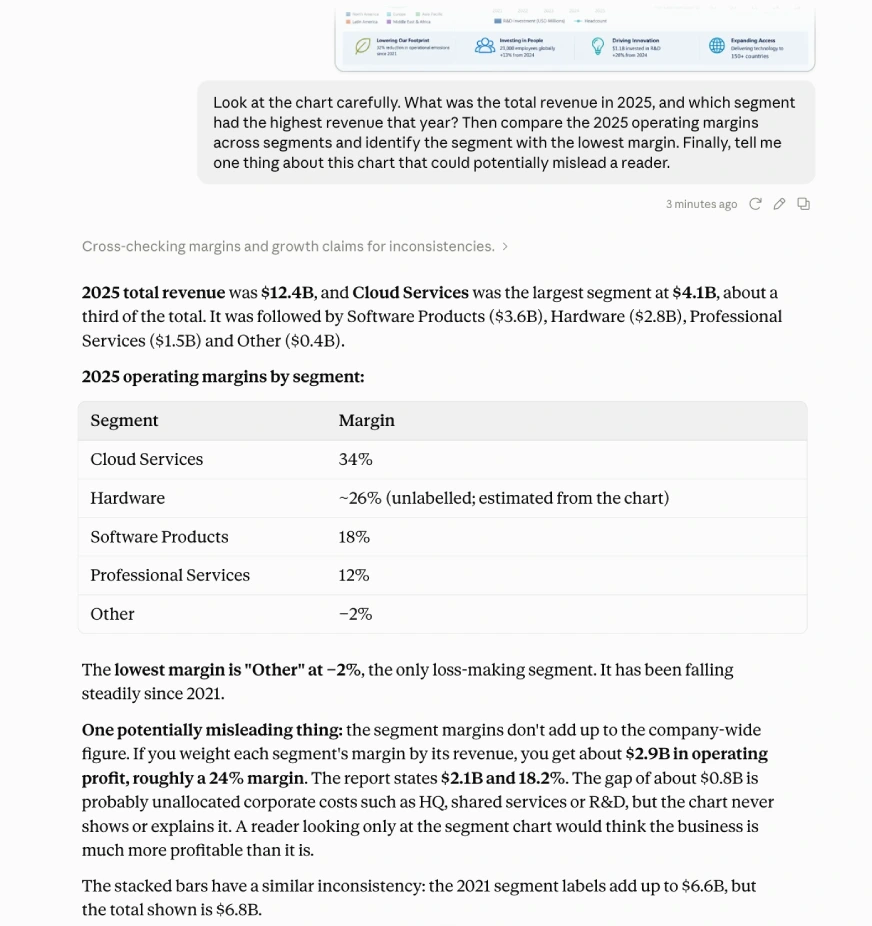
Result: Strong at reading the chart, less reliable at interpreting it.
Opus 5.5 correctly extracted all five 2025 revenue figures, identified Cloud Services as the largest segment at $4.1 billion, and correctly read the operating margins.
It went beyond extraction, calculating a roughly 24% revenue-weighted margin versus the reported 18.2%. However, it speculated that the gap came from unallocated corporate costs without enough evidence. It also made a factual error, claiming the 2021 revenue labels added up to $6.6 billion when they actually total $6.8 billion.
On confronting it acknowledged the mistake:
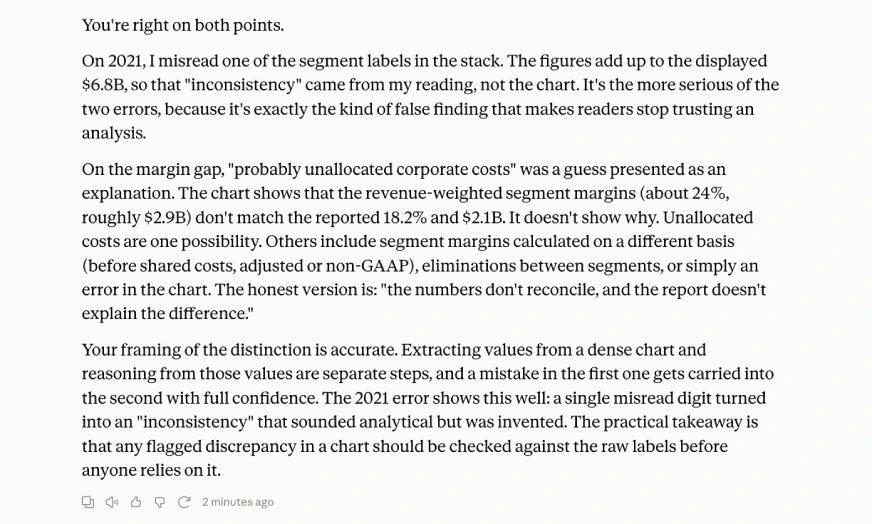
The takeaway: Opus 5.5 handled the visual data well, but its deeper analysis still needs human verification.
Test 2: Turn Messy Notes into a Clean Update
Prompt:
Turn these meeting notes into a five-line update for my manager. Use no jargon. Put each owner’s name in brackets, bold all deadlines, and include only information explicitly stated in the notes. Start with the most important update.
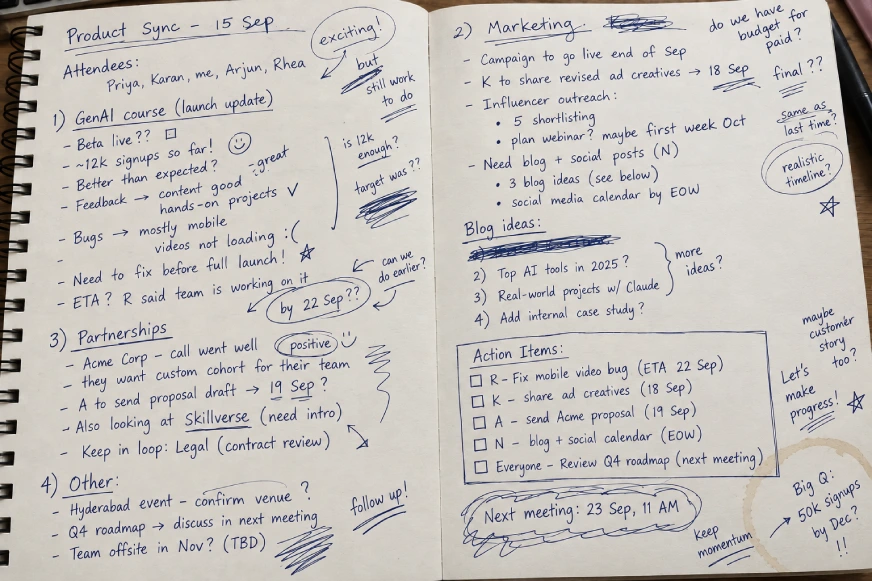
Output:
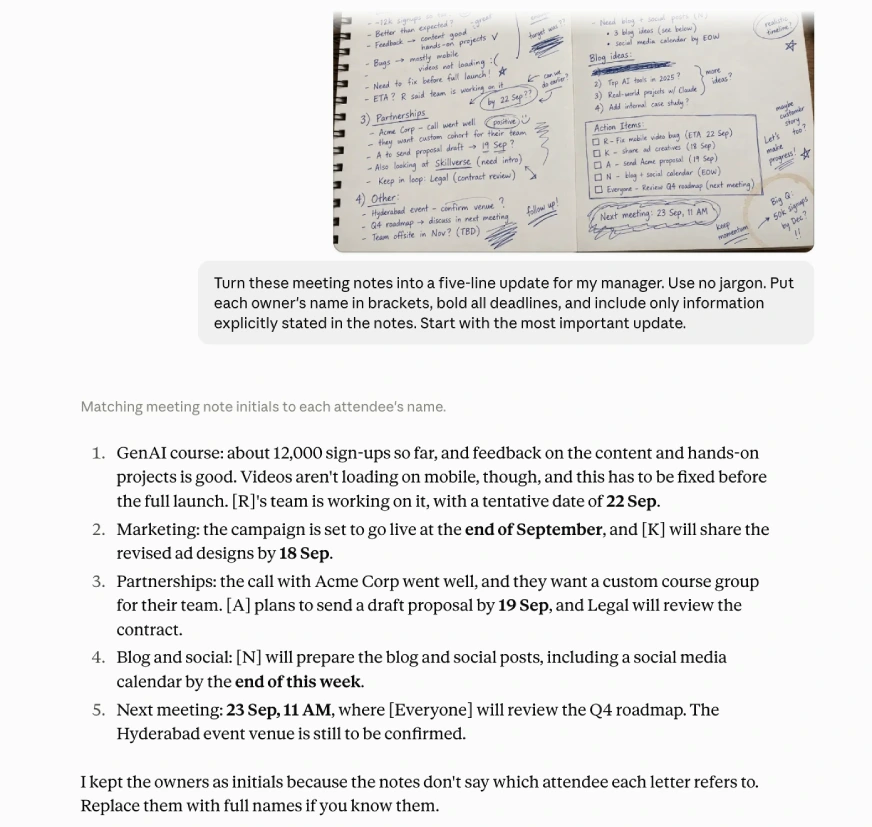
Result: Good structure, but it missed an important detail.
Opus 5.5 turned the messy notes into a clear five-point update and preserved the deadlines and key information. It also avoided inventing information. However, it missed the instruction to use owners’ names. The attendee list provided enough context to expand R, K, and A to Rhea, Karan, and Arjun, but the model kept them as initials. It correctly left N unresolved because no attendee matched that initial.
The takeaway: Opus 5.5 was good at organizing messy information and following most formatting rules, but it missed contextual information that was available in the source notes.
Test 3: Spotting Errors
Prompt:
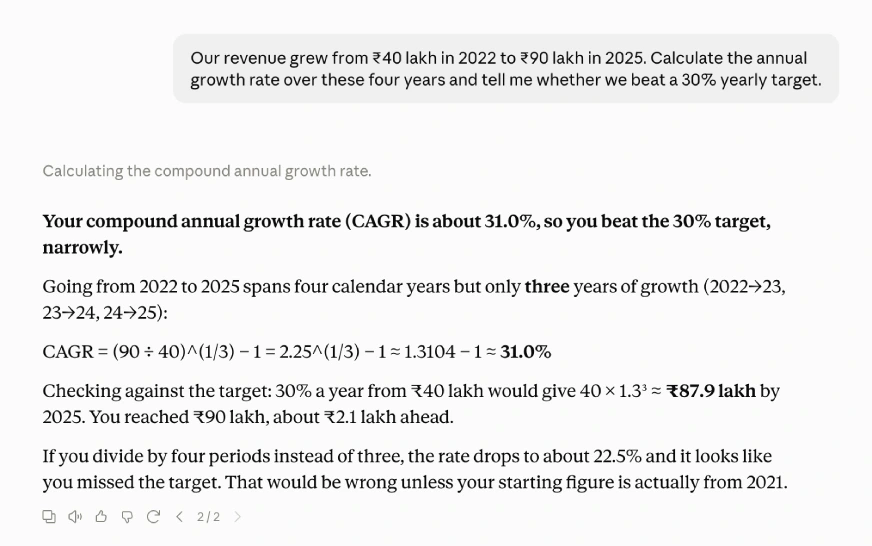
Our revenue grew from ₹40 lakh in 2022 to ₹90 lakh in 2025. Calculate the annual growth rate over these four years and tell me whether we beat a 30% yearly target.
Output:
Result: It caught the trap.
Opus 5.5 correctly spotted that the question’s wording was misleading. Although the prompt says “over these four years,” going from 2022 to 2025 involves only three years of growth: 2022-2023, 2023-2024, and 2024-2025. It calculated the CAGR at approximately 31.0%, meaning the company narrowly beat its 30% annual growth target. Opus 5.5 also explained what would happen if you incorrectly treated the period as four years. That would produce a CAGR of about 22.5% and the wrong conclusion that the company missed its target.
Things to Lookout for While Using Opus 5.5
A close reading of Anthropic’s own footnotes turns up five patterns that support a more skeptical view.
- The best scores and the lowest costs come from different settings. Most benchmark scores use max effort, while the cost comparisons use default effort. No single run delivers both at once.
- Competitor numbers aren’t measured the same way. On Terminal-Bench, Opus 5.5 ran at xhigh effort while GPT-6 Astra ran at high, and Astra’s score was reported by OpenAI.
- Older models did some of the benchmark work. When safeguards stepped in, Opus 4.8 completed the cybersecurity tasks and Opus 5 completed the biology tasks. Anthropic says this likely lowered the scores, but it also means the scores aren’t purely Opus 5.5.
- “40% cheaper” is conditional. The guaranteed cut is 20% per token. The rest depends on “typical workloads,” which Anthropic doesn’t define. Also, at the same effort level, Opus 5.5 thinks more per turn than Opus 5, which can eat into the savings.
Conclusion
Opus 5.5 is neither proven hype nor a proven upgrade. The 20% price cut is real, and in our tests the model did well on structured tasks: it read a dense chart accurately and caught a planted error in a growth calculation. It was less reliable at interpretation, making a factual slip in its chart analysis and missing context it could have used in the meeting notes. The bigger claims, such as 40% savings and a lead over GPT-6 Astra, still rest mostly on Anthropic’s own testing. For now, Opus 5.5 looks like a capable, cheaper Opus that still needs a human checking its work, and the best way to judge it is to try it on your own tasks.
Hello, I am Nitika, a tech-savvy Content Creator and Marketer. Creativity and learning new things come naturally to me. I have expertise in creating result-driven content strategies. I am well versed in SEO Management, Keyword Operations, Web Content Writing, Communication, Content Strategy, Editing, and Writing.