Python, APIs, cloud deployment. You’ll find these skills in both forward deployed engineer and AI engineer job descriptions. Yet the two jobs can lead to very different working days.
An FDE might spend the morning tracing a customer’s approval process before writing an integration. A product AI engineer might spend it investigating why the same application became slower after an update. Both need to ship working software. What changes is how their responsibilities are organized, which problems reach them and how success is judged.
Table of contents
FDE vs AI engineer at a glance
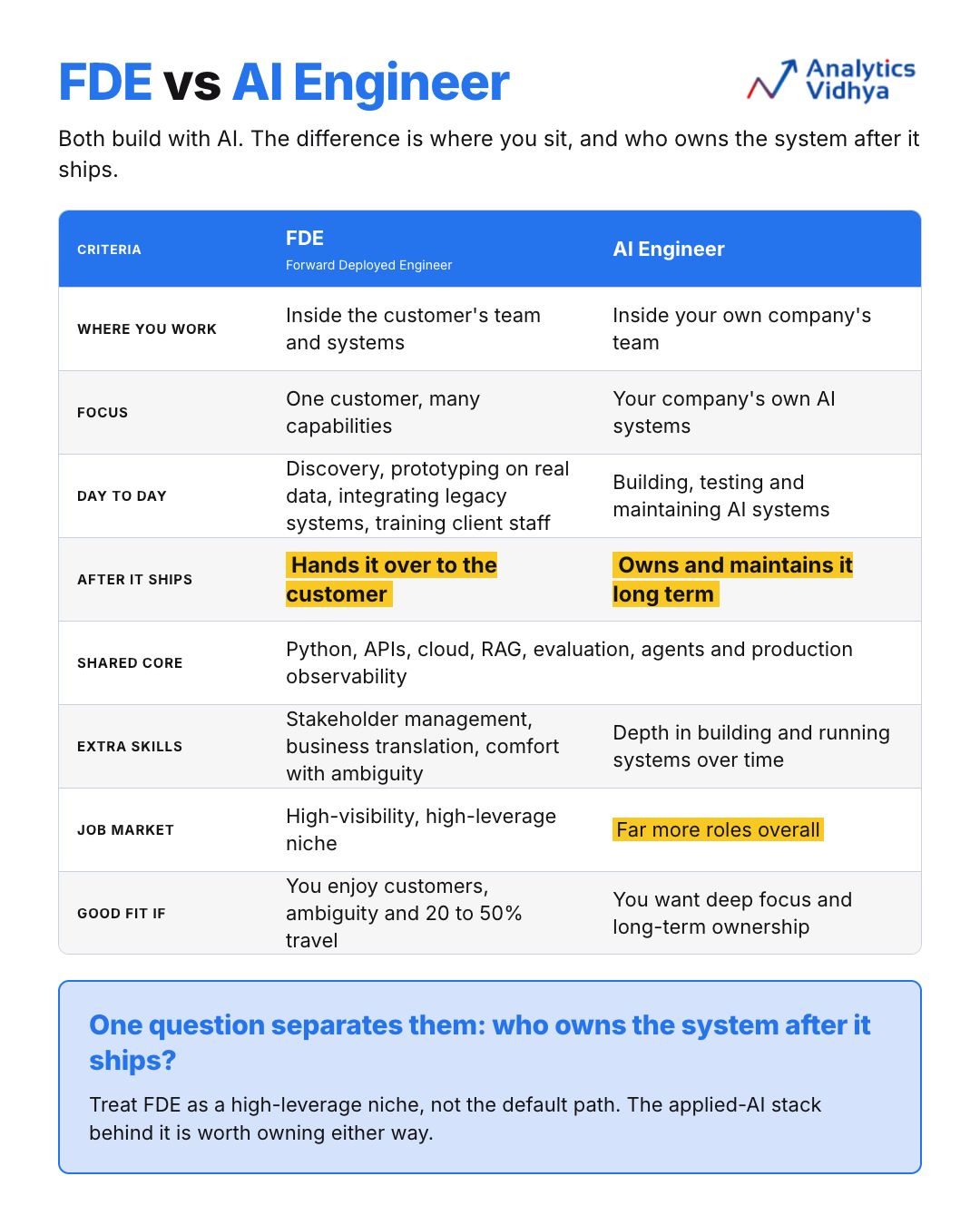
Treat this graphic as a broad orientation. FDEs may retain production ownership; AWS’s description includes maintenance and production incidents. Travel varies by role. The “far more roles” claim isn’t supported by a vacancy count, so the job-market row shouldn’t determine your choice.
What a forward deployed engineer does
A forward deployed engineer builds and deploys software alongside customers. In AI companies, that often means taking a model-based workflow from an initial idea into production. OpenAI’s FDE role spans discovery, technical scoping, system design, implementation and rollout. The customer’s operating environment shapes the engineering: restricted data, old systems and undocumented approval rules all become part of the problem.
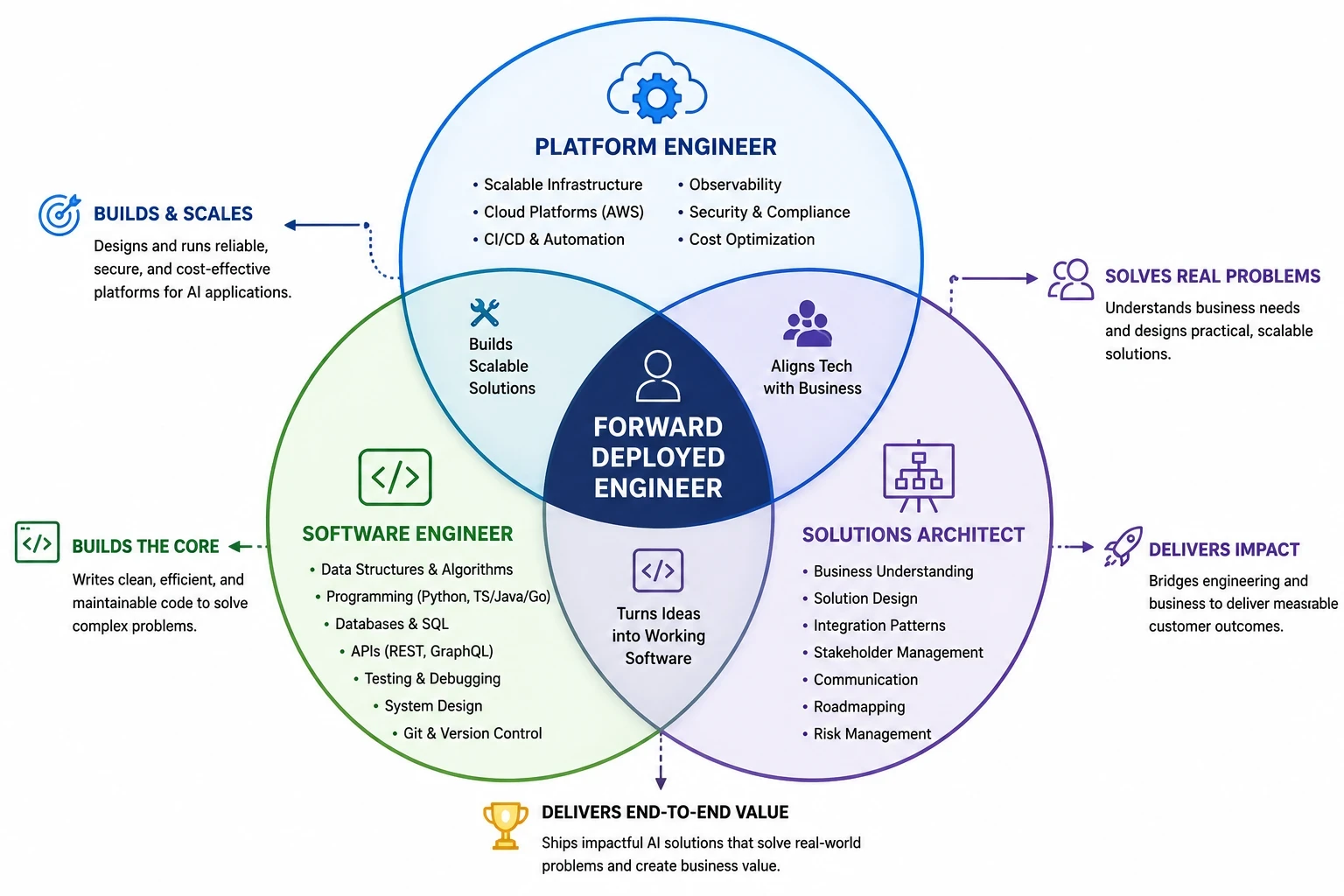
FDE work draws on several disciplines to deliver a usable customer system.
The work commonly moves through these phases:
- Discover the workflow: observe how people work and identify the constraint worth solving.
- Scope a first release: agree on the useful outcome, data access and limits.
- Build and integrate: connect models, data and existing software, then test failure cases.
- Roll out and support: help users adopt the application and establish operational ownership.
- Feed learning back: identify repeatable patterns that could improve the vendor’s product.
That last step matters. Anthropic’s FDE description explicitly includes sharing deployment patterns with Product and Engineering. Customer work can inform reusable capabilities, rather than becoming an endless collection of custom fixes.
What an AI engineer does
An AI engineer builds and operates software that uses AI. Depending on the role, that could mean an assistant, recommendation service, vision application or tool-using agent. On a product or internal team, the work often continues across releases. Criteo’s Senior AI Engineer role, for example, includes agents, debugging, deployment, monitoring and maintenance.
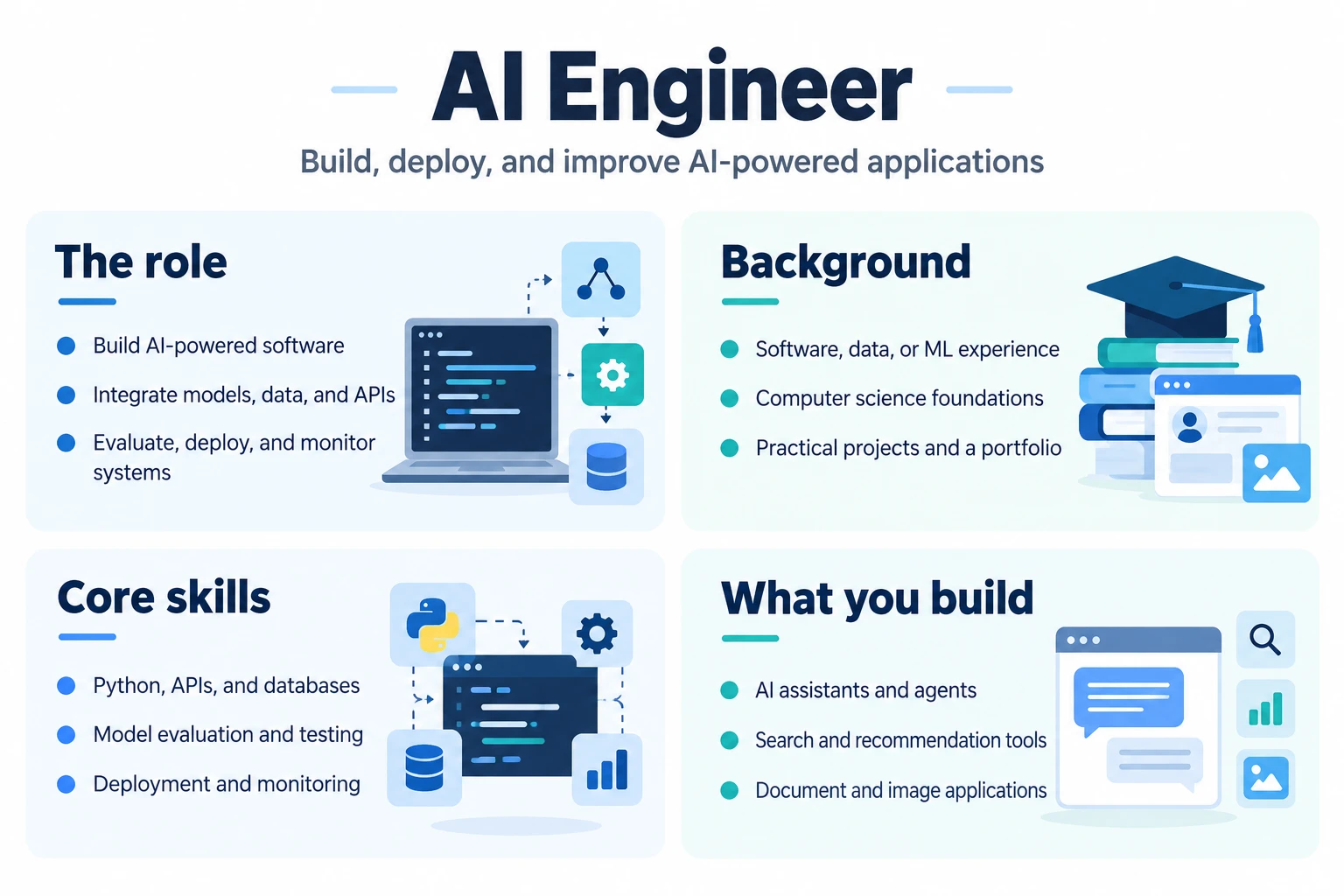
AI engineering combines application development with evaluation and production delivery.
A model upgrade is an engineering decision
Suppose a cheaper model answers routine questions well but misses unusual policy exceptions. Switching models reduces the cost per request while introducing a quality problem. The engineer needs representative evaluation cases, latency and cost measurements, and a way to roll back the release.
Following the application over time builds knowledge of which inputs fail, which dependencies are fragile and which changes help users. Maintaining that system involves data, integrations and software operations alongside the model. Training a model from scratch isn’t a requirement of every AI engineering position.
A release decision should explain the trade-off: which cases changed, what happened to operating costs and what evidence justifies letting users depend on the new version. That explanation belongs alongside the implementation.
The same project through two roles
Imagine a retailer introducing an AI assistant for support staff. It must answer policy questions, look up orders and leave refund approvals to authorized employees. Both engineers could help build it. The difference becomes clearer when you examine the decisions they need to make.
Deployment vs. Continuing Product Responsibilities
A practical framework for defining ownership, enforcing controls, and maintaining product quality over time.
| Decision area | Customer deployment Configure & agree | Continuing product Enforce & monitor |
|---|---|---|
| Policy access | Establish which employees can retrieve each document. | Test that retrieval consistently preserves those permissions. |
| Refund actions | Agree on refund approval rules with the retailer. | Enforce approval rules and test tool failures. |
| Model change | Confirm deployment-specific acceptance criteria. | Compare quality, latency, and cost before release. |
| After launch | Assign support and escalation ownership. | Monitor failures and maintain ongoing evaluations. |
Guiding principle:
Deployment establishes context and ownership; the product ensures
controls remain effective over time.
The FDE might discover that an outdated policy repository is the immediate obstacle. The product AI engineer might discover that a model upgrade introduced a regression. Either could fix either problem. The table shows different emphases within a shared engineering effort, not a compulsory division of tasks.
Skills both roles need
- Software engineering: Python or the team’s main language, APIs, SQL, Git, testing and debugging.
- AI application design: model selection, structured outputs, retrieval-augmented generation (RAG) and tool use where needed.
- Evaluation: representative test cases, failure analysis and checks for regressions before release.
- Production delivery: deployment, access controls, logging, monitoring and cost management.
FDE work adds a strong customer-discovery requirement: ask useful questions, negotiate scope and explain trade-offs. Product AI work rewards sustained knowledge of a system and its behaviour. Both need communication and engineering depth. To explore one shared skill, start with RAG evaluation frameworks for assessing retrieval and answer quality.
Depth depends on the application. A vision role may need image pipelines; a document assistant may need retrieval and permissions. Treat the job description as a set of problems to investigate, rather than a shopping list of frameworks. Ask what the team ships and which parts you would own.
How to prepare for either career
Build a document assistant that someone else can use without your help. Treat the project as evidence of your decisions, not just a working chat interface. The same application can help you practise both kinds of responsibility.
1. Define the workflow
Interview a prospective user. Identify the questions they need answered, which documents they can access and when a person must approve an action. Write down the first release’s scope and success criteria. This develops the discovery and scoping skills central to FDE work.
2. Build beyond the demo
Add permission-aware retrieval, an evaluation set, monitoring and deployment instructions. Include cases involving missing documents, conflicting policies and unavailable services. Record failures instead of hiding them behind the assistant’s best responses.
3. Ship a second release
Change the retrieval settings or model, then compare the versions. Document what improved, what regressed and how you decided whether to ship. This demonstrates the continuing evaluation and maintenance expected in product AI work.
4. Present the engineering decisions
Include a workflow map, permission rules, evaluation results, a failure log and release notes. For FDE applications, explain how user feedback changed the scope. For product AI applications, show how you diagnosed and resolved a regression.
For a structured introduction, explore The Forward Deployed Engineer: Taking AI From Pilot to Production. It offers a certificate of completion. Use it to organize your learning, then demonstrate what you can deliver through the project.
Portfolio Evidence: FDE vs. Product AI
Demonstrate how customer-facing engineering and product AI translate user needs into measurable outcomes.
| Portfolio evidence | Forward Deployed Engineer (FDE) Customer context & deployment success | Product AI Requirements & system quality |
|---|---|---|
| Discovery notes | Show how user interviews changed the scope, integration, or acceptance criteria. | Show how user needs became product requirements and evaluation cases. |
| Release evaluation | Show whether the deployment meets its agreed success criteria. | Show quality, latency, and cost changes between versions. |
| Support plan | Define handover, escalation, and ownership with the customer. | Define monitoring, rollback, and maintenance for the continuing system. |
Roadmap for AI focused FDE work
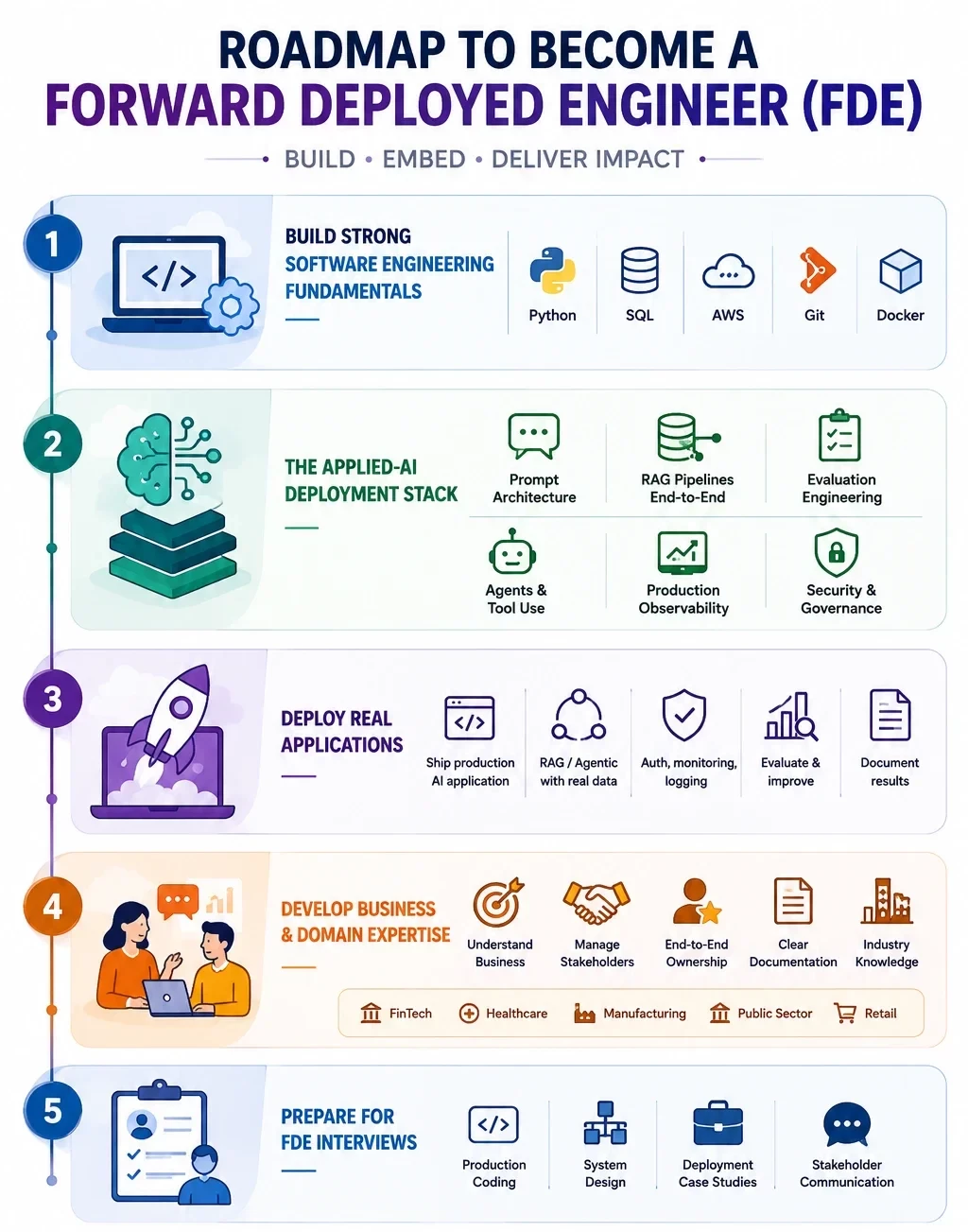
Which career should you choose
Consider FDE work if you enjoy learning how unfamiliar organizations operate, clarifying incomplete requirements and working directly with customers. Consider a product or internal AI engineering role if you want to follow a system across releases, develop architectural depth and investigate recurring failures.
Look at the working day
FDE work can involve frequent changes of context: a customer workshop, an integration problem, then a discussion about scope. Product AI engineering often offers greater continuity with one system, although incidents and changing priorities can still interrupt planned work. Neither role is a promise of uninterrupted coding.
Before accepting an offer, ask for a recent project example:
- What did the engineer build, and how much production code did they write?
- How much time went into customer discovery, travel and ongoing support?
- Who maintained the system after launch, and how was success measured?
If you’re starting out, learn to build, deploy and support a useful AI system first. Then choose the role whose daily responsibilities you want to take on. The title is a starting point; the work is the decision.
Frequently Asked Questions
Q1. Is an FDE an AI engineer?
A. An AI-focused FDE can do AI engineering. The FDE title emphasizes customer deployment; the role also exists outside AI.
Q2. Do FDEs write production code?
A. Yes. Many FDE roles include implementation, testing and deployment. The coding workload depends on the employer.
Q3. Can an AI engineer move into FDE work?
A. Yes. Combine production engineering experience with evidence of customer discovery, scoping and delivery under unfamiliar constraints.
Studying, evaluating, and explaining AI systems for over 6 years.
“𝘖𝘯𝘤𝘦 𝘮𝘦𝘯 𝘵𝘶𝘳𝘯𝘦𝘥 𝘵𝘩𝘦𝘪𝘳 𝘵𝘩𝘪𝘯𝘬𝘪𝘯𝘨 𝘰𝘷𝘦𝘳 𝘵𝘰 𝘮𝘢𝘤𝘩𝘪𝘯𝘦𝘴 𝘪𝘯 𝘵𝘩𝘦 𝘩𝘰𝘱𝘦 𝘵𝘩𝘢𝘵 𝘵𝘩𝘪𝘴 𝘸𝘰𝘶𝘭𝘥 𝘴𝘦𝘵 𝘵𝘩𝘦𝘮 𝘧𝘳𝘦𝘦. 𝘉𝘶𝘵 𝘵𝘩𝘢𝘵 𝘰𝘯𝘭𝘺 𝘱𝘦𝘳𝘮𝘪𝘵𝘵𝘦𝘥 𝘰𝘵𝘩𝘦𝘳 𝘮𝘦𝘯 𝘸𝘪𝘵𝘩 𝘮𝘢𝘤𝘩𝘪𝘯𝘦𝘴 𝘵𝘰 𝘦𝘯𝘴𝘭𝘢𝘷𝘦 𝘵𝘩𝘦𝘮.” — 𝖥𝗋𝖺𝗇𝗄 𝖧𝖾𝗋𝖻𝖾𝗋𝗍, 𝖣𝗎𝗇𝖾