I see AI image models getting better every month. Sharper outputs, more parameters, higher benchmark scores. So why would I, or anyone for that matter, get excited about a smaller AI image model? Well, because most image models still behave like offline tools. You prompt, you wait, you hope. There is nothing interactive about that. And definitely nothing real-time. Flux.2 Klein is now here to quietly change this style of AI image generation and editing.
Built for speed, low latency, and everyday hardware, Flux.2 Klein is the latest AI image model from Black Forest Labs. It has been primarily designed for faster image generation, as an AI that feels responsive, not heavy. The name itself gives the clue. “Klein” comes from the German word for “small”, and that philosophy runs through the model. Small, but fast – small, but practical – small, but production-ready.
And once you see what it brings to the table, especially in interactive workflows, you realise that the folks at Black Forest Labs are not chasing the biggest model anymore. With Flux.2 Klein, they are most focused on building image intelligence that actually keeps up with you and your tasks.
Here is a look at the new model in detail.
Table of contents
What is Flux.2 Klein?
At its core, Flux.2 Klein is an image generation and editing model built for, as the company puts it, “real-time image generation without sacrificing quality,” especially so on limited hardware capabilities.
Most image models today optimise for maximum visual quality, even if that means higher latency and heavier hardware requirements. Flux.2 Klein takes the opposite route. It prioritises speed, responsiveness, and deployability, especially on consumer-grade machines and edge setups.
Flux.2 Klein forms a part of the Flux.2 family, but it is intentionally smaller and faster than its larger siblings. The goal here is simple: make image generation feel less like a batch job and more like a live system you can work with in real time.
This makes Flux.2 Klein particularly well-suited for use cases where iteration speed matters. This may include live previews, interactive editing, rapid prototyping, and production apps that cannot afford long wait times. This most obviously includes agentic workflows where image generation forms a small part of a larger process and needs a speedy execution.
In short, Flux.2 Klein is not trying to win the “best-looking image” contest. It is trying to win the usability contest.
The Klein Family: Models at a Glance
Flux.2 Klein is not a single model but a small, purpose-built family. Each of the variants exists for a very specific workflow. Here are the four models that form a part of it.
- [klein] 4B – is the fastest model in the lineup, designed for maximum speed, edge deployment, and smooth performance on consumer hardware. If real-time image generation is the priority, this is the go-to model for you.
- [klein] 9B – is the “flagship small model”, giving you a better quality-to-latency balance. This version is aimed squarely at production-grade applications where you want stronger visual fidelity without sacrificing responsiveness.
Then come the Base or the “full-capacity foundation” models, as Black Forest Labs likes to call them.
- [klein] 4B Base is built for fine-tuning on limited hardware, giving developers full control over behaviour and outputs.
- [klein] 9B Base goes even further, targeting research workflows, LoRA training, and maximum output diversity.
In simple terms, the Klein family lets you choose between speed, quality, or control, without forcing a one-size-fits-all decision.
Distilled vs Base Models
The best part about the Flux.2 Klein family is the flexible design choices it offers among the distilled and the base models. The distilled Klein models are built to run in just four diffusion steps. That is not a typo. Four steps. That’s it! This is why they feel fast and responsive, even on modest hardware. You trade a bit of raw diversity for speed, but gain something far more valuable for real-world use: instant feedback.
The Base models, on the other hand, follow the traditional route with up to 50 diffusion steps. They are slower, but far more flexible. These models are meant for fine-tuning, research, LoRA training, and scenarios where you want deeper control over style, structure, and variation.
So the choice is not about “better” or “worse”. It is about intent.
If you want real-time generation and interactive editing, the distilled models are the obvious pick. If you want to train, customise, or experiment deeply, pick the Base models.
Benchmark Performance
Flux.2 Klein did not share its benchmark performance in the traditional sense. Since it optimises usable image quality per second and per gigabyte of VRAM, it avoids chasing leaderboards that ignore latency and hardware limits.
That is exactly what the benchmark charts shared by Black Forest Labs are designed to show.
Across text-to-image and image-to-image tasks, the graphs plot Elo rating against end-to-end latency and peak VRAM usage. Elo acts as a proxy for human-perceived image quality, while latency and VRAM reflect real deployment constraints. The rule is simple: higher Elo, lower latency, and lower VRAM is better.
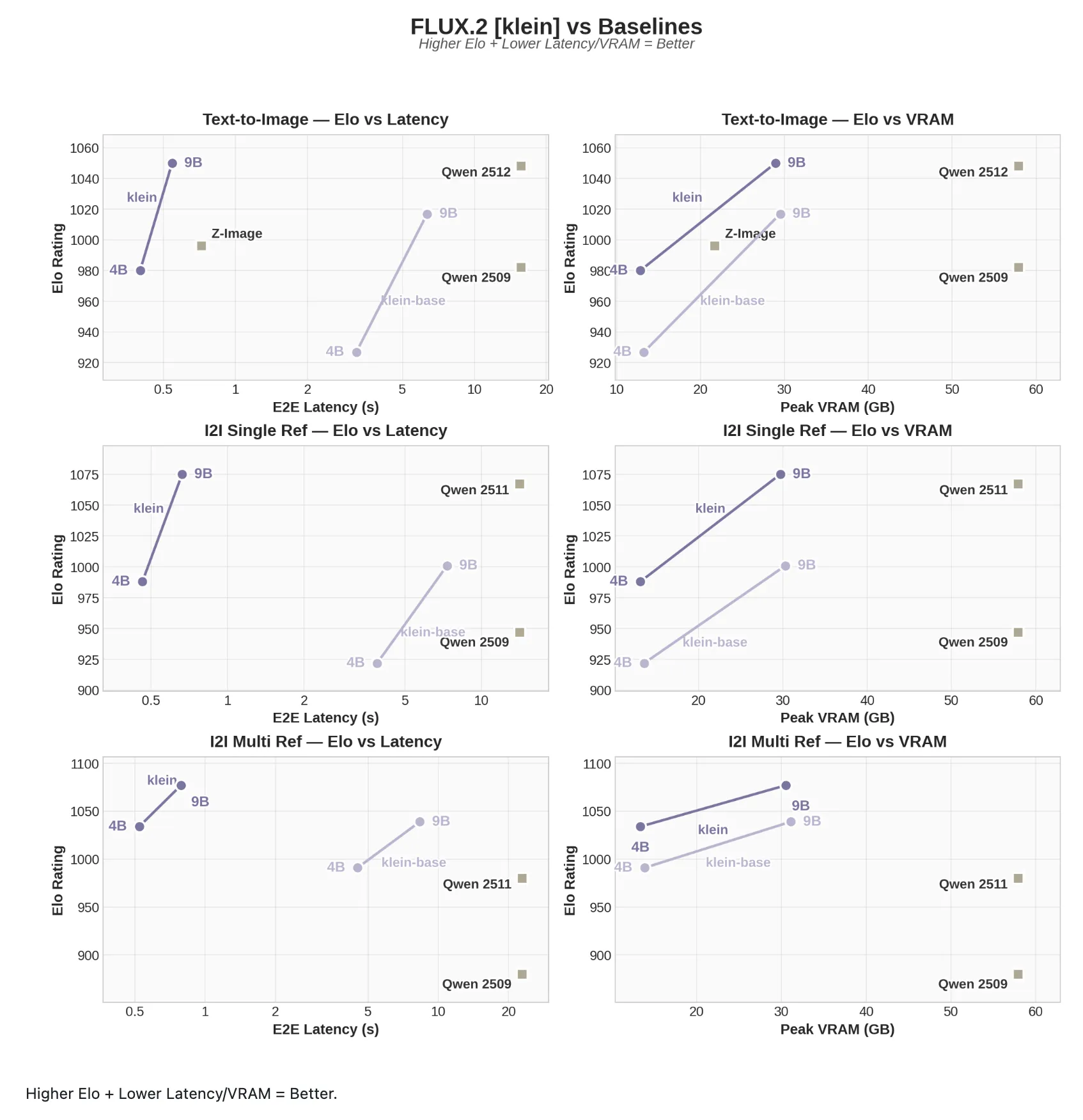
What stands out immediately is where Flux.2 Klein sits on these curves. The 4B and 9B distilled models consistently deliver strong Elo scores while operating at a fraction of the latency and memory footprint of larger baselines. In contrast, competing models from Qwen often achieve similar or slightly higher Elo only by consuming significantly more time and GPU memory.
These benchmarks do not claim that Flux.2 Klein produces the most detailed images possible. They demonstrate something more relevant for production: efficient visual intelligence. The kind that responds quickly, runs on everyday hardware, and fits naturally into interactive workflows.
Now that we know what Flux.2 Klein excels at, it is time to try its capabilities firsthand. Here is how to access it.
How to Access Flux.2 Klein
Black Forest Labs has been generous enough to offer a free demo of the new Flux.2 Klein. Within the announcement blog introducing the new Flux.2 Klein, you can simply click on the link reading “Try it now for free here”, and it will redirect you to the demo of the new AI model.
Or you can simply click on this link and try the Flux.2 Klein demo yourself.
Now that we know how to access it, let us put it to some real tests for its image generation and editing capabilities.
Hands-on with Flux.2 Klein
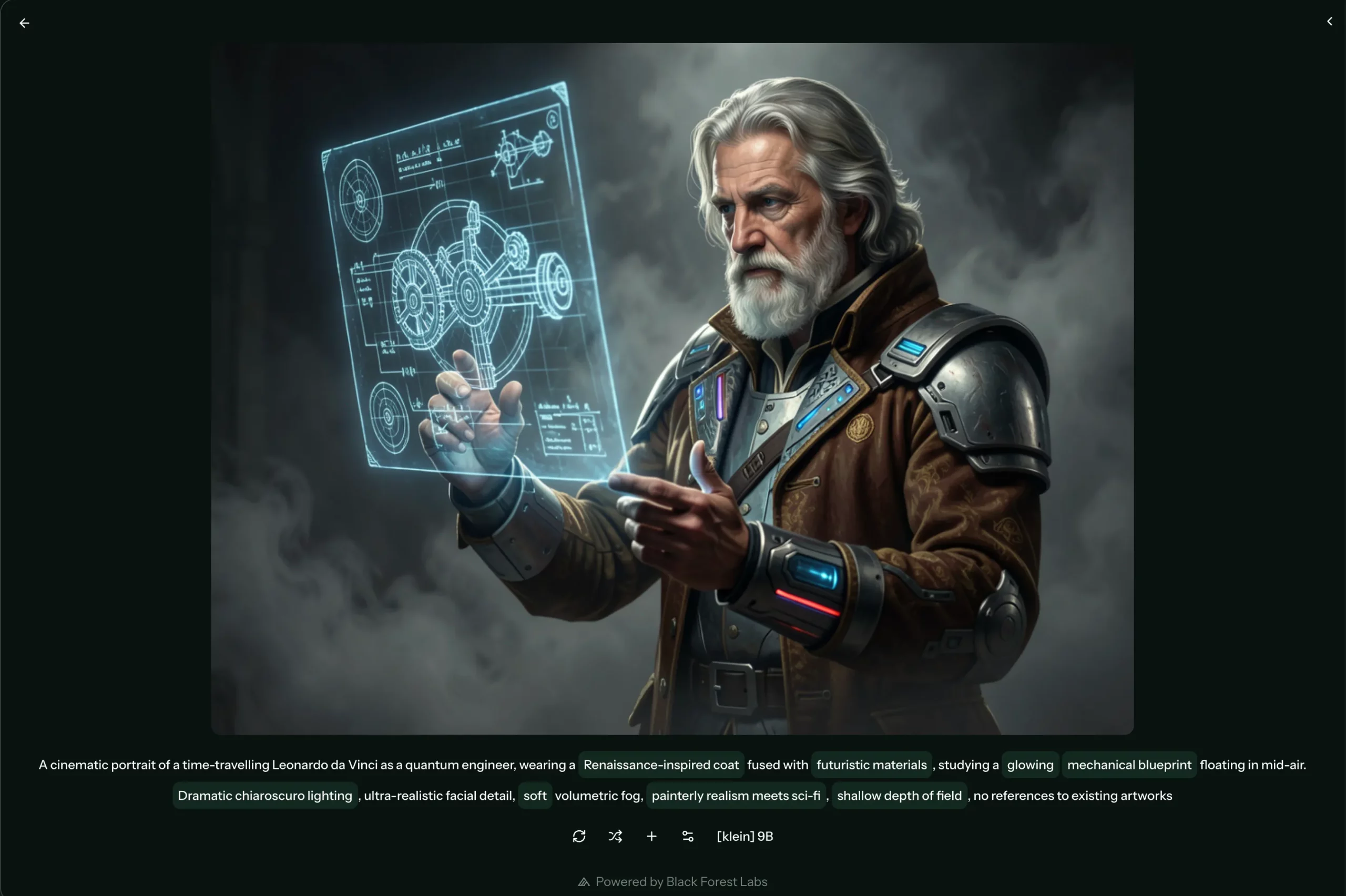
Here is the prompt I used to test the Flux.2 Klein on its image generation abilities.
Prompt:
A cinematic portrait of a time-travelling Leonardo da Vinci as a quantum engineer, wearing a Renaissance-inspired coat fused with futuristic materials, studying a glowing mechanical blueprint floating in mid-air. Dramatic chiaroscuro lighting, ultra-realistic facial detail, soft volumetric fog, painterly realism meets sci-fi, shallow depth of field, no references to existing artworks.
Here is the prompt I used to test its image editing capabilities.
Output:
Prompt:
Show a group of miniature humans – 1/10th the size of this ball – trying to move the ball from the right side. While some humans are on the ground, others are on ladders, reaching half the height of the ball, and trying to push. Show at least 8 humans, dressed in the Renaissance era attire
Output:

Conclusion
As we have seen and tested by now, the Flux.2 Klein AI image model brings a refreshing take to AI image generation and editing practices. The crux of this change is speed, proving its mettle for agentic workflows. At a time when such agentic tasks are increasingly being adopted across workflows, Flux.2 Klein might just prove to be a lot more useful than any large AI model that promises high-quality images, but at a lot lower speed. The best part – Flux.2 Klein can do its duties on your existing hardware, making AI image generation and editing much more accessible to the masses.