We have come far in our series of Excel 101, exploring various functions and formulas of the service and how best to use them in real-world scenarios. For those who are new to this, make sure to check out the complete list of Excel functions that we have covered so far in the links shared below. As for this iteration, we shall focus on one of the most recent features that Microsoft has introduced within Excel, and one that comes with the advent of AI – Excel Agent Mode.
The name itself is pretty self-explanatory for many – the use of agents within Excel to carry out tasks. Here, we shall explore how it works, when to use it, and how best it can be of help to you in your everyday Excel tasks.
So without any delay, here is your complete Excel Agent Mode guide to make you an expert on the feature in no time.
Also read:
- Excel 101: Cell and Column Merge vs Combine
- Excel 101: COUNT and COUNTIF Functions
- Excel 101: Complete Guide to VLOOKUP Function
- Excel 101: IF, AND, OR Functions and Conditional Logic Explained
Table of contents
What is Excel Agent Mode?
If regular Copilot in Excel feels like a smart assistant, Agent Mode feels like handing the sheet to someone who actually knows what they are doing.
That is the simplest way to understand it.
You see, in real Excel work, the problem is rarely just, “Which formula should I use?” The bigger problem is usually that you have a messy sheet, a vague business question, and five hidden steps standing between you and the answer. Agent Mode in Excel is designed for exactly that gap.
Agent Mode is Microsoft’s more action-oriented AI experience inside Excel. For anyone who has used Copilot, you know that it can answer a question, suggest a formula, or summarize a table. Agent Mode, on the other hand, takes a broader goal from you, breaks it into steps, and starts working through the workbook to get there. That’s not just a normal AI helper, but an AI on steroids. And that explains the key question –
Why is it called “Agent” Mode?
Because, just like an AI agent, it is meant to act and not just respond.
It does not simply explain what you should do next. It can:
- interpret your goal in plain English
- decide the sequence of steps needed
- work directly inside the workbook
- make edits or generate outputs
- show the logic behind what it is doing
For anyone using Excel daily, it is easy to see how that is a massive jump from existing Excel capabilities. With Agent Mode, Excel has moved from a tool where you “must know the entire process first” to one where you can “tell it, and it will be done”.
In essence, Agent Mode reduces the number of manual steps to your first usable result through an AI-powered workflow layer inside Excel that can plan, act, edit, and iterate on spreadsheet tasks for you. Let us understand in detail what the new Agent Mode can do in Excel.
What Can Agent Mode in Excel Do?
You will understand Agent Mode better if you stop thinking of it as a “feature” and start treating it as a task executor inside Excel.
Microsoft’s own examples frame it around multi-step work such as full dataset analysis, financial reporting, loan calculators, and household budgeting, where the agent decides which formulas, sheets, formatting, and visuals are needed along the way.Here are the kinds of jobs it can take on:
- Full data analysis: review a dataset, identify patterns, highlight unusual values, and present the result visually
- Financial reporting: create structured reports with growth comparisons, formatted tables, and business-ready presentation
- Scenario-based calculators: build functional tools like loan calculators with schedules, payment breakdowns, and summaries
- Budget tracking: set up monthly planners with categories, over/under-budget indicators, and dashboard-like charts
- Workbook building: create new sheets, insert formulas, organise outputs, and shape the file around the task you asked for
What that looks like in real use
Here is how you use Agent Mode to directly reach an end result:
- Run a full analysis on this sales data and make it visual:
The agent can inspect a table, decide which formulas or summaries are needed, create supporting sheets, surface trends, and turn the findings into charts or visuals that are easier to act on. - Create a monthly close report for this business:
In Microsoft’s own example, this includes breaking down product lines, comparing sequential and year-over-year growth, and applying standard financial formatting. In other words, the output is meant to look more like a report and less like a raw spreadsheet dump. - Build a loan calculator:
Here, Agent Mode can go beyond a single EMI formula. It can create a proper structure with user inputs, monthly payment logic, and an amortisation-style schedule showing principal, interest, and remaining balance. - Create a household budget tracker:
This is where Agent Mode starts resembling an Excel user who knows the full workflow. It can add spending categories, apply conditional formatting, compare planned versus actual spending, and even create charts to make the summary easier to read.
The big takeaway is simple: Agent Mode is most useful when the job involves multiple spreadsheet steps stitched together into one outcome. We shall explore some of these examples in hands-on tasks shortly. First, let us understand how to access Excel Agent Mode.
How to Access Agent Mode in Excel
Accessing Agent Mode is fairly simple, provided your Excel version supports it. Microsoft has rolled it out across Excel for Web, Windows, and Mac. However, note that the availability still depends on your subscription and region. Microsoft’s latest release notes also mention that the experience is now referred to as “Edit with Copilot in Excel”, which is worth keeping in mind if you do not see the older “Agent Mode” name.
Here are the main ways to access it
- From the Home tab in Excel
– Open your workbook
– Go to Home
– Click Copilot to open the Copilot pane - From the Copilot pane’s Tools menu
– Open the Copilot pane
– Look for Tools
– Select Agent Mode if it is shown there in your build - From the cell-level Copilot icon
– Select a cell or range
– Click the small Copilot sparkle icon that appears nearby
– Launch the workflow from there - In Excel for the web
– Create or open a workbook in Excel for Web
– Open Home > Copilot
– Click on the Tools icon beneath the chat window
– Enable the ‘Edit with Copilot’ option to allow direct edits to your workbook - In desktop Excel on local files
– Open a file saved on your computer or network
– Click Copilot in the ribbon
– If Agent Mode is not immediately visible, check Tools inside the Copilot pane
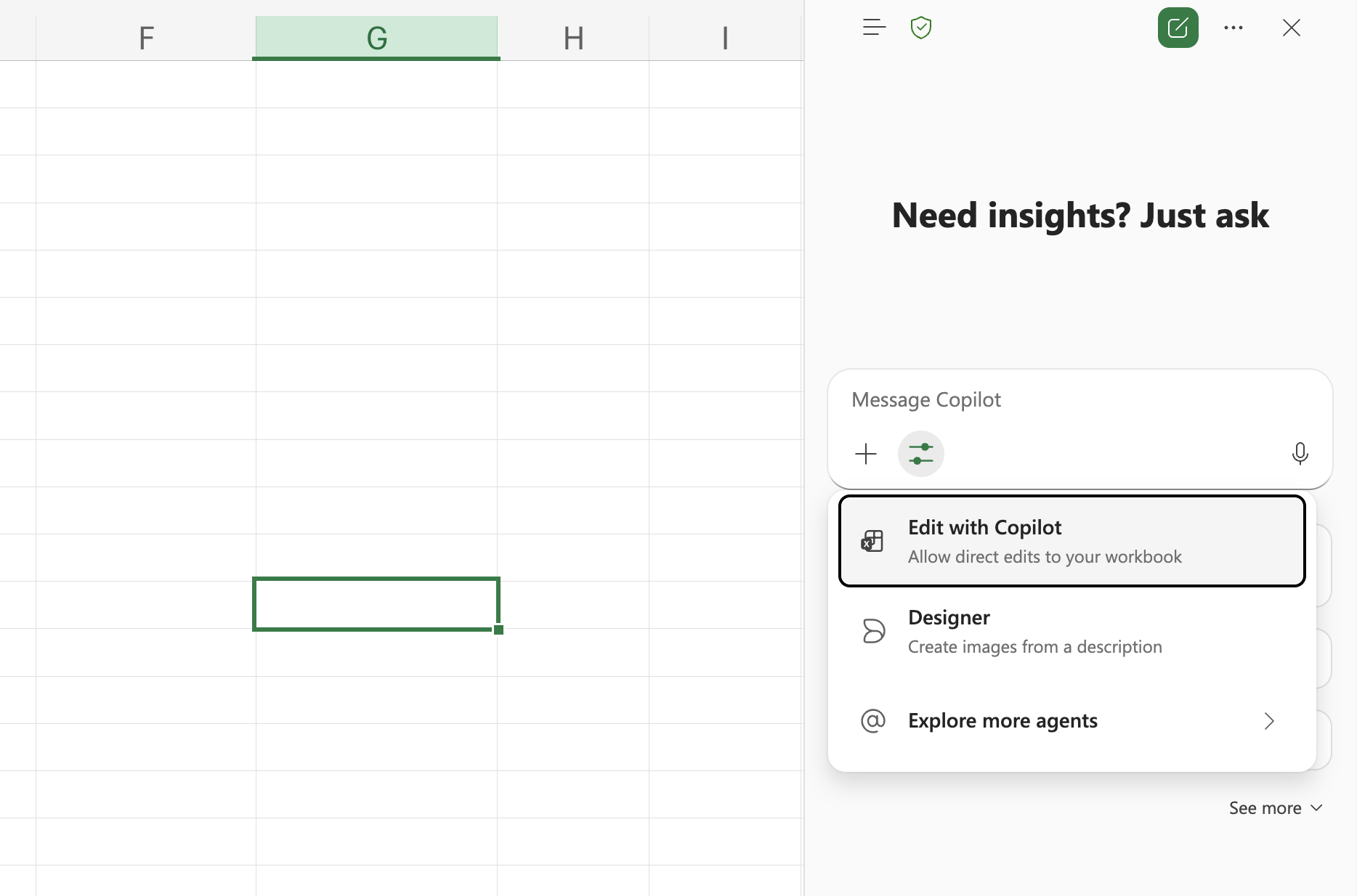
In case the option does not appear, check if you have the required Microsoft 365 Copilot-enabled access on that account.
Now that you know how to access it, here are some hands-on examples where we use it for real-world tasks.
Hands-on with Excel Agent Mode
Task 1: Analyse a Sales Dataset
Let us begin with a simple sales sheet. The goal here is to see if Agent Mode can understand a small business-style dataset, compare performance against targets, identify the strongest and weakest entries, and turn that into a useful summary. This makes it a good first test, because it shows the feature acting on a realistic Excel task instead of just answering a one-line query.
For this, I gave it a sampel dataset to work on, and the following prompt.
Prompt:
Analyse this sales dataset and tell me which region performed best overall, which months missed target, and which sales rep generated the highest total revenue. Then create a clean summary table and a chart to present the findings.
Output:
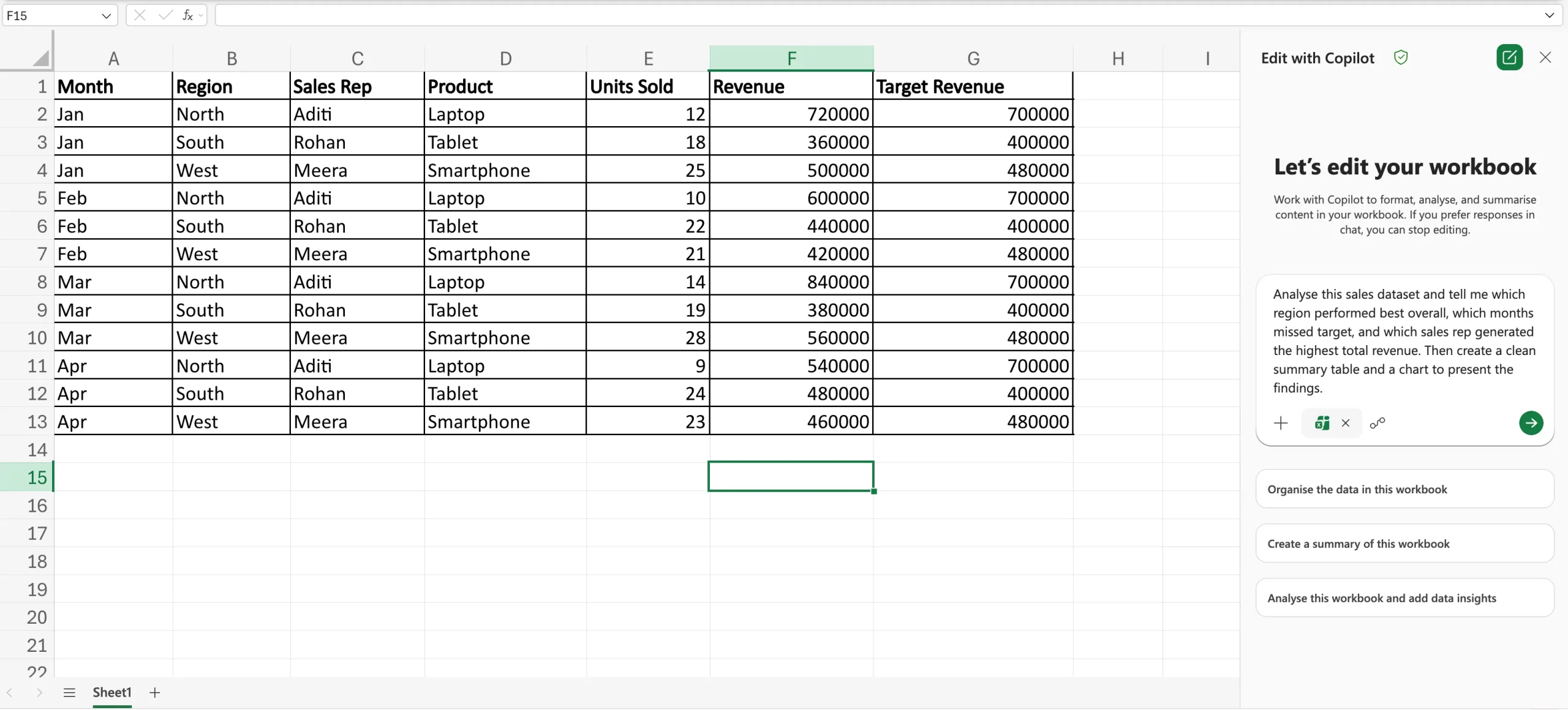

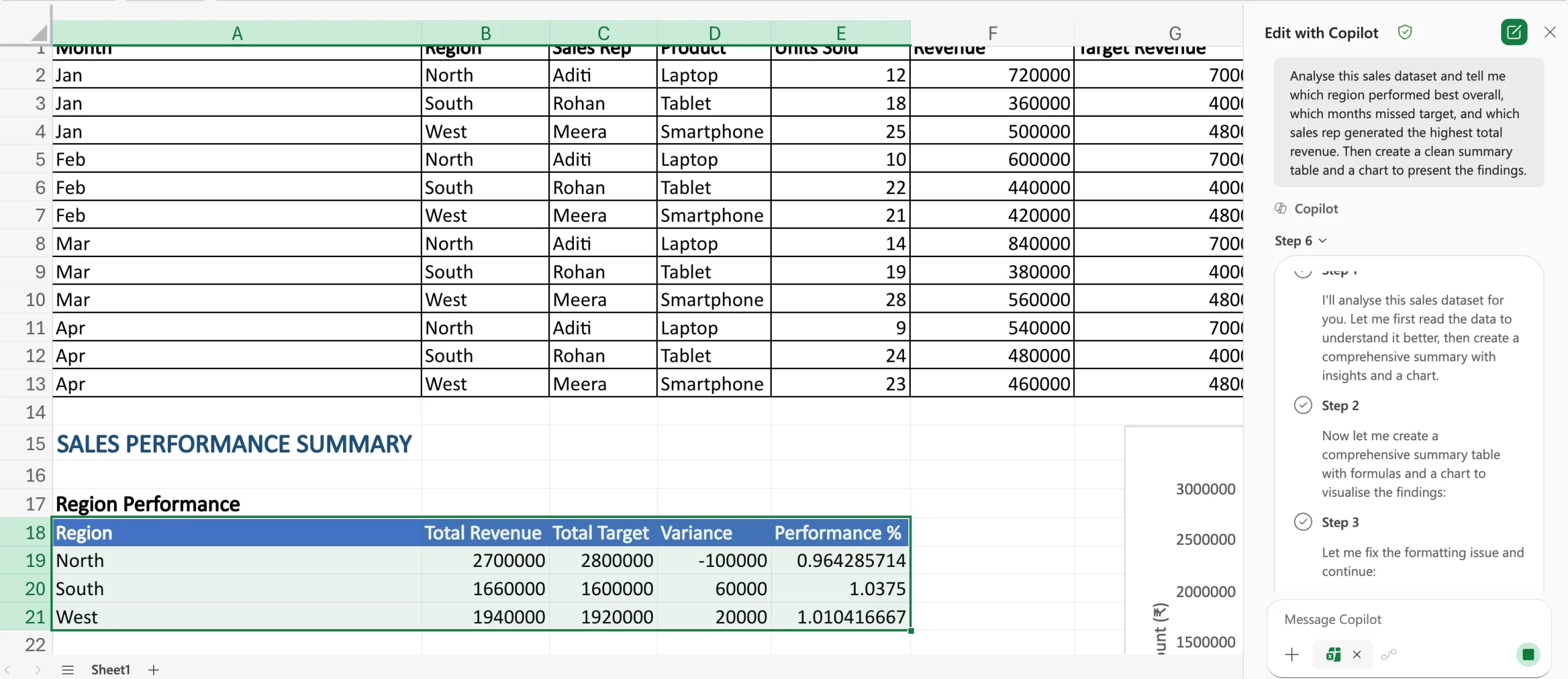
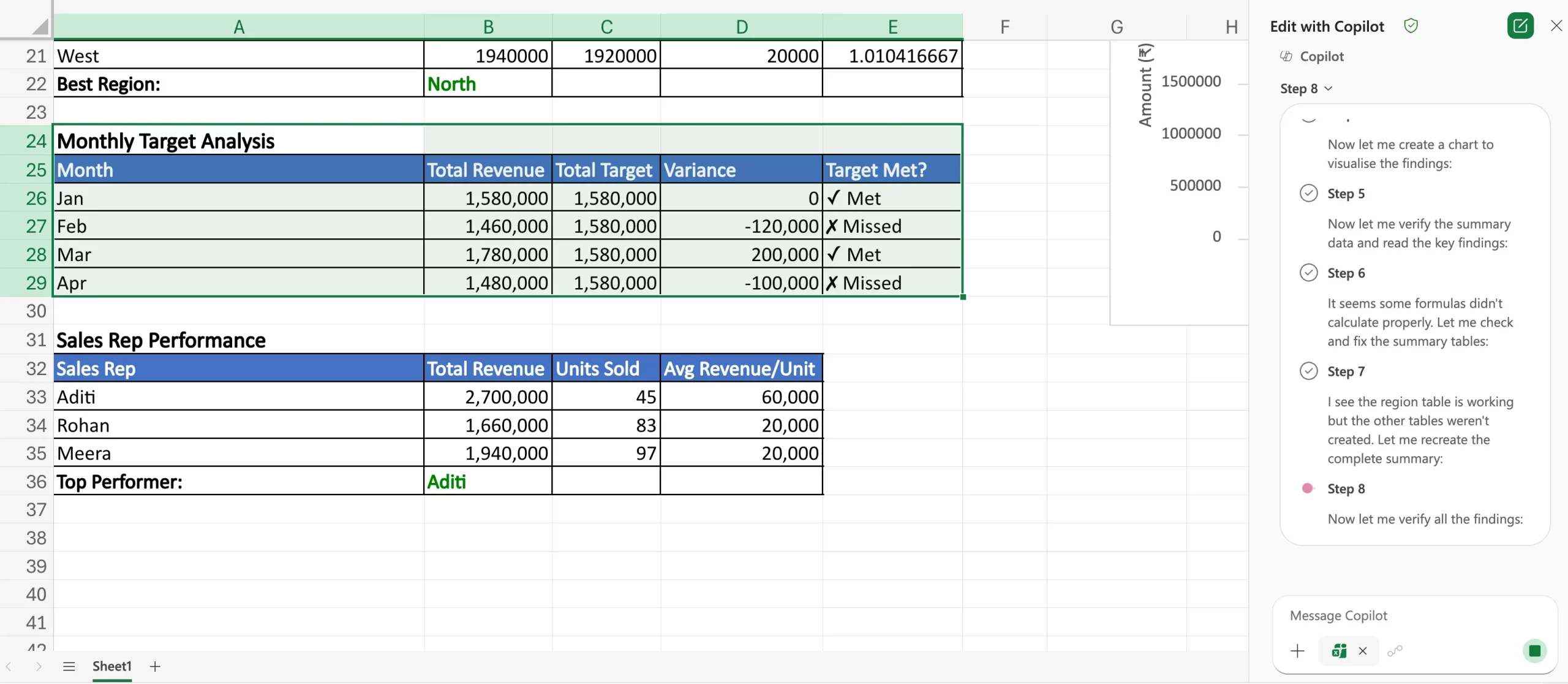
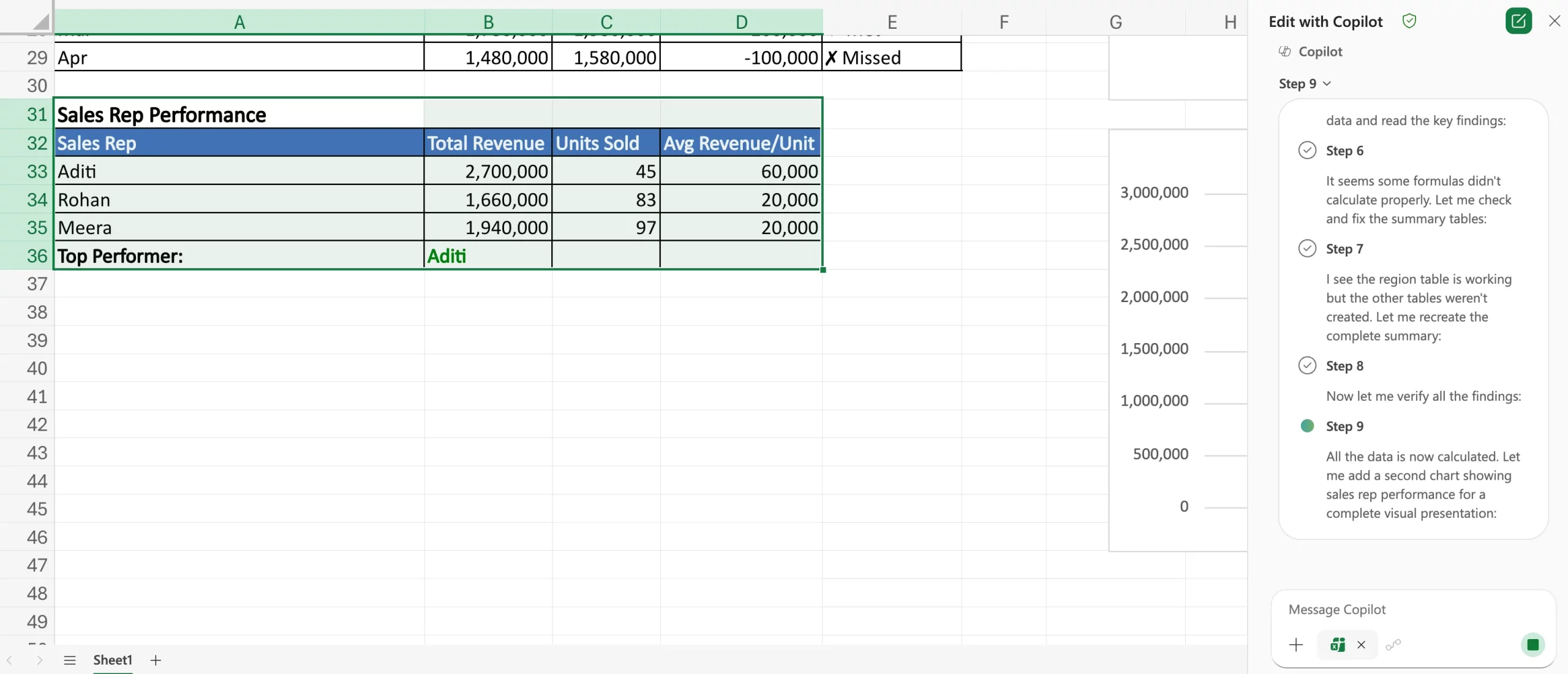
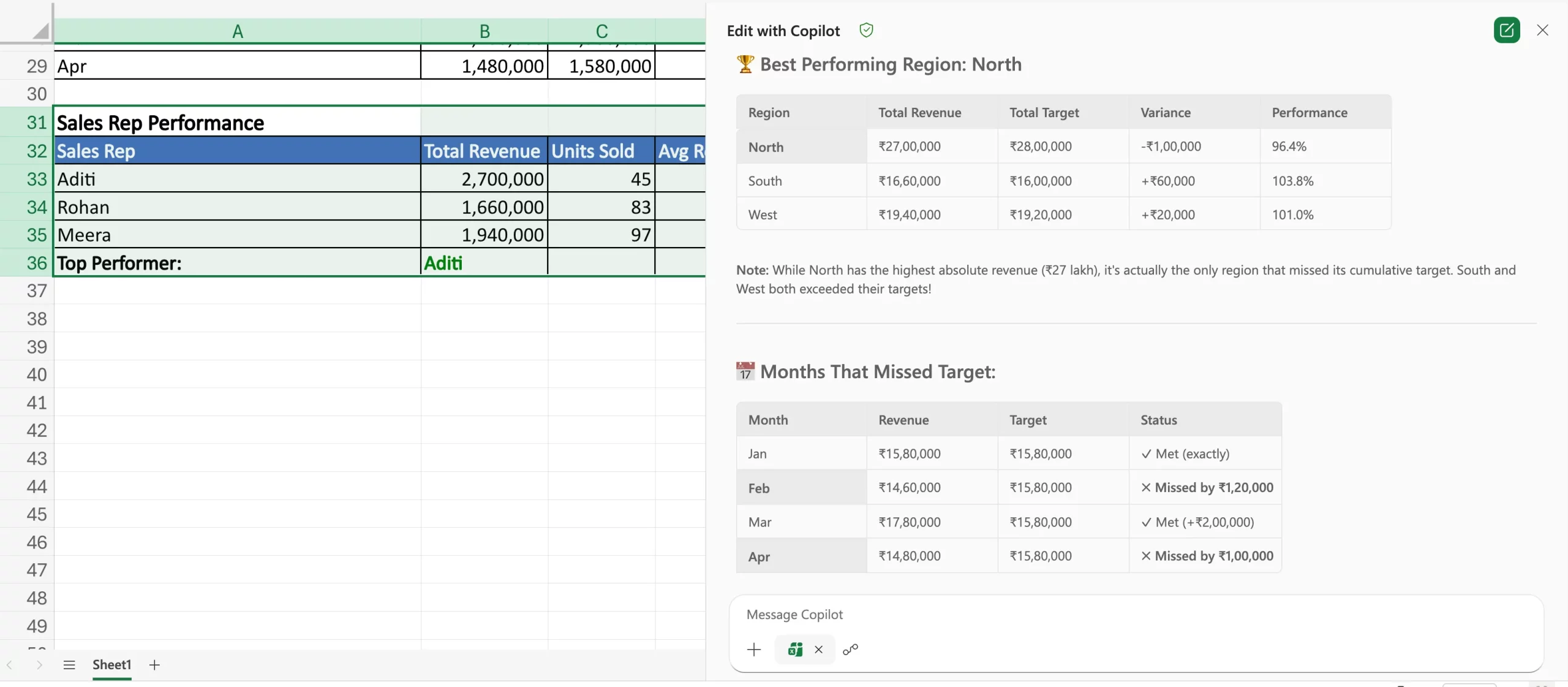
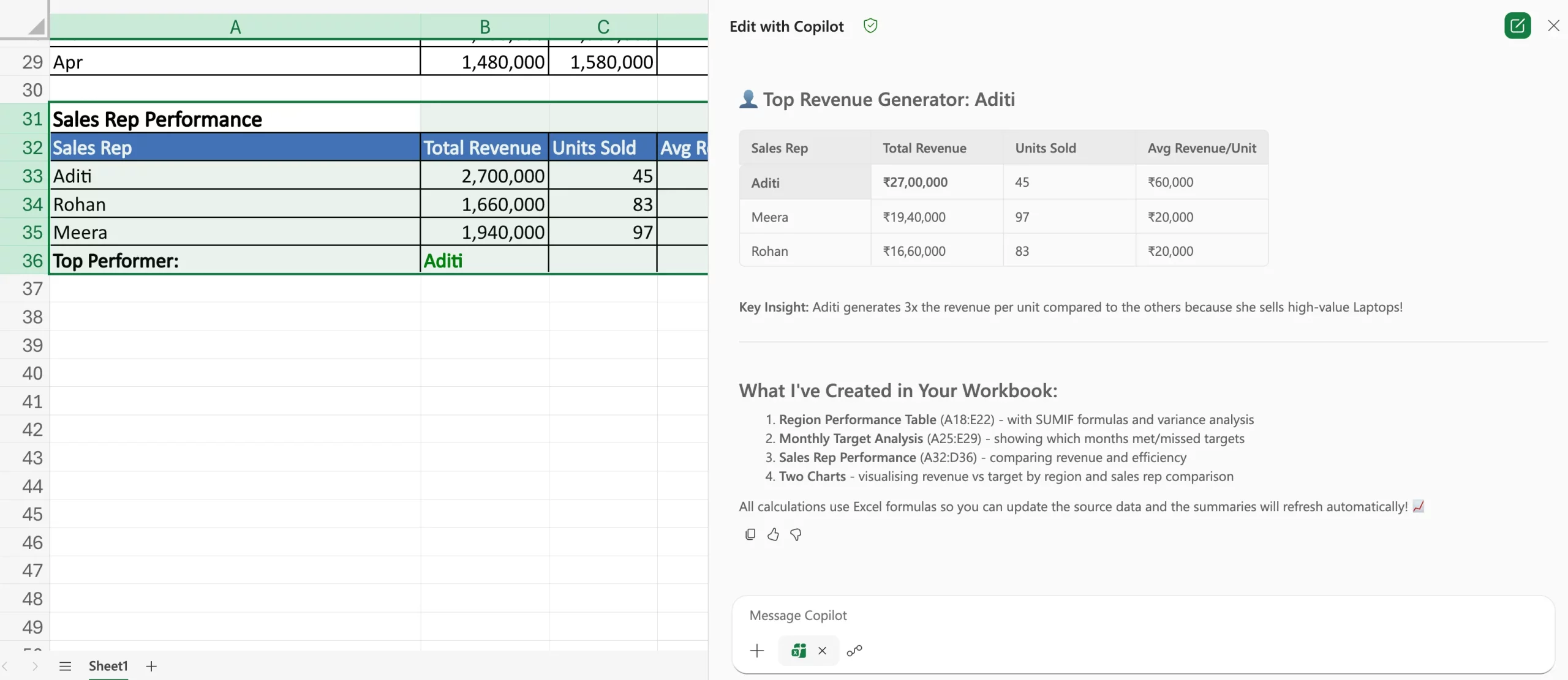
I just sat back and sipped my coffee as Excel took about 5 minutes to understand the task, break it down into a step-by-step process, and execute it to completion. As you can see in the set of images above, it addressed all the 3 tasks at first and then carried them out perfectly, presenting the right results in each case. All of this, without me typing even a single formula.
Task 2: Summarise Student Marks
For the second task, let us move from business data to something more familiar and straightforward. A student marksheet is a good test for Agent Mode because it requires basic summarisation, comparison, and insight generation. In one go, we can check whether it can calculate totals, identify the top performers, point out weaker subjects, and present the results in a cleaner format.
Here is the prompt I used for the same on a sample dataset:
Prompt:
Summarise this students’ marks dataset by identifying the top-performing student, the average marks in each subject, and any students who may need attention based on low scores. Then create a clean summary table and a simple chart to present the findings.
Output:
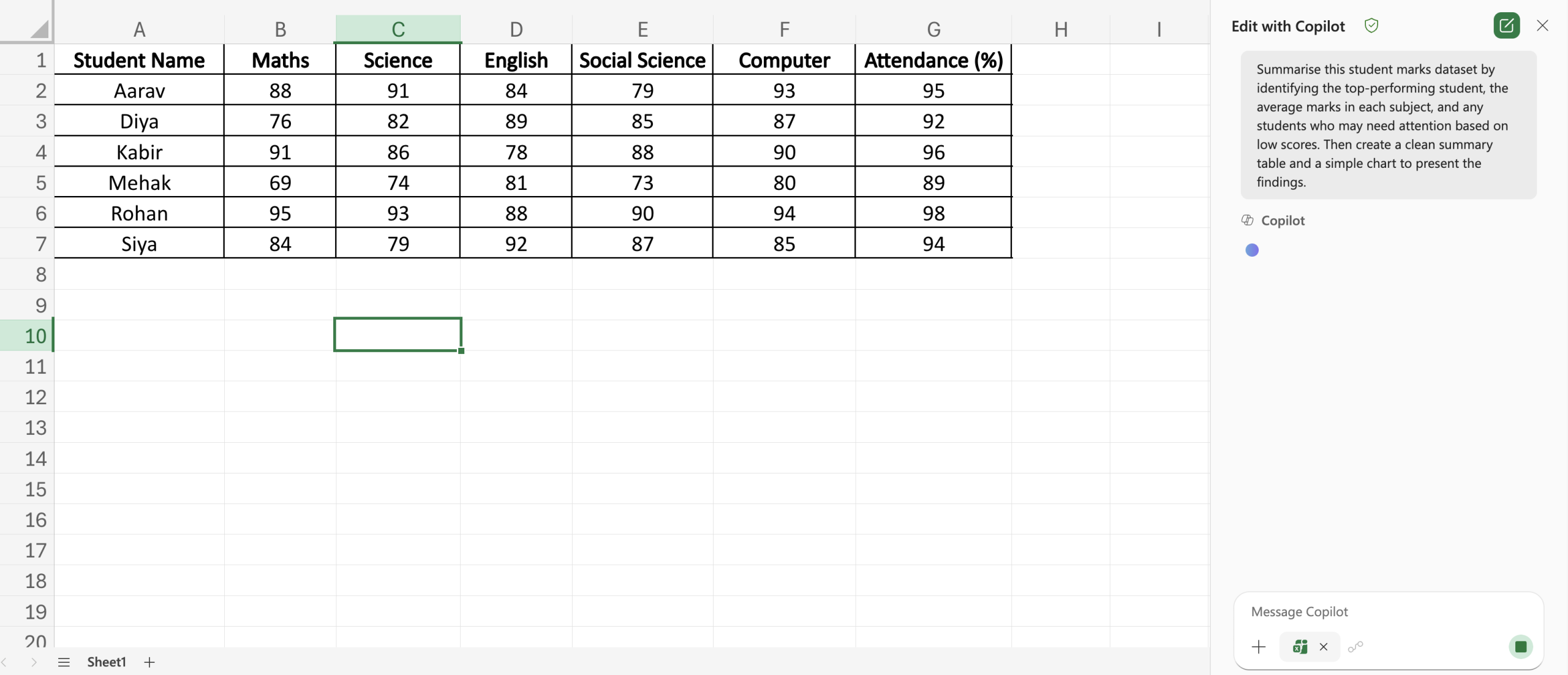
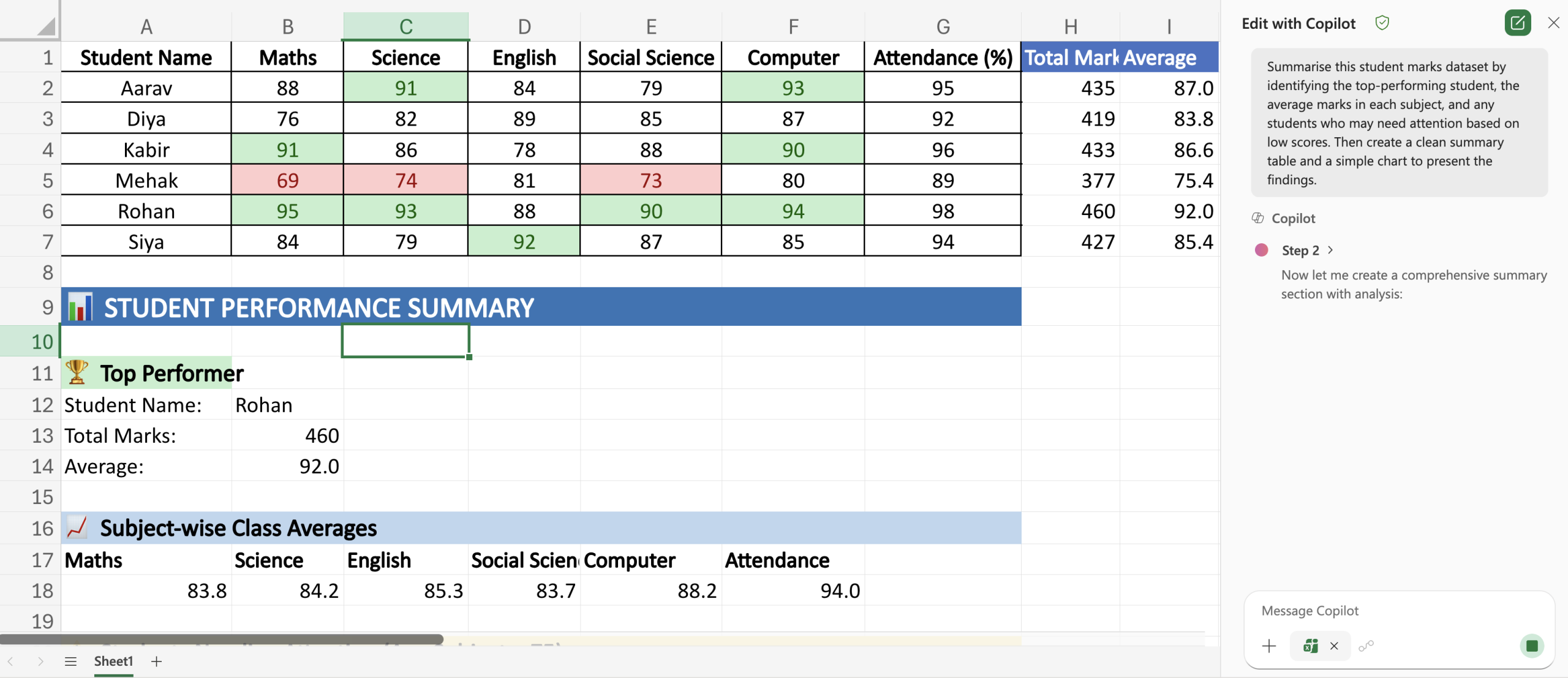
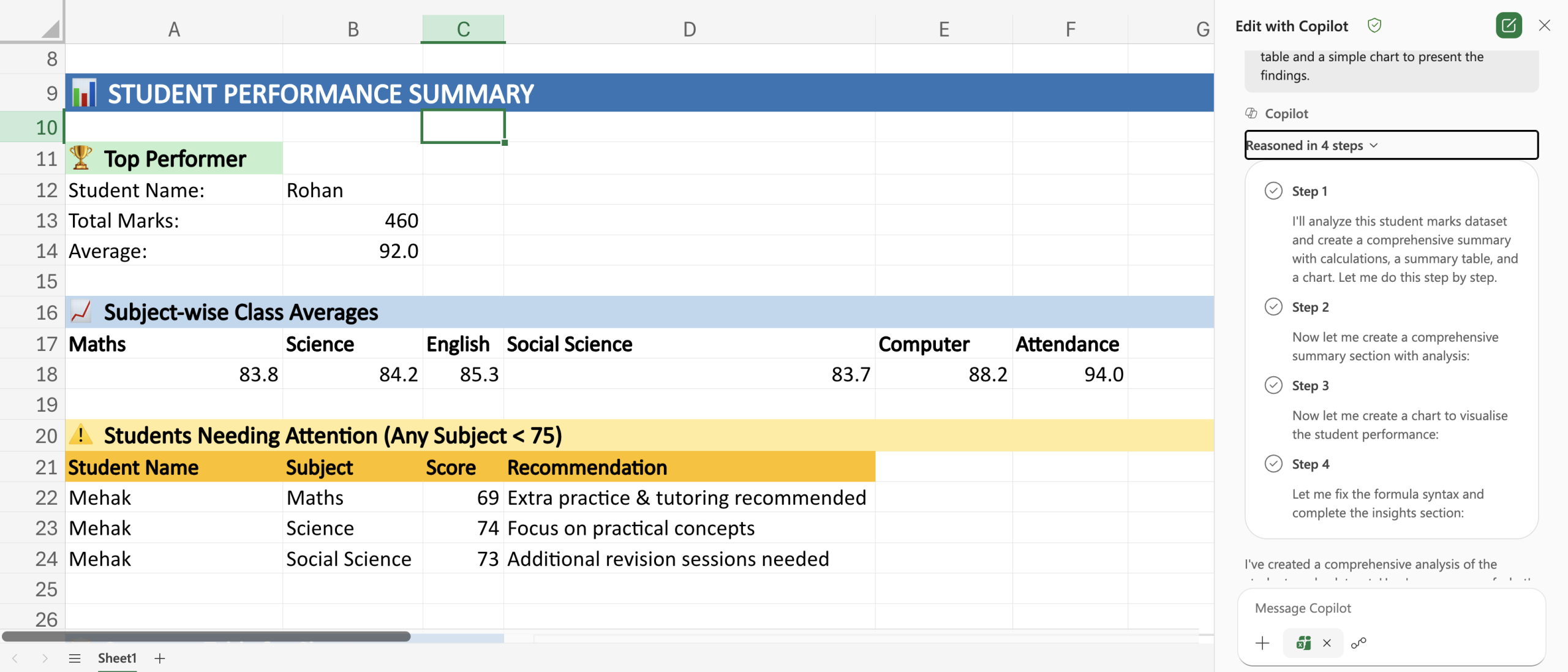

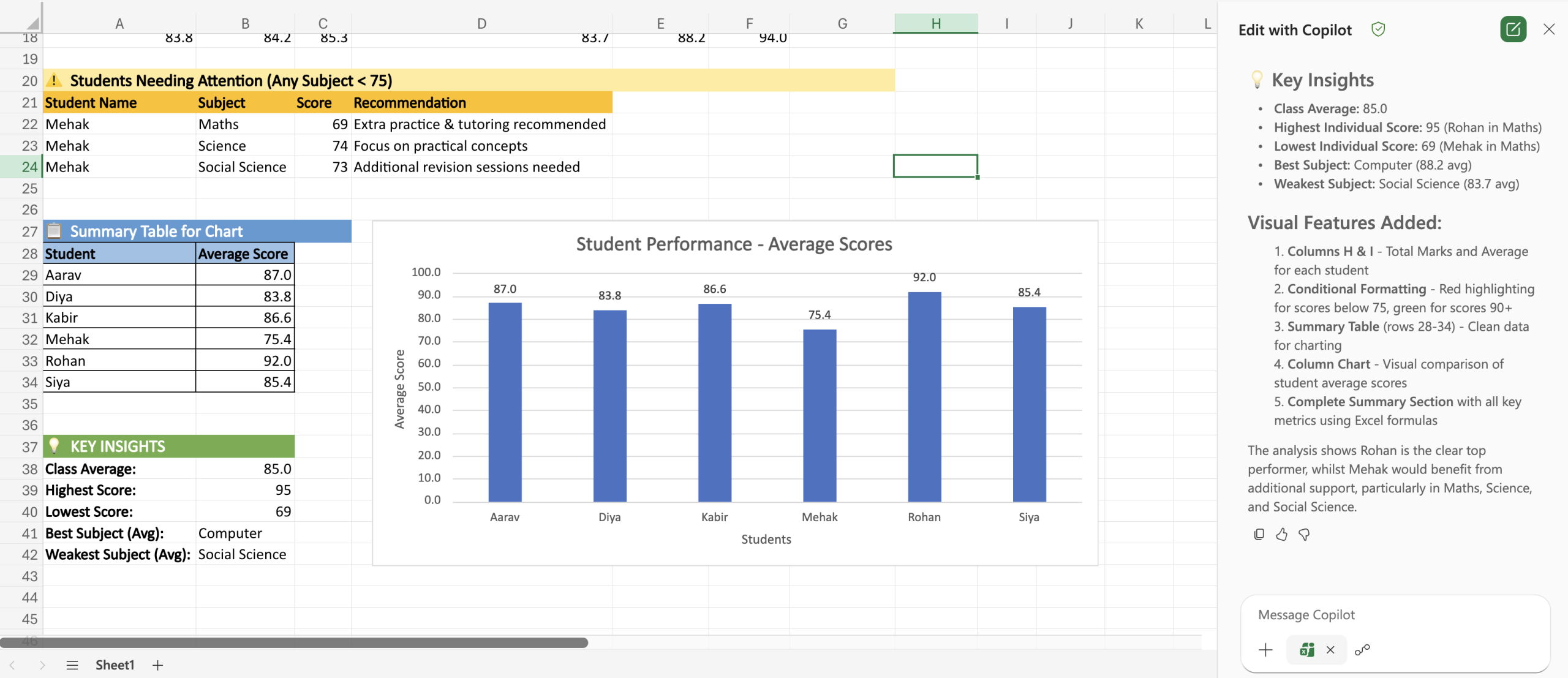
And once again, Excel Agent Mode or Edit with Copilot has provided the final output to me in the most perfect manner possible. Without me using a single Excel function, I get to see the insights from all the marksheets, who topped in what subject, and what was the most successful subject in terms of marks obtained by students. What’s more, it was even able to present the insights in a perfect visual table for easy understanding.
Task 3: Performing Time Series Analysis
Time series analysis is another highly important use-case where you can put the power of Excel’s Agent Mode to work. Instead of only summarising static data, it can work with information spread across time, identify trends, spot dips or spikes, and present the pattern visually. For instance, you could give it monthly website traffic data and ask it to analyse how performance changed over the year.
Here is the prompt I used for this:
Prompt:
Analyse this monthly website traffic dataset as a time series. Identify the overall trend in visits and signups, highlight any unusual dips or spikes, and create a simple chart showing how performance changed over time. Also summarise the key insights in a clean table.
Output:
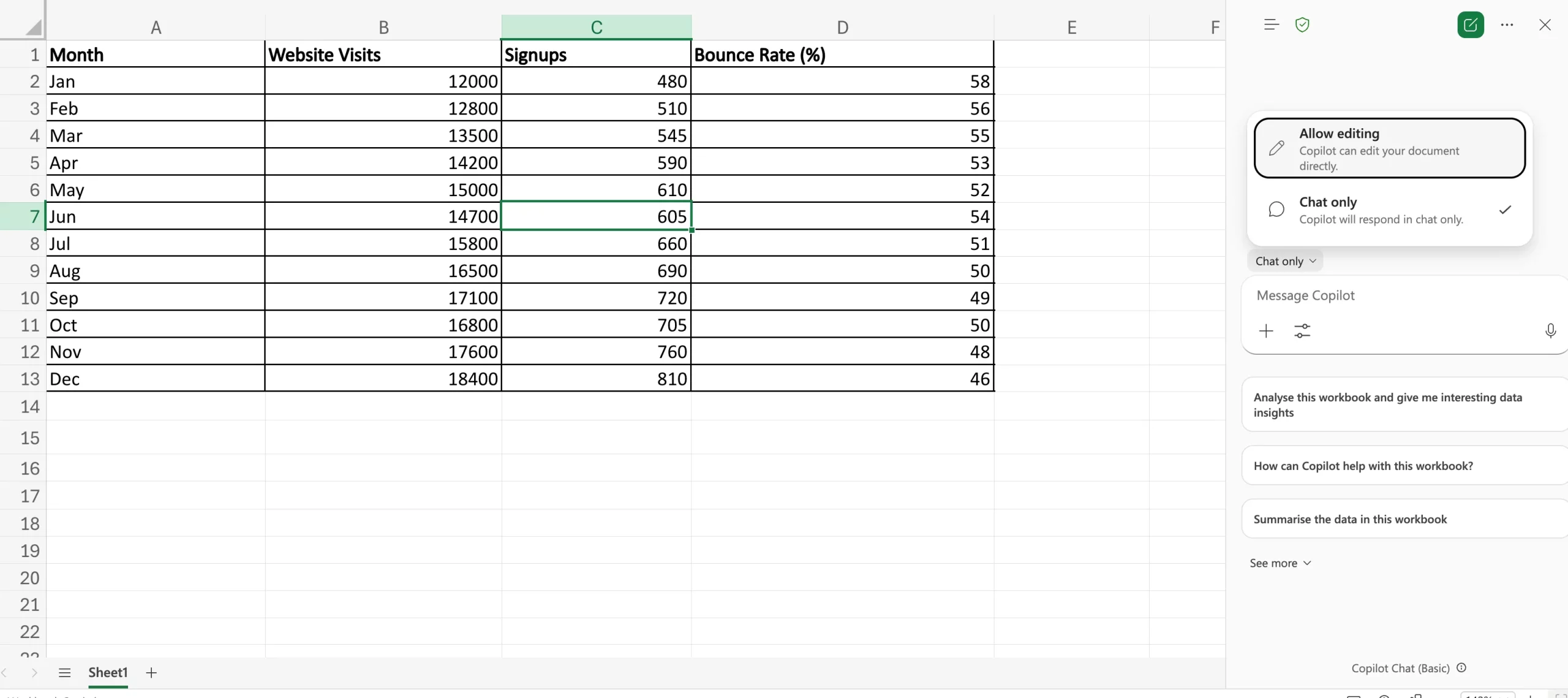
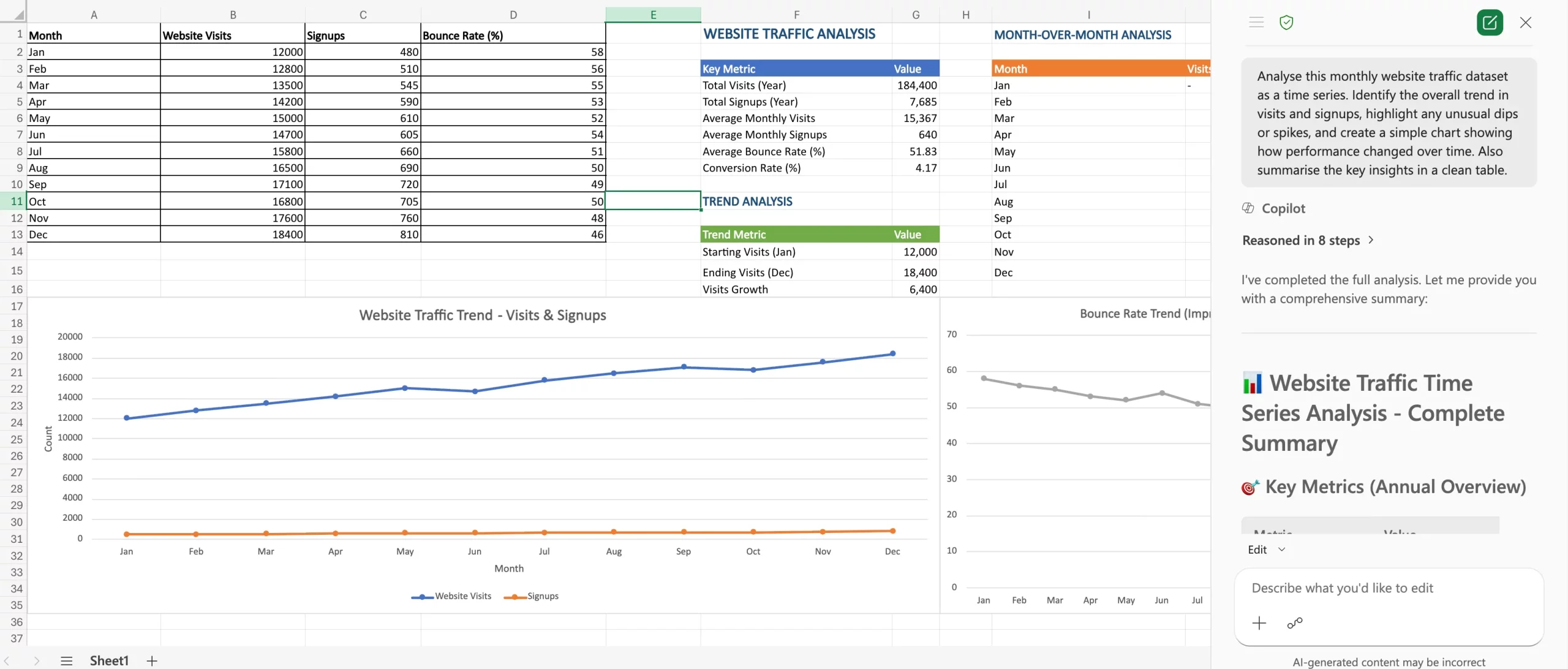
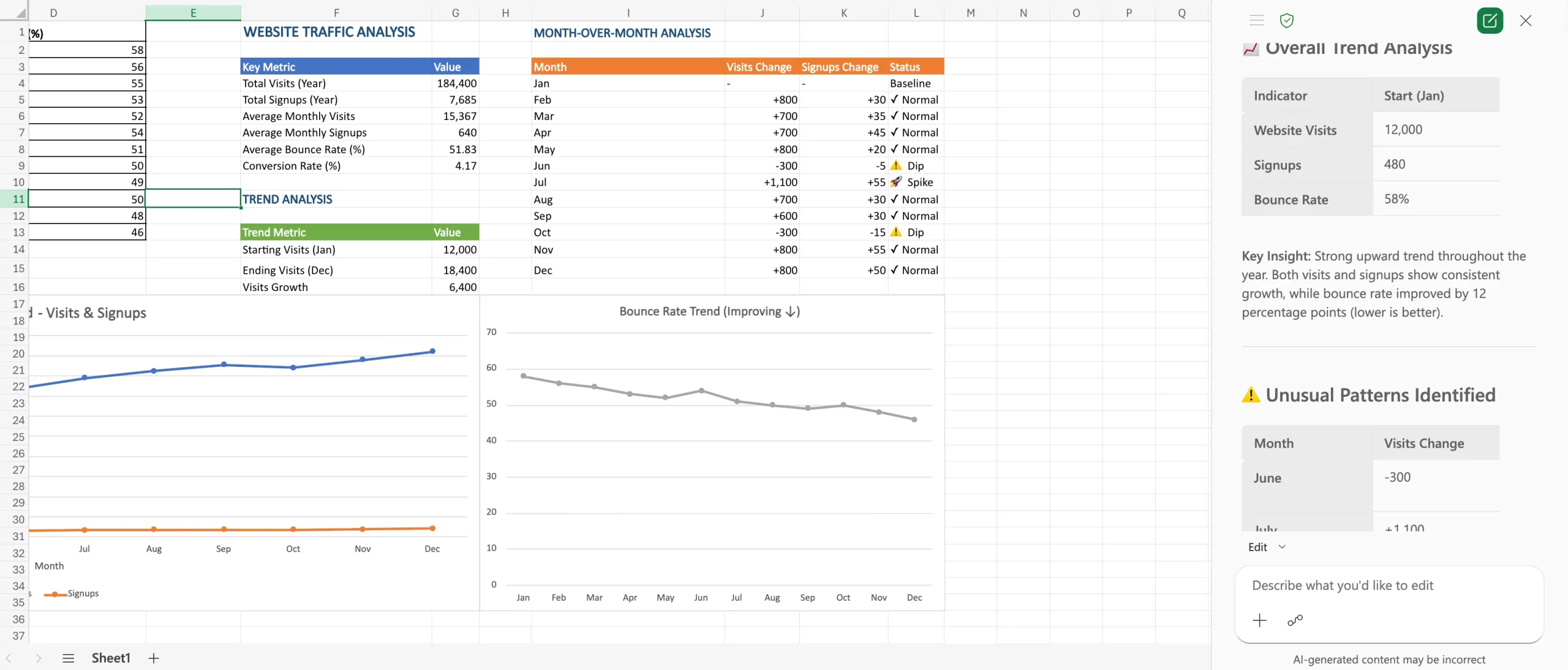
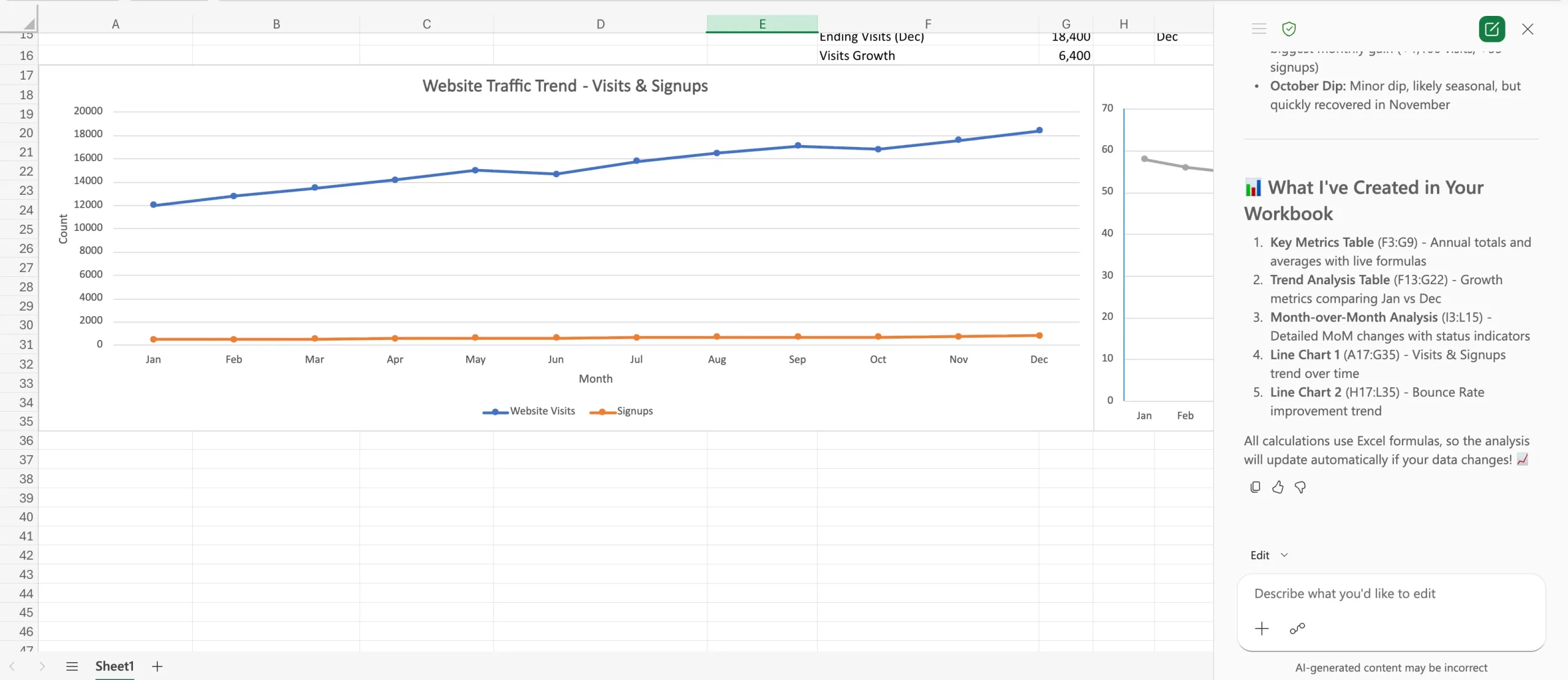
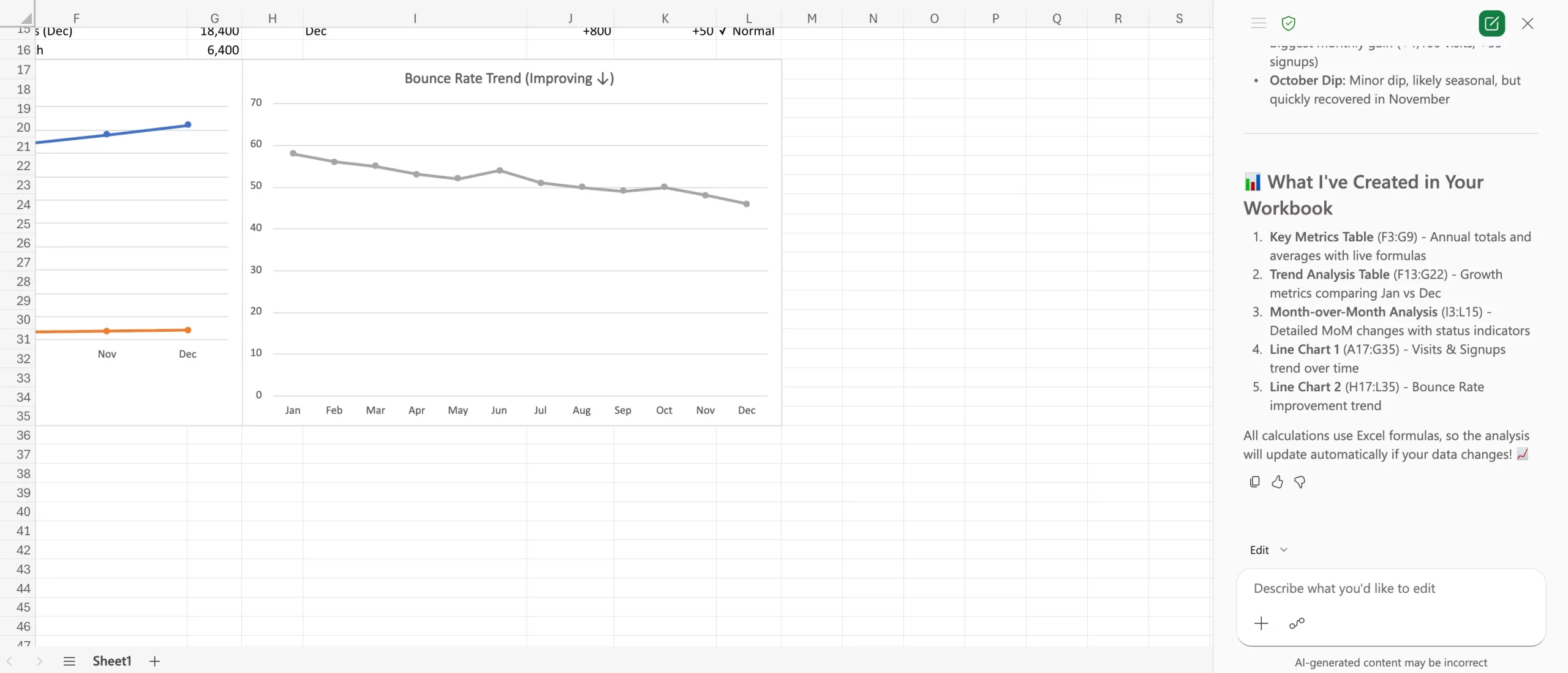
Clearly, Excel Agent Mode, or Edit with Copilot, has managed to do in seconds what would otherwise take multiple formulas, helper columns, and charts. With a single prompt, it turned a simple monthly website traffic sheet into a full-time series analysis. It even highlighted the overall upward trend in visits and signups, pointing out the unusual dips in June and October, and even showed that bounce rate kept improving through the year. What’s more is that the output did not stay limited to plain text insights. It created structured analysis tables, month-over-month comparisons, and clean visual charts that made the trend instantly understandable at a glance.
Task 4: Regression Models
This is a great example of how Agent Mode can go beyond summarising tables and actually help with predictive-style analysis. Instead of just telling you what happened, it can work with related variables, identify patterns between them, and present the relationship visually. For instance, you could give it a simple marketing dataset and ask it to analyse how ad spend affects lead generation or sales.
Prompt:
Analyse this dataset using regression-style analysis. Find whether Ad Spend has a relationship with Leads Generated and Sales Closed, show the trend visually, and summarise the key insights in a clean table.
Output:
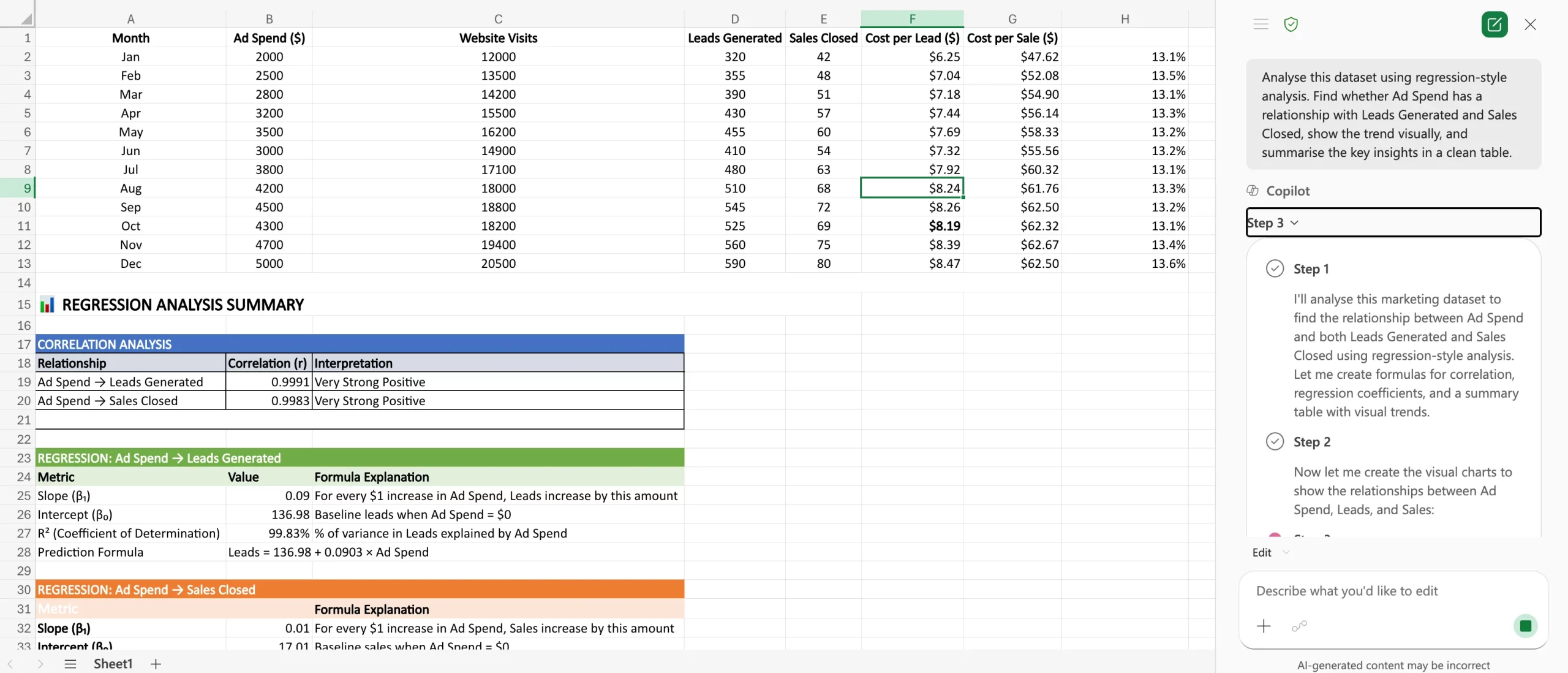
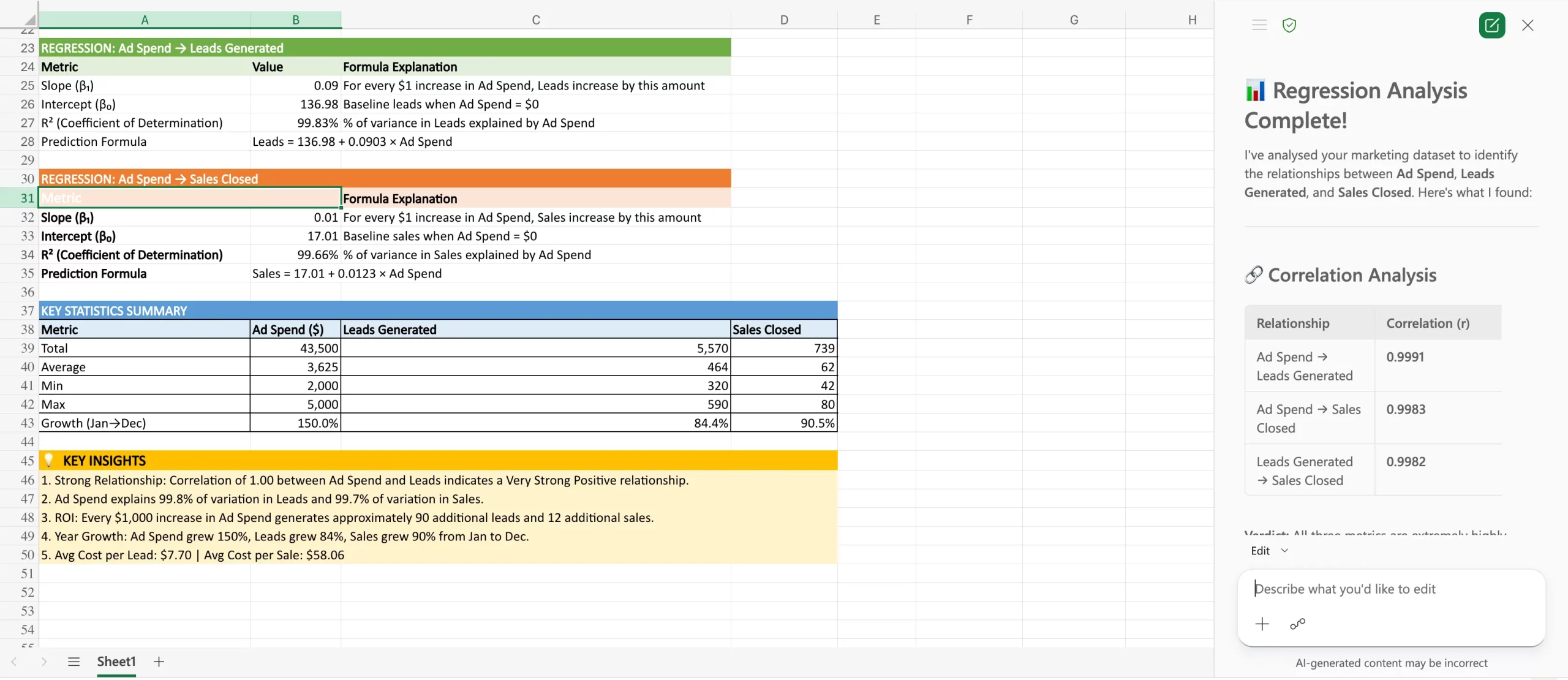
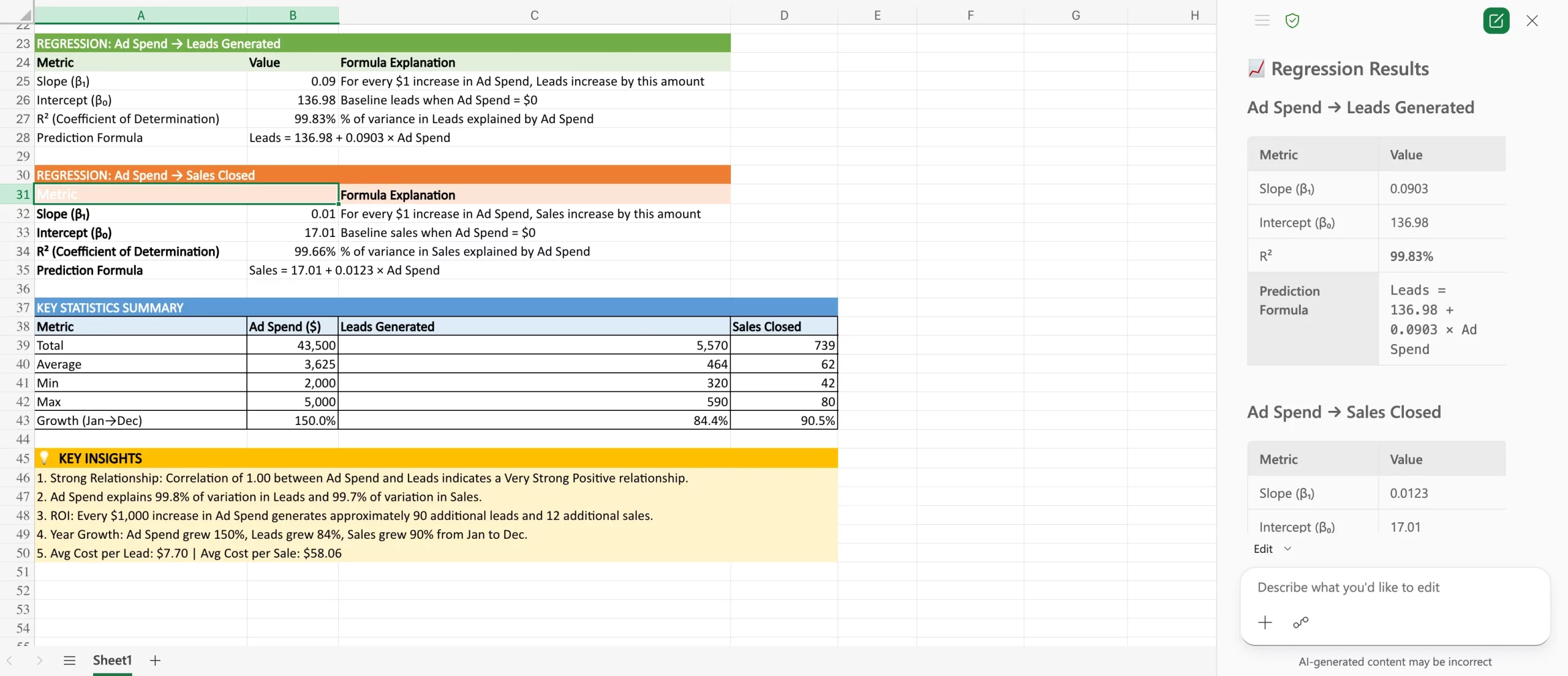
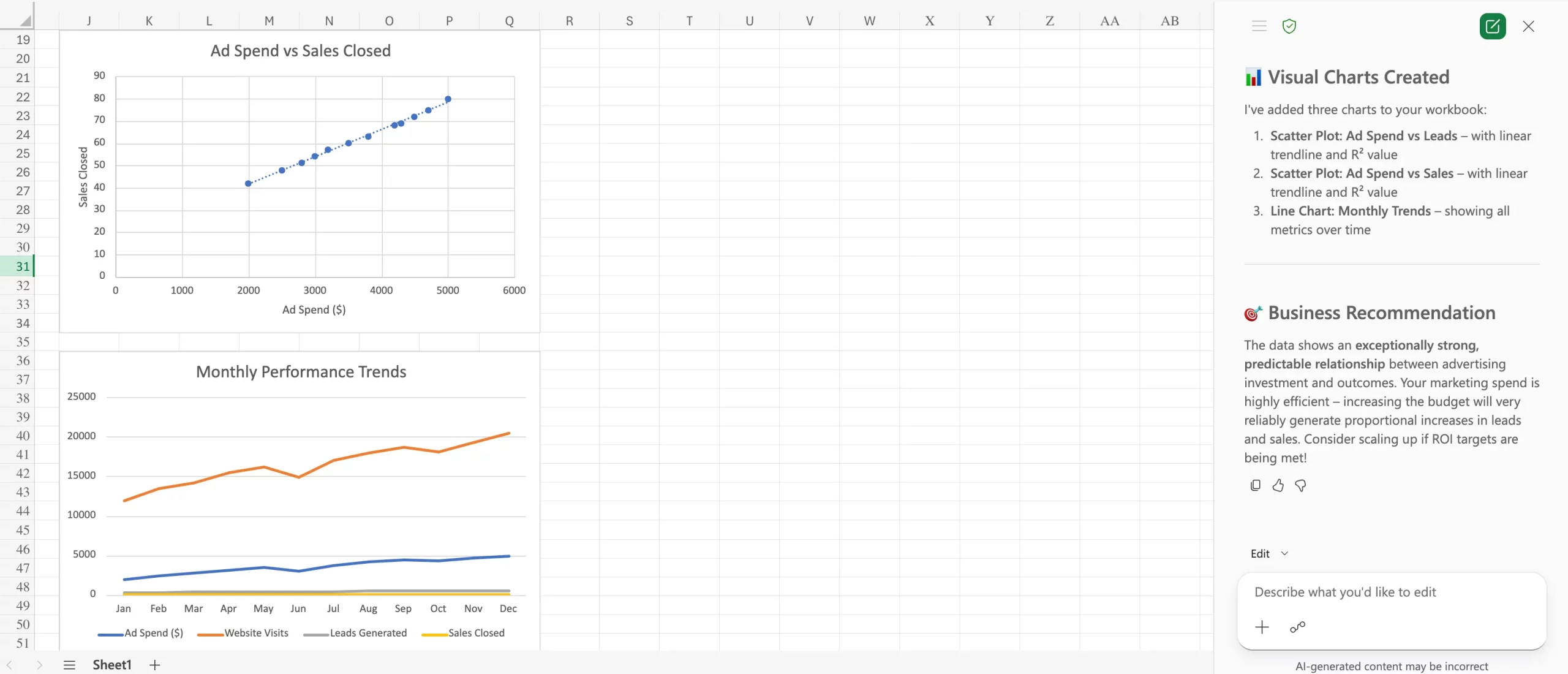
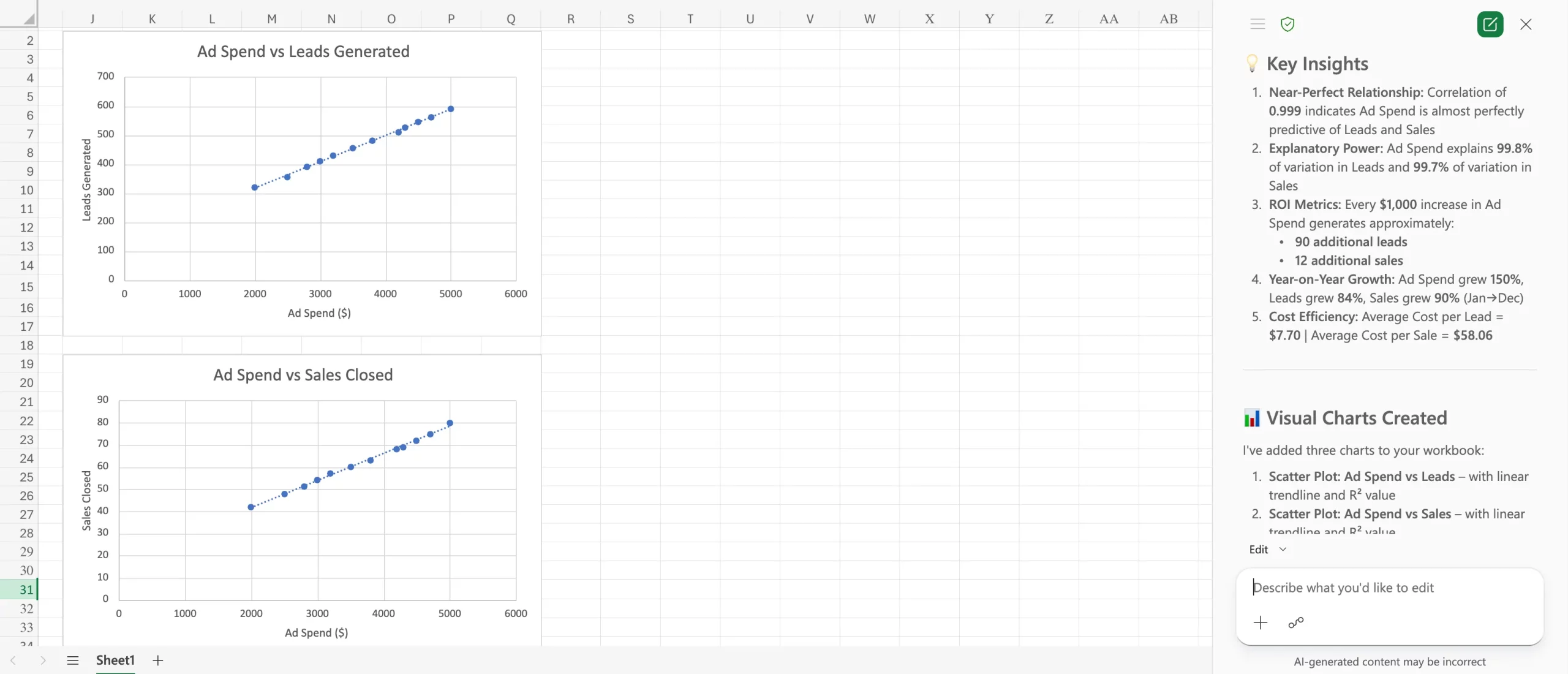
As is evident from the results, Excel Agent Mode handled the heavier analytical lifting without me needing to manually build a regression setup from scratch. With one prompt, it was able to study the relationship between ad spend, leads, and sales, present the trend visually, and turn raw business data into a much more decision-friendly format. Result – I got a ready view of how strongly marketing inputs were connected to actual outcomes.
Tips to Get the Best Results from Excel Agent Mode
While it may seem so, be very sure – Agent Mode is not magic. It can save time, reduce manual effort, and help you move faster through a workbook. Yet, the quality of the output still depends heavily on the quality of your input.
In other words, if you give it a vague task, you will usually get a vague result. In the hands-on examples I shared above, the datasets used were super clean and easily understandable. If you give Excel Agent Mode such clean sheets, a clear goal, and a well-phrased prompt, it will surely be immensely useful. But anything goes wrong, and your results might be screwed.
That is why using Agent Mode well is less about “knowing AI” and more about giving it the right working conditions. Here are a few simple ways to get the best results.
Excel Agent Mode Tips
- Start with a clear objective: Do not just say, analyse this sheet. Tell it what you actually want. For example:
– find the top-performing region
– compare actual revenue with target
– identify students with low scores
– create a summary table and chart - Keep your data clean: Agent Mode works better when:
– column names are clear
– there are no blank rows
– numbers are stored as numbers, not text
– tables are in proper structur - Ask for one complete outcome: A prompt works better when it is goal-led. For example:
– Summarise this sales data and create a chart
instead of
– check sales, then tell me region-wise performance, then maybe compare targets too - Be specific about the output format: If you want something visual or structured, say so:
– create a summary sheet
– make a bar chart
– highlight low-performing entries
– show the result month-wise - Review everything before trusting it: This is the big one. Always check:
– formulas it inserted
– summaries it generated
– charts it created
– assumptions it may have made - Use follow-up prompts to refine the work: You do not have to get everything perfect in the first prompt. You can continue with the following prompts:
– Make this chart simpler.
– Group the summary by region.
– Highlight only entries below target.
– Create a cleaner final version
The practical takeaway
The best way to use Agent Mode is to treat it like a fast-working junior analyst. Problems arise when people start using it as an unquestionable expert. Give it a clean brief, review the work, and keep refining the result until it matches what you actually need.
Conclusion
Until Agent Mode, the use of Excel largely depended on your level of skills in the service. You had to know the right formulas to achieve the desired results. You even had to understand the logic, clean the data, structure the sheet, and then slowly work your way toward the final outcome.
Agent Mode changes that equation.
While it does not remove the need for Excel knowledge, it does reduce the effort required to get from raw data to usable output. That is exactly what makes it super important. Instead of forcing you to manually build every step, it lets you begin with the outcome you want and then helps you move toward it faster.
That said, this is still not a substitute for judgment. You still need to ask clear questions, review the output, and make sure the workbook is actually saying something meaningful. In that sense, Agent Mode is best seen as a strong assistant inside Excel and not a replacement for the person using it.
In short, remember this – for beginners, Agent Mode can make Excel feel less intimidating. For regular users, it can cut down repetitive work. And for advanced users, it can act as a speed layer on top of existing spreadsheet skills.
Now go ahead, practice it, and we will be back with more such detailed guides on the features of Excel in the series soon.