
In today’s hyper-competitive marketplace, eye-catching product visuals are the secret weapon for small business owners striving to succeed online. Traditionally, creating professional-grade posters has been a costly, manual task requiring design expertise. But now, there’s a smarter way: by integrating n8n’s powerful automation with Google’s Nano Banana AI for image generation, anyone can instantly transform basic product data into stunning marketing visuals, all with zero design skills required. This innovative workflow empowers brands to automate every step, from capturing product input to delivering studio-quality posters, unlocking new creative potential, and leveling the playing field for businesses of all sizes.
Table of contents
What is n8n?
n8n is an open-source agent building, workflow automation, and integration tool designed to help you connect applications and build agentic workflows. n8n is different from other automation tools because you have a variety of options to self-host, which enables more flexibility and avoids vendor lock-in. As a no-code/low-code tool, n8n enables people with no coding backgrounds to build powerful automated pipelines without writing a single line of code.
Read more: What is n8n?
What is Nano Banana?
Gemini 2.5 Flash Image is the new image generation and editing model by Google. It comes as an update to the much-hailed Gemini 2.0 Flash Image generation model, making it faster and better, with added image-editing features.
For context, the new Gemini 2.5 Flash Image can blend multiple images into one, maintain character consistency, and make targeted transformations in an image. As Google puts it, the model uses Gemini’s “world knowledge to generate and edit images.”
Read more: What is Nano Banana?
Why connect n8n with Nano banana?
Integrating n8n with Nano Banana lets users automate creative, marketing, and content production workflows. The combined power means you can trigger image edits or generation based on events, automatically distribute results, and reduce manual effort in creative pipelines.
Problem Statement
Many small business owners want to display their products online by using Amazon, Flipkart, and other marketplaces. They go through a lot of trouble without being able to fully establish them because of high-quality, professional images that capture the attention of buyers.
We will solve this problem by combining Nano Banana to create professionally designed posters, merging product images with product descriptions to produce high-quality posters. We will also harness the power of n8n to automate all of this, to eliminate the manual effort and extra expenses.
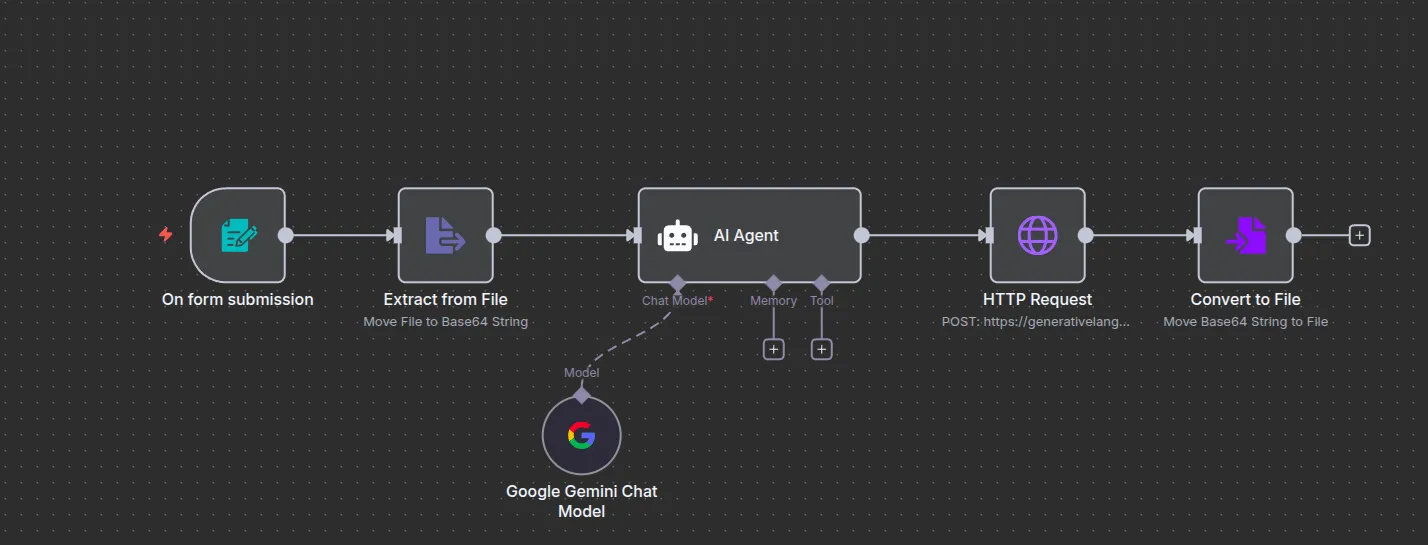
This workflow automates the creation of an advertising poster by combining user input, AI-generated creative prompts, and image generation through Google’s Nano Banana. It starts from a form where a product description and image are submitted, then processes this input through an AI agent to craft a vivid prompt tailored for an image generation AI, requests the image generation from Google’s Gemini API, and concludes by converting the AI-generated image back into a usable file format for download or further use.
Step-by-Step Process to Build This Workflow
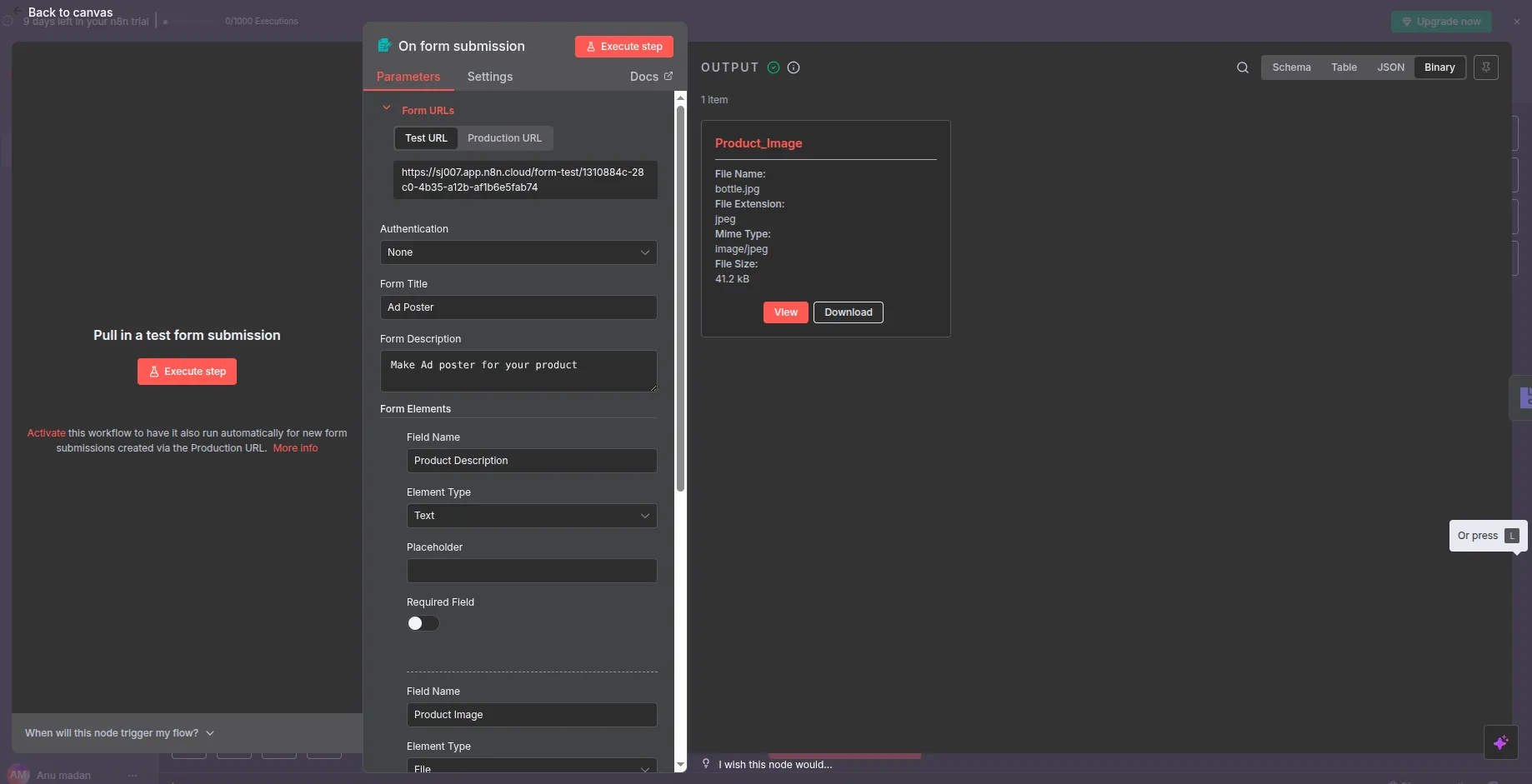
1. Form Trigger Node
- Add a Form Trigger node to start the workflow when a user submits a form.
- Configure form fields to collect:
- Product Description (text input)
- Product Image (file upload)
- This node activates the workflow upon form submission, receiving initial user inputs.

2. Extract Image from Uploaded File
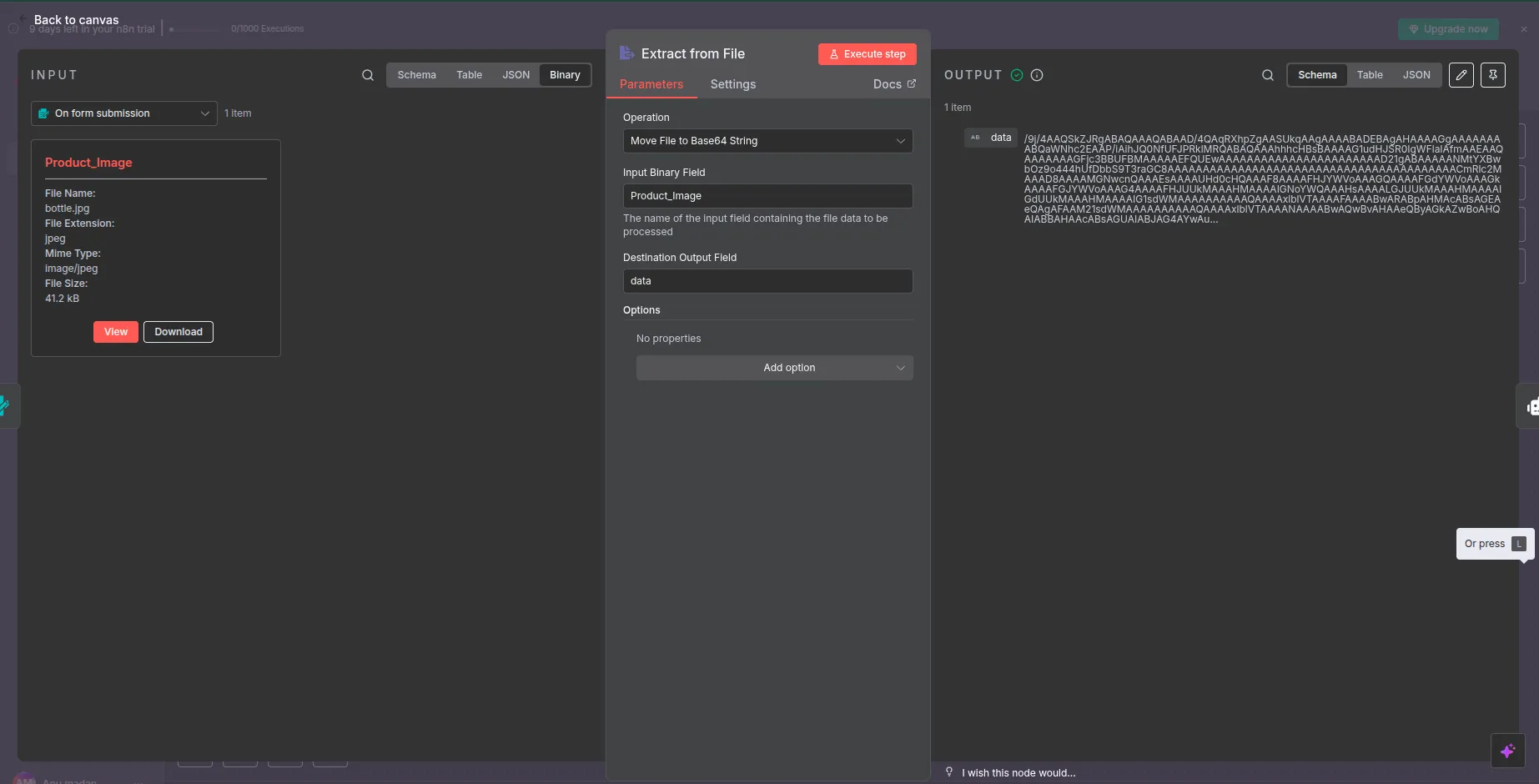
- Add an Extract from File node connected to the form trigger.
- Extract the binary data of the uploaded product image file so it can be handled in subsequent steps.
3. AI Agent Node for Prompt Generation
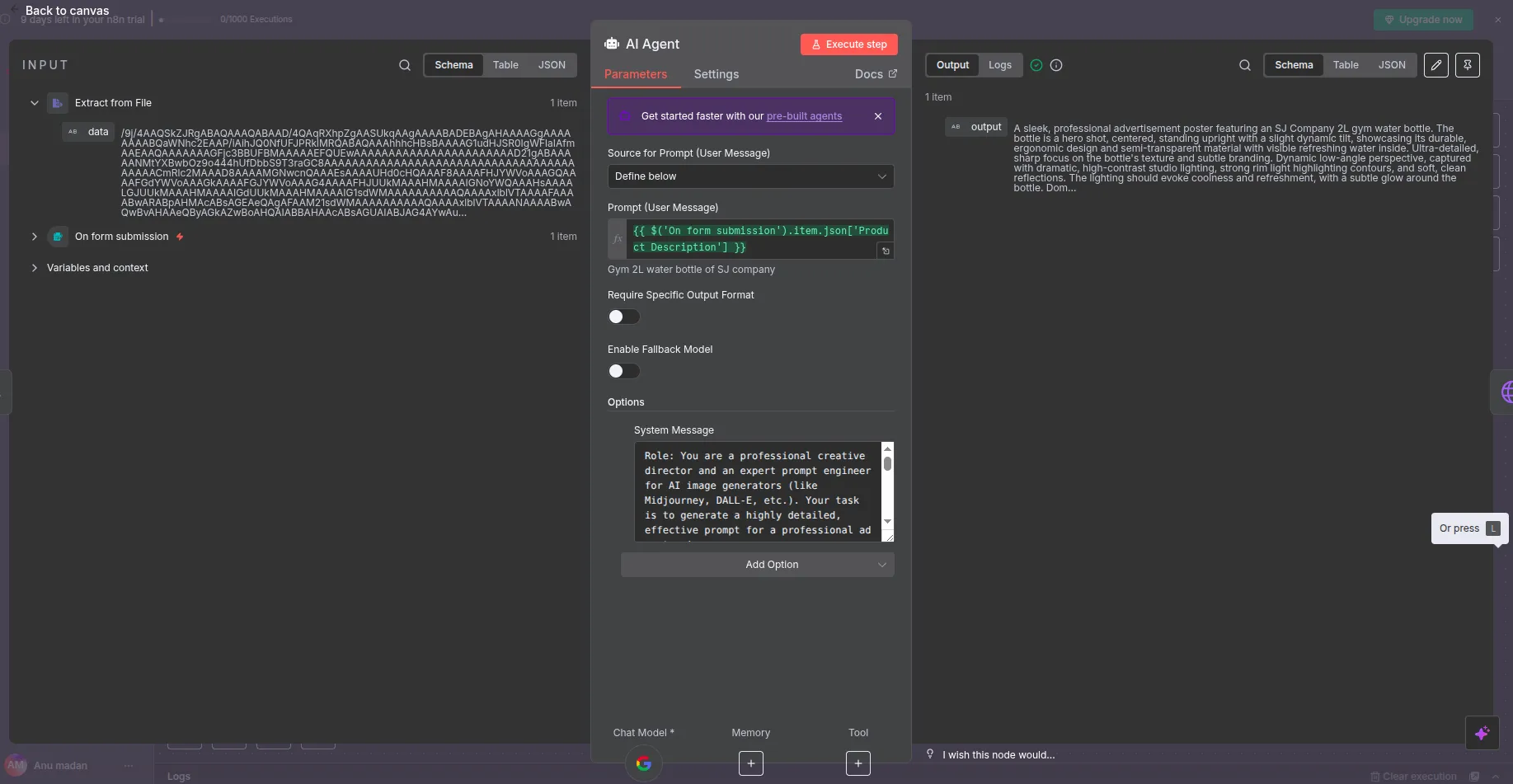
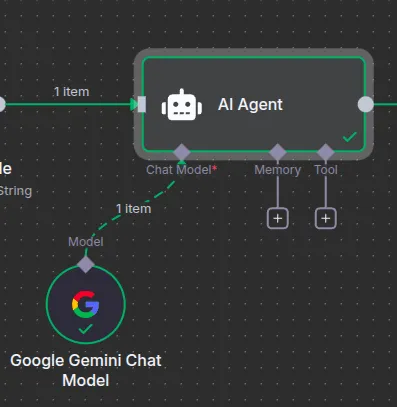
- Insert an AI Agent node that uses the product description as input.
- Configure it to use a system message that frames the role as a creative director and expert prompt engineer.
- This node will analyze the product description and generate a professional, detailed prompt for image creation, specifying subject, lighting, color palette, style, and mood.
4. Google Gemini Chat Model Node
- Add the Google Gemini Chat Model node to provide the AI language model capability.
- This node is likely invoked internally by the AI Agent node or set up as a linked language model to process the prompt.
5. HTTP Request Node to Call Image Generation API
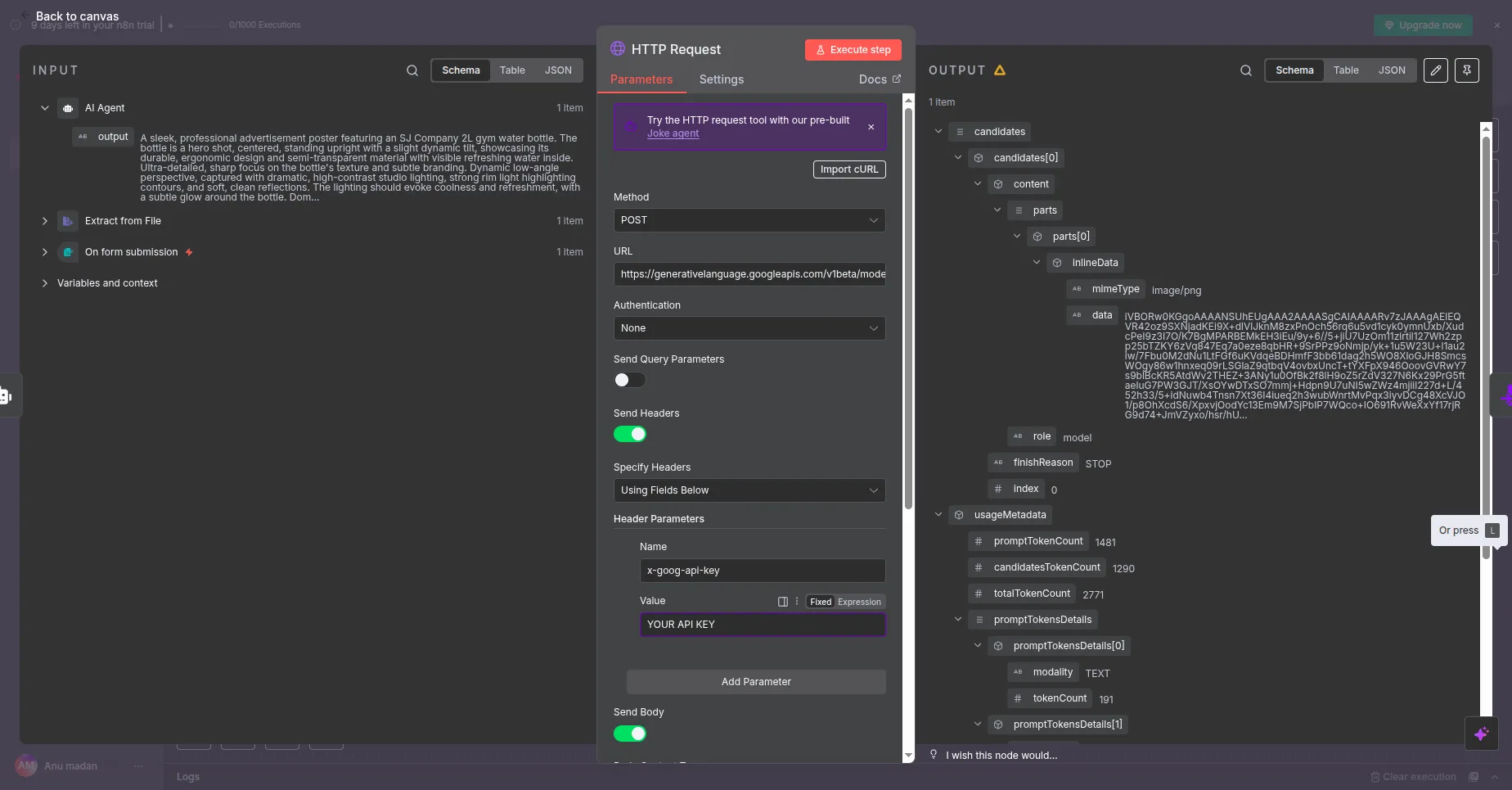
- Create an HTTP Request node that sends a POST request to the Google Gemini image generation API endpoint.
- The JSON body contains:
- The extracted image binary data (for inline data content related to the input image)
- The detailed prompt generated by the AI Agent
{
  "contents": [
    {
      "parts": [
        {
          "inline_data": {
            "mime_type": "image/png",
            "data": "{{ $('Extract from File').item.json.data }}"
          }
        },
        {
          "text": "{{ $json.output }}"
        }
      ]
    }
  ],
  "generationConfig": {
    "responseModalities": [
      "IMAGE"
    ]
  }
}- Include authorization headers with an API key.
- Request the API to generate an image response based on the prompt.
6. Convert Generated Content to Binary File
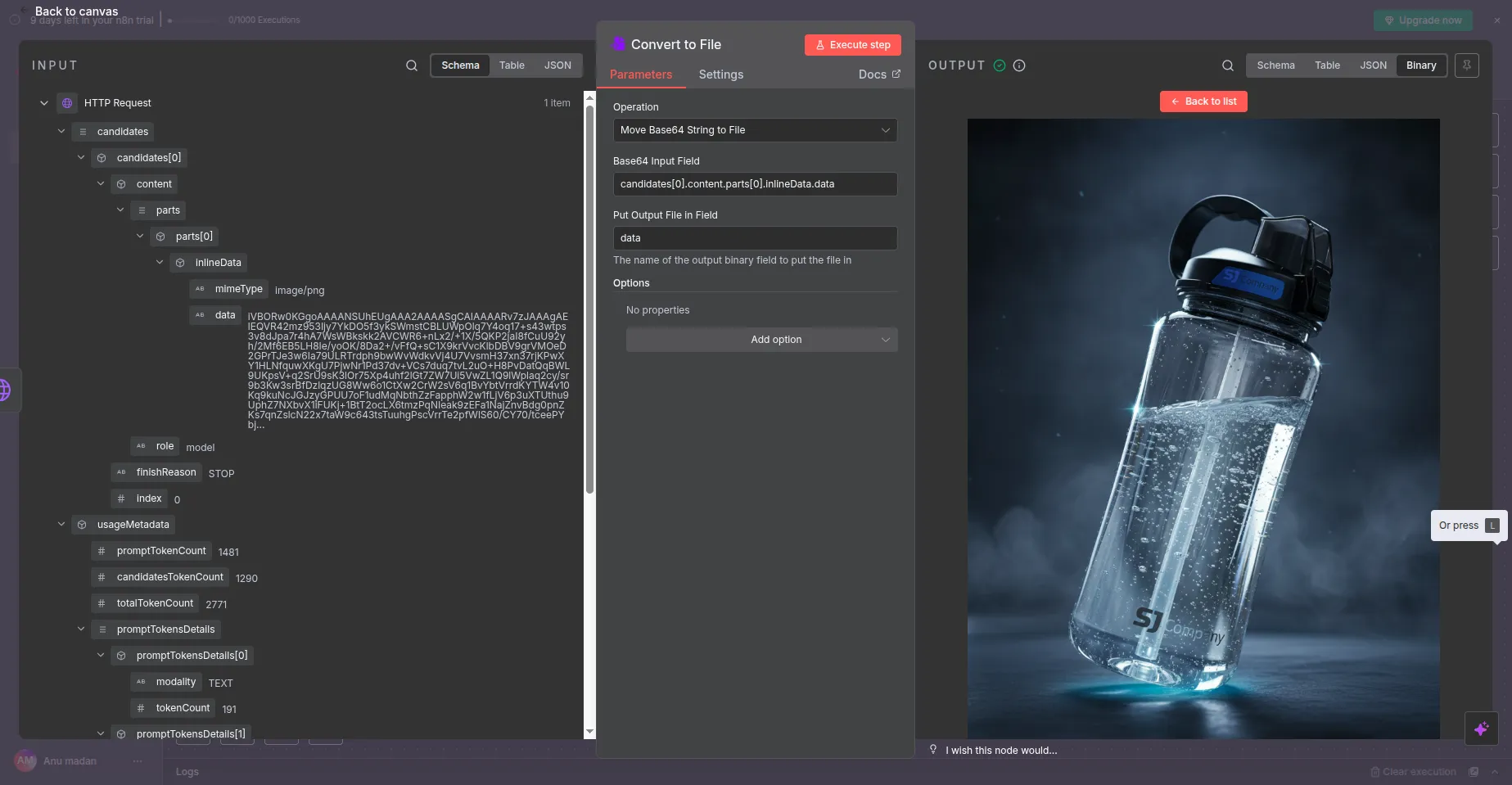
- Add a Convert to File node that takes the inline base64 image data from the API response and converts it to a proper binary file.
- This makes the AI-generated image usable for download or further processing.
Final overview of the workflow
The workflow starts when a user submits a product image and description through a form. This input is processed automatically, and an AI agent generates a creative prompt based on the product details, which is then sent with the image to Google’s Nano Banana AI. The system creates a high-quality, professional product visual, which is delivered back for use in marketing or e-commerce.
Other Applications for n8n + Nano Banana?
Here are some other applications of n8n when paired with Nano banana:
- Automated Social Media Post Generation: Instantly create and publish visual content based on trending topics or scheduled campaigns.
- Personalized Email Marketing: Dynamically generate personalized banners or product images for targeted email campaigns using customer data triggers.
- Content Creation for Blogs & Newsletters: Populate blogs, newsletters, or digital magazines with fresh visual content on autopilot.
- Digital Poster or Flyer Distribution: Automate the design and dissemination of event invitations, advertisements, or digital flyers based on calendar or CRM triggers
Also Read:
- 15 Nano Banana Prompts to Try Today!
- Is Nano Banana Better than GPT 5? Let’s Find Out!
- Nano Banana vs Qwen: Which is Better?
- How to Use Nano Banana AI to Create Your Own 3D Figurine?
Conclusion
With n8n integrated with Nano Banana, businesses can change how they manage creative workflows by getting past technical barriers and democratizing high-impact visuals. Whether you are creating marketing materials or managing e-commerce listings, by using n8n, this automation means speed and scalability while maintaining a professional standard of quality to stand apart in an increasingly digital world, and removing all of the cumbersome manual steps that have plagued many creative processes in the past.
Frequently Asked Questions
Q1. What is n8n and how does it help small businesses?
A. n8n is an open-source workflow automation tool. It lets small businesses automate repetitive tasks, integrate 400+ apps, and streamline processes without needing advanced coding skills.
Q2. What exactly is Nano Banana (Gemini 2.5 Flash Image)?
A. Nano Banana is Google’s AI model for fast, high-quality image generation and editing, powered by natural language prompts.
Q3. Why combine n8n with Nano Banana?
A. Together, they automate marketing workflows—taking product inputs, generating creative prompts, and producing professional visuals with minimal manual effort.
Q4. What problem does this workflow solve for small businesses?
A. It removes the cost and effort of creating professional product posters, letting businesses generate high-quality visuals automatically.
Q5. Beyond product posters, what else can this integration do?
A. It can automate social media visuals, email banners, blog content, and digital flyers—scaling creative output effortlessly.
Podcast: Play in new window | Download
I am a Data Science Trainee at Analytics Vidhya, passionately working on the development of advanced AI solutions such as Generative AI applications, Large Language Models, and cutting-edge AI tools that push the boundaries of technology. My role also involves creating engaging educational content for Analytics Vidhya’s YouTube channels, developing comprehensive courses that cover the full spectrum of machine learning to generative AI, and authoring technical blogs that connect foundational concepts with the latest innovations in AI. Through this, I aim to contribute to building intelligent systems and share knowledge that inspires and empowers the AI community.








This is so cool! Best use case of nano banana!