You are a product of your environment, so choose to be with the best.
In the age of AI, this proverb is just as true as on the day it was said. If you are to compete in this ultra-fast AI environment with innovations around every corner, being around industry leaders will do you heaps of good. And for this, DataHack Summit 2026 is your best shot.
For six years, DataHack Summit has led India’s most active AI conversations. It needs no introduction in AI, machine learning, and data science. Now in its 7th edition, DataHack Summit 2026 returns with a sharper purpose. It will bring together AI builders, researchers, data scientists, business leaders, and learners. Together, they will discuss and shape the future of AI.
In short, you need to be here to understand what is changing. You will see what is working in the real world. You will also learn which AI skills will matter next.
Here is everything you need to know about DataHack Summit 2026. Read this before you reserve your spot at India’s most happening AI gathering.
Table of contents
What is DataHack Summit 2026?
DataHack Summit 2026 is the 7th edition of India’s largest AI conference. It brings together people building, studying, deploying, and learning AI in the real world. The event focuses on Generative AI, Agentic AI, Responsible AI, machine learning, and data science. It also covers practical AI adoption across industries.
In simple words, DHS 2026 takes you beyond the AI noise. You get expert-led sessions, hands-on workshops, hack sessions, and an AI exhibition. You also get networking opportunities with people solving serious AI problems. It is not just for people who want to “know about AI.” It is for people who want to work with AI, build with AI, and grow with AI.
Why Should You Attend DHS 2026?
If you are serious about AI, DHS 2026 gives you the one thing no online course or LinkedIn thread can fully offer: proximity. Proximity to people building AI systems, deploying them in companies, researching what comes next, and teaching others how to use them better.
The summit brings together AI talks, workshops, hack sessions, an AI exhibition, networking, and expert-led sessions in one place. So you are not just listening to theory. You are seeing what is being built, asking questions, learning from practitioners, and understanding which parts of AI are actually useful in the real world.
Now let’s be honest. AI is moving too fast for passive learning. And this is exactly why reading about tools is useful, but being in a room full of builders, researchers, leaders, and learners helps you understand the direction of the industry much faster.
Whether you are a data scientist, developer, founder, student, business leader, or someone trying to break into AI, DHS 2026 can help you learn what to focus on next, which skills to build, and which conversations will define the next phase of AI.
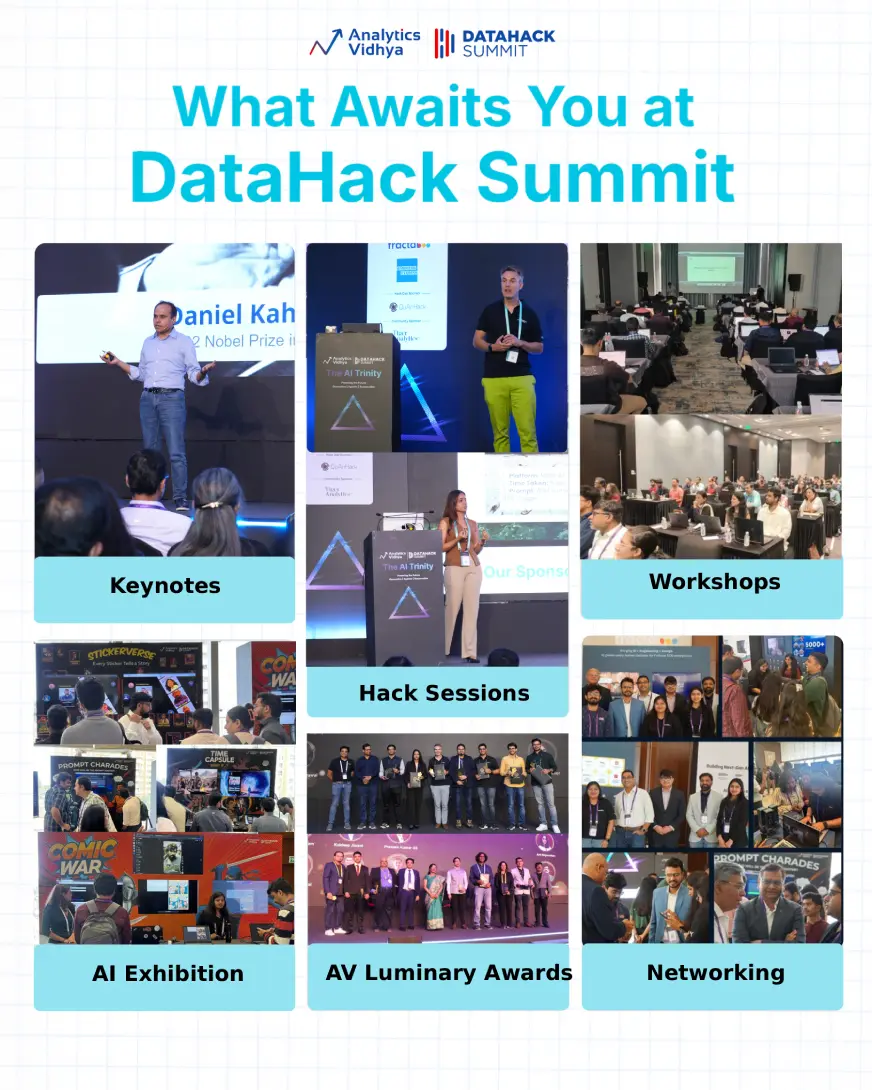
DataHack Summit 2026: Planned Activities
DHS 2026 is not planned as a sit-back-and-listen conference. The idea is to give attendees multiple ways to learn, interact, build, and connect with the AI community. Here are some of these:
Networking
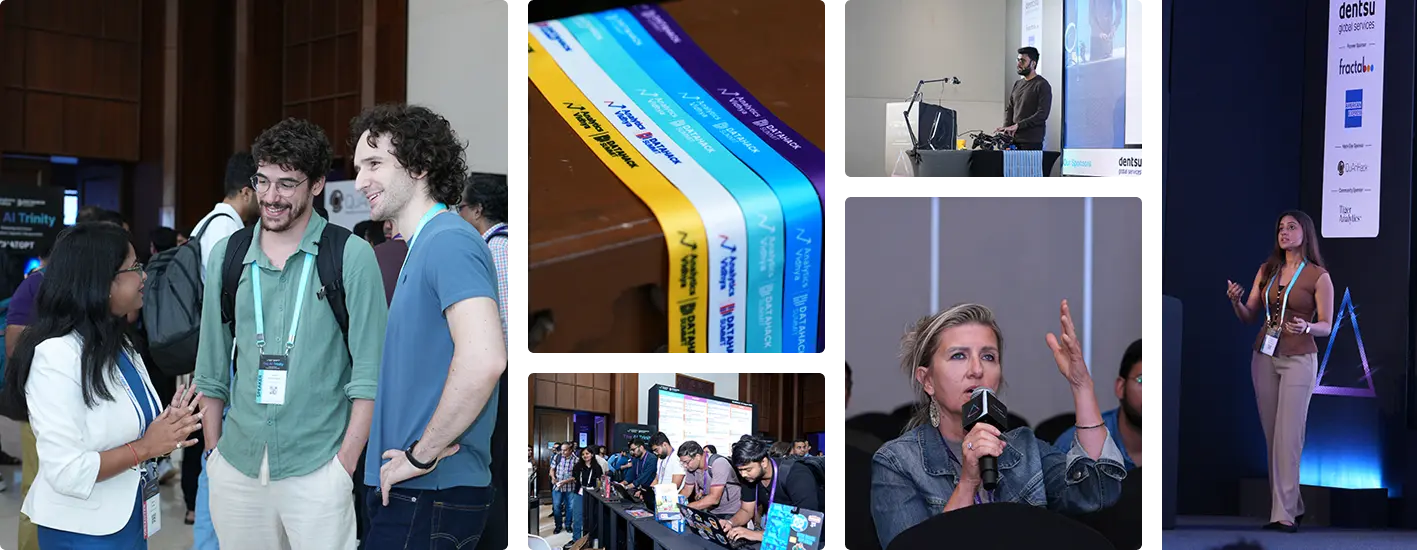
One of the biggest reasons to attend DHS 2026 is the people you get to meet. The summit brings together data scientists, developers, AI leaders, researchers, founders, hiring teams, and learners under one roof. So whether you are looking for career guidance, collaboration opportunities, business connections, or simply smarter people to learn from, the networking itself is one of the biggest takeaways from the event.
Thought-Provoking Keynotes
The keynotes at DHS 2026 are the sessions where industry leaders and experts share their larger view of the AI landscape, from emerging technologies and business adoption to risks, opportunities, and the future of work. For attendees, these talks can help connect the dots between daily AI tools and the bigger industry shift.
AI Exhibition
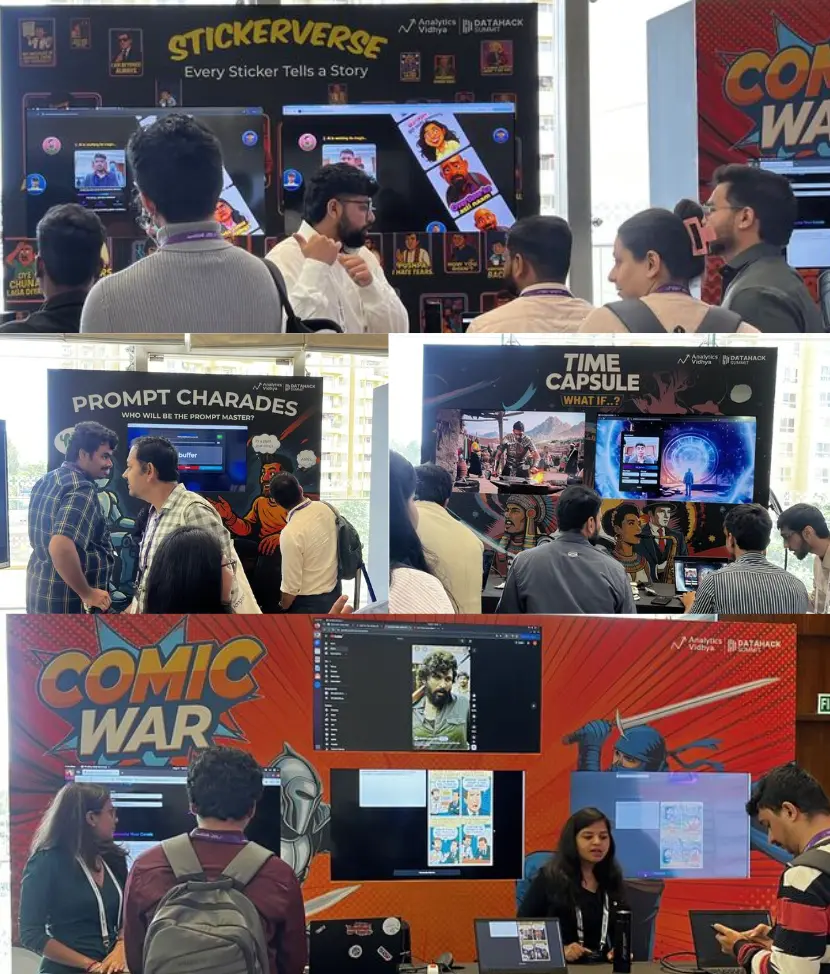
The AI Exhibition will give attendees a closer look at real AI products, tools, platforms, and solutions. This is where you move beyond just hearing about innovation and actually see what companies are building. For anyone exploring AI tools for work, business, or learning, this can be a great way to discover practical applications in one place.
Hack Sessions
Hack sessions are where the energy of the summit becomes more practical and intense. These sessions suit people who enjoy solving problems, experimenting with ideas, and applying what they know in a hands-on format. For builders and learners, hack sessions can be a strong way to test skills, learn fast, and experience AI problem-solving in action.
AV Luminary Awards
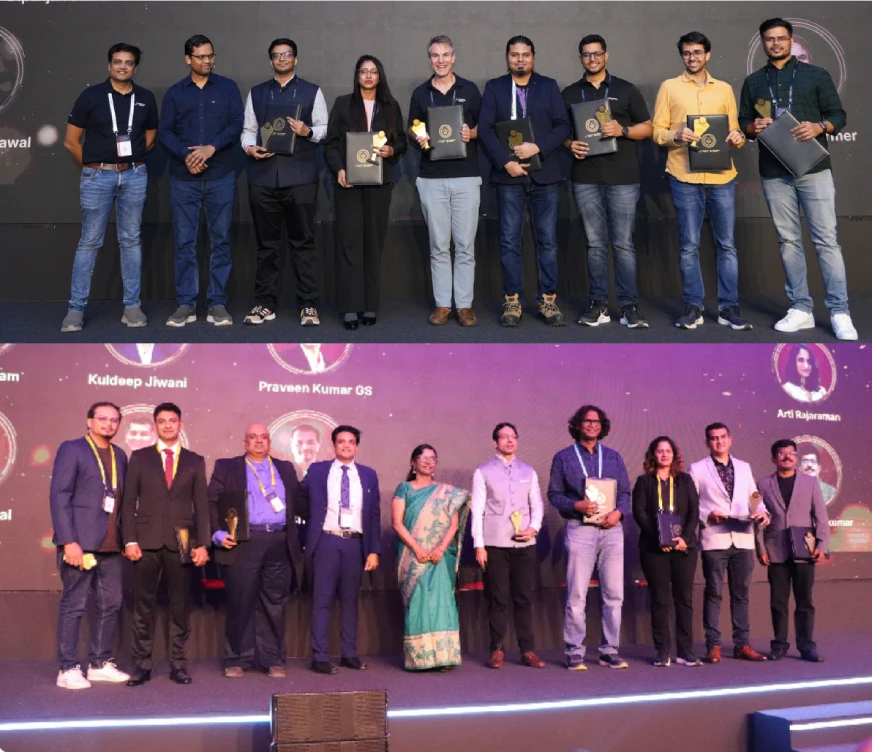
The AV Luminary Awards are one of the key highlights of DataHack Summit 2026. While the summit focuses on learning, networking, and exploring what is next in AI, the awards focus on recognising the people already pushing the field forward.
These awards celebrate AI leaders, scientists, practitioners, and community contributors who are doing meaningful work in AI, machine learning, Generative AI, and data science. In past editions, the awards have honoured innovators in GenAI and Data Science “who are shaping the future,” and DHS 2026 continues that spirit by giving visibility to people creating real impact in the AI ecosystem.
For attendees, this is also a chance to discover the kind of work, leadership, and contribution that the AI industry values today. In a field moving this fast, that can be just as useful as any session or workshop.
Sessions at DHS 2026: A Glimpse
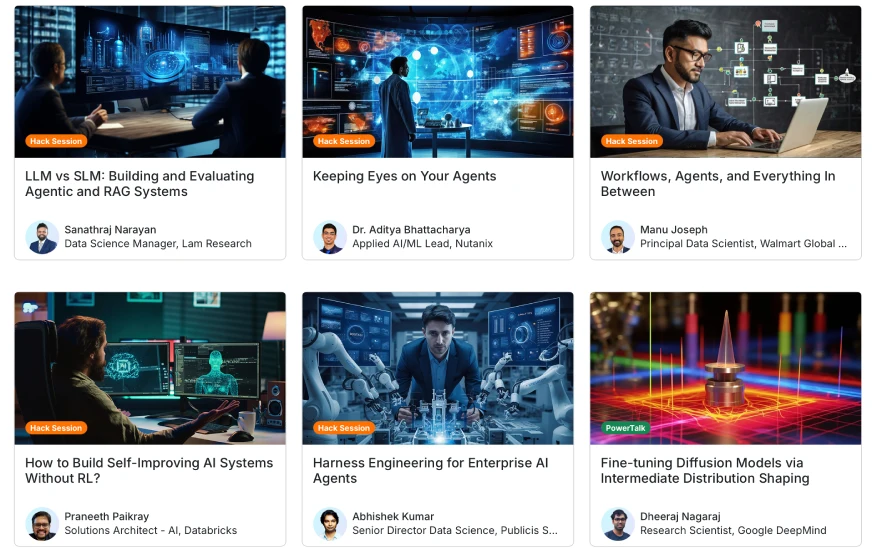
The sessions at DHS 2026 bring together people who are actively building the future of AI, not just talking about it from a distance. The official lineup already includes topics across agentic AI, RAG systems, enterprise AI agents, self-improving AI systems, diffusion models, and real-world AI workflows.
Some of the listed sessions include “LLM vs SLM: Building and Evaluating Agentic and RAG Systems,” “Keeping Eyes on Your Agents,” “Workflows, Agents, and Everything In Between,” “How to Build Self-Improving AI Systems Without RL?” and “Harness Engineering for Enterprise AI Agents.” As you can understand by simply reading the titles, these are not surface-level AI explainers. These sessions help people understand how teams design, test, monitor, and deploy AI systems in real environments.
The lineup also includes a PowerTalk on “Fine-tuning Diffusion Models via Intermediate Distribution Shaping,” which shows that DHS 2026 goes beyond GenAI applications. It also goes into deeper technical areas for those interested in model behaviour, research, and advanced AI development.
In short, the sessions at DHS 2026 give you a direct look at what matters in AI right now: agents, evaluation, RAG, enterprise deployment, multimodal systems, model fine-tuning, and production-ready AI.
Workshops at DHS 2026: Your Ultimate Learning Platform
The workshops at DHS 2026 are for people who want to move beyond watching AI demos and actually build with AI. These are full-day, hands-on sessions where participants work through practical AI systems, tools, and workflows with expert instructors. The focus is clear: learn concepts, apply them during the session, and walk away with skills you can use after the event.
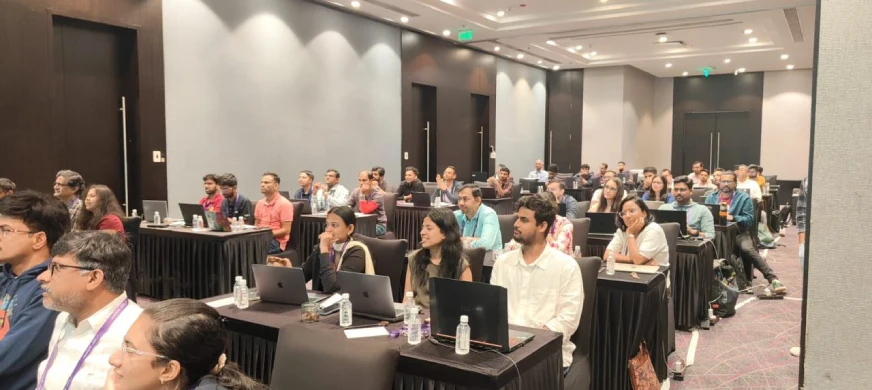
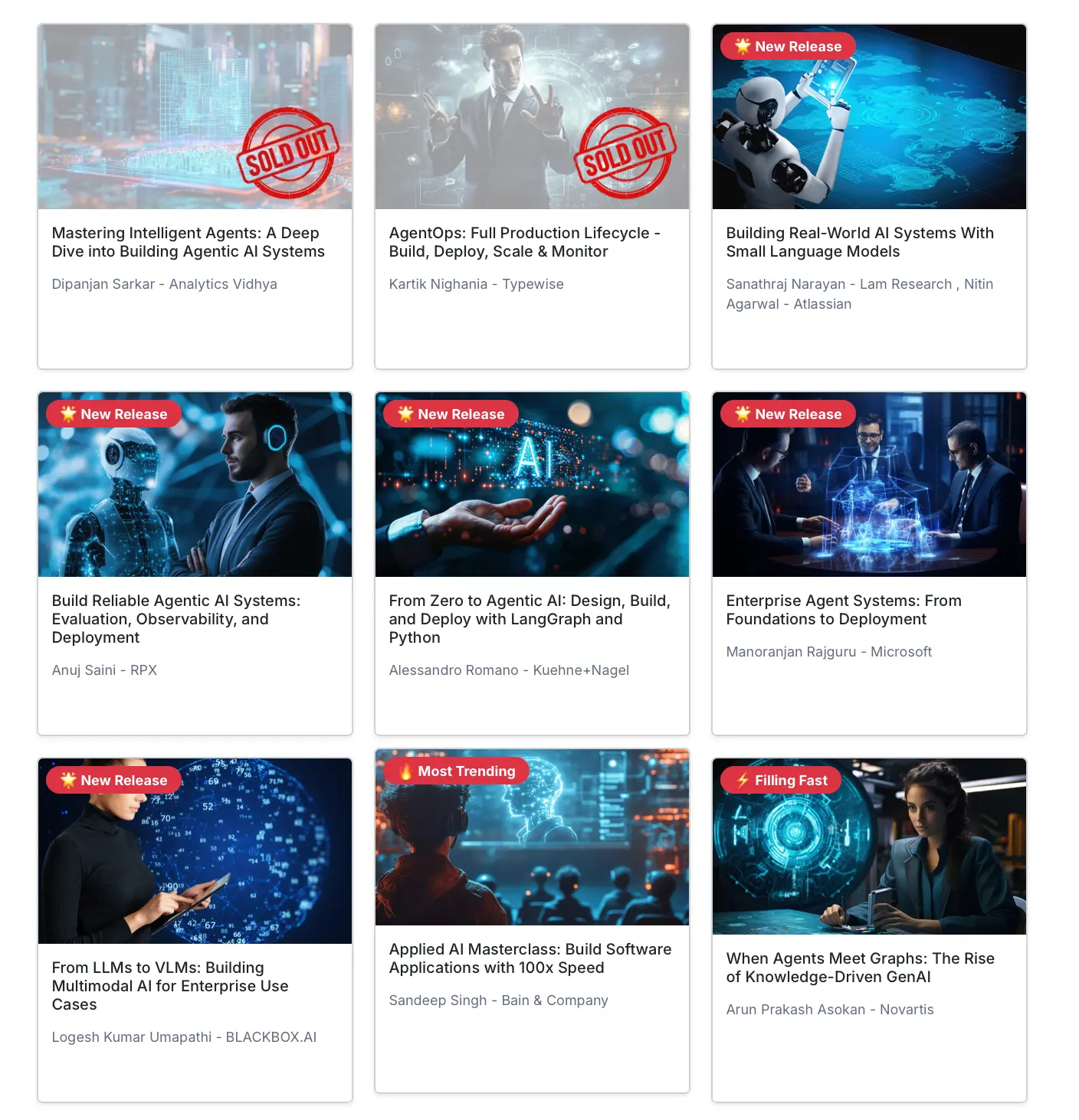
The workshop lineup already covers some of the most important areas in AI today. For example, “From Zero to Agentic AI” focuses on building and deploying an agentic AI application using LangGraph and Python, while “Enterprise Agent Systems” takes learners through enterprise-ready AI agents on Azure. There are also workshops on small language models, AgentOps, reinforcement learning for LLM agents, and production-ready AI systems.
What makes this important is the practical depth. These workshops are not just about understanding what agents, RAG, SLMs, or deployment mean. They are built around actually creating systems, connecting tools, working with external data, managing workflows, and understanding how AI applications move from prototype to production.
So if the sessions tell you where AI is going, the workshops help you build the skills to go there with it.
Meet the Speakers
One of the strongest reasons to attend DHS 2026 is the speaker lineup. The summit brings together AI leaders, researchers, data scientists, engineers, founders, and practitioners from companies and institutions working directly on the future of AI.
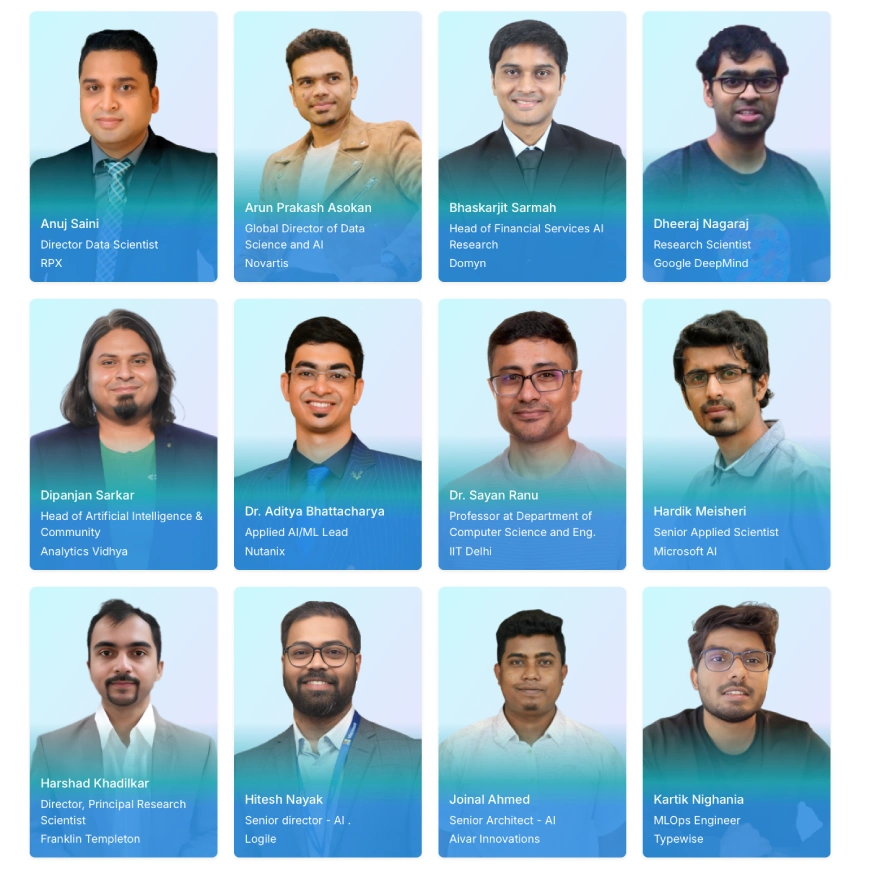
The current speaker lineup includes names from organisations such as Analytics Vidhya, Novartis, Bain & Company, NVIDIA, Atlassian, Franklin Templeton, IIT Delhi, JP Morgan Chase, Udaan, Sigmoid, Lam Research, Kuehne+Nagel, RPX, Typewise, and more. This gives the summit a good mix of enterprise AI, research, applied data science, MLOps, agentic AI, finance AI, and production-grade AI systems.
In simple words, these are not just people who follow AI trends. These are people building models, deploying AI systems, leading AI teams, solving business problems, and shaping how AI helps humans with their everyday lives.
So for attendees, the value is not just in listening to talks. It is in understanding how experienced practitioners think, what problems they are solving, what tools they trust, and what skills they believe will matter next.
Conclusion
AI is moving too fast for anyone to learn it from the sidelines.
At some point, you have to enter the room where the real conversations are happening. DataHack Summit 2026 gives you exactly that room.
DHS 2026 brings together everything shaping the next phase of AI. You get keynotes, sessions, workshops, hack sessions, an AI exhibition, and networking opportunities. You also get the AV Luminary Awards.
The summit brings together people, ideas, tools, and skills in one place. It has something meaningful for every kind of attendee. Beginners can find direction. Data scientists can sharpen their edge. Developers can explore better ways to build AI systems. Business leaders can understand what AI means for their organisations.
More importantly, it gives you context. You get to see which trends are real, which skills are becoming valuable, which tools are worth learning, and how the best minds in the industry are thinking about the future.
So, if you want to stay ahead in AI, do not just read about the change from a distance.
Be where it is being discussed, demonstrated, and built. Book your tickets here.
Be at DataHack Summit 2026.