If you spent any time on GitHub Trending in August, you probably noticed the centre of gravity had shifted again. Models took a back seat to the machinery around them: agent harnesses, skills, memory layers, gateways, and document tooling. One repository alone gained more than 190,000 stars in four weeks.
We tracked star growth, momentum, ecosystem impact, and real-world relevance to identify the 15 repositories that mattered most. In this article, we break down what each project does, why it trended, and who should be paying attention.
Table of contents
- 1. deepseek-ai/deepseek-harness (~204K stars)
- 2. mattpocock/skills (~242K stars)
- 3. openai/codex (~121K stars)
- 4. tt-a1i/archify and cathrynlavery/diagram-design (~43K and ~29K stars)
- 5. DietrichGebert/ponytail (~120K stars)
- 6. firecrawl/anydoc and firecrawl/pdf-inspector (~20K and ~9K+ stars)
- 7. earendil-works/pi (~101K stars)
- 8. diegosouzapw/OmniRoute (~60K stars)
- 9. PrimeIntellect-ai/prime-agent (~20K stars)
- 10. TencentCloud/TencentDB-Agent-Memory (~26K stars)
- Conclusion
- Frequently Asked Questions
1. deepseek-ai/deepseek-harness (~204K stars)

If August 2026 had a single headline, this was it. DeepSeek Harness, or dsh, is DeepSeek AI’s open-source agent harness, and it added roughly 191,000 stars in a single month, including more than 62,000 in one week. Built on an everything-is-a-plugin architecture powered by Cordis and released under the MIT license, the project already has over 14,000 commits and 23,000 forks. A single npx @deepseek-ai/dsh web command starts a local web UI on port 3080, helping explain its rapid adoption. The response reflects growing demand for an open harness from a frontier lab.
One important caveat: The project describes itself as a developer preview, with compatibility-breaking changes expected. Read the repository’s safety notice before running it on anything that matters.
Best For:
- Engineers who want a production-grade agent to harness they can read, fork, and extend
- Teams evaluating plugin-based architectures instead of monolithic agent frameworks
- Anyone tracking how frontier labs are choosing to open up their agent infrastructure
GitHub Repository: https://github.com/deepseek-ai/deepseek-harness
2. mattpocock/skills (~242K stars)

With roughly 242,000 stars, this is the largest repository on the list by total count, while still adding about 45,000 in August. It is Matt Pocock’s working agents directory, a collection of composable agent skills distributed through Claude Code’s official plugin marketplace and the skills.sh installer. The project deliberately avoids process-owning frameworks such as GSD, BMAD, and Spec-Kit, arguing that they reduce control and make failures harder to debug. Skills are split between user-invoked commands like /grill-me and /triage, and model-invoked skills like /tdd, /code-review, and /diagnosing-bugs. More than any other repository here, it shaped how developers’ package and share agent behaviour in 2026.
Best For:
- Developers who want their agent aligned on the requirement before it writes any code
- Teams looking for small, adaptable skills rather than an opinionated end-to-end framework
- Engineers who want to see what a well-structured skills repository looks like
GitHub Repository: https://github.com/mattpocock/skills
3. openai/codex (~121K stars)
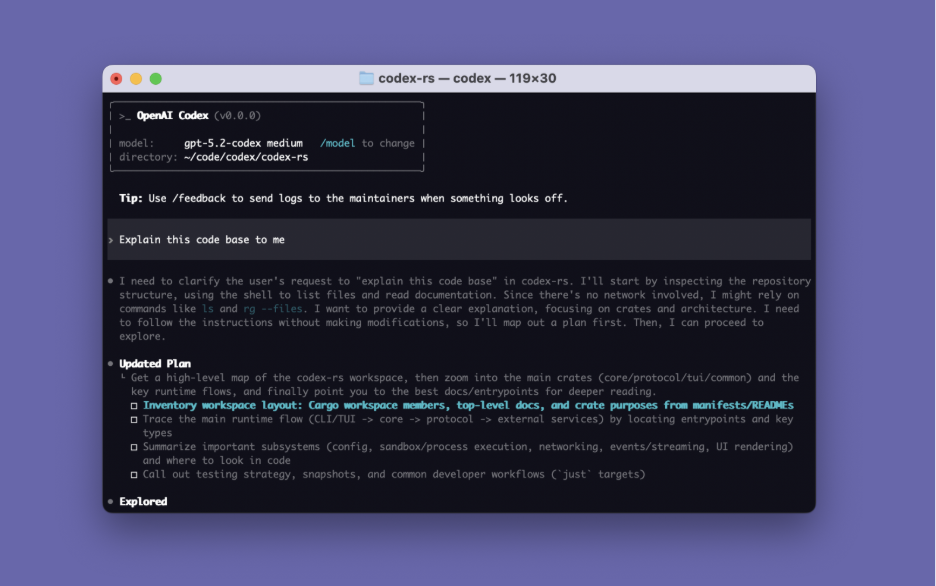
Codex is OpenAI’s lightweight coding agent for the terminal, and it added about 17,500 stars in August. On raw monthly growth alone, it would sit near the bottom half of this list, but that framing is misleading. A mature, widely deployed tool still adding five figures of stars every month is showing sustained adoption rather than a launch spike, and Codex remains the reference point that nearly every other coding agent gets benchmarked against. Several other repositories in this article ship Codex-specific plugins or installers, which is the clearest possible signal of where it sits in the ecosystem.
Best For:
- Developers who prefer a terminal-native agent over an editor-embedded one
- Teams standardising on one coding agent across a mixed toolchain
- Anyone who wants a stable baseline to compare newer agent harnesses against
GitHub Repository: https://github.com/openai/codex
4. tt-a1i/archify and cathrynlavery/diagram-design (~43K and ~29K stars)
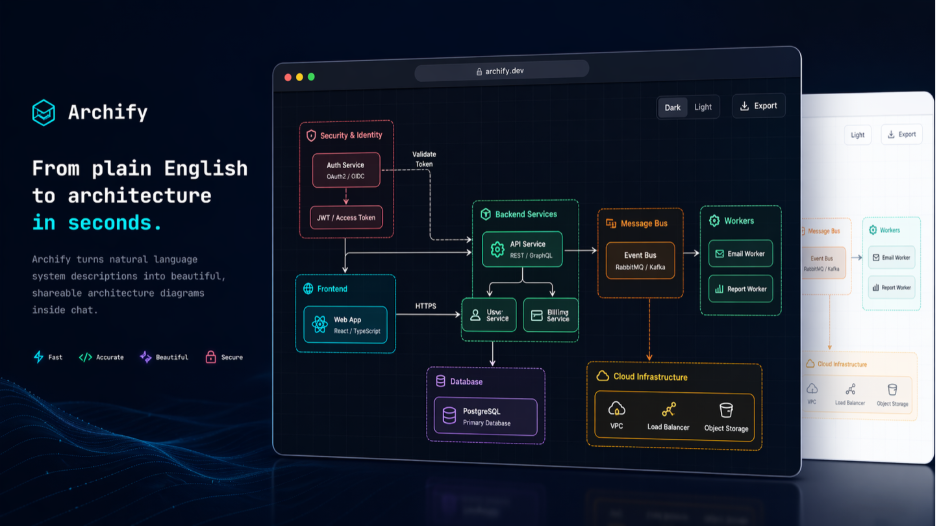
These two are counted as one entry because they are the same story. Both are agent skills that generate diagrams as self-contained HTML and SVG, both launched this year, and between them they gained roughly 56,000 stars in August, the second-strongest momentum on this list. Archify covers architecture, workflow, sequence, dataflow, and lifecycle diagrams with motion and clean export. Diagram-design ships 38 editorial diagram types for Claude Code, Codex, and Pi, and its README is refreshingly blunt about its goal: no shadows, no Mermaid slop. The pair reflects a genuine gap, since agents have been able to write code for years but have been poor at producing a diagram anyone would put in a document.
Worth keeping in perspective: Two near-identical skills trending at the same time is as much a signal of a fast-moving fashion as of durable infrastructure. Treat this as the defining trend of the month rather than a settled category.
Best For:
- Engineers who need architecture diagrams as a by-product of a design conversation
- Technical writers and educators producing explanatory visuals at speed
- Teams tired of Mermaid output that looks like Mermaid output
GitHub Repositories:
https://github.com/tt-a1i/archify | https://github.com/cathrynlavery/diagram-design
5. DietrichGebert/ponytail (~120K stars)

Ponytail is the best-evidenced project on this list. It is an agent skill, MIT licensed and compatible with around 20 agent hosts, that makes a coding agent behave like a senior engineer who deletes more than they add. It works through a seven-rung ladder the agent walks before writing anything: does this need to exist, is it already in the codebase, does the standard library or the platform handle it, is there an installed dependency, can it be one line. The published benchmark runs a headless agent session against a real FastAPI and React repository across twelve feature tickets and reports 54 percent less code, 20 percent lower cost, and 27 percent faster completion with safety guards fully intact. Most notably, the maintainer publicly withdrew an earlier and more flattering 80 to 94 percent claim after a contributor pointed out the baseline was unfair, which is rarer and more reassuring than any headline number.
Best For:
- Teams whose agents habitually install a library for something the browser already does
- Engineering leads trying to measure and control the cost of AI-assisted development
- Anyone who wants agent tooling that publishes its methodology and corrects itself
GitHub Repository: https://github.com/DietrichGebert/ponytail
6. firecrawl/anydoc and firecrawl/pdf-inspector (~20K and ~9K+ stars)
Firecrawl shipped two halves of the same problem and both trended, adding around 34,600 stars between them in August. Anydoc converts Word, PowerPoint, Excel, OpenDocument, RTF, EPUB, CSV, and PDF files into clean Markdown, written in Rust with Node.js and Python bindings. Pdf-inspector handles the harder question of whether a PDF needs optical character recognition at all, classifying documents as text-based, scanned, image-based, or mixed in 10 to 50 milliseconds and extracting position-aware Markdown without OCR. It was built on the observation that roughly 54 percent of PDFs never needed OCR in the first place, and it publishes a benchmark against liteparse, opendataloader, pymupdf4llm, and markitdown on a 200-document corpus. This is unglamorous plumbing, and it is exactly the kind of repository that quietly ends up inside a great many production pipelines.
Best For:
- Teams paying for OCR on documents that already contain extractable text
- Developers building retrieval pipelines that need reliable Markdown from messy inputs
- Engineers who want a local, dependency-light parser instead of a hosted document API
GitHub Repositories: https://github.com/firecrawl/anydoc | https://github.com/firecrawl/pdf-inspector
7. earendil-works/pi (~101K stars)
Pi is an agent toolkit that bundles a unified LLM API, an agent loop, a terminal UI, and a coding agent CLI, and it added about 18,500 stars in August. Its placement here owes less to its own growth than to a pattern visible across the rest of this list: other trending repositories ship Pi-specific extensions and installers alongside their Claude Code and Codex support. When independent projects start treating something as a first-class host worth targeting, it has stopped being a tool and started being a platform, and that is a more durable signal than a month of stars.
Best For:
- Developers who want one interface across providers rather than per-vendor SDKs
- Teams building custom agents who would rather not write the agent loop themselves
- Anyone choosing a harness that third-party skills already support
GitHub Repository: https://github.com/earendil-works/pi
8. diegosouzapw/OmniRoute (~60K stars)
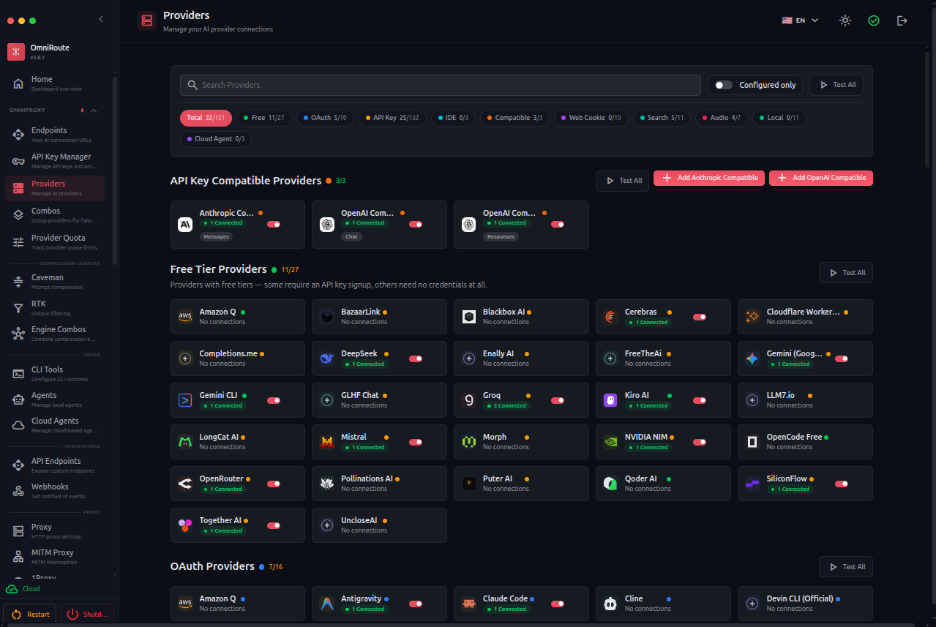
OmniRoute is an MIT-licensed AI gateway that collapses many providers into a single endpoint, and it added roughly 23,200 stars in August. It advertises 352 providers and more than 1,200 models, over 150 of them free, and works with Claude Code, Codex, Cursor, OpenCode, Cline, and Copilot. On top of routing, it adds quota-aware automatic fallback, prompt compression the project claims save between 15 and 95 percent of tokens, MCP and A2A support, and desktop and PWA clients, with more than 550 contributors credited. It is genuinely useful infrastructure that solves a real cost and lock-in problem, though it sits in the convenience category rather than the breakthrough one, and its claims are the most marketing-forward on this list.
Best For:
- Developers juggling API keys across several providers and agent tools
- Teams trying to cut token spend through compression and smarter fallback
- Anyone who wants a single switchable endpoint in front of a volatile model market
GitHub Repository: https://github.com/diegosouzapw/OmniRoute
9. PrimeIntellect-ai/prime-agent (~20K stars)
Prime Agent is a self-improving RLM agent aimed at coding workflows and long-running autonomous tasks, from a lab already known for its work on decentralised training. Almost its entire star count arrived in August, which makes it the clearest example of a category that showed up repeatedly this month: repositories that went from nothing to roughly 20,000 stars in four weeks. Research significance here is high and real-world adoption is still unproven, which is precisely why it belongs on a watchlist rather than in a production stack.
Best For:
- Researchers and engineers interested in self-improving agent loops
- Teams experimenting with long-horizon autonomous tasks rather than single-turn assistance
- Anyone who wants an early look at where agent architectures are heading next
GitHub Repository: https://github.com/PrimeIntellect-ai/prime-agent
10. TencentCloud/TencentDB-Agent-Memory (~26K stars)
This one addresses a problem that almost every team running agents has hit and almost nobody has solved cleanly. TencentDB Agent Memory is a team-level memory hub that turns conversations, documents, and code into four reusable assets: Chat Memory, Skill, LLM-Wiki, and Code-Graph, each governed and shareable across agents and frameworks. It added about 15,600 stars in August. Agent memory is genuinely unsolved territory, and major-cloud backing means this particular attempt is unlikely to be abandoned in a quarter, which matters more here than it would for a smaller project.
Best For:
- Teams where every agent starts from zero context on every task
- Organisations that need memory to be governed and auditable, not just persistent
- Engineers evaluating shared memory layers across multiple agent frameworks
GitHub Repository: https://github.com/TencentCloud/TencentDB-Agent-Memory
Conclusion
The clearest takeaway from August 2026 is that the interesting work has moved one layer above the model. The top projects are infrastructure for making agents useful: harnesses, skills, gateways, memory, and document parsers. DeepSeek’s open-source harness was the landmark, but the bigger signal is how many projects plug into multiple harnesses. The ecosystem is standardising on the socket, not the appliance.
This list will date quickly. Eight repositories left GitHub’s top twenty in late August, and star counts measure attention, not quality. Use this as a starting point, follow the projects that fit your workflow, and expect the rankings to change next month.
Frequently Asked Questions
Q1. Why is one repository so far ahead of everything else this month?
A. DeepSeek Harness gained roughly 191,000 stars in August, which is more than the next several entries combined. That happens when a frontier lab open-sources core agent infrastructure under a permissive licence and makes it runnable with one command. It reflects pent-up demand for an open harness rather than a claim that the software is several times better than its neighbours on this list.
Q2. What exactly does the star count in each heading mean?
A. The figure in each heading is the repository’s approximate total stars, while the number quoted inside each entry is roughly how many arrived during August 2026. The two are very close for several projects here, including prime-agent and anydoc, because those repositories were created during the month. Star counts move daily, so verify them against GitHub before relying on any specific number.
Q3. Why are the diagram skills and the two Firecrawl libraries counted as single entries?
A. Because in both cases the pair tells one story. Archify and diagram-design are competing implementations of the same idea and trended together; anydoc and pdf-inspector are two halves of the same document pipeline from the same team. Listing them separately would have padded the ranking and obscured the trend each pair represents.
Data Analyst with over 2 years of experience in leveraging data insights to drive informed decisions. Passionate about solving complex problems and exploring new trends in analytics. When not diving deep into data, I enjoy playing chess, singing, and writing shayari.