
We live in a world where answers are instant. AI copilots, search engines, short videos, and interactive courses can explain almost anything in minutes. Information is no longer scarce. What is scarce is depth, clarity, and the ability to connect ideas into sound decisions.
That is where books still matter.
In an era of fast content and fragmented learning, well written books offer something most tools cannot. They provide structured thinking, real world context, and the discipline to follow an idea from fundamentals to mastery. For professionals working with data, this depth is critical. Business analytics is not just about tools or dashboards. It is about understanding data, asking the right questions, and translating insights into decisions.
Like any serious discipline, business analytics has a set of foundational books that shape how professionals think and work. In this article, we look at some of the most relevant books that help build strong analytical skills, practical business intuition, and long term career growth.
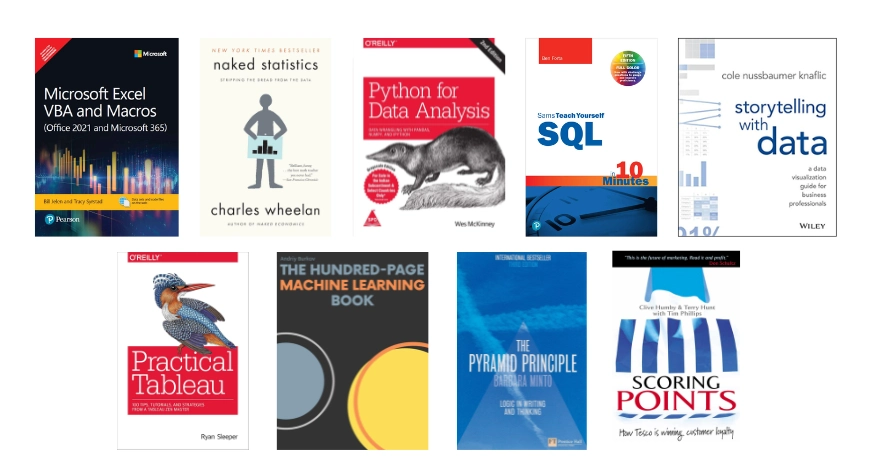
Table of contents
- Microsoft Excel Data Analysis and Business Modeling by Wayne L. Winston
- Naked Statistics: Stripping the Dread from the Data by Charles Wheelan
- Python for Data Analysis: Data Wrangling with Pandas, NumPy, and IPython by Wes McKinney
- SQL in 10 Minutes a Day by Ben Forta
- Storytelling with Data: A Data Visualization Guide for Business Professionals by Cole Nussbaumer Knaflic
- Practical Tableau: 100 Tips, Tutorials, and Strategies from a Tableau by Ryan Sleeper
- The Hundred-Page Machine Learning Book by Andriy Burkov
- The Pyramid Principle: Logic in Writing and Thinking by Barbara Minto
- Conclusion
1. Microsoft Excel Data Analysis and Business Modeling by Wayne L. Winston
Microsoft Excel Data Analysis and Business Modeling (Office 2021 and Microsoft 365) by Wayne Winston is a hands-on, scenario-based guide for mastering business modeling and data analysis using modern Excel features. Updated extensively for Office 2021 and Microsoft 365, it teaches how to ask the right questions, work with data effectively, and produce actionable results using tools like dynamic arrays, Power Query, STOCKHISTORY, and advanced lookup functions. The book includes extensive real-world problems and solutions, showing readers how to transform raw data into insights with techniques such as predictive analytics, Monte Carlo simulation, relational data models, and compelling visualization.
What will you learn?
- Performing data cleaning, preparation, and transformation using modern Excel features
- Applying descriptive statistics and probability concepts to real business problems
- Building robust business models for decision making and scenario analysis
- Using advanced Excel formulas, lookup functions, and dynamic arrays effectively
- Conducting regression analysis and time series forecasting
- Solving optimization problems with Solver and what if analysis
- Running Monte Carlo simulations for risk and uncertainty analysis
- Working with relational data models and Power Query
- Creating insightful charts and dashboards for data driven storytelling
- Translating analytical outputs into actionable business insights
2. Naked Statistics: Stripping the Dread from the Data by
Naked Statistics: Stripping the Dread from the Data by Charles Wheelan takes the mystery out of statistics and turns it into a surprisingly accessible subject. Rather than overwhelming readers with formulas and jargon, the book uses real world examples to explain how statistics works in everyday life. You will see how probabilities shape decisions in politics, business, sports, and risk assessment. The author focuses on intuition and understanding rather than heavy mathematical proofs, making this a great read for beginners and professionals who want to build confidence with data without getting bogged down in technical complexity.
What will you learn?
- Interpret basic statistical concepts such as mean, median, mode, and variance
- Understand probability and its implications for real world events
- Grasp the logic behind sampling and why good samples matter
- Comprehend correlation, causation, and regression in practical terms
- Recognize how statistics influences policy, business decisions, and risk
- Think critically about data presented in media, surveys, and studies
- Build intuition for using statistics rather than memorizing formulas
3. Python for Data Analysis: Data Wrangling with Pandas, NumPy, and IPython by
Python for Data Analysis: Data Wrangling with Pandas, NumPy, and IPython by Wes McKinney is a practical, hands-on guide to using Python for real-world data work. Written by the creator of the pandas library, this book teaches you how to load, clean, transform, analyze, and visualize data using industry-standard tools like pandas, NumPy, IPython, and Jupyter notebooks. It focuses on solving common data tasks with efficient Python code rather than just theory, making it ideal for beginners and experienced analysts alike who want to turn messy data into insights.
What will you learn?
- Use IPython and Jupyter notebooks for interactive, exploratory data work
- Understand and leverage core data structures like pandas Series and DataFrames
- Load and clean data from CSV, Excel, databases, and other sources
- Transform, merge, reshape, and aggregate datasets efficiently
- Perform numerical computing with NumPy arrays
- Create visualizations with matplotlib and integrate them into analysis workflows
- Handle time series and irregular data effectively
- Apply group operations for slicing and summarizing data at scale
4. SQL in 10 Minutes a Day by Ben Forta
SQL in 10 Minutes a Day, Sams Teach Yourself by Ben Forta is a beginner-friendly guide to learning SQL in small, manageable lessons. The book breaks down the essentials of Structured Query Language into short chapters designed to be completed in about ten minutes each, making it ideal for busy learners and self-taught analysts. Starting with basic queries to fetch and filter data, it gradually introduces more advanced concepts like joins, subqueries, and stored procedures in an accessible, hands-on way. This book gives you the foundational skills needed to work confidently with databases across many different systems.
Click here to buy this business analytics book!
What will you learn?
- Understand what SQL is and how relational databases work
- Retrieve and filter data using the SELECT and WHERE clauses
- Sort and organize query results with ORDER BY and GROUP BY
- Use joins to combine related data from multiple tables
- Apply subqueries to solve layered data problems
- Work with data manipulation commands like INSERT, UPDATE, and DELETE
- Create and modify tables and views to structure your data
- Explore advanced topics such as stored procedures, triggers, and constraints
If you want to learn SQL from scratch, checkout this FREE course – SQL Skills for Data Beginners
5. Storytelling with Data: A Data Visualization Guide for Business Professionals by Cole Nussbaumer Knaflic
Storytelling with Data: A Data Visualization Guide for Business Professionals by Cole Nussbaumer Knaflic shows how to turn raw numbers into clear, meaningful visual narratives that influence decisions. Too often data is presented as confusing charts that don’t communicate insight. This book outlines how to think beyond spreadsheet outputs and focus on connection and clarity. It teaches how to choose the right visuals, remove clutter, and design for impact so your audience understands not just what the data shows but why it matters. Its practical framework makes data communication accessible for analysts, managers, and communicators alike.
Click here to buy this business analytics book!
What will you learn?
- Understand the context and audience before designing visuals
- Choose the most effective chart or graphic for your message
- Remove visual clutter to keep attention focused on insight
- Direct your audience’s attention to key data points
- Apply basic design thinking to data visualization
- Craft a narrative arc around your data rather than just showing numbers
- Use practical tips and examples to build persuasive, impactful presentations
Must Check: Building Data Stories using Excel and Tableau
6. Practical Tableau: 100 Tips, Tutorials, and Strategies from a Tableau by Ryan Sleeper
Practical Tableau: 100 Tips, Tutorials, and Strategies from a Tableau Zen Master by Ryan Sleeper is a deep, practical guide for anyone who wants to go beyond basic dashboards and build high-impact Tableau visualizations. Sleeper, a recognized Tableau expert, shares a wide range of techniques that help you think like a data storyteller and solution designer. Through structured tips, step-by-step tutorials, and real examples, the book teaches how to design effective visuals, optimize workbook performance, and use Tableau features with purpose. It is ideal for analysts who want to elevate their Tableau skills with professional best practices and advanced strategies.
What will you learn?
- Build dashboards that communicate insight clearly and effectively
- Use a wide variety of chart types and know when to apply them
- Leverage parameters, filters, and calculated fields to create interactive analyses
- Apply the INSIGHT framework to structure your analytics workflows
- Design visuals with color and layout best practices in mind
- Optimize workbooks for performance and scalability
- Tell compelling data stories with sequence and emphasis
7. The Hundred-Page Machine Learning Book by Andriy Burkov
The Hundred-Page Machine Learning Book by Andriy Burkov is a compact yet thorough guide that demystifies machine learning without overwhelming readers with unnecessary detail. It delivers a structured overview of core ML concepts, algorithms, and practical considerations in around 100 pages, making it ideal for professionals and students alike who want to grasp the essentials quickly. The author focuses on clarity and practical understanding so you can learn how machine learning works, what problems it solves, and how key techniques fit together. This makes the book a valuable reference and starting point for anyone looking to build or deepen ML skills.
Click here to buy this business analytics book!
What will you learn?
- Understand what machine learning is and how it differs from traditional programming
- Distinguish between supervised, unsupervised, and reinforcement learning
- Apply fundamental algorithms such as linear regression, logistic regression, decision trees, and support vector machines
- Use gradient descent and optimization techniques to train models
- Engineer, preprocess, and select features to enhance model performance
- Evaluate models using metrics, cross-validation, and performance measures
- Explore neural networks, deep learning, and ensemble methods like boosting and random forests
- Understand practical aspects like overfitting, underfitting, and model selection
Getting started with ML? Here’s a FREE guide on Introduction to AI and ML.
8. The Pyramid Principle: Logic in Writing and Thinking by Barbara Minto
The Pyramid Principle: Logic In Writing And Thinking, 3/E by Barbara Minto is a classic guide to clear, impactful communication in business and beyond. Instead of letting ideas remain scattered, this book teaches you to organise your thinking into a structured, hierarchical format so your audience can grasp your point fast. The core idea is to start with a clear conclusion, supported by logically grouped arguments underneath, then detail the evidence or rationale for each point. This approach helps you write reports, emails, and presentations that are easier to understand and harder to ignore, especially when communicating with busy decision-makers.
What will you learn?
- Present your main message first so your audience understands the conclusion up front
- Organise supporting ideas into a clear hierarchical structure that reflects logical relationships
- Group related points effectively to avoid confusion and redundancy
- Use the pyramid structure to improve both written and verbal communication
- Apply different logical ordering methods, such as chronological, structural, and importance order
- Think more clearly about a problem before writing about it
- Build arguments that are persuasive and easy for others to follow
9. Scoring Points: How Tesco Continues to Win Customer Loyalty by Terry Hunt
Published by Kogan Page, Scoring Points: How Tesco Continues to Win Customer Loyalty tells the inside story of how Tesco created one of the world’s most successful customer loyalty programmes. The book goes beyond theory to show how Tesco collected and analysed millions of customer transactions to build the Clubcard, a system that transformed its relationship with customers and helped the company grow into a dominant global retailer. It combines real case examples with the strategic thinking behind targeted marketing and data-driven decision making, making it useful for anyone interested in how analytics and loyalty intersect in the real world.
What will you learn?
- Understand the strategic purpose behind customer loyalty programmes and why many fail while some succeed
- Analyse large-scale transactional data to uncover customer behaviour patterns
- Segment customers using data insights to tailor offers and engagement
- Design loyalty schemes that reward and retain high-value customers
- Use data to influence pricing, promotions, and inventory decisions
- Align loyalty strategy with broader business goals for sustainable growth
- Translate customer insight into competitive advantage in retail and beyond
Conclusion
In analytics, tools will keep evolving, but strong fundamentals do not. The concepts covered in this article come from experts who have applied data analysis to real business problems, not just theoretical use cases. Learning how these practitioners think helps you build clarity, structure, and better decision making skills.
If you want to move from understanding concepts to applying them, our free Data Analyst course is a great place to start. It is designed to help you work with real data, learn practical techniques, and build confidence in core analytics skills.
Good tools help. Clear thinking makes the difference.
Hello, I am Nitika, a tech-savvy Content Creator and Marketer. Creativity and learning new things come naturally to me. I have expertise in creating result-driven content strategies. I am well versed in SEO Management, Keyword Operations, Web Content Writing, Communication, Content Strategy, Editing, and Writing.





Nice one, thanks for sharing the resources.
Thanks for sharing resources. This is great!