My main complaint with AI solutions is that they are largely dependent on my presence for any task. Even with agentic AI now in the mix, complete automation of any complex process still seems like a myth. Tools like n8n and make.com need a considerable setup time and do not really function as conventional AI chatbots. OpenClaw requires specific installation steps before it can begin. And then comes Claude with its Cowork, a promising chatbot-type AI delegation. But the most interesting addition in this area is the new Claude Dispatch, which looks quite close to the type of automation I always wished for.
Imagine giving a prompt and your AI taking over your computer to complete the task for you. Not just ‘help me think’, not just ‘draft this email’, but ‘take this task, use my computer, and come back with the work done.’ That is the exact kind of AI automation that Claude is promising with Cowork.
Now imagine sending this single prompt from your phone. That is the power of Claude Cowork + Dispatch. In this article, we’ll explore what these features are, how they work, and where they add value.
Table of contents
What is Claude Dispatch?
In the most basic terms, Dispatch is Claude’s latest ability that works with its Cowork and Code platforms. Dispatch is a way to connect the Claude app on your phone with the Claude app on your system. So the next time you are away from your computer and need something done, simply instruct Claude on your phone, and it will perform that task on your computer. All without you even being in the room.
Here is how it works:
- You assign a task to Claude with a prompt through your phone
- It performs the task on your computer, completely on its own
- It returns the final result to your phone.
That, right there, is how the new Claude Dispatch on Cowork functions. Now, to put this into perspective, imagine instructing Claude to make a presentation based on specific files on your system, even before you begin your drive to work. By the time you reach the office, your system will have the final presentation ready.
A total game-changer, isn’t it?
Dispatch works on Cowork as well as Claude Code. For those unaware, Cowork is yet another feature of Claude that lets AI take over your computer for any task that you assign it. You can read all about it here. Claude Code, on the other hand, is the AI coding assistant by Claude. Know more about it here.
The Dispatch is nothing more than a gateway connecting the Claude on your system and your phone.
Think – a remote control for your computer.
Now that we know the basic steps involved in its working, let’s dive a little deeper on what happens behind the scenes.
Claude Dispatch: How it Works
Above, I shared the basic steps in which Claude Dispatch works. There are some nuances that are taken care of at the backend. Here is what happens:
When you assign a task, Claude figures out what kind of work it actually is and then routes it accordingly. If it is a development-related task, it runs in Claude Code. If it is more of a research, document, or desktop workflow task, it runs in Cowork. These sessions then show up in their respective sidebars, so you can check in if you want details.
But the real beauty of this entire process is that you do not have to sit there and micro-manage Claude. Instead of making you monitor every click and action, Claude simply comes back with the end result. That result could be a memo, a spreadsheet, a comparison table, or even a pull request. And if something important needs your approval, Claude sends a notification to your phone. So, you can be assured that no task gets stuck at any point.
A notable feature here is that instead of creating a brand-new session for every task, Claude gives you a single persistent thread. In simple words, the conversation does not keep forgetting what you were doing. Claude retains the context of your previous tasks, which means you can continue work from where you left off instead of repeatedly briefing it like a new intern every time.
So, say you message Claude from your phone while commuting. Later, when you sit at your desk, you can open the same conversation on your desktop and continue from that exact point. Same thread, same context, no unnecessary reset.
Now that you know how it works, here is how to access it.
Also read: Claude Skills Explained: Use Custom Skills on Claude Code
Claude Cowork Dispatch: Requirements and Access
There is a very brief list of requirements for Claude’s latest function to work properly across devices. You can check it out here:
- Install the latest version of the Claude Desktop app on your computer. It currently works on macOS and Windows x64.
- Keep your computer awake and the Claude Desktop app open, since Claude performs the task through your system.
- Install the latest version of the Claude mobile app on your phone.
- If you already use the Claude mobile app, update it to the newest version before trying Dispatch.
- Make sure you are on a Claude Pro or Max plan, since the feature is not available on lower tiers.
- Ensure that both your phone and your computer have an active internet connection, or the workflow will not function properly.
An important note here – Cowork (including Dispatch) is currently a research preview, and Anthropic hasn’t published specific credit or usage limits for it. From what I could find, usage draws from your existing Claude plan (Pro, Max, or Team), and there is no separate credit pool or documented cap specific to Dispatch tasks.
If you’re on Pro or Max and hitting a wall, it’s more likely to be Claude’s general message/usage limits than a Dispatch-specific one.
Once you make sure you meet these requirements, let’s move on to the setup.
Claude Dispatch: How to Set Up
Here are the easy-to-follow steps to set up Dispatch on your system and phone.
- Download or update Claude Desktop on your computer before starting the setup.
- Download or update the Claude app on your iPhone or Android phone as well.
- Open Cowork from either your desktop or your phone.
- In the left-side panel, click on “Dispatch.”
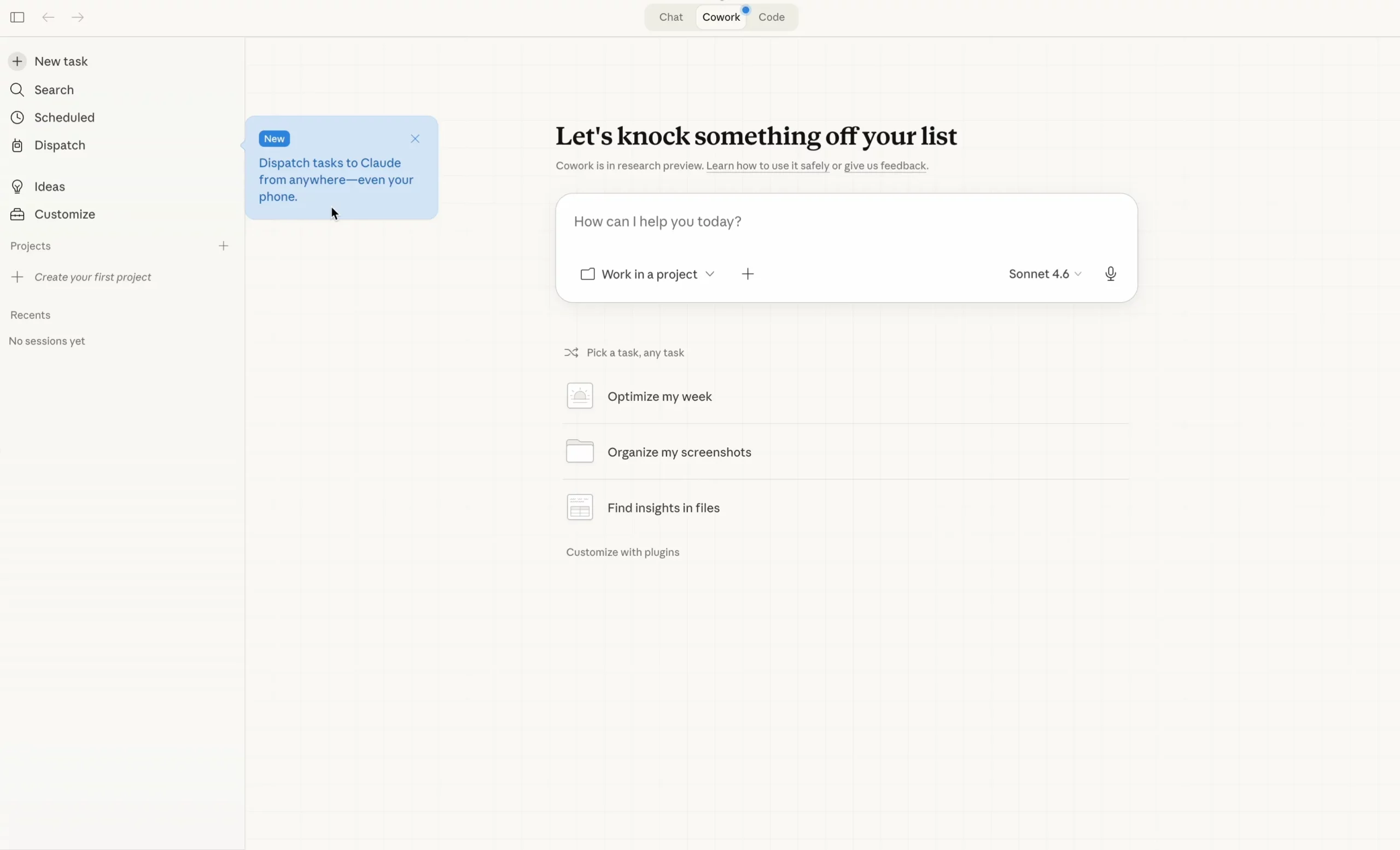
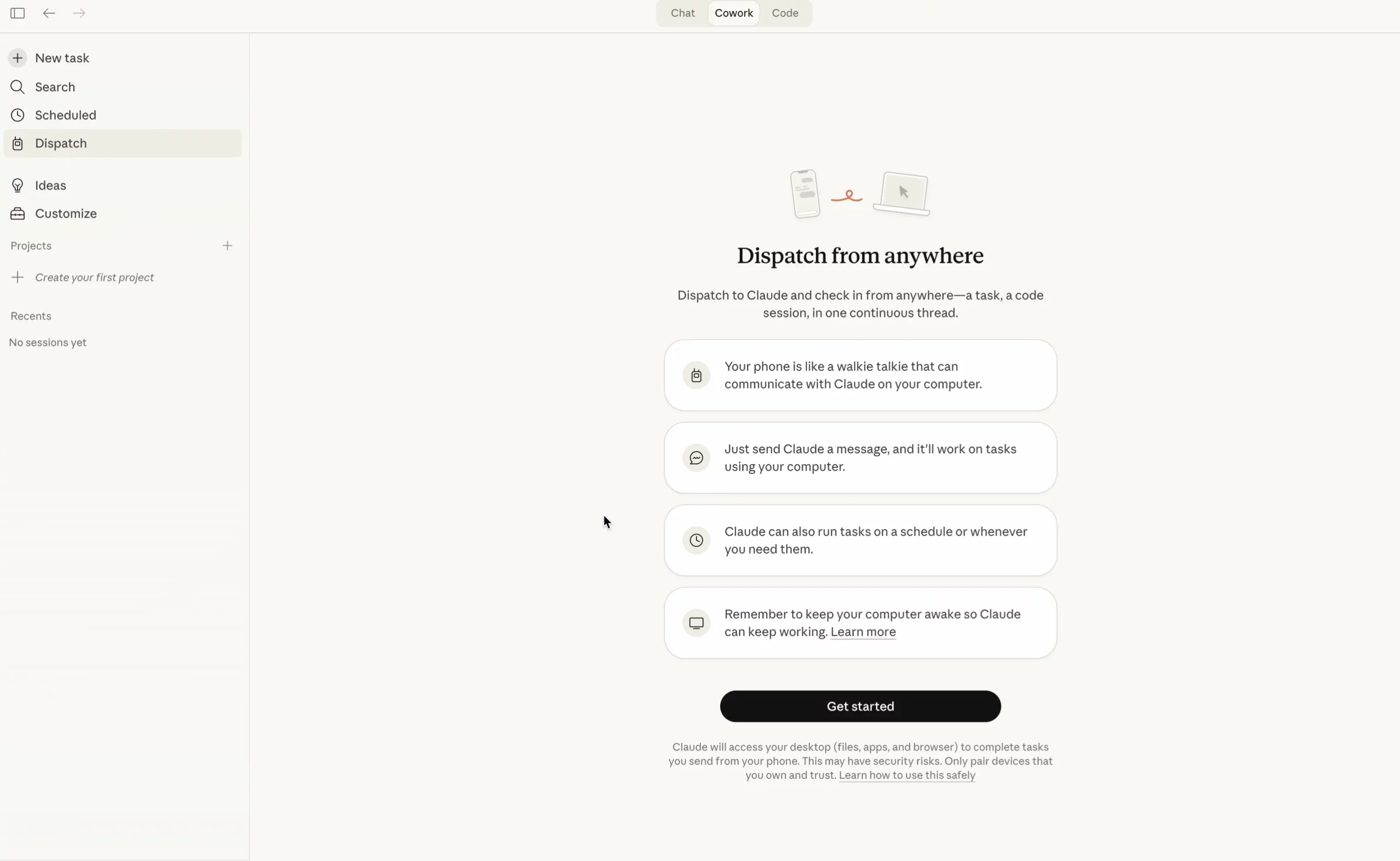
- Claude will first show you a page explaining what Dispatch does. From there, click “Get started.”
- On the next screen, grant Claude access to your files and enable the option to keep your computer awake, if prompted.
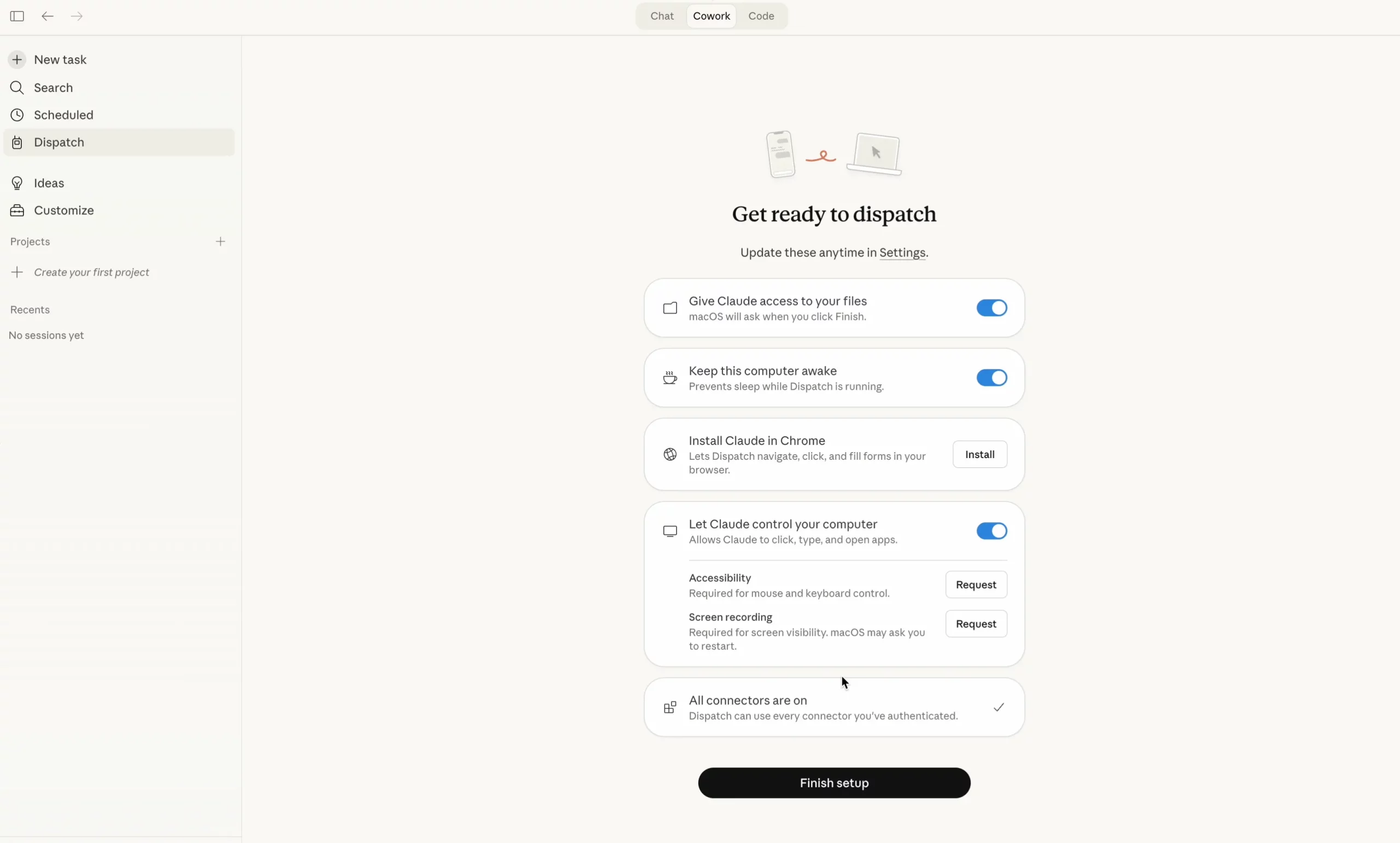
- Once that is done, click “Finish setup.”
- After setup is complete, start chatting with Claude directly inside the Dispatch section.
- From that point onward, your continuous conversation syncs automatically across both your phone and desktop.
Once set up, I used it to perform a basic function on my computer to test its abilities. Here is how it went:
Trying Out Claude Dispatch
Once I had set it up across my Mac and phone, I was overly optimistic while using Claude Dispatch. And for good reasons. It is seldom that you see an AI that will take over your system and complete your tasks for you, just with a prompt through a phone. So, in the anticipate to see it in action, I kept the task minimal, so as to see whether the cross-platform agentic AI operations even worked or not.
Here is the task that I assigned to Claude through Dispatch:
The idea was to find some files in a particular folder on my system, open them one by one, and then extract the key points from each of them. These files were research papers with quite a large volume of data on each. Had I done it on my own, even if using AI, this was an easy 15-30-minute task. With Dispatch, I simply wrote a prompt and went for lunch.
I used a series of prompts to guide Claude through the process. Here is how it underwent:
1. Prompt:
Find the folder “eVTOLs” on my system and list all the files inside it
Output:
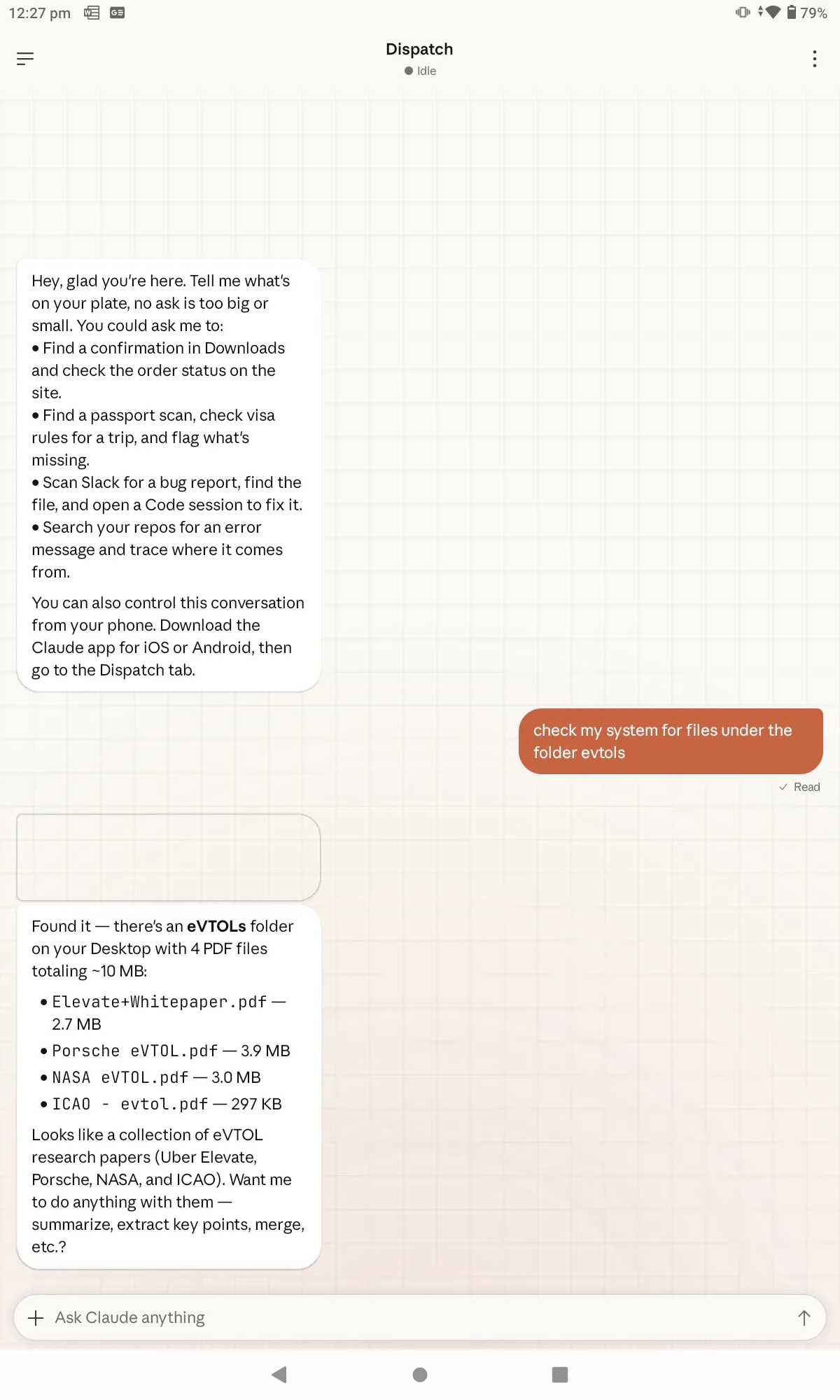
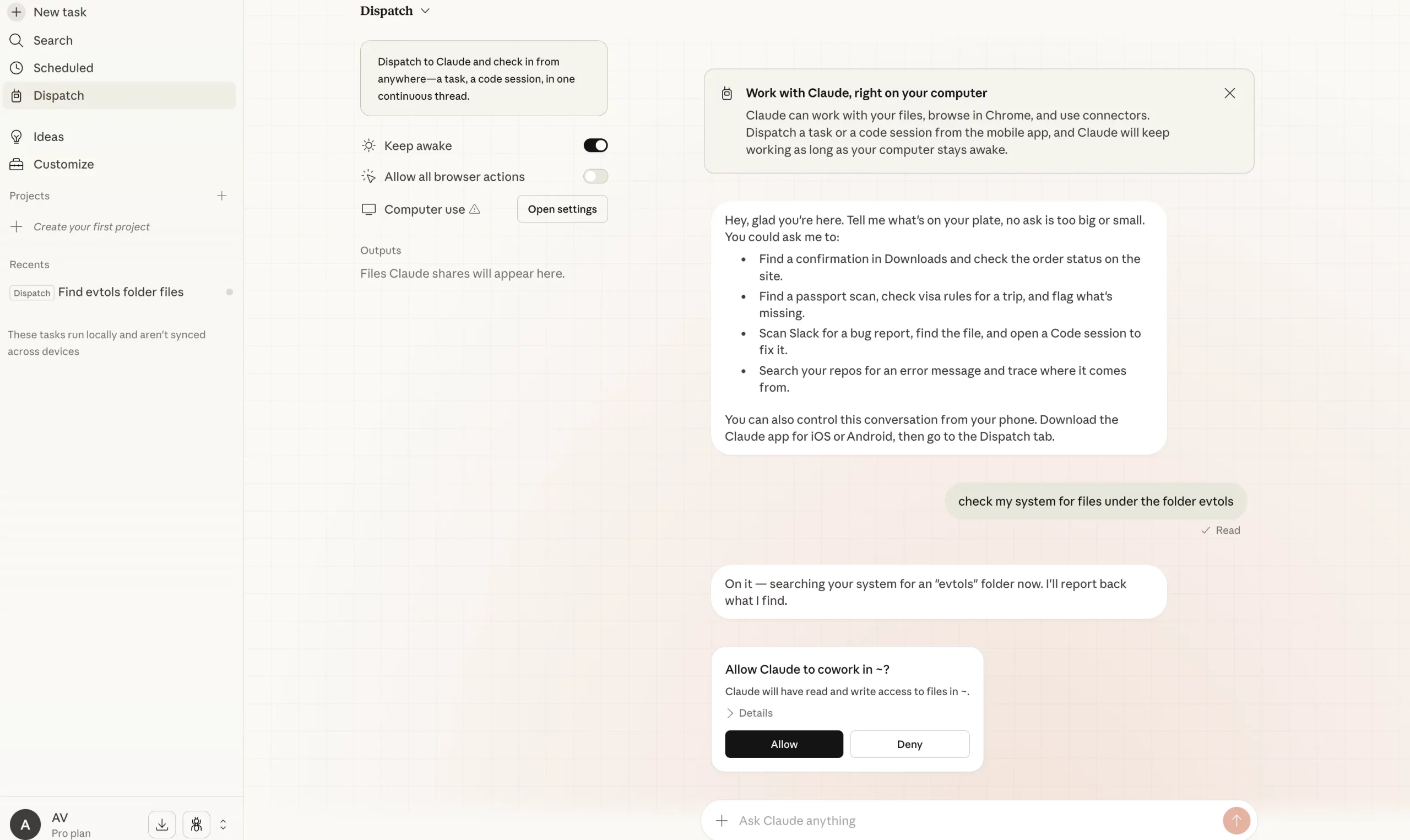
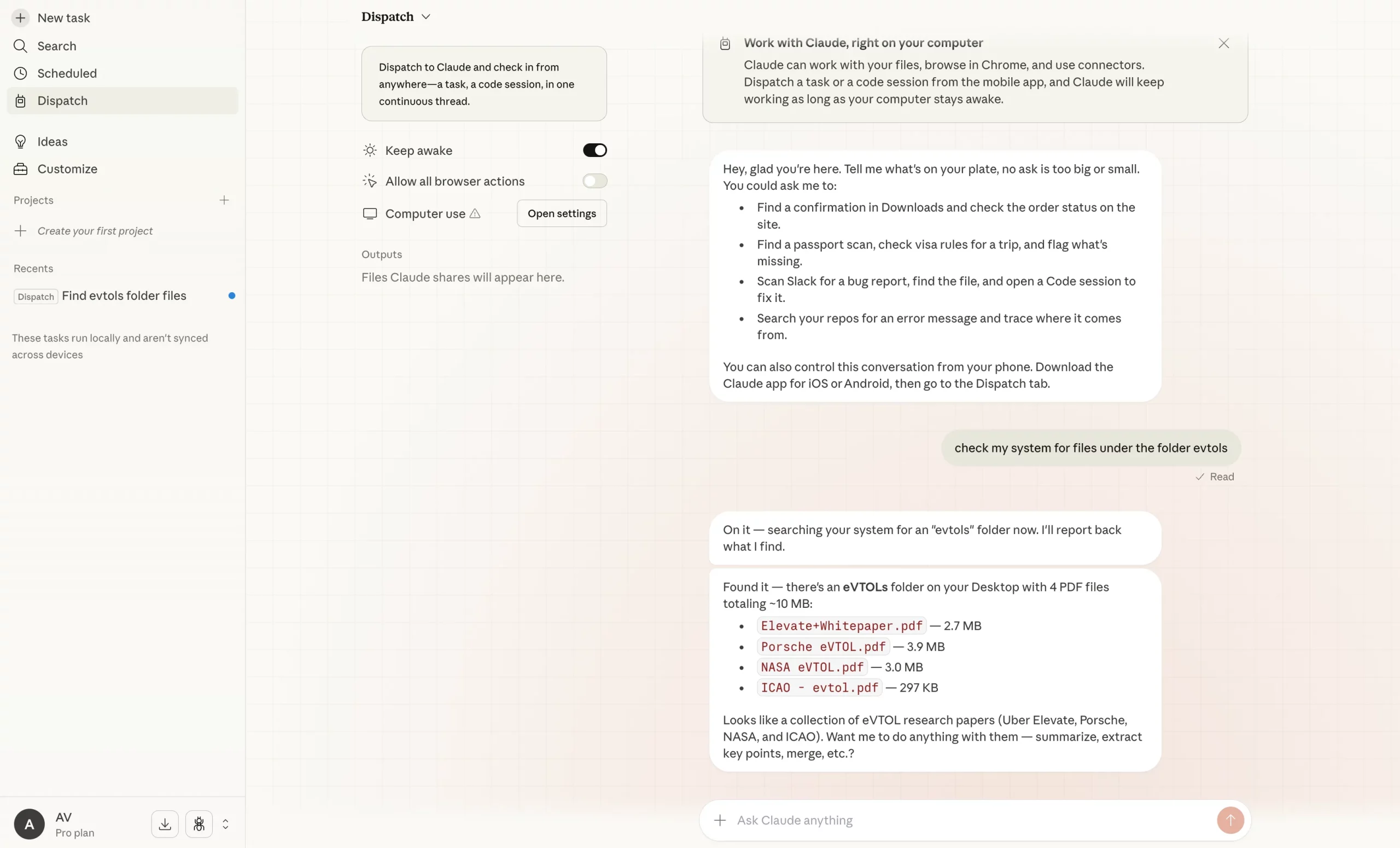
This was my first experience with remote agentic AI in action, and it was equal parts surprising and exciting. After some access permissions, which I could approve through my phone itself, Claude got into action and was easily able to locate the files within a folder.
That was stage 1 complete. From thereon, I knew it wouldn’t disappoint with the next step:
2. Prompt:
Go through these files and extract the key points from each of them. Make a document listing all these key points, categorised as per source
Output:
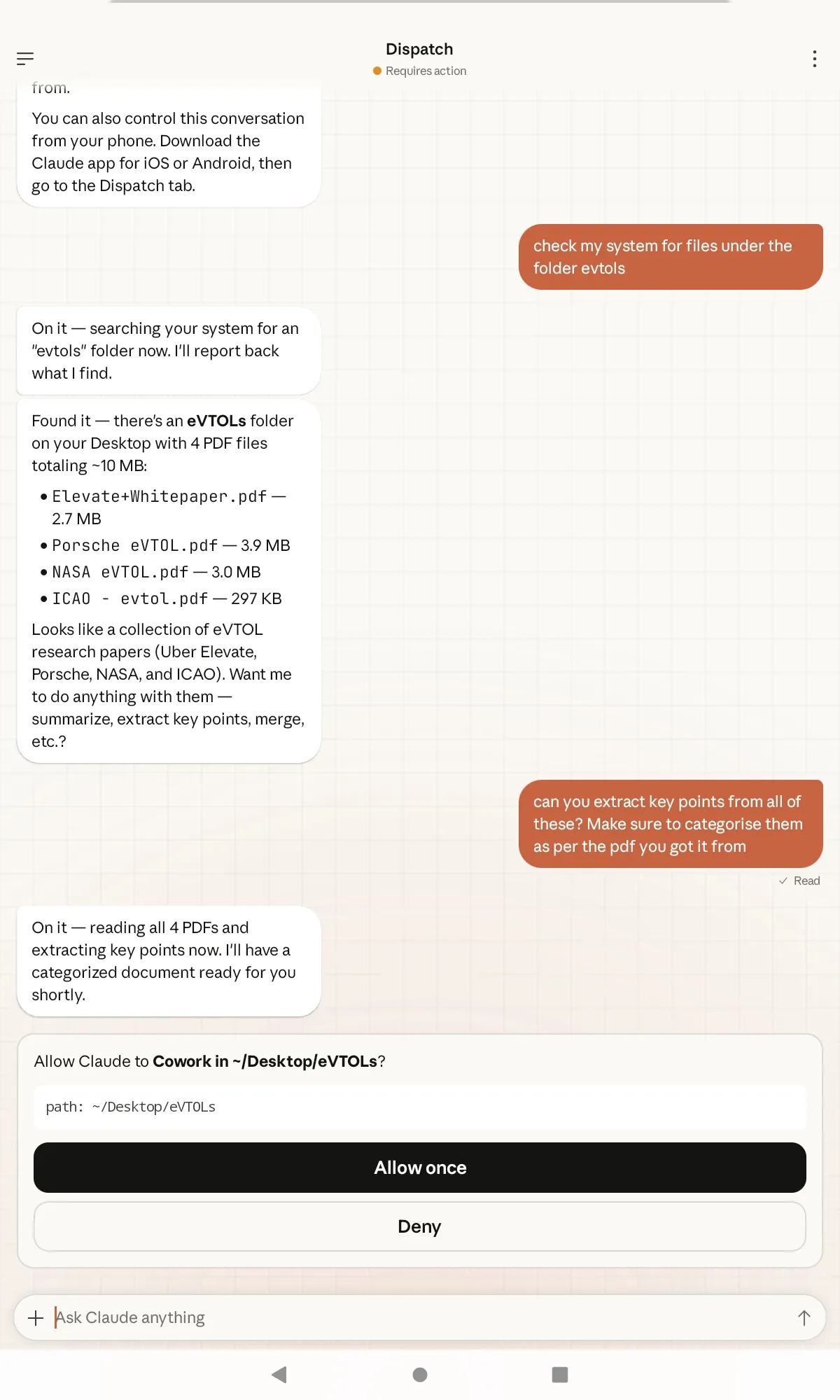
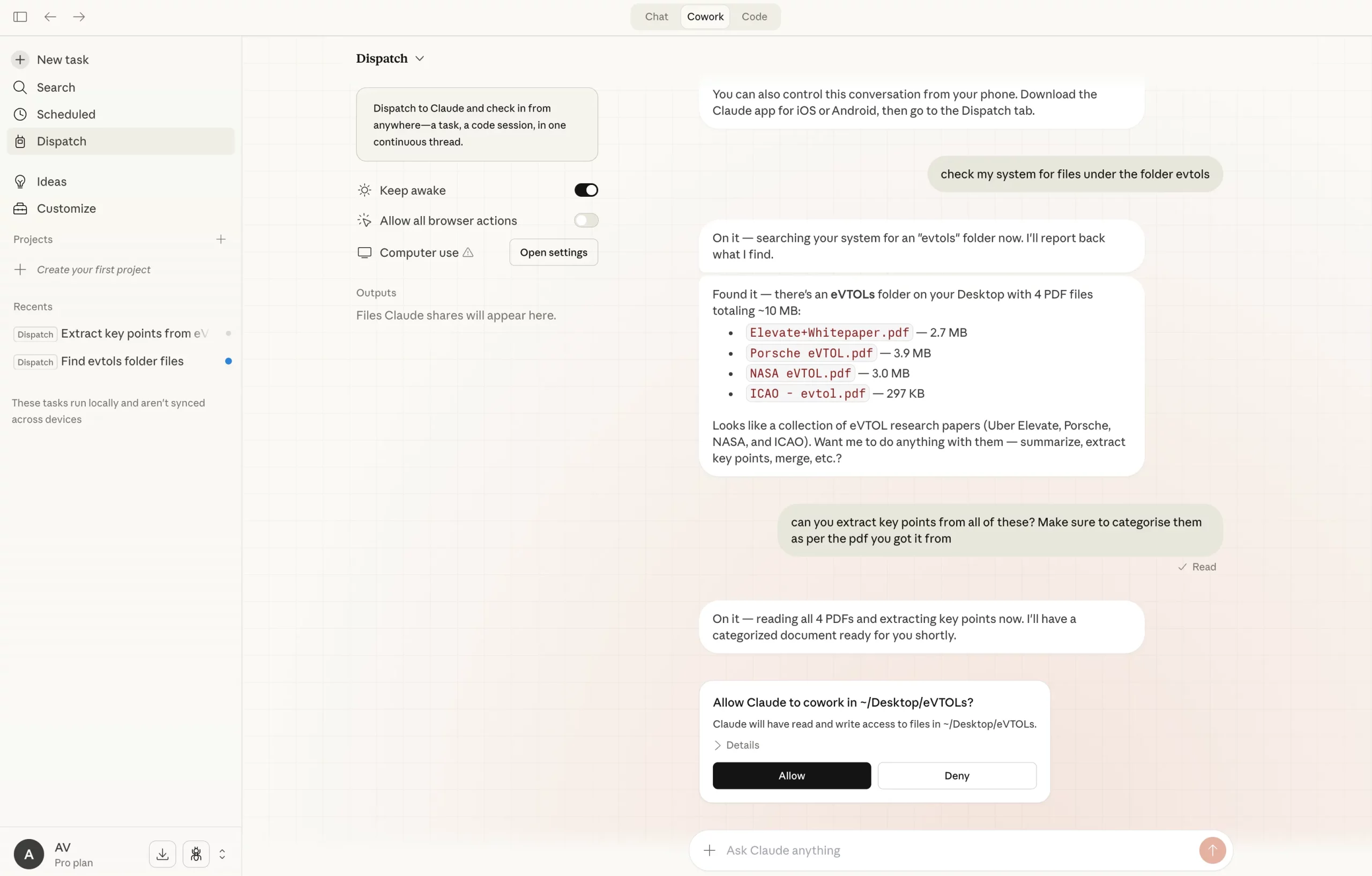
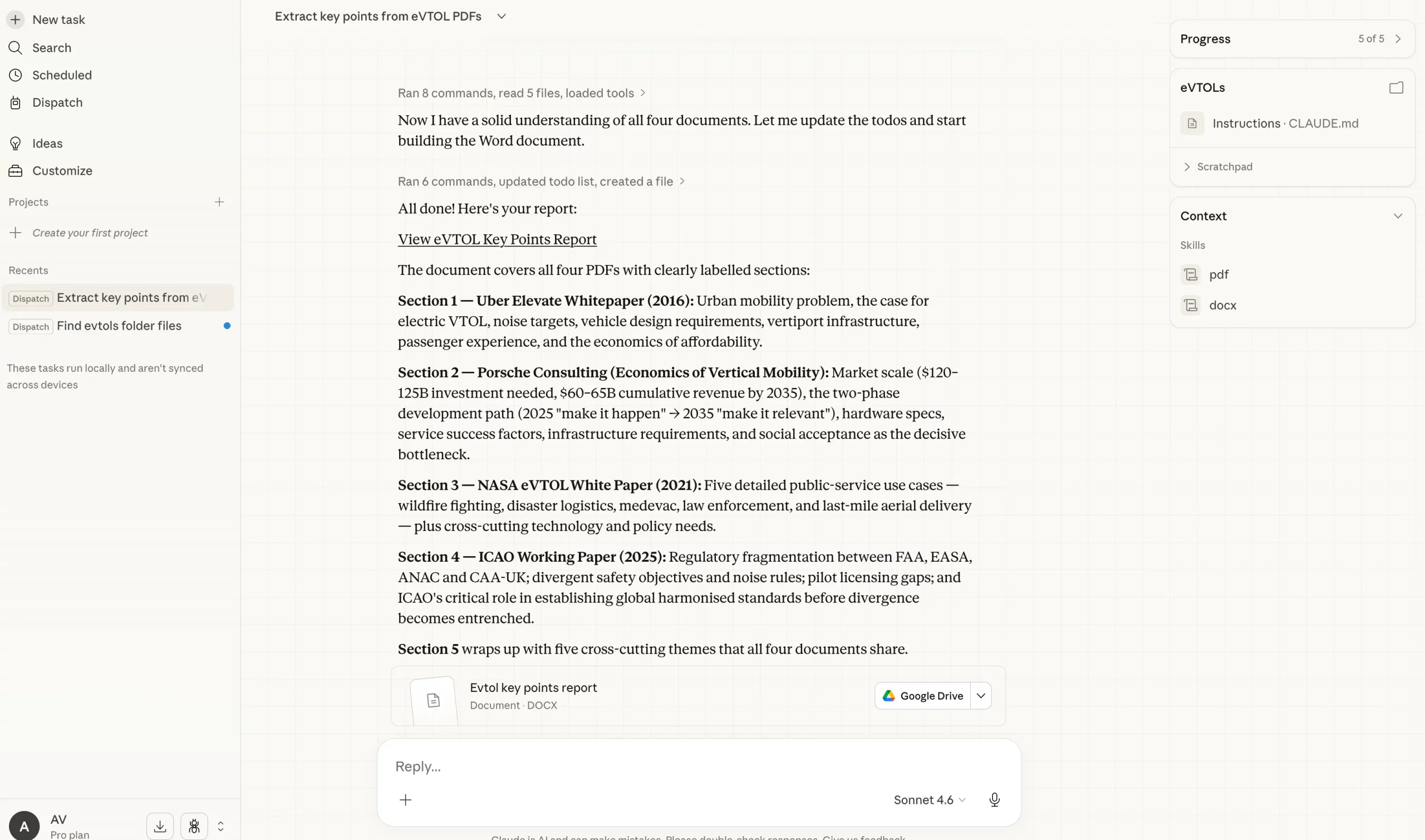
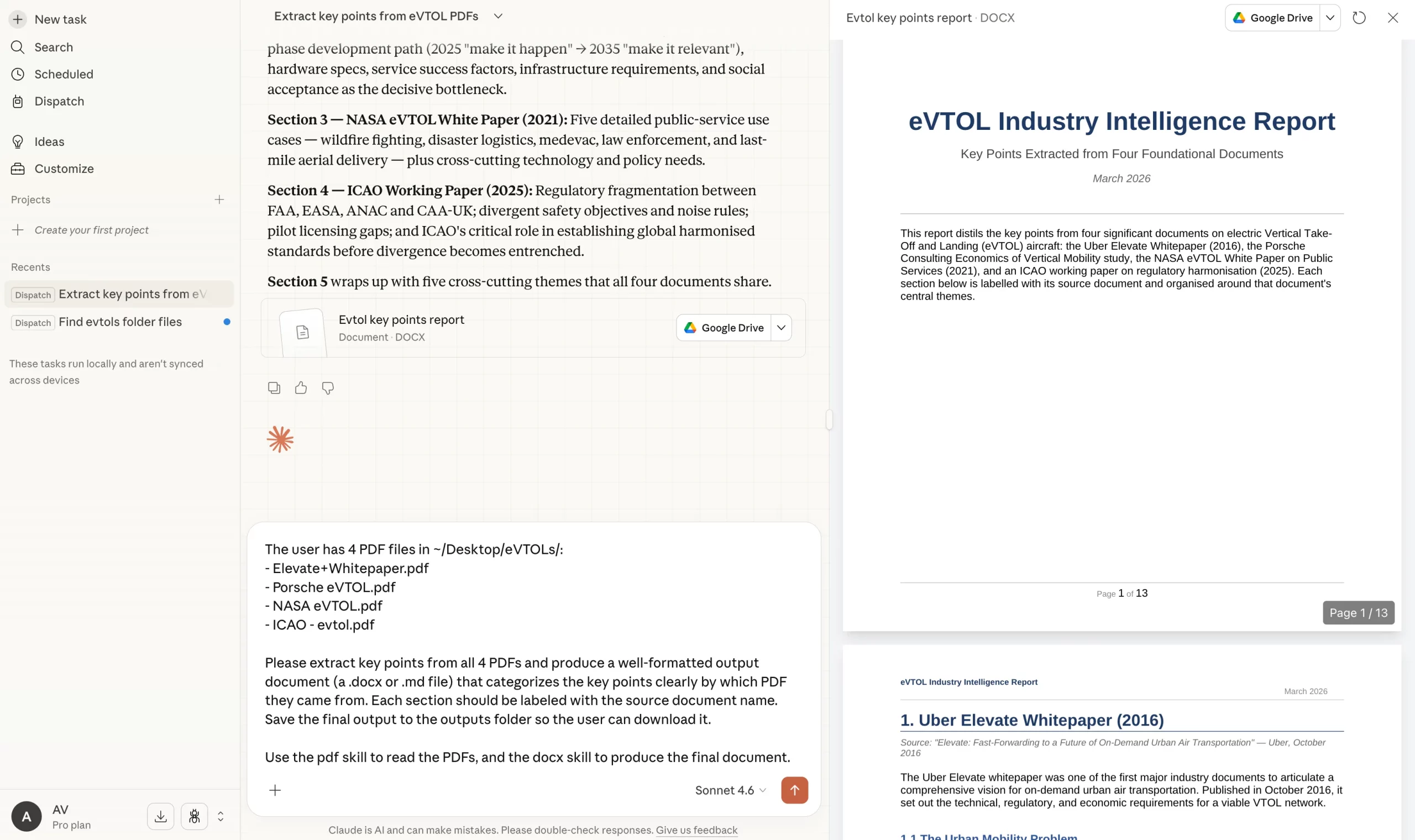
Just these 2 prompts, and I had with me the key points of 4 super-lengthy research papers on flying electric vehicles. But I believe the most useful result here was that I was able to access the files on my system in the first place, all remotely.
Claude Dispatch Use Cases
Operating your system remotely means you are no longer bound to work on the cloud or carry your laptop everywhere. Just keep it on and connected to the internet, and Claude, and the new Claude Dispatch with Cowork will let you –
- Pull insights from local files:
Ask Claude to open a spreadsheet stored on your computer, extract the important data, and turn it into a neat summary report without you touching the machine. - Search across your work tools:
Have Claude go through your Slack messages, emails, or connected platforms and draft a quick briefing document for you before you even sit at your desk. - Build presentations from existing files:
You can instruct Claude to gather relevant material from your Google Drive or desktop folders and turn it into a formatted presentation. - Organise files on your computer:
Claude can process, sort, or clean up files inside a specific folder, which is especially useful for repetitive admin work. - Access outputs from your phone:
If Claude creates a file as part of the task, you can retrieve it directly from your phone or locate it on your desktop through the path Claude gives you. - Work with your existing setup:
Claude uses the same connectors, plugins, and file permissions you have already configured in Cowork, so you do not need to repeat the setup separately for mobile use. - Run recurring tasks automatically:
You can set up routines such as checking emails every morning, compiling weekly metrics, or generating a Friday report, and Claude can keep handling them on schedule. - Handle work that your phone simply cannot:
Since Claude is working through your desktop environment, it can access apps, files, and workflows that would normally be impossible to manage from a phone alone.
Conclusion
I feel this is a major upgrade over the prevalent use of agentic AI on any platform. Other than ClawdBot, nothing comes close to the level of automation that Claude provides with Dispatch over Cowork and Code. So if you often have recurring tasks or wish to run an army of agents while your system is completely free, or simply code even when you are aFK, I would suggest you give Claude Dispatch a shot and be mind-blown already.




