Search “best Claude Skills for writing” and you get lists padded with skills that write commit messages and internal status reports. Useful things. Not writing.
This list only includes repositories that exist for writing. Every entry is a repository whose entire reason for being is writing or editing, which means its star count measures the thing you care about. Here are some of the best writing agent skills (ranked by their popularity) that help distinguish your writing from a mere: AI-slop!
Note: All figures pulled from the GitHub on 5th August 2026.
Table of contents
1. humanizer | ★ 33,700
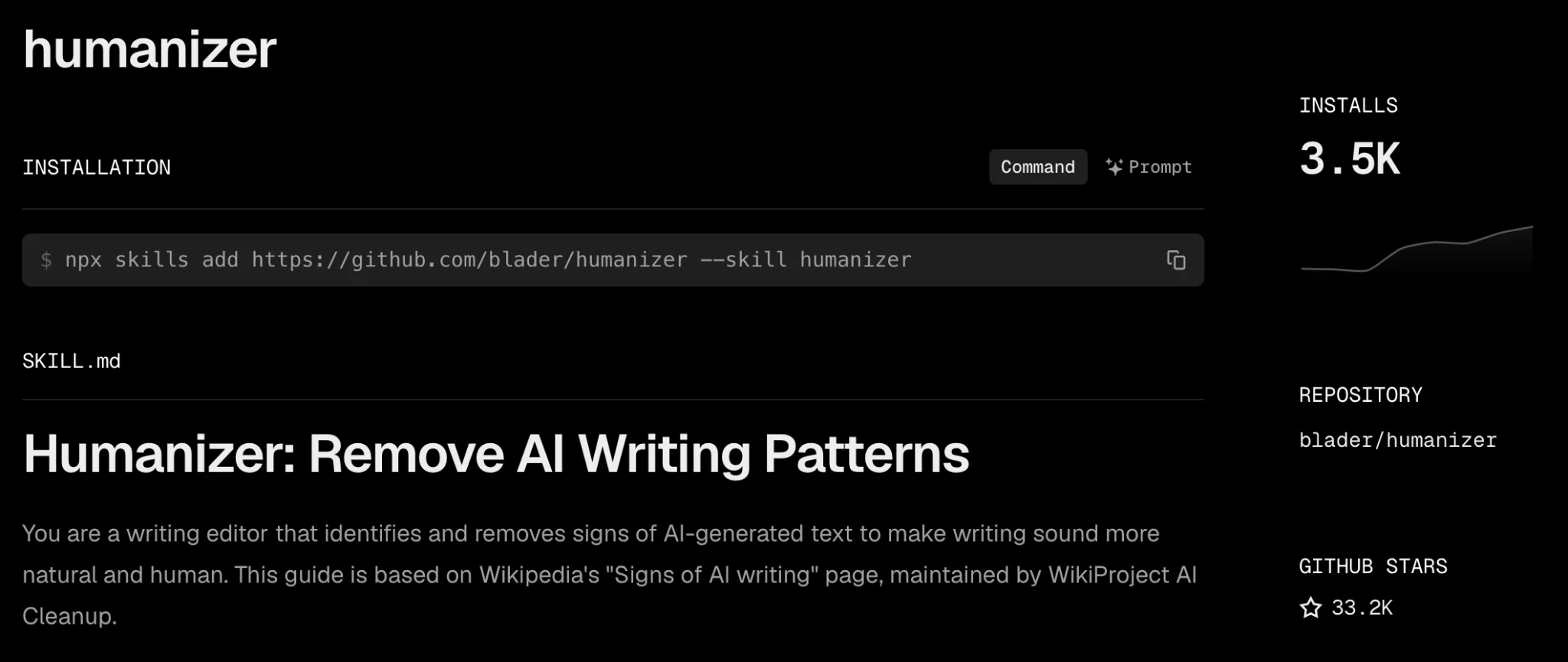
blader/humanizer · 1,005 forks
Thirty-three numbered patterns, each with a before and after example, all drawn from Wikipedia’s Signs of AI Writing guide. The early versions went after obvious vocabulary, but later releases moved to rhythm: subjectless fragments, manufactured punchlines, the chatty rhetorical opener that answers its own question, and em dashes cut outright rather than merely rationed.
Two things it does that stop-slop doesn’t:
- Voice matching: Paste two or three paragraphs of your own writing first. It reads your sentence rhythm, word choices, and quirks, then rewrites toward those instead of toward generic clean prose. Most anti-slop skills flatten everything to the same neutral register. This one aims at yours.
- A second pass: After rewriting, it runs an “obviously AI generated” audit over its own output and rewrites again, on the theory that the first pass leaves tells.
Best for: Everything. Default Claude responses are on the verge of AI-slop themselves. Adding this skills, helps giving them a humane touch.
2. stop-slop | ★ 15,199
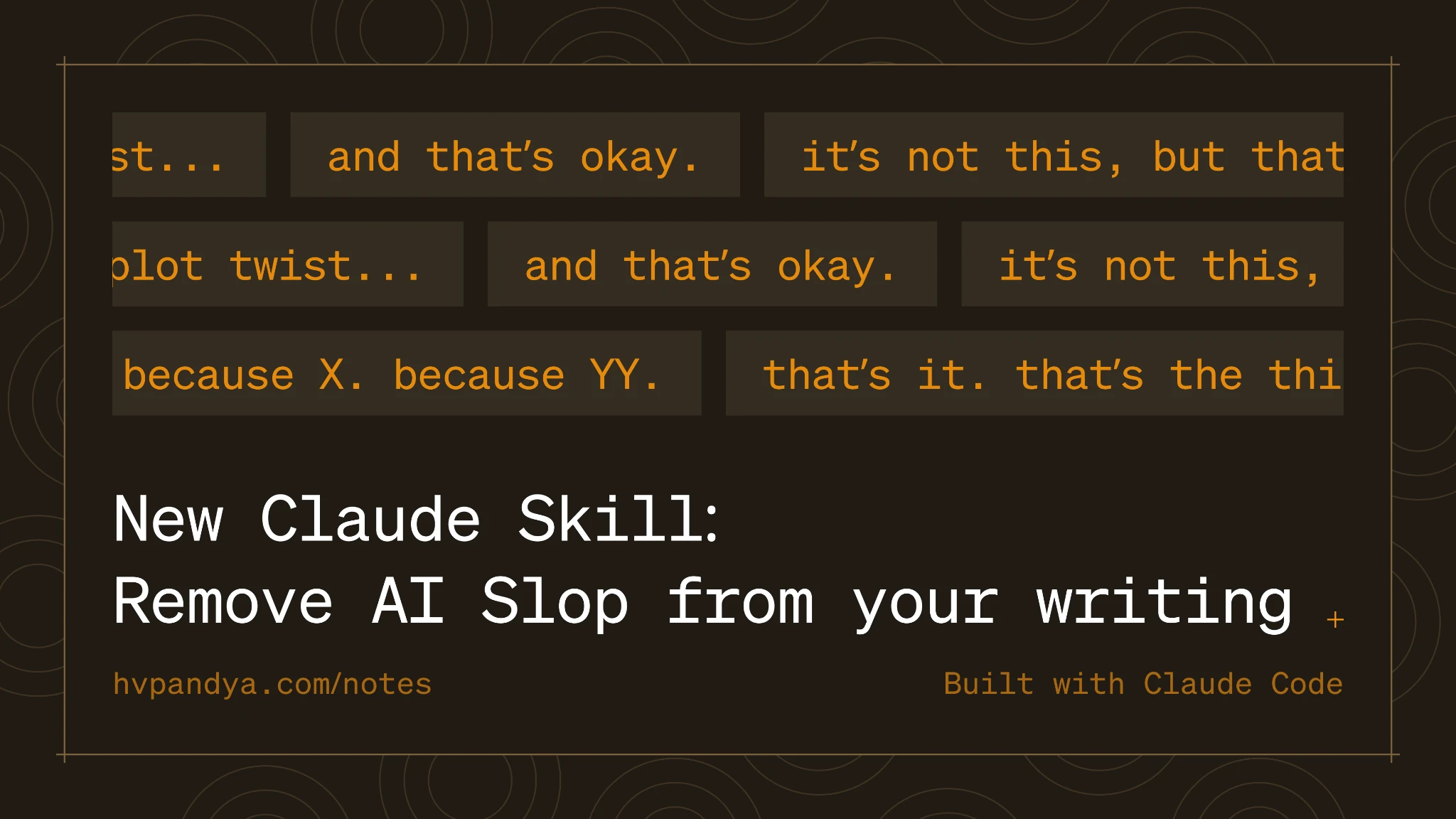
hardikpandya/stop-slop · 1,082 forks
The most-starred writing skill on GitHub, and it’s one SKILL.md plus three reference files. It works because it refuses to tell the model to “sound more human.” It ships lists instead:
phrases.mdbans throat-clearing openers, emphasis crutches, business jargon, every adverb, vague declaratives, meta-commentarystructures.mdbans binary contrasts, negative listings, dramatic fragmentation, rhetorical setups, false agency, passive voice- Sentence rules bans em dashes, staccato fragments, and lazy extremes like “every” and “never”
Then it scores the result 1 to 10 on directness, rhythm, trust, authenticity, and density. Below 35 out of 50, revise. That’s a check the model runs against itself, which is what separates a skill from a suggestion.
Best for: Final pass on anything drafted with AI help.
3. AI-Research-SKILLs | ★ 11,400
Orchestra-Research/AI-Research-SKILLs · 833 forks
Ninety-eight skills across 23 categories, built to let an agent run the full AI research lifecycle from literature survey to submitted paper. Most of it is engineering: Megatron, vLLM, TRL, Flash Attention, quantization. Not writing.
But three of its categories are, and they’re stronger than most standalone writing repos:
- Academic Plotting generates publication-quality figures with venue-specific styling, covering both architecture diagrams and matplotlib data charts.
- Ideation has two skills for the blank-page problem. Research Brainstorming runs ten complementary lenses over a topic. Creative Thinking applies bisociation, structure-mapping and constraint manipulation.
- ARA Rigor Reviewer scores a draft across six dimensions of research rigor, including falsifiability, scope calibration, argument coherence and methodological rigor, then issues a severity-ranked report ending in an accept-to-reject recommendation.
4. oh-story-claudecode | ★ 5,080
worldwonderer/oh-story-claudecode · 687 forks
13 times the stars of my fiction entry, and a better idea of what fiction writing with an agent looks like. Built for Chinese web fiction, but the English README is complete and the method transfers.
The pipeline is trend scouting, deconstruction, writing, slop cleanup, cover art. The middle step is the one nobody else does. Point it at a novel that worked and it produces a structured teardown:
- Story Teardown Report scores the story core across five dimensions, six payoff facets, cognitive reversal, and nine layers of resonance.
- Plot Beats extracts every plot point with an emotion marker from −9 to +9, giving you the emotional curve as data.
- Craft Techniques catalogues eleven techniques: POV handling, dialogue, information gaps, object hooks
Those outputs become a reusable library. The writing skills read from it, so you draft against the structure of something that already worked rather than against the model’s defaults.
5. claude-blog | ★ 1,579

AgriciDaniel/claude-blog · 274 forks
Thirty sub-skills and five agents covering the whole blog lifecycle: strategy, briefs, outlines, drafting, rewriting, schema, site audits, topic clusters, content decay detection.
The part worth stealing even if you never install it is the delivery contract. Every draft is scored against a 100-point rubric across five gates, and anything below 90 is blocked and re-run up to three times before it reaches you. The author’s framing: the user is never the first reviewer.
That’s the verification pattern applied to prose. Most writing skills stop when the output looks finished, which makes you the quality gate.
Best for: Publishing at volume, where you can’t personally review every draft.
Installing them in Claude Code
Install any of these by cloning into your skills directory:
git clone https://github.com/<owner>/<repo> ~/.claude/skills/<name>Final Thoughts
Pick by what you write:
Everyone should have humanizer regardless. It’s the one entry that improves output no matter what the output is (forget the em-dashes and other AI markers).
Read more: How to Connect MCP Servers with Claude (Claude Desktop and Claude Code)
Frequently Asked Questions
Q1. Why rank by stars instead of installs?
A. Because stars on a dedicated repo attribute to the skill itself. stop-slop has 15,199 stars for one SKILL.md, which is 15,199 people endorsing that specific file. A skill inside a 200,000-star bundle of 41 tools tells you nothing about that skill.
Q2. How many should I install?
A. Two or three. One anti-slop pass, one for your format, optionally one for research. Beyond that their trigger descriptions overlap and you lose the ability to predict which fires.
Q3. Do these work outside Claude Code?
A. Most do. Skills are markdown, so they port to Codex, Cursor, and Gemini CLI. stop-slop documents four install surfaces including raw API system prompts. skill-deslop ships a packaged .skill file for Claude Desktop.
Q4. Why are anti-slop skills so dominant?
A. Because the patterns are documentable. Wikipedia’s WikiProject AI Cleanup maintains a list drawn from thousands of AI-generated texts, which gives these skills a shared factual base that general writing advice lacks. It’s the one writing problem with an agreed answer key.
Q5. Should I build my own?
A. Once you have a house style, yes. Read stop-slop for how to write rules a model can actually check, and writing-shape for how to structure a multi-turn writing session. Between them you’ll have the pattern. All star and fork counts retrieved from the GitHub API on 5 August 2026. These move fast. Verify before publishing.
Studying, evaluating, and explaining AI systems for over 6 years.
“𝘖𝘯𝘤𝘦 𝘮𝘦𝘯 𝘵𝘶𝘳𝘯𝘦𝘥 𝘵𝘩𝘦𝘪𝘳 𝘵𝘩𝘪𝘯𝘬𝘪𝘯𝘨 𝘰𝘷𝘦𝘳 𝘵𝘰 𝘮𝘢𝘤𝘩𝘪𝘯𝘦𝘴 𝘪𝘯 𝘵𝘩𝘦 𝘩𝘰𝘱𝘦 𝘵𝘩𝘢𝘵 𝘵𝘩𝘪𝘴 𝘸𝘰𝘶𝘭𝘥 𝘴𝘦𝘵 𝘵𝘩𝘦𝘮 𝘧𝘳𝘦𝘦. 𝘉𝘶𝘵 𝘵𝘩𝘢𝘵 𝘰𝘯𝘭𝘺 𝘱𝘦𝘳𝘮𝘪𝘵𝘵𝘦𝘥 𝘰𝘵𝘩𝘦𝘳 𝘮𝘦𝘯 𝘸𝘪𝘵𝘩 𝘮𝘢𝘤𝘩𝘪𝘯𝘦𝘴 𝘵𝘰 𝘦𝘯𝘴𝘭𝘢𝘷𝘦 𝘵𝘩𝘦𝘮.” — 𝖥𝗋𝖺𝗇𝗄 𝖧𝖾𝗋𝖻𝖾𝗋𝗍, 𝖣𝗎𝗇𝖾