In the past couple of years, we have seen vibe coding evolve from just an idea that sounded “fancy” to a full-time practice for many budding developers. What used to sound like a gimmick is now a must-have skill, even in the professional world. Proof? The recent round of funding secured by one such platform. Emergent, a widely popular vibe coding platform (check out the top 5 here), is now series B funded. Which basically means leading investors now want you build and launch faster than ever.
And they are putting their money where their mouth is. A gargantuan $70 million has been pumped in for this funding round. And thanks to that, Emergent is gaining new visibility for its capabilities. But is it worth your time? We are here to explore just that.

But before anything else, let’s start from the top and understand what Emergent really is.
Table of contents
What is Emergent?
Emergent is a popular vibe coding platform. For those unaware, vibe coding means using AI to generate code by simply describing it in your native language, like English. So, in essence, Emergent is designed to turn natural language intent into working software, without forcing you to write the code firsthand. Just describe what you want, and the app writes the code for it.
At a high level, Emergent lets you describe what you want to build, not how to build it line by line. You explain the feature, the flow, or the change in plain English, and the platform generates the underlying code, wiring, and logic for you. From there, you refine the output through a simple follow-up conversation.
Emergent stands apart from other vibe coding apps in one particular aspect. It does not treat code generation as a one-off action. Instead, it treats it as a loop with a constant review and adjustment movement. In this sense, you can think of Emergent as less of an AI code generator and more of an interactive development environment powered by intent. One where speed, iteration, and momentum matter more than perfection on the first try.
Also read: Vibe Coding in Google AI Studio: How I Built an App in Minutes
How Emergent Actually Works
Now that you know what Emergent does, here is the “how” behind it.
In its true essence, Emergent is basically an AI aggregator or a playground. Which basically means that it does not have an AI of its own. Instead, it makes API calls to other AI models like Claude, ChatGPT, and Gemini at the backend to write the code you want.
Where it excels is keeping your intent, context, and codebase tightly linked at all times. You start by describing what you want to build, like a feature, a component, or an entire app flow. Emergent then calls upon the model of your choice to turn your description into actual code. In doing so, it sets up the structure, logic, and connections behind the scenes and keeps writing the code as the project evolves.
Once the first version is ready, the real workflow begins. You review what Emergent has produced, then refine it through follow-up instructions. You can ask it to change behaviour, adjust layouts, fix bugs, or add new features, and it updates the existing code instead of starting from scratch.
An important detail here – Emergent remembers what it has already built. That project-level memory allows you to iterate without constantly restating the context. Over time, the app grows through small, conversational changes, much like how a human developer would refine a product.
Core Capabilities of Emergent
At its crux, there are some core capabilities responsible for the success of Emergent.
- It helps generate full-stack applications from a simple description. This includes frontend components, backend logic, and the basic data flow required to make everything work together. Which means when using Emergent, you are never starting from an empty repo anymore.
- It helps tweak the code in a conversational format. You can modify UI elements, tweak logic, or add new functionality by explaining the change in plain language, and Emergent updates the existing code instead of rewriting everything.
- As I mentioned before, context retention is yet another key capability of Emergent. It remembers your project structure, previous decisions, and ongoing changes. That allows you to build complex workflows without constantly re-explaining what already exists. The best part, it can even answer its own follow-up questions to give you the ideal app.
- Emergent runs entirely in the browser. Which means there is no heavy local setup or environment configuration to slow you down. You log in, describe what you want to build, and start iterating immediately.
- Yet another, lesser talked about feature of Emergent is that it is highly focused on development, with a minimalistic interface, avoiding any possible distractions. Such a focused UI that doesn’t overwhelm you with features helps reduce friction between idea and execution.
Now that we know what clicks for Emergent, here is how to access it.
Emergent – How to Access
Since Emergent is built to be approachable, you can start using Emergent without any payment initially. Here is how to access it:
1. Log on to https://app.emergent.sh/
2. Sign in with your Gmail or Email account. You may have to create and confirm your account through a verification code sent to your email.
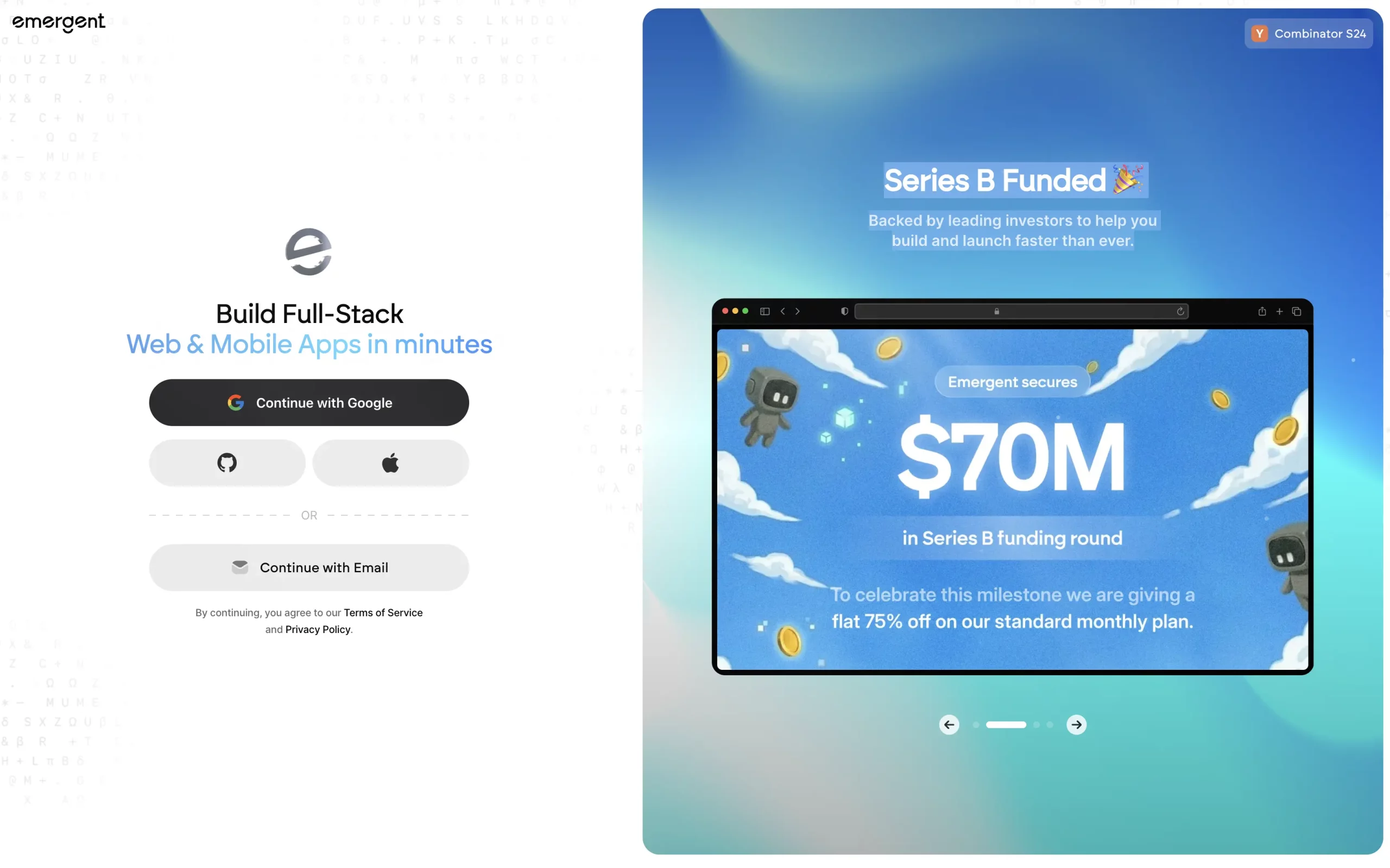
3. Once in, select the kind of development you want from the 3 options at the top of the chat window – Full-stack, App, or Landing page.
4. Here, you can also select the AI model you wish to choose, from the drop-down menu, as shown in the image below.

5. For more control, you can select the MCP tools you wish to use, template, budget, and model, from the Advanced Control tab on the bottom right of the chat window.
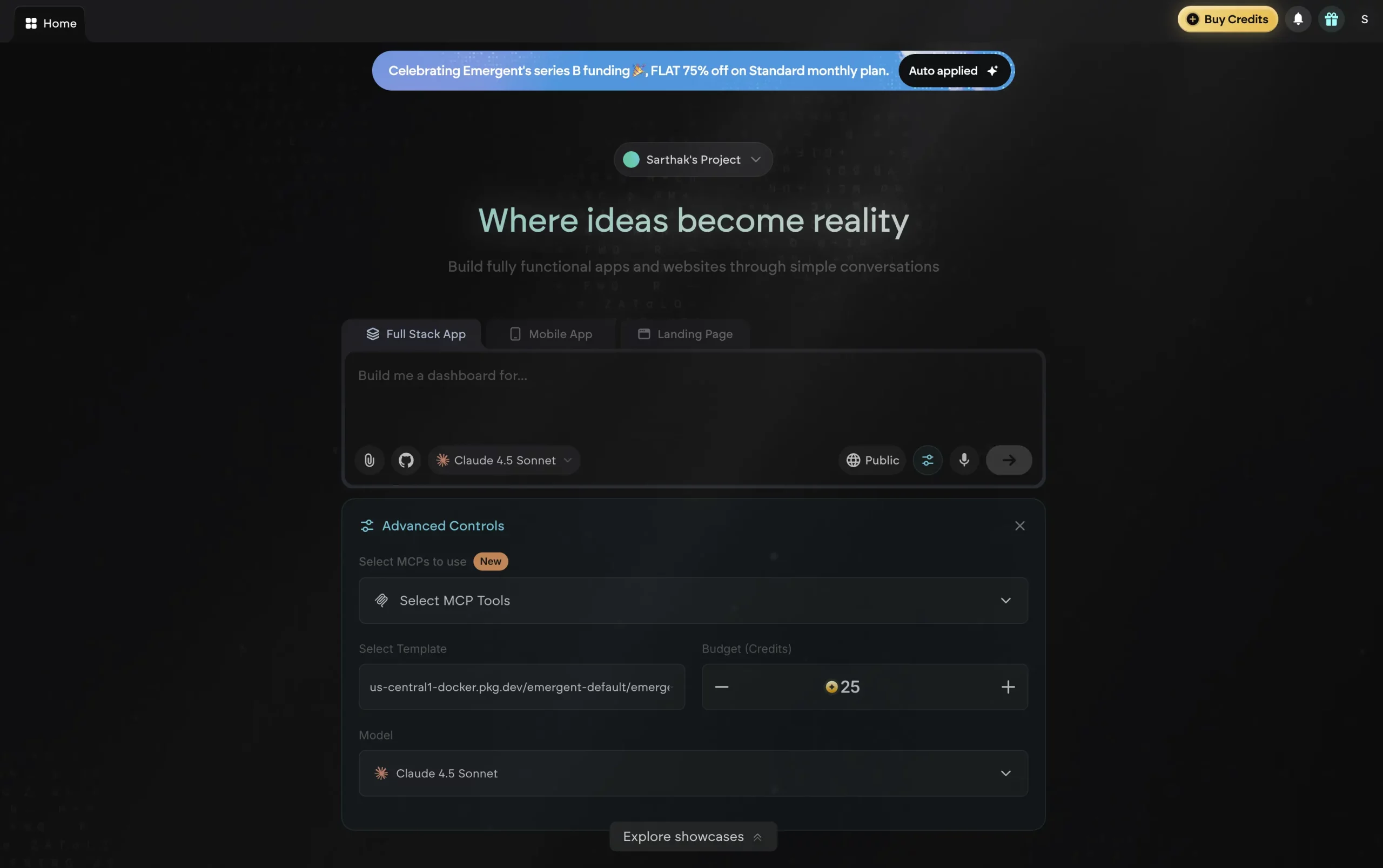
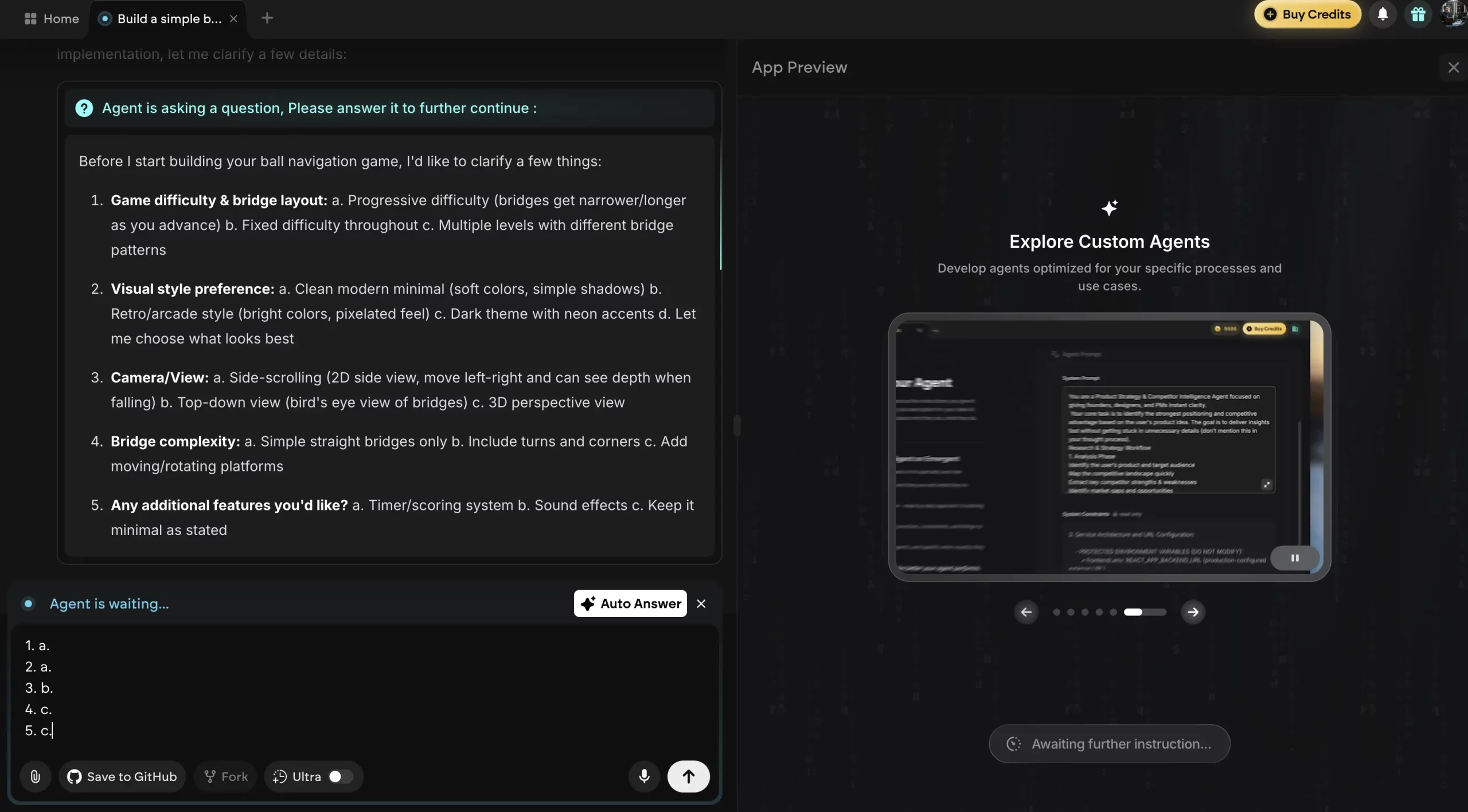
6. Once you finalise the settings, simply type in what you want to generate and press enter. Emergent gets to work after a few follow-up questions.
Emergent Pricing
One of the best parts about Emergent is that it lets you get started for free. This basically means that you can try out the platform without any cost, and even complete your simple projects end-to-end.
How it works is that the platform gives you certain credits to use for free. These credits are the core unit of usage on Emergent. Credits are used for every operation that you run, like coding, testing, debugging, deploying, or integrating with third-party tools. To keep things fair, Emergent only charges credits when something actually runs.
So, each time you create a project, some of the credits are used up. Once your free credits are over, you can buy more through the 3 packages listed below.
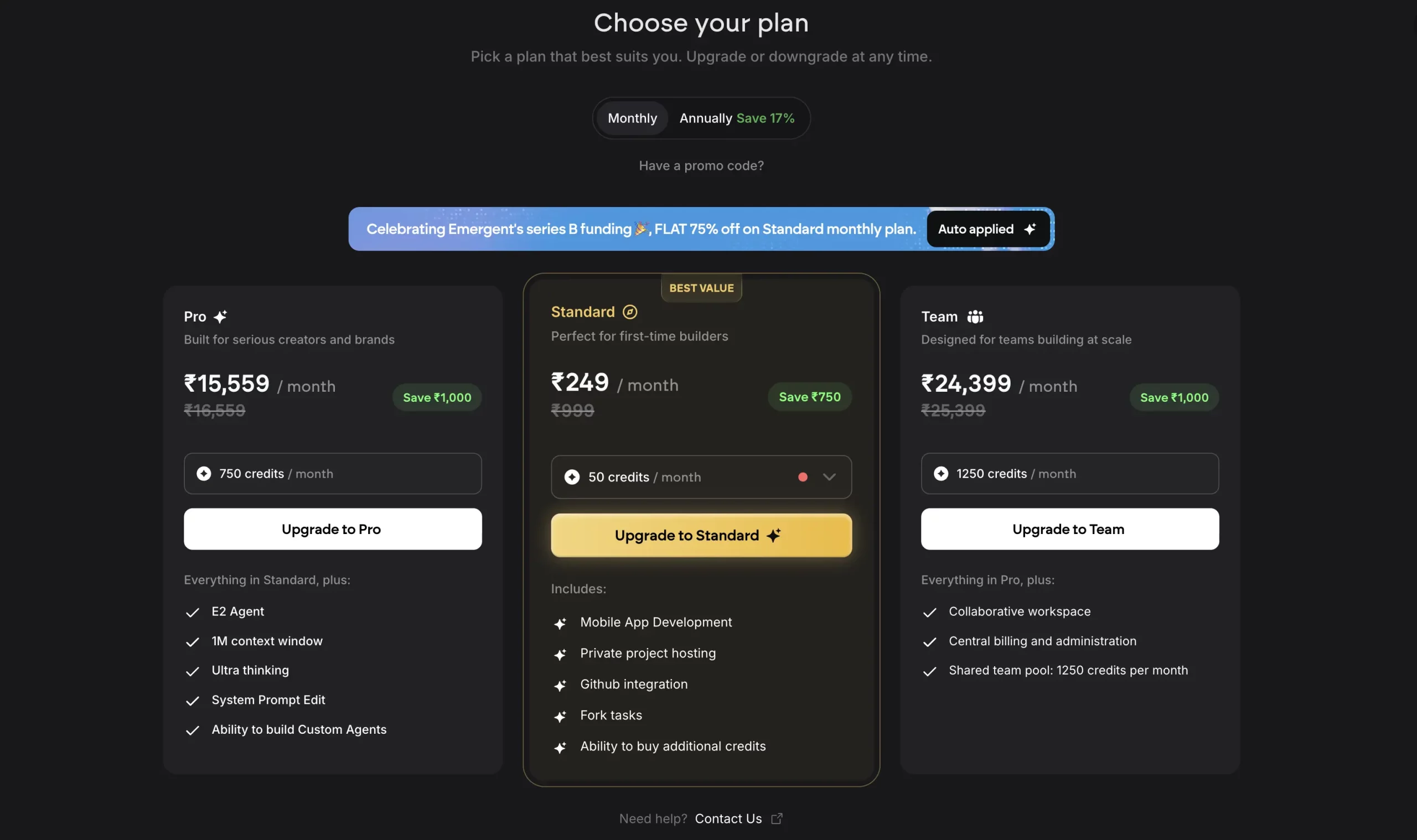
- Standard: starts from Rs 999/ month for 50 credits per month (you can buy more credits here at a higher price).
- Pro: Rs 16,559 for 750 credits per month. Comes with additional features such as E2 Agent, 1M context window and more.
- Team: Rs 25,399 for 1250 credits per month. Comes with team-focused features like a collaborative workspace and central billing and administration.
NOTE: The company is currently running a flat 75% off on its Standard monthly plan to celebrate its Series B funding.
Hands-on with Emergent: Building a Bridge-Ball Game
To test out the vibe coding platform’s abilities, I decided to make a typical bridge-ball game by simply providing it with the instructions in the form of a prompt. The prompt I used is as follows:
Prompt:
Build a simple browser-based game where the player controls a ball using the arrow keys. The ball must navigate narrow bridges suspended over empty space to reach a finish point. If the ball falls off a bridge, it should fall with a short animation, and the player loses one life. The player starts with 3 lives and respawns at the last point where the ball fell off. If all lives are lost, restart the game from the beginning. Keep the visuals minimal, use basic shapes and colours, and display remaining lives on screen.
Output:
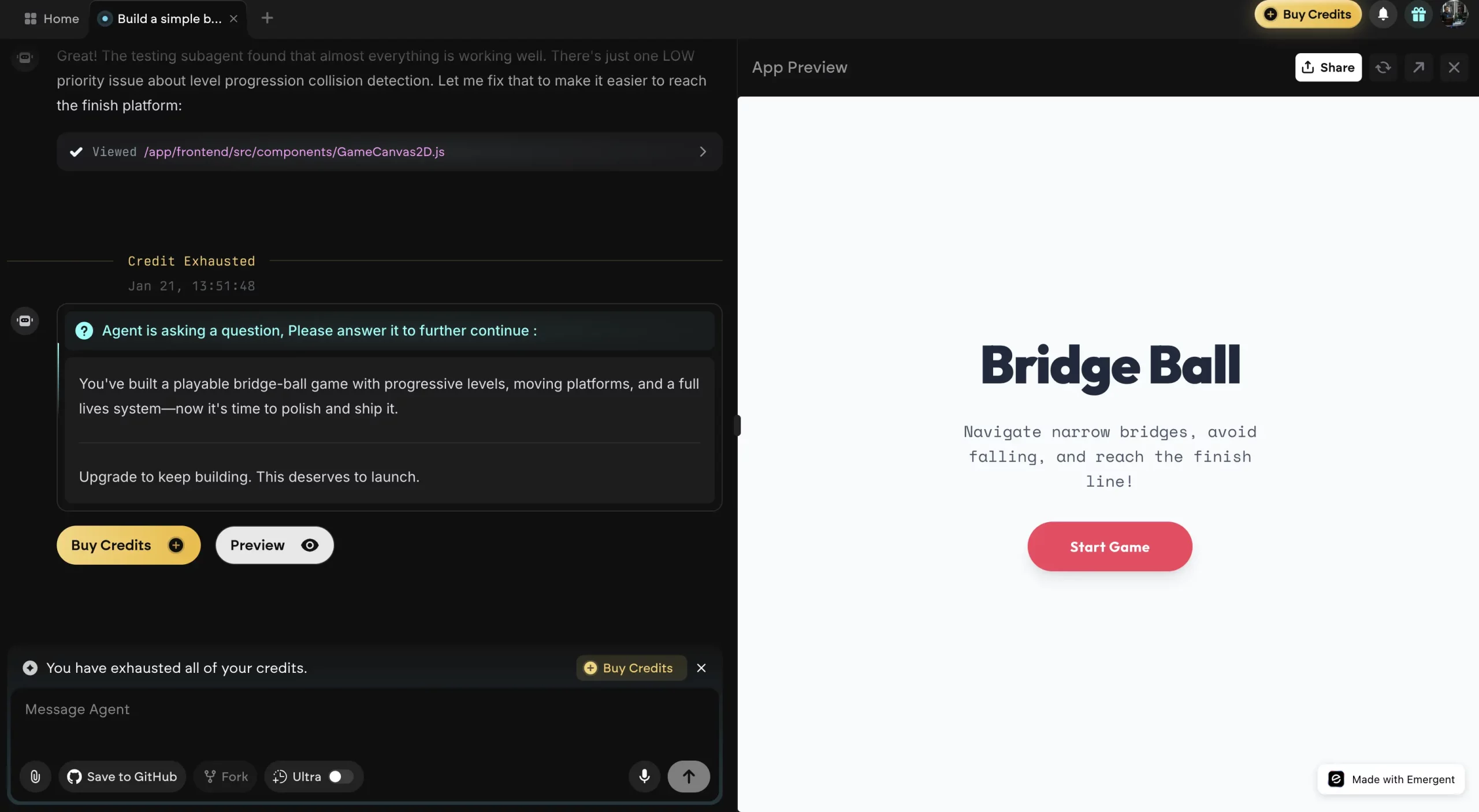
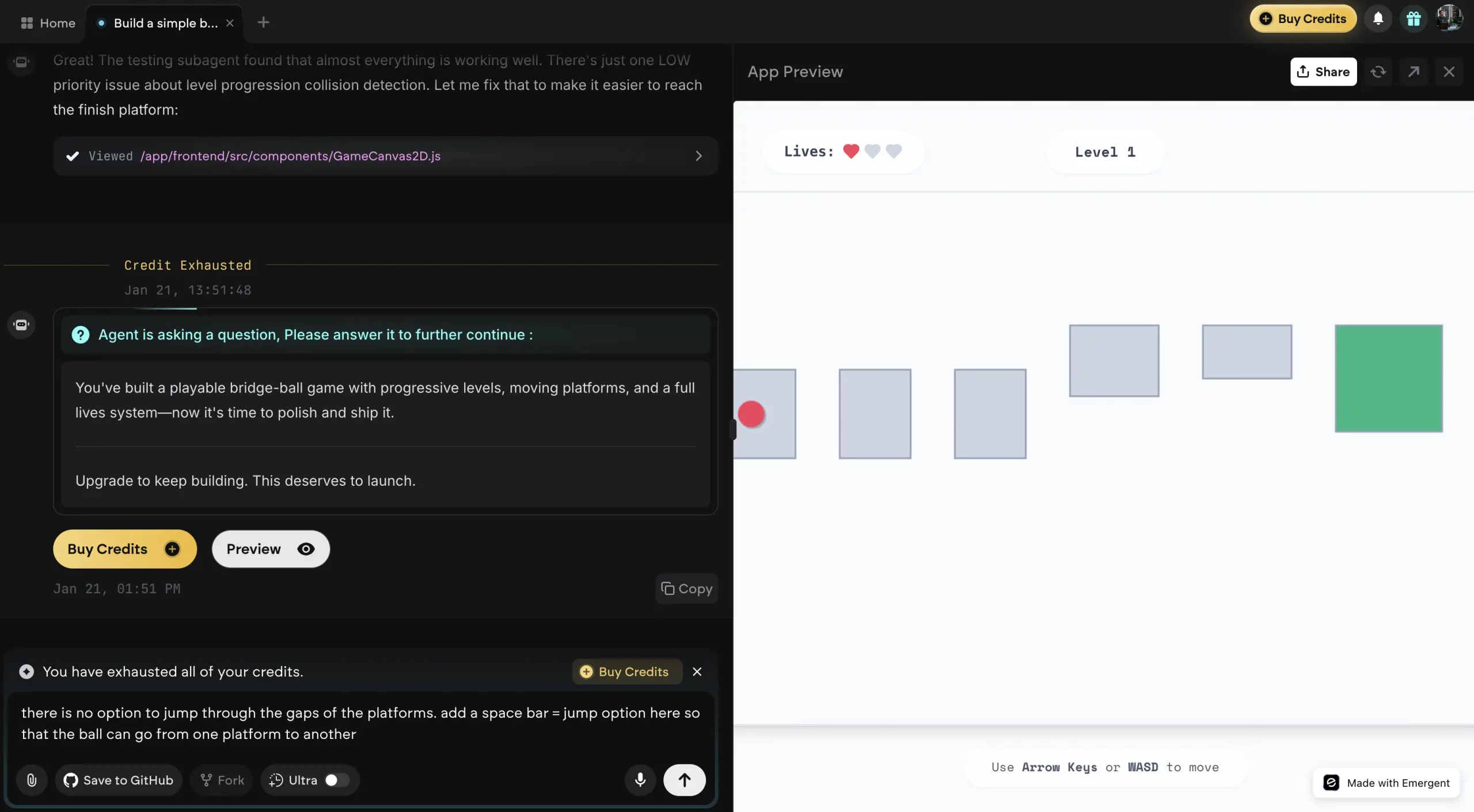
As you can see, Emergent was quick to identify the type of game I wanted. It followed up the prompt with a set of questions for more clarity. Once I provided the answers to the same as per my preference, Emergent got to work by producing the code in the background. In about 20 minutes, the platform was ready with the final version of the game.
I should highlight here that the game has one major flaw – there is no option to get the ball from one platform to another, as there is no jump command coded into the game. So practically, the game is unplayable.
Having said that, Emergent was smart enough to come up with a working version of the game with that simple set of instructions. The interface looks clean as I instructed, the gameplay is pretty straightforward, and it looks like a game I would’ve played at length, had it been playable with the jump command.
Also read: I Tried Vibe Coding with Cursor AI and It’s Amazing!
Conclusion
Through the hands-on experience above and my personal inferences from the platform, I believe Emergent is one of the top options for vibe coding out there today. The platform follows a minimalistic, practical approach and removes the heavy grunt of line-by-line coding from your workflow. While it handles the backend work, it shows you the results immediately once it finishes.
A minor tweak here and there, and I am sure you will be able to build the app of your dreams with Emergent. Just carry on the conversation to make any required tweaks, and Emergent is sure to get you there. Now, what can be better than producing entire apps without even typing a single line of code? And for that, Emergent is definitely one AI platform that you should try out.