X (formerly Twitter) recently released details of its recommendation system, opening up over 400,000 lines of code that power the “For You” feed. This wasn’t just a minor update, it was the first time creators and users got to peek behind the curtain at how the platform truly works. These rules explain why some posts go viral overnight, why others flop, and what makes certain accounts consistently visible while others struggle to grow. If you’re serious about building an audience, understanding this algorithm is no longer optional – it’s essential!
Table of contents
Reputation Scores: Your Invisible Ranking
Every account on X has a hidden reputation score that determines how widely posts are distributed. This score acts like a secret popularity rating that shapes everything from whether your tweets show up in timelines to how your replies rank.
Here’s how it works:
- New accounts start at -128, which makes it nearly impossible to reach large audiences at first.
- Blue check subscribers immediately jump to +100 reputation, giving them a huge head start.
- Legacy verified accounts (from before X’s subscription model) get even bigger boosts.
- Viral accounts that already perform well keep receiving preferential treatment.
Think of this score like a credit rating. A high score means the system trusts you more, and your posts get shown more often. A low score keeps you invisible, no matter how good your content might be.
The TweetCred System (Still Active)
TweetCred: Still Shaping Reach
X once claimed it was phasing out old systems, but TweetCred is still in play. This hidden scoring system evaluates your behavior:
- How old and consistent your account is.
- The quality of your followers and engagement.
- Ratio of followers to following.
- Devices and login patterns.
In practice, this means that unverified accounts need 10x more engagement to get the same reach as verified ones. Many creators find themselves stuck because they don’t know this hidden rule is holding them back.
Code Snippet:
These snippets come from Twitter/X’s algorithm codebase. They show how the system tracks negative feedback signals given by users against content or accounts.
def getLastNegativeFeedbackTime(userId: Long): Stitch[Option[Time]] = {
  val enabledNegativeSignalTypes = Seq(
    SignalType.AccountBlock,
    SignalType.AccountMute,
    SignalType.TweetSeeFewer,
    SignalType.TweetReport,
    SignalType.TweetDontLike
  )

  // negative signals
  val maybeNegativeSignals =
    enabledNegativeSignalTypes.map { negativeSignal =>
      SignalRequest(
        maxResults = Some(1), // Only most recent needed
        signalType = negativeSignal
      )
    }
}
def getLastNegativeFeedbackTime(userId: Long): Stitch[Option[Time]] = {
val enabledNegativeSignalTypes = Seq(
SignalType.AccountBlock,
SignalType.AccountMute,
SignalType.TweetSeeFewer,
SignalType.TweetReport,
SignalType.TweetDontLike
)
// negative signals
}
Hidden Labels That Limit Reach
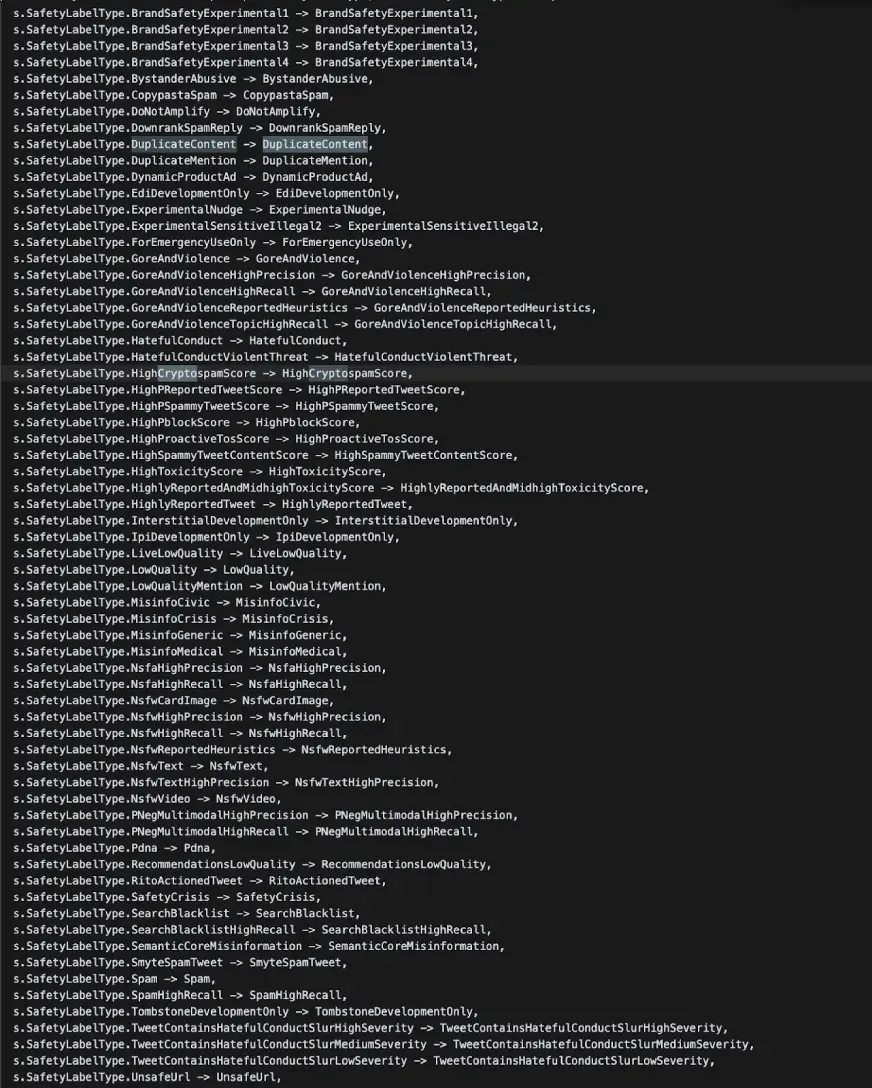
In addition to reputation scores, X quietly tags content with invisible labels that can drastically shrink distribution. A few examples:
- DoNotAmplify: Reduces reach by 90%+ if your score drops too low.
- HighCryptoSpamScore: Targets accounts that frequently post about crypto.
- DownrankSpamReply: Penalizes excessive replies, which affects community managers the most.
- CopyPastaSpam: Punishes posts that repeat trending memes or phrases.
- DuplicateContent: Flags repeated or similar posts, making it harder for recurring content series to grow.
Creators often see their reach vanish for weeks without knowing why – these hidden tags are usually the reason.
The Three-Month Penalty System
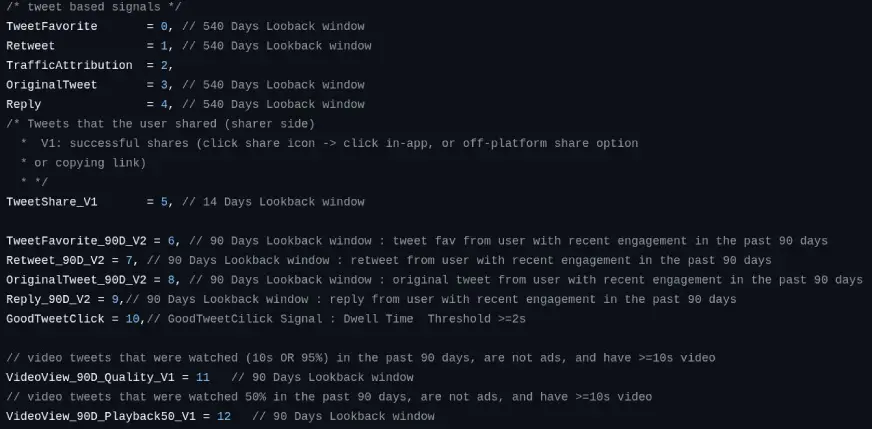
If users take the following negative actions upon your content, you are penalized through the algorithm for three months in total:
- Press “I’m not interested in this tweet”
- Select “See fewer posts like this”
- Report your content (even if they are false reports)
- Block or mute your account
- Utilize less than 2 seconds looking at your content
def getLastNegativeFeedbackTime(userId: Long): Stitch[Option[Time]] = {
  val enabledNegativeSignalTypes = Seq(
    SignalType.AccountBlock,
    SignalType.AccountMute,
    SignalType.TweetSeeFewer,
    SignalType.TweetReport,
    SignalType.TweetDontLike
  )

  // negative signals
  val maybeNegativeSignals =
    enabledNegativeSignalTypes.map { negativeSignal =>
      SignalRequest(
        maxResults = Some(1), // Only most recent needed
        signalType = negativeSignal
      )
    }
}
Critical Impact: One virulent post that causes negative actions can ruin your reach for a full quarter. The system does not recognize or differentiate between an authentic feedback and a collision of attacks.
Some rules of the algorithm that can get you penalized or deboosted are:
- Posting offensive text that might hurt the sentiments of a person or a community
- Using offensive phrase or text in your username
- All caps tweet which can be seen as shouting might lead to reduction in your tweet or score getting decreased
- Avoid using restricted or flagged words, as the algorithm monitors specific terms
/** Configure from a config file, validate the configuration. */
public TweetTextScorer(String configFile) {
    TweetProcessingConfig.init(configFile);

    // get dampings
    checkWeightRange(offensiveTermDamping = TweetProcessingConfig
        .getDouble("offensive_term_damping", DEFAULT_OFFENSIVE_TERM_DAMPING));
    checkWeightRange(offensiveNameDamping = TweetProcessingConfig
        .getDouble("offensive_name_damping", DEFAULT_OFFENSIVE_NAME_DAMPING));

    // get weights
    checkWeightRange(lengthWeight = TweetProcessingConfig
        .getDouble("length_weight", DEFAULT_LENGTH_WEIGHT));
    checkWeightRange(readabilityWeight = TweetProcessingConfig
        .getDouble("readability_weight", DEFAULT_READABILITY_WEIGHT));
    checkWeightRange(shoutWeight = TweetProcessingConfig
        .getDouble("shout_weight", DEFAULT_SHOUT_WEIGHT));
    checkWeightRange(entropyWeight = TweetProcessingConfig
        .getDouble("entropy_weight", DEFAULT_ENTROPY_WEIGHT));
    checkWeightRange(linkWeight = TweetProcessingConfig
        .getDouble("link_weight", DEFAULT_LINK_WEIGHT));
}
- Content spamming might get you into trouble
Algorithms has its own set of rules and if your tweet doesn’t follow them then there is a huge chance your account will either get penalized or deboosted.
userRules = Seq(
  AbusiveRule,
  LowQualityRule,
  ReadOnlyRule,
  CompromisedRule,
  SpamHighRecallRule,
  DuplicateContentRule,
  AbusiveHighRecallRule,
  EngagementSpammerNonFollowerWithUqfRule,
  EngagementSpammerHighRecallNonFollowerWithUqfRule,
  DownrankSpamReplyNonFollowerWithUqfRule
)
The Boost System: Maximizing Algorithmic Advantage
Benefits of Verification
Blue check verification has many competitive advantages like:
- Your reputation jumps from -128 to 100 instantly
- 4x engagement inside your network
- 2x engagement outside your network
- Your replies get priority placement
- You get placed higher in search results
def recordViralContentStats(
  candidates: Seq[ItemCandidateWithDetails],
  statsReceiver: StatsReceiver,
  clientId: String
): Unit = {

  val viralContentCount = candidates.count { candidate =>
    candidate.features.getOrElse(ViralContentCreatorFeature, false)
  }

  val viralContentInNetworkCount = candidates.count { candidate =>
    candidate.features.getOrElse(ViralContentCreatorFeature, false) &&
    candidate.features.getOrElse(InNetworkFeature, true)
  }

  val viralContentOutOfNetworkCount = candidates.count { candidate =>
    candidate.features.getOrElse(ViralContentCreatorFeature, false) &&
    !candidate.features.getOrElse(InNetworkFeature, true)
  }
}
Legacy Verified Bonus
If you were verified under the old platform, you receive algorithmic benefits beyond the normal blue check benefits such as reach multipliers and penalties.
Content Types Multipliers
In general, algorithmically, the platform treats different content types dramatically different:
Video Content Dominance
The video content has the strongest algorithmic multiplier if it meets the 10-Second Rule: If it keeps the viewer attention for more than 10 seconds in a video then it qualifies for:
- 340% better reach than text posts
- Submit repost to be placed in a video carousel.
- The video post is highly likely to also be distributed to other platforms
- The risk of notification penalties for any other content on the account is reduced
The video can be optimized by following these:
- Use the first 3 seconds of the video to hook the audience
- Consider using captions to retain attention and keep viewers watching
- Create mobile-optimized video content
- Include finishing and/or completing elements to keep viewers engaged
Text Post Mastery
It might not have much stronger dominance as compared to the videos but we have the 2-Seconds Dwell Time Trigger where basically the text posts where people stay on for 2 seconds or longer receive boosts from the algorithm. The text posts can be optimized by following these:
Engagement Hierarchy
All type of engagement doesn’t hold the same percentage with the algorithm:
High-Value Engagement
- Bookmarks (5x multiplier): Highest value signal indicating exemplary content, meaning the user found it content worth saving
- Quote Tweets (4x multiplier): Indicating that the content sparked enough interest for some commentary.
- Meaningful Replies (3x multiplier): A thoughtful response, or thoughtful responses over 10 words that generates a discussion.
Medium-Value Engagement
- Retweets (2x multiplier): Has some value and engagement, but is less impactful than a quote tweet.
- Link Clicks: Also tracked but the weight of it is less than previously identified high-value engagement.
Low-Value Engagement:
- Likes (1x multiplier): engagement but it is in the low tier with little algorithm value.
Diversity Filters: Stopping Content Floods
X prevents any one account or topic from dominating feeds with diversity filters:
- Author diversity:
- Stops multiple posts from the same account appearing in a row
- Limits how often one user sees your content in a day
- Best practice: post every 2–3 hours, not all at once
- Topic diversity:
- Repetitive takes on trending topics are penalized by “Slop Score”
- Original, thoughtful contributions get rewarded
Practical Optimization Strategies
If you want to succeed on X today, you need a strategy that aligns with the algorithm. Here’s a breakdown:
- Content planning: Rotate 3–4 main themes. Post bold takes during peak engagement. Build anticipation with recurring series.
- Video-first content: Focus on videos with strong hooks, captions, and mobile-friendly design.
- Better text posts: Write posts that are longer, more insightful, and designed to encourage discussion.
- Engagement plan: Reply to comments within 2 hours, encourage quote tweets and bookmarks.
- Posting schedule: Aim for 3–5 quality posts daily, spaced 2–3 hours apart. Post during peak times: 9–11 AM and 7–9 PM EST. Weekends often outperform weekdays.
Also Read: A Guide on Social Network Recommendation System
Conclusion
The 2025 algorithm update changed the rules of growth on X. Reputation scores, hidden labels, and engagement multipliers now dictate who wins and who fades. Most users have no idea these mechanics exist—but those who learn them gain a huge advantage.
Success on X isn’t about posting more. It’s about posting smarter. Focus on value-rich content that sparks conversations, earns bookmarks, and builds trust. The algorithm rewards consistency, originality, and genuine community building. If you align your strategy with these rules, the system won’t hold you back – it will push you forward.
Data Science Trainee at Analytics Vidhya
I am currently working as a Data Science Trainee at Analytics Vidhya, where I focus on building data-driven solutions and applying AI/ML techniques to solve real-world business problems. My work allows me to explore advanced analytics, machine learning, and AI applications that empower organizations to make smarter, evidence-based decisions.
With a strong foundation in computer science, software development, and data analytics, I am passionate about leveraging AI to create impactful, scalable solutions that bridge the gap between technology and business.
📩 You can also reach out to me at [email protected]