Is this the right time to move into AI? Can a software developer become an AI engineer in 6 month? Is it wise to make the career transition? If these questions haunt you, then here’s the good news: you absolutely can! AI engineering is one of the fastest-growing tech careers today. According to The Economic Times, India alone is expected to add over 2.3 million AI jobs by 2027. That’s a massive opportunity just waiting to be tapped. This article is your guide to making the transition from software engineer to AI engineer.
Table of contents
- Why Transition to AI?
- Shared Skills Between Software Developers and AI Engineers
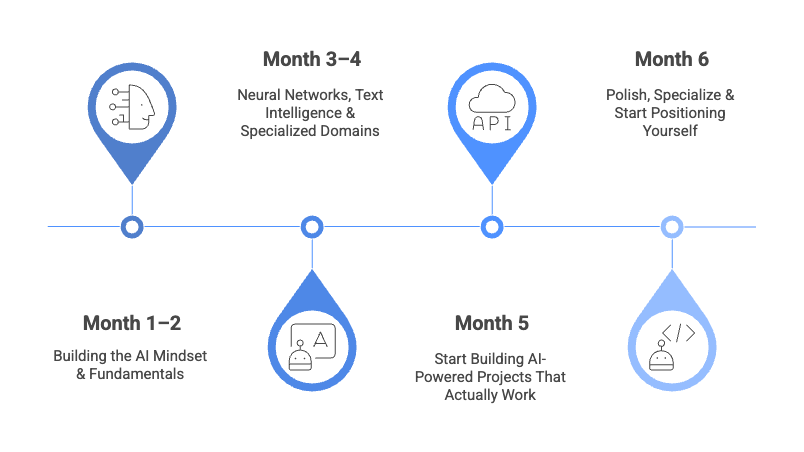
- Months 1-2: Building the AI Mindset and Fundamentals
- Months 3-4: Going Deeper with Neural Networks, Text Intelligence, and Specialized Domains
- Month 5: Start Building AI-Powered Projects That Actually Work
- Month 6: Polish, Specialize, and Start Positioning Yourself
- Success Stories
- Conclusion
- Frequently Asked Questions
Why Transition to AI?
AI is quickly becoming the backbone of modern software and business innovation. As companies race to adopt AI-powered tools and workflows, the demand for professionals who understand both traditional software and AI is soaring. For software engineers, this is the perfect time to upskill and future-proof your career. Here’s why the switch makes sense:
- Explosive job growth: India is expected to see over 2.3 million AI jobs by 2027 (The Economic Times).
- Better pay: AI roles typically offer 30–50% higher salaries than traditional dev jobs.
- Strong skill overlap: Coding, system design, APIs, and problem-solving all carry over into AI workflows.
- Meaningful impact: Work on cutting-edge problems in healthcare, climate, finance, and more.
- Remote-ready and global: AI talent is in demand worldwide, with more remote and flexible options.
Making the shift isn’t about starting over, it’s about building forward.
Shared Skills Between Software Developers and AI Engineers
| Shared Skill | Software Developer | AI Engineer |
|---|---|---|
| Math Fundamentals | Basic exposure; used in algorithm analysis and performance tuning | Deeper use; linear algebra, statistics, and calculus underpin model training and evaluation |
| Programming (Python, C++, Java) | Building applications, services, and system components | Implementing ML pipelines, writing model training/evaluation code, leveraging libraries like TensorFlow/PyTorch |
| Data Structures & Algorithms | Designing efficient data flows, optimizing application performance | Optimizing data preprocessing, model inference speed, and memory usage |
| Problem-Solving & Logical Thinking | Debugging code, architecting features, reasoning through edge cases | Diagnosing model failures, tuning hyperparameters, structuring experiments |
| APIs & Modular Code Design | Creating reusable services, microservices, and libraries | Wrapping models in APIs, integrating ML components into larger systems |
| Version Control (Git) | Branching, merging, and collaborating on codebases | Tracking experiment code and model versions, collaborating on notebooks and scripts |
| Software Engineering Best Practices | Writing clean, maintainable code; unit testing; using Docker and CI/CD for app deployment | Ensuring reproducible experiments; testing data pipelines and model outputs; employing MLOps with Docker/CI/CD |
Also Read: How to Transition Your Career into AI?
From Software Engineer to AI Engineer: A 6-Month Roadmap
If you’ve been building software for a while, you’ve probably felt it too, that quiet shift. A recruiter asking if you’ve worked on LLMs. A product team mentioning “embedding models” during planning. Your curiosity grows, but so does the anxiety: “Can I really move into AI? Isn’t this only for PhDs?”
The truth is: many working developers have made this leap. Not overnight, not without doubt. But step by step. This roadmap is for you if you’re willing to invest 6 intentional months to move closer to an AI-first career. It’s designed to stack on top of your current skills, not replace them.
Months 1-2: Building the AI Mindset and Fundamentals
Start your transition by shifting from rule-based programming to data-driven learning, focusing on core concepts and tools. Build a strong base in ML workflows, algorithms, and math prerequisites to handle real datasets. This phase emphasizes conceptual understanding and practical data manipulation to prepare for advanced AI techniques.
- AI and ML Introduction
- Differences between traditional programming and machine learning
- Math Foundations
- Linear algebra (matrices, vectors)
- Calculus (derivatives)
- Probability and statistics (distributions, hypothesis testing)
- Optimization basics
- Data Tools
- Pandas: Data inspection (.head(), .info(), .describe()), filtering, grouping, aggregation
- Matplotlib: Histograms, boxplots, scatter matrices
- Learning Paradigms
- Supervised learning: Classification, regression (e.g., spam filtering, price prediction)
- Unsupervised learning: Clustering (e.g., customer segmentation), dimensionality reduction (e.g., PCA)
- Core Algorithms
- Logistic regression
- Decision trees
- Hyperparameters (e.g., tree depth, regularization)
- Overfitting detection
- ML Workflow
- Data loading, cleaning, splitting (train/test)
- Model training, prediction, evaluation (e.g., MSE)
- Conceptual Math
- Gradient descent
- Overfitting vs. validation error
- Regularization
Learning Resources
- Introduction to AI and ML
- What is Machine Learning?
- Machine Learning Concepts and Techniques
- Top 10 Machine Learning Algorithms in 2025
Months 3-4: Going Deeper with Neural Networks, Text Intelligence, and Specialized Domains
Now you can start learning neural networks for pattern recognition, then expand to NLP and emerging areas like computer vision and reinforcement learning. Explore transformers for language tasks and integrate ethical considerations early. This phase bridges foundational ML to specialized AI, including RAG for grounded generation and basics of CV/RL for versatility.
- Deep Learning Introduction
- Neural networks and pattern detection
- Layers, activation functions, loss functions
- Neural Network Basics
- Feed-forward networks (input, hidden, output layers)
- Model summaries and parameter counts
- Activation & Loss
- ReLU vs. sigmoid
- Mean squared error vs. cross-entropy
- Loss curves and convergence
- Training Mechanics
- Epochs, batch sizes, learning rates
- Metrics logging
- Optimizers such as Adam, Rmsprop
- CNN & RNN Overview
- Convolutional networks (Conv2D, pooling, flatten)
- Recurrent networks (RNN, GRU, LSTM) for sequences
- Computer Vision (CV)
- Image processing (OpenCV)
- Object detection (YOLO)
- Segmentation
- Datasets (e.g., MNIST, COCO, ImageNet)
- Reinforcement Learning (RL)
- Text Preprocessing (NLP)
- Tokenization (word-level, subword), normalization (lowercasing, punctuation removal, stop words), stemming and lemmatization
- Feature Extraction
- Bag of Words
- TF-IDF vectors
- Word embeddings (Word2Vec, GloVe)
- Hugging Face Ecosystem
- Pre-trained models (Example: bert-base-uncased)
- Tokenizers, attention masks
- Pipelines (Example: sentiment analysis)
- Transformers & Attention
- Self-attention mechanisms
- BERT vs. GPT
- Classification (BERT)
- Generation (GPT)
- RAG Pipelines
- Ethics and Responsible AI
- Bias detection and fairness
- Explainability (Example: SHAP)
- Ethical considerations in AI development
Learning Resources
- Top 15 Vector Databases for 2025
- Understanding the working of Neural Networks
- Getting Started with Deep Learning
- The A to Z of Unsupervised ML
- Building Your First Computer Vision Model
Month 5: Start Building AI-Powered Projects That Actually Work
Apply your knowledge through hands-on projects, focusing on deployment and scalable systems. Incorporate agentic systems for autonomous workflows and hybrid setups for reliability. This month transforms theory into practice, emphasizing MLOps for production-ready AI.
- Model Serialization
- API Development
- FastAPI: Endpoints, JSON input/output, Pydantic validation
- Quick Web UIs
- Streamlit: File uploaders, interactive demos
- Containerization & Hosting
- Docker: Dockerfile basics, building/running containers
- Deployment platforms (Heroku, AWS Elastic Beanstalk)
- Scalability and Big Data
- Distributed processing (Spark)
- Cloud platforms (AWS SageMaker, Google AI Platform)
- Orchestration (Kubernetes, Airflow)
- Agentic Systems
- Hybrid Solutions
- Confidence thresholds
- Fallback to external APIs (Example: OpenAI)
Learning Resources
Month 6: Polish, Specialize, and Start Positioning Yourself
Refine your skills by specializing in a chosen path, building a portfolio, and preparing for careers. Focus on advanced techniques like fine-tuning and prompt engineering while networking. This final phase positions you as a job-ready AI engineer with a well-rounded profile.
- Specialization Paths
- NLP Engineer: LLMs, chatbots, embeddings, RAG
- ML Engineer: Model building/deployment at scale
- Data Scientist: Experimentation, metrics
- AI Product Builder: End-to-end apps
- CV Engineer: Image processing, detection, segmentation
- RL Engineer: Agents, policies, environments
- Fine-Tuning & Transfer Learning
- Hugging Face Trainer API
- Hyperparameters, checkpoints
- Prompt Engineering
- Templates, few-shot examples
- Output quality/consistency
- Portfolio & Writing
- READMEs: Descriptions, instructions, examples
- Blog posts: Problem-solving walkthroughs
- Interview Prep
- Concepts: Overfitting, bias-variance, gradient descent, transformers pros/cons
- Coding: LeetCode problems
- System design: Data flow, feature stores, pipelines, serving
- Networking & Applications
- LinkedIn optimization
- Community engagement (Slack, Discord)
- Resume tailoring
Success Stories
Yogesh Kulkarni: AI Advisor (Helping organizations in their AI journeys)
Yogesh Kulkarni’s TEDx talk “Hit Refresh” shows how deliberately reinventing your career, whether moving from engineering to startups, academia to machine learning, or into AI advisory, helps you ride the waves of rapid technological change by embracing lifelong learning, a growth mindset, and the courage to start anew.
Janvi Kalra: Research at OpenAI
Janvi Kalra’s talk breaks down her path from software engineer to AI engineer—drawing on interviews with 46 AI companies to highlight the key industry roles, skills, and strategies (like mental models for learning AI and evaluating startups) that aspiring AI engineers need today.
Conclusion
Most software developers who made this switch didn’t have a perfect roadmap. They had small windows of time, a lot of doubt, and the grit to keep going. What made the difference was consistency, community, and real application. So take it slow, but stay intentional. Build even when it feels like you’re fumbling. Learn even when it’s uncomfortable. Because six months from now, you won’t just understand how AI works, you’ll be someone who can build it.
Frequently Asked Questions
Q1. Do I need a PhD or math-heavy background to get into AI?
A. No. While math helps, many AI engineers come from software backgrounds. Focus on learning through projects and intuition, not advanced theory.
Q2. How is AI engineering different from software development?
A. AI engineering teaches models to learn from data, while software development relies on hard-coded rules. You deal more with data and experimentation.
Q3. Can I switch to AI without leaving my current job?
A. Yes. Many developers start learning part-time and build side projects. Once confident, they apply AI within their team or switch roles.
Q4. What languages or tools should I learn first?
A. Start with Python, Pandas, and scikit-learn. Then explore TensorFlow, PyTorch, and tools like Streamlit or FastAPI for deploying models.
Q5. Will my existing software engineering skills still be useful?
A. Definitely. Skills like clean coding, debugging, and system design are crucial in AI pipelines. They give you an advantage over pure research backgrounds.
Hello, I am Nitika, a tech-savvy Content Creator and Marketer. Creativity and learning new things come naturally to me. I have expertise in creating result-driven content strategies. I am well versed in SEO Management, Keyword Operations, Web Content Writing, Communication, Content Strategy, Editing, and Writing.